
Via Lemovicensis: Walking in Sunshine
Like yesterday, I was awake at about 3 AM. This time, however, I was able to get back to sleep, and it was past six when I went to the common room for breakfast.
Somehow, I still managed to be the first one there. There were eventually six of us for breakfast, plus the hospi. I couldn’t really enjoy it much, however, as I’d gotten a note that my phone account was involved in a data breach, and so I had to go through all the rigamarole of changing passwords.
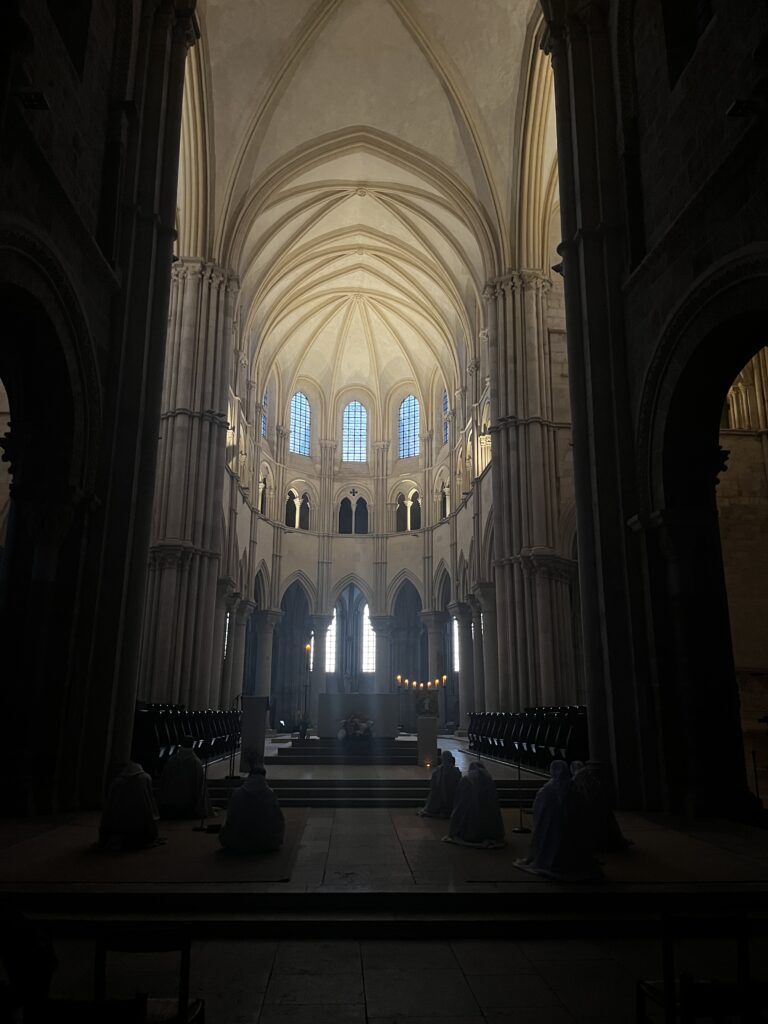
Chanted lauds at dawn in the basilica. The sun shown through the windows during the Lord’s prayer. Seven pilgrims received the blessing today.
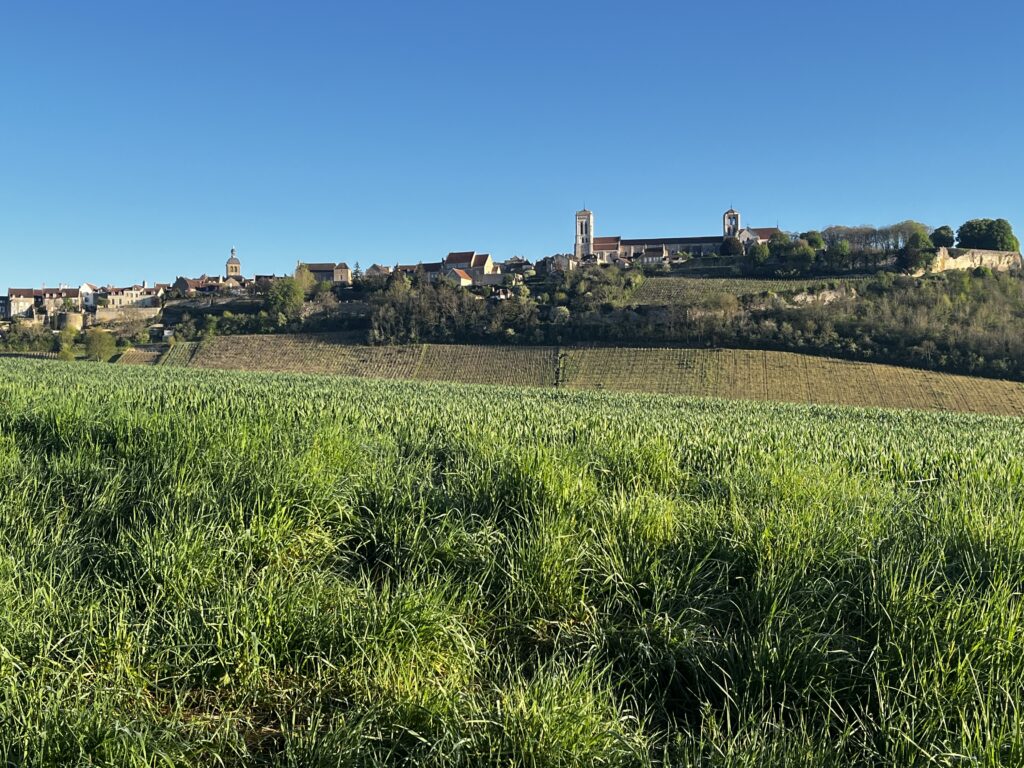
I left the gîte just before eight in the morning and walked down the hill to the main entrance of the village. The air was cold and the sky was clear.
I was on my way.
I’m definitely out of practice – I forgot to turn on my tracker until I was almost out of the village!
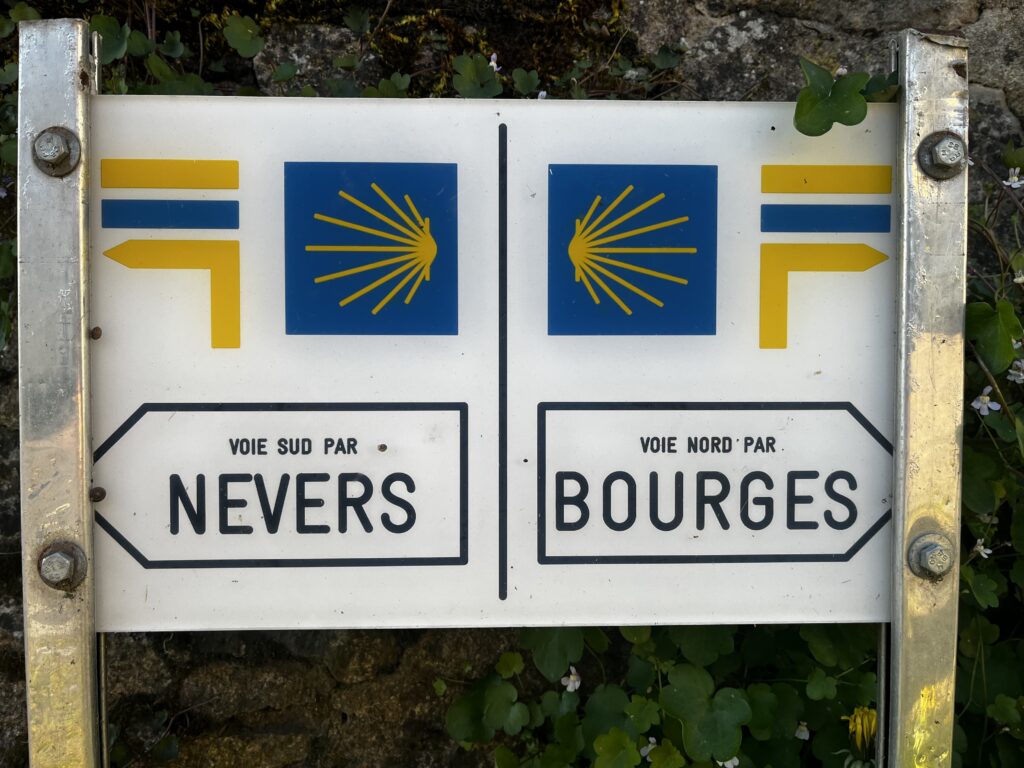
At the entrance to the village, the Camino splits into two routes which would only meet up again in a week and a half or so. I turned left to take the southern route towards Nevers.
In just a few minutes, the Camino turned off the asphalt onto a road of stone and gravel. loaded up with food and water, my pack felt heavy, but my heart felt light.
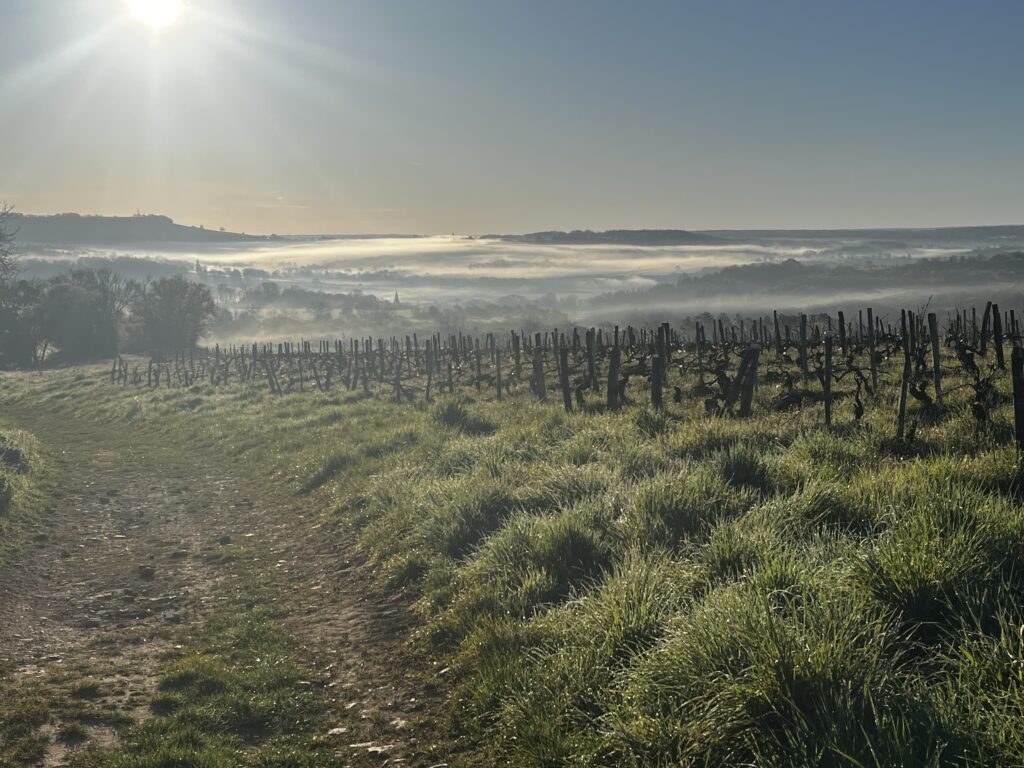
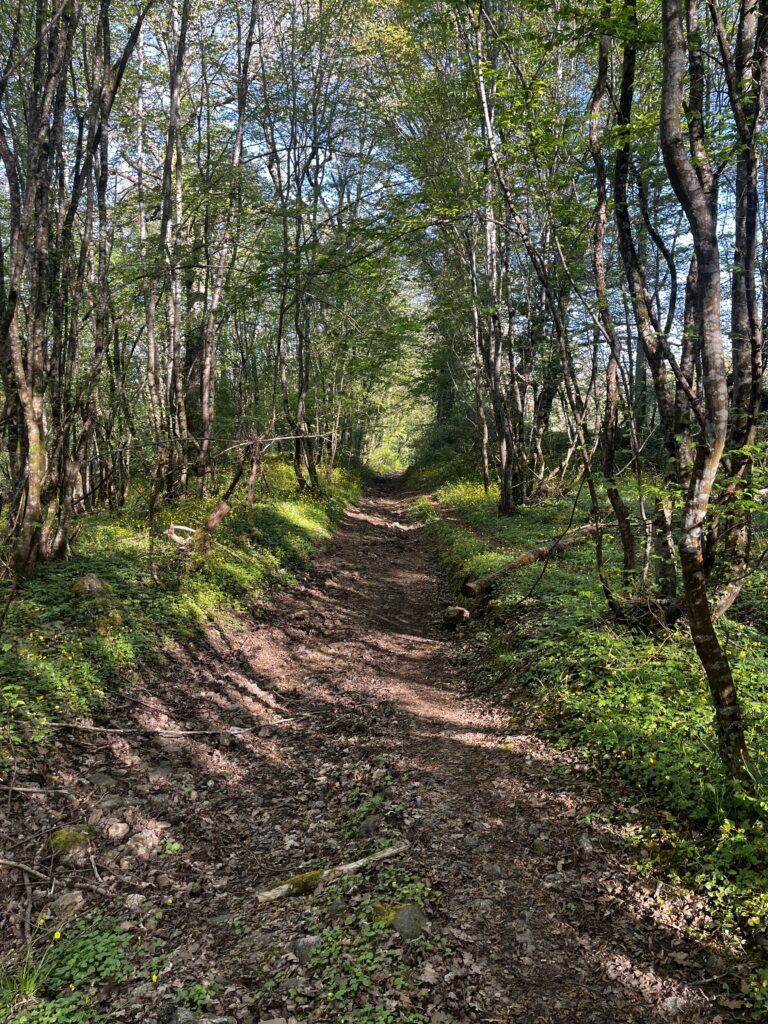
The Camino was well marked as it wound its way through vineyards towards the little village of Saint Père in the misty valley below. The gravel road soon became a grass path, wet with dew, and then a dirt farm road through the trees and fields, the ruts of tractor tires deeply embedded in the stony earth.
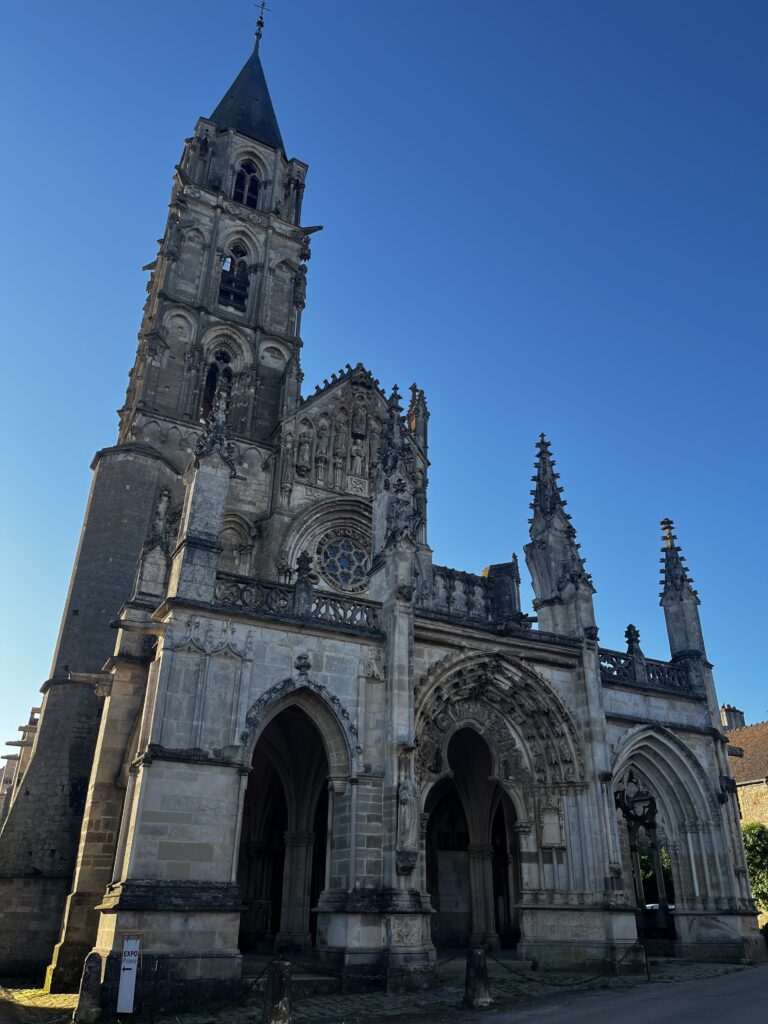
I reached a little village of Saint Père before 8:30 AM. Unfortunately, the Neo-Gothic jewel of a church didn’t open until 9 AM.
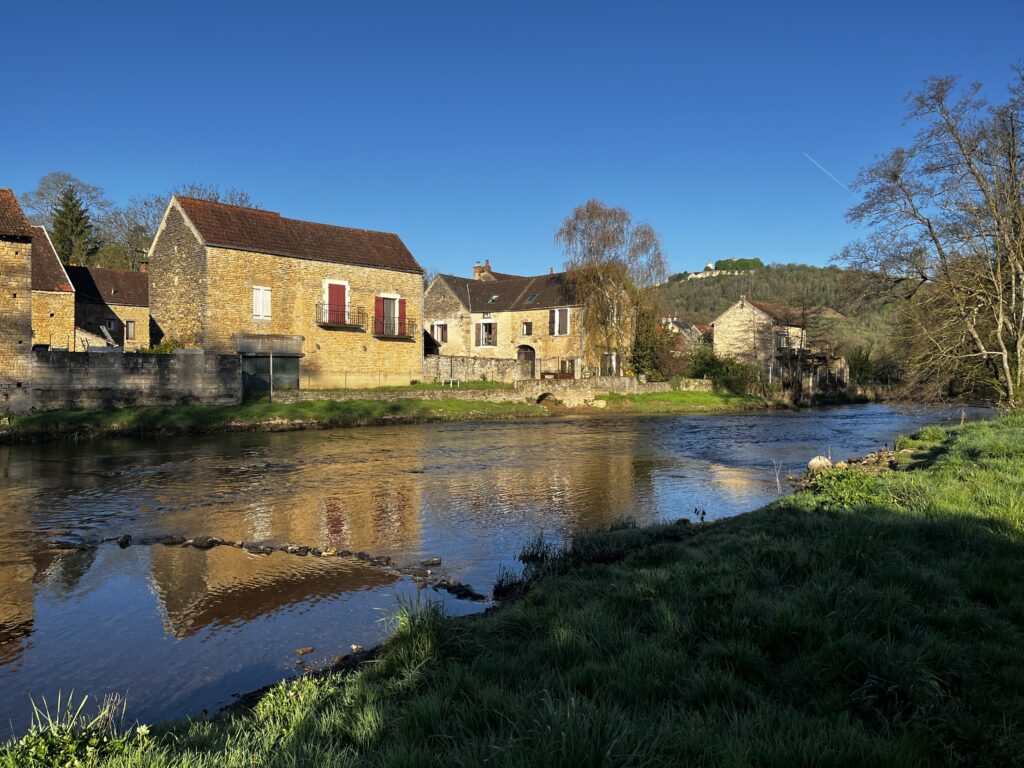
In the village, the Camino passed over the River Cure, which was much wider here than where I saw it last. It was here that I made my first wrong turn of the day. It would not be my last.
Fortunately, I realized it after only a few hundred meters and backtracked. After the bridge, I had reflexively walked straight forward. The Camino on the other hand, took a sharp right turn following the river. It took me a couple of false starts to find it again.
After a short bit of walking along a fairly busy road, it was back to the farm road, now following the river. At one point, the road turned into a morass of mud and standing water.
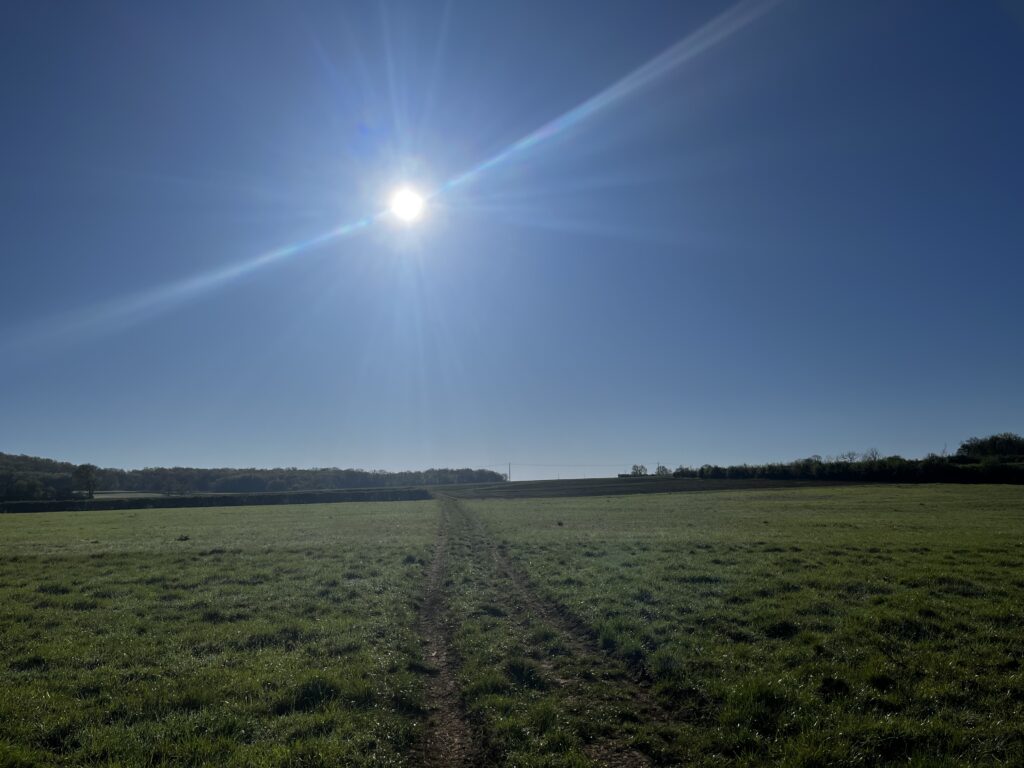
At about 9:15 AM I crossed the D 53 roadway and took off my fleece and put on my sunglasses. I could already tell that today was going to be a scorcher.
Just after 9:30, I passed through the farming hamlet of Précy-le-Moult, where I took a right-hand turn to follow a blacktop road. I followed this all the way into the the grand but tiny hamlet of Pierre-Perthuis about 15 minutes later. Here I once again crossed over the river that flowed through a deep gorge below the bridge.
The village buildings are all that remains of a once grand château. The road literally goes through the middle of it. I stopped at the village church – once the chapel of the château – but it was locked up tight.
I got a little turned around, but I eventually found the Camino path – and it was a path – leading me down into the gorge and into forest land.
This is the Bois de l’Epenay. It was absolutely beautiful, with oaks and pines and trees I did not recognize. The forest floor was carpeted with white and yellow flowers, with ivy growing everywhere. The trail was often rocky and slow going.
At about 10:30, the path joined up with a forest road, gravel long and straight and lined with yellow dandelions and purple blue bells.
The gravel road soon merged into a blacktop road. I am not super fond of road walking, but what can you do?
Soon I was out of the forest and back into the rolling farm fields.
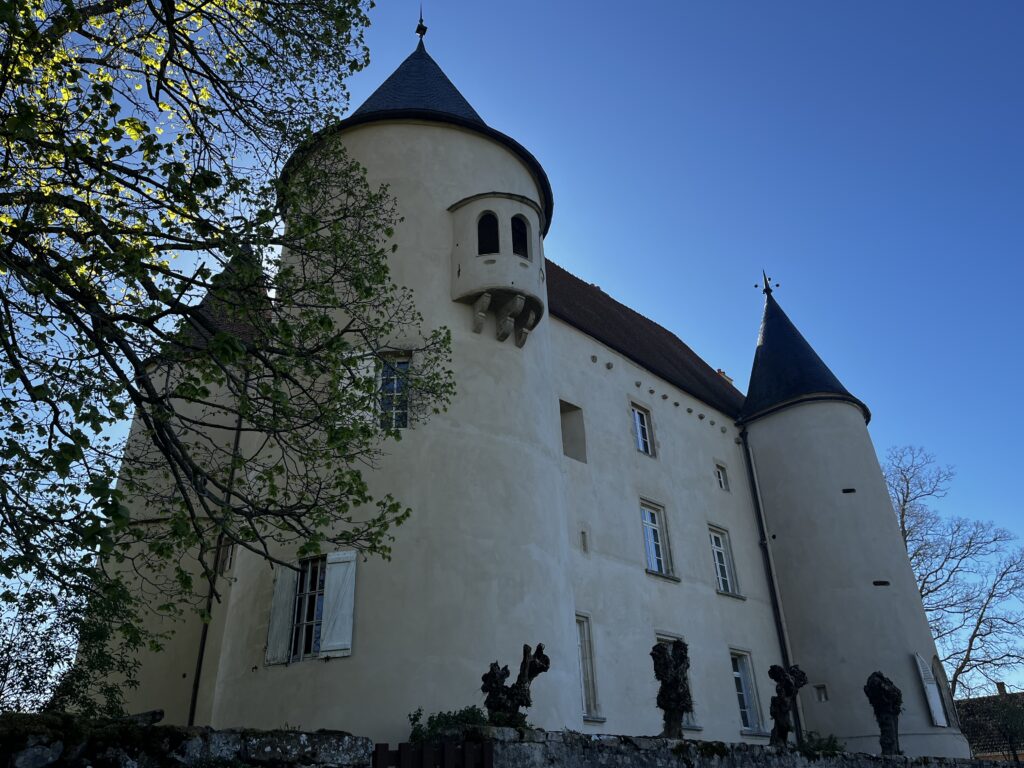
About 10:45 AM, in the shadow of Château de Domecy, I stopped for a snack of bread and cheese and an apple. I was serenaded by the baa-ing of sheep.
While I was eating, I was passed by Joes (pronounced like juice), a pilgrim from the Netherlands I met last night. He was the first pilgrim I’d seen all morning since passing Judith before Saint Père. Joos is young, tall, and lanky, and I imagine he’ll be passing me quite a bit in the coming days.
Just past the Château the Camino passed through the outskirts of the village of Domecy-sur-Cure. I stopped by the cemetery to refill my water bottles. Although the air still felt fairly cool, the sun was blazing in the sky, and I was going through a lot of water.
The Camino soon turned off of the blacktop to follow the path of an ancient Roman Road back into the forest, this time the Bois de Chamery. It was a dead straight shot for a couple of kilometers, before it became a more meandering dirt road.
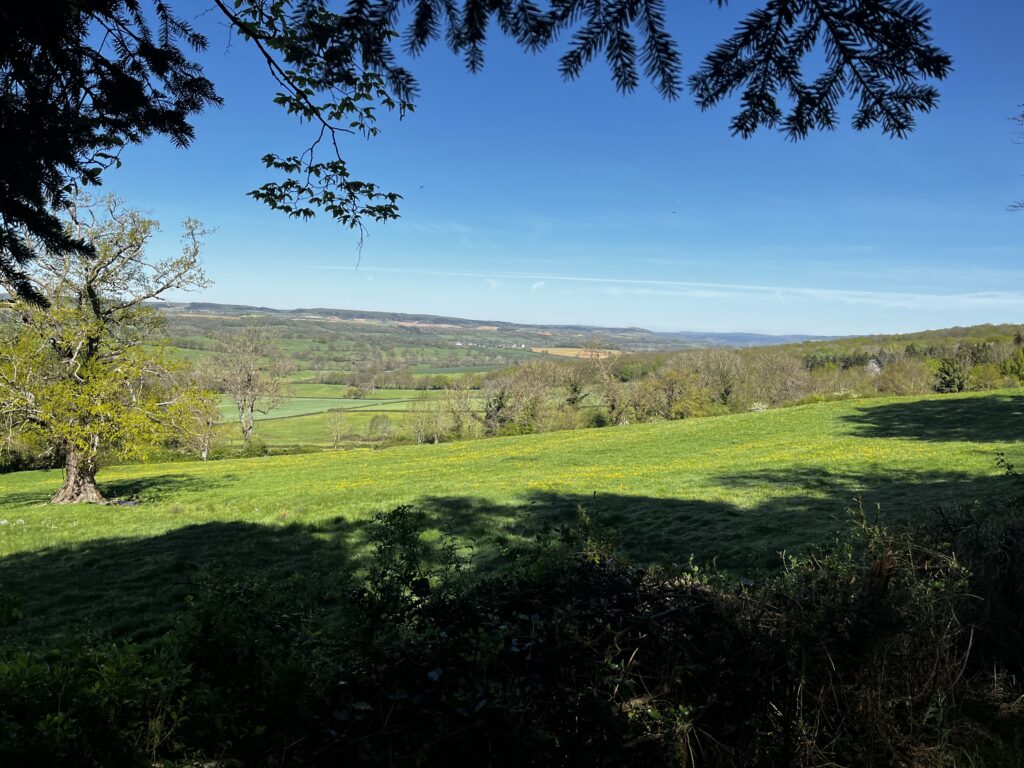
Occasionally now there would be meadows visible to the right, which offered a bucolic view across the valley.
That panoramic view soon became a fixture, blocked only by the long stone wall surrounding the vast Château de Bazoches.
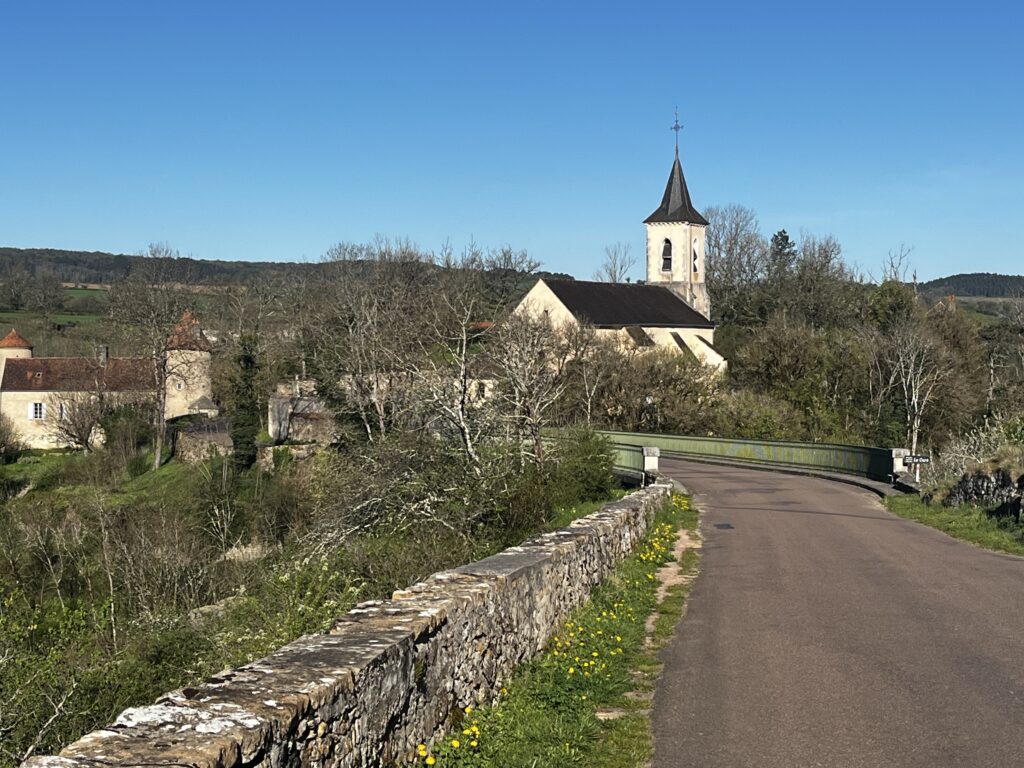
Just past the entrance to the Château, I passed Joos eating at a picnic table. The Camino now descended into the valley on a blacktop road into the village of Bazoches.
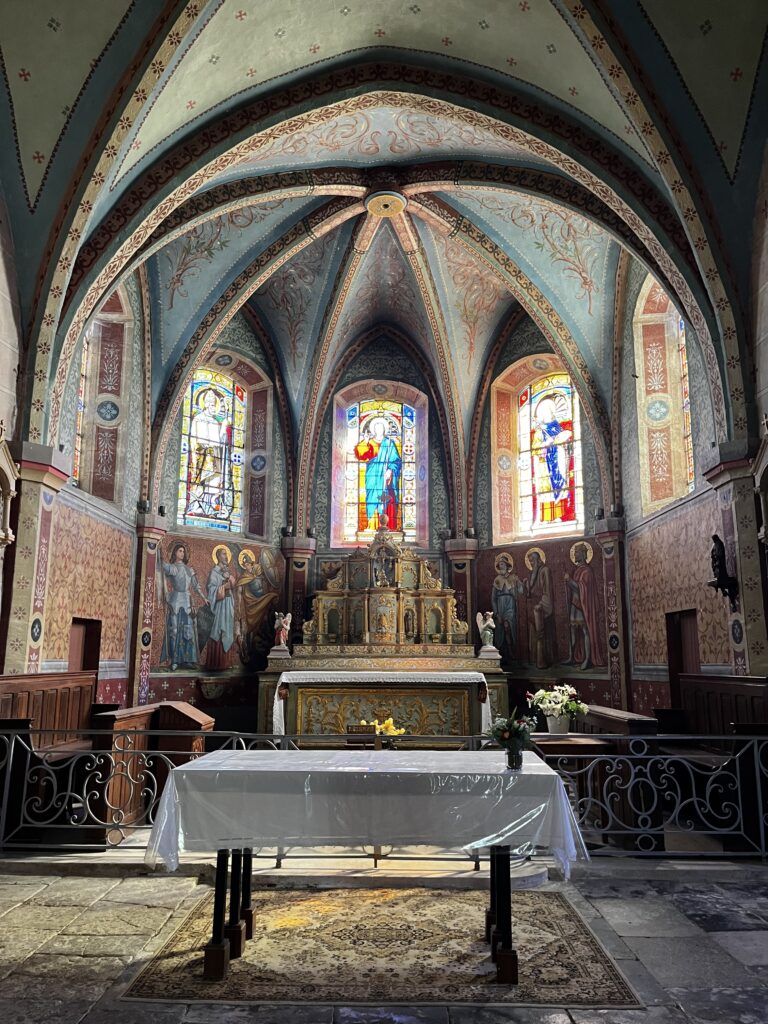
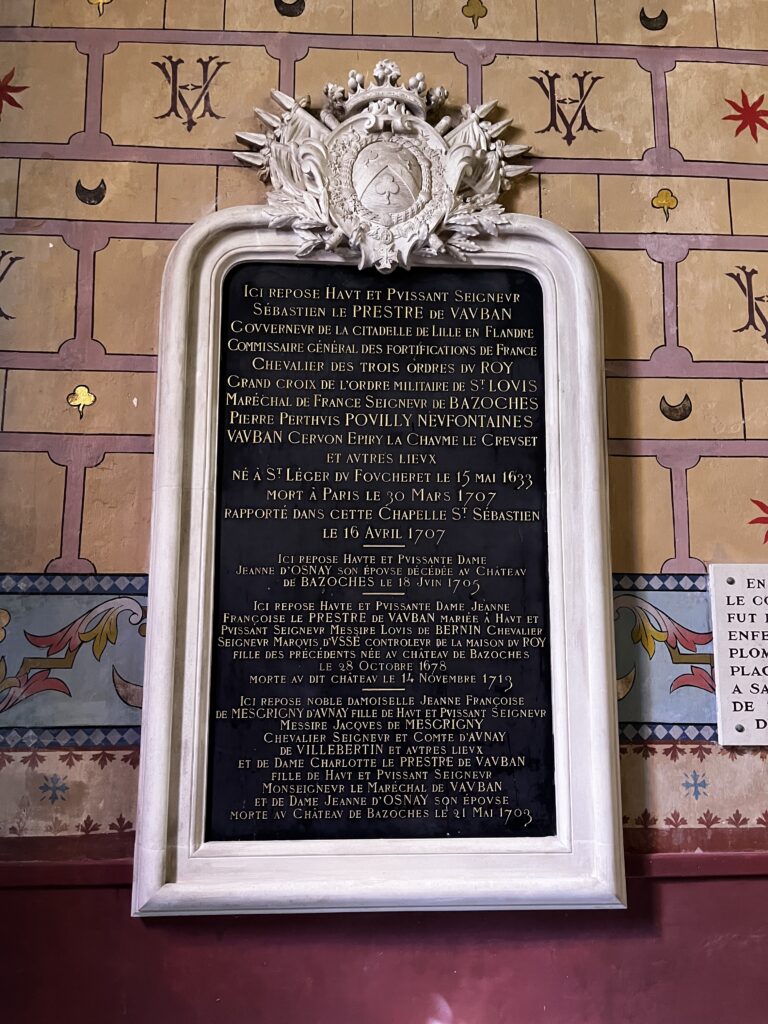
It was straight up noon when I stopped to pray in the little church of Saint Hilaire. This is a charming church, with delightful frescoes in the sanctuary and side chapels. Sadly, it is much neglected. Plaster was peeling and cracking throughout the nave, and a flight of songbirds had taken up temporary residence.
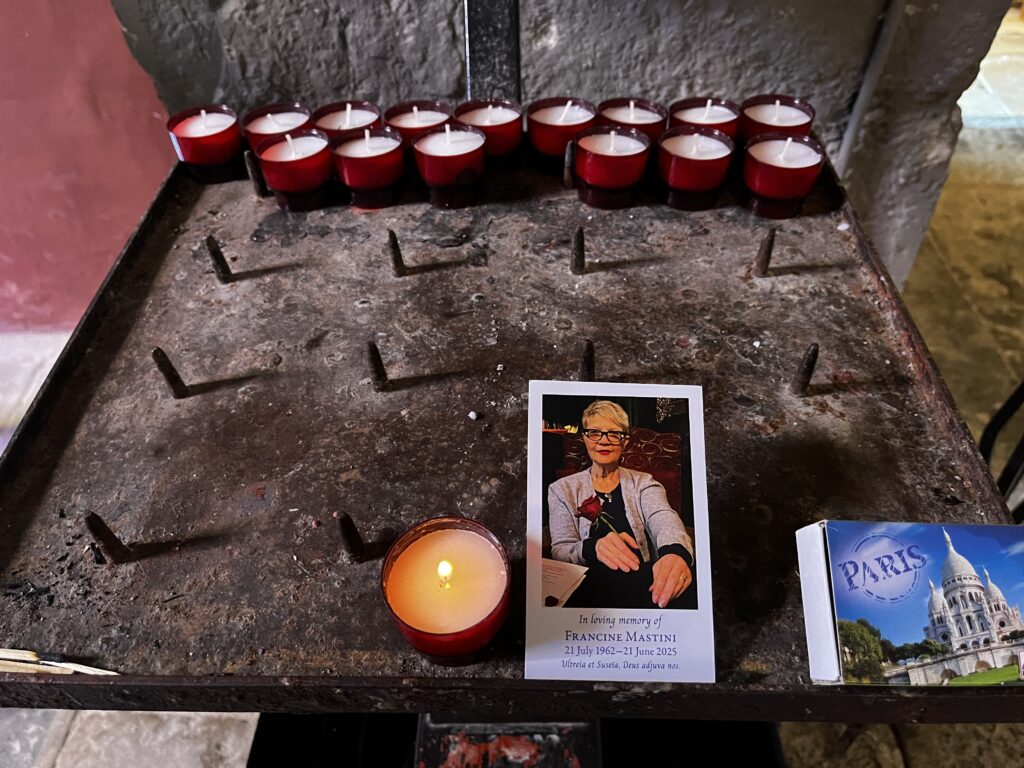
Marshal Vauban – the guy who helped popularize those star-shaped fortresses you see all over western Europe in the 17th century – is entombed in one of the side chapels. It was here that I lit a candle for Francine.
Road walking out of the village and then back up out of the valley. I really hope I got my sunscreen on in time.
I was all the way up out of the valley when I realized I was following the wrong blazes and had to go back down. Apparently, I’m determined to make this a 30 km day for no good reason.
Once again, I retraced my steps, pausing at every intersection to examine the markings. I ended up walking all the way back to the church, and then setting off in a completely different direction once I found the proper markings, which had been hiding behind a parked car.
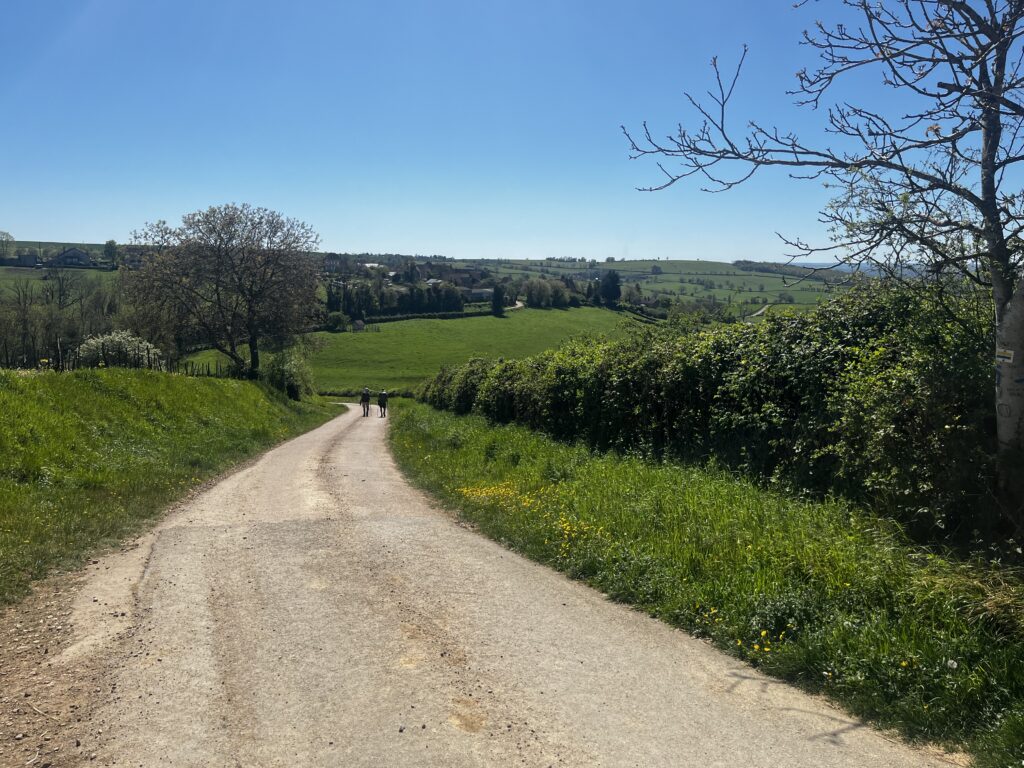
I was soon on a farm road once more, walking deeper into the valley, before heading up the other side. The people who told me this route was flat didn’t know what they were talking about.
By the time I reached the ridge line and the tiny (locked) Chapelle Saint-Roche, I was pretty wiped out and considering the life choices that brought me to this point.
But it was back into the forest now (Bois de Monty), which was definitely cooler than the direct sunlight in the meadows.
But of course, there were more meadows to come under the blazing sun. More meadows equals more sunscreen.
Finally, pushing 1:30 PM, I did what I should’ve done three hours previous and put up my hiking umbrella.
When I arrived the hamlet of Neuffontaines about 15 minutes later, I was beginning to obsess about drinking an Orangina. There was no café to be found, and the little church was locked behind a grille. I prayed there at the entrance, and as I did so I was passed by two Dutch pilgrims.
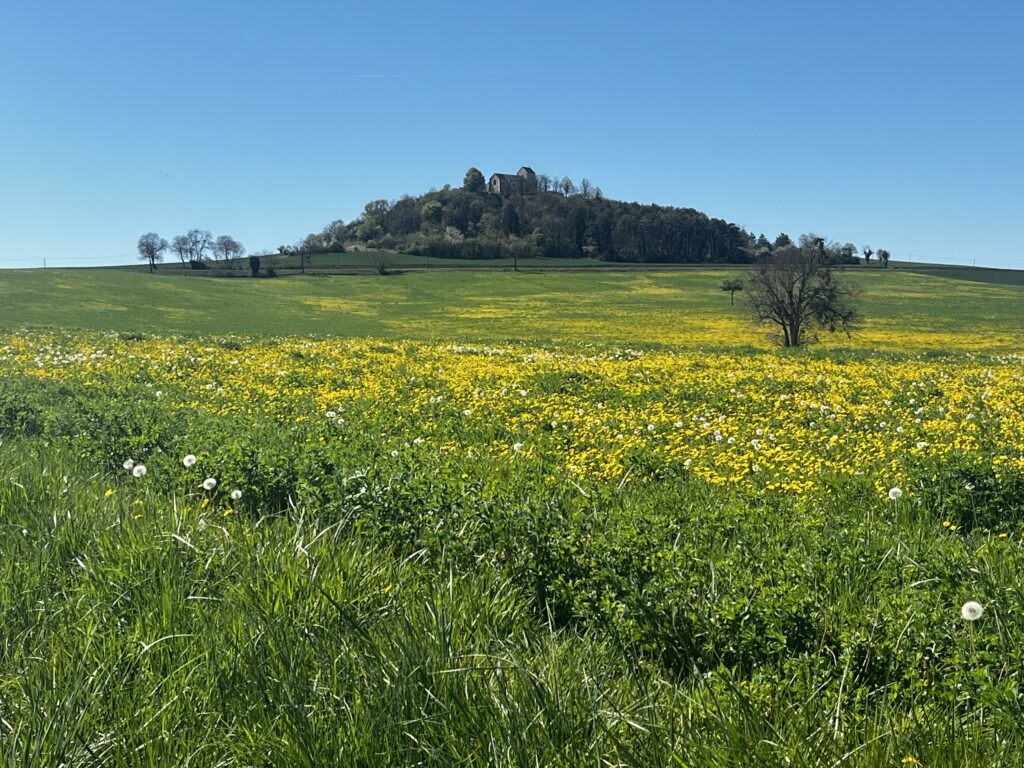
There a large, impressive religious structure on a hill overlooking the town. I initially thought it to be an abbey, but I later learned that this is the Chapelle du Mont Sabot, a 12th-century chapel recently restored. Other than the occasional hill – islands of trees – all around was field and farmland to the horizon.
By the time I crossed the D 42 highway, it was already 2 PM, and I was 24.2 km into what should have been a 25 km day.
Spoiler alert: it would not be a 25 km day.
I caught up to the two Dutch pilgrims in the hamlet of Vignes-le-Haut at 2:20 PM. After that, we leapfrogged each other pretty much the rest of the day.
To reiterate: this route is not flat.
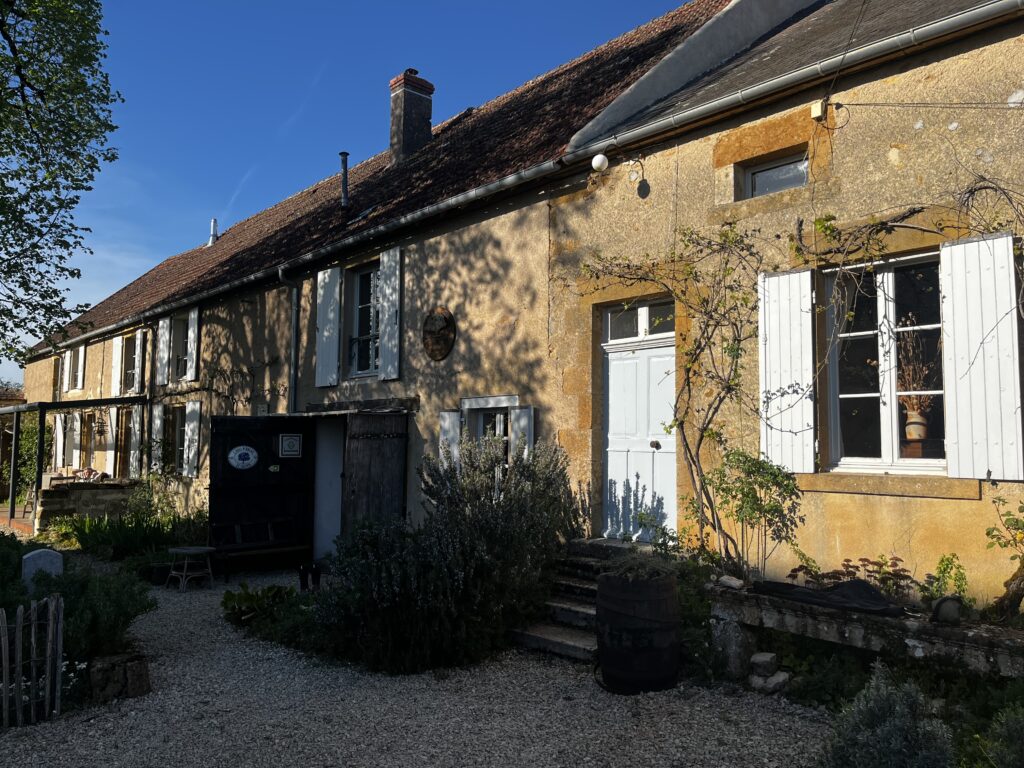
I arrived at the unnamed hamlet that contains my gîte, Le Chemin, at exactly 3 PM. The very kind Dutch hosts immediately plied me with glass after glass of water.
I’m pretty clearly sunburned, at least on my arms, and I probably have a touch of heat exhaustion. I suppose that’s what comes from living in a rainy, overcast climate.
In any case, I felt a lot better after all that water and a shower.
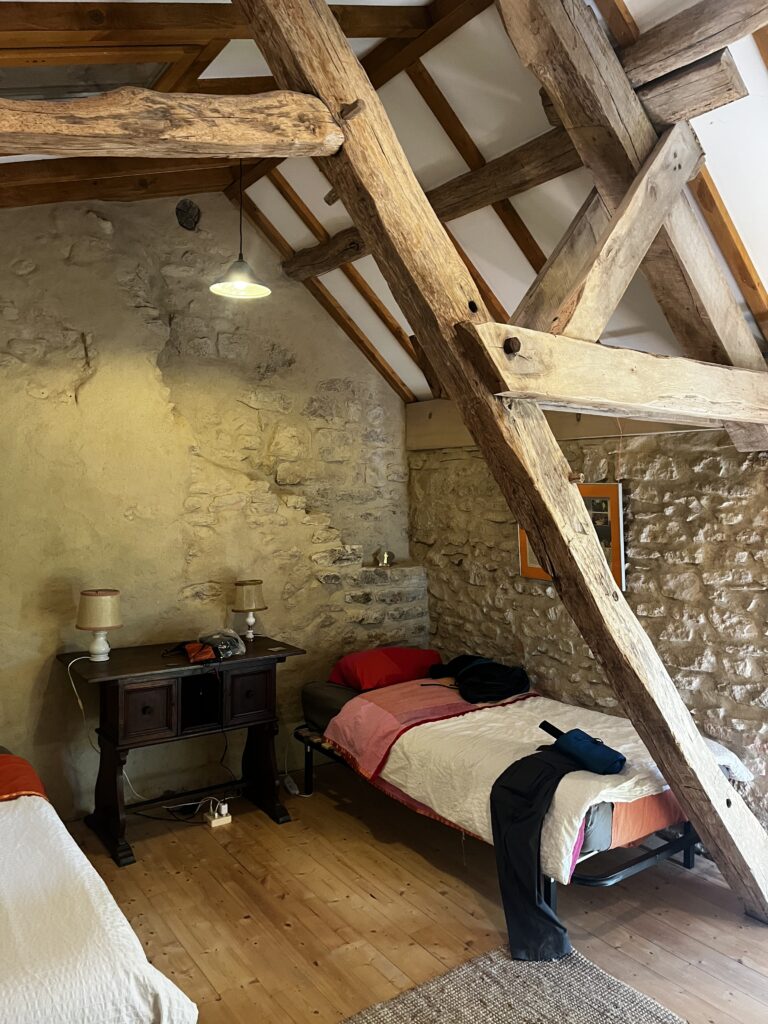
This is one of the nicest places I’ve ever stayed on Camino. I have a room all to myself, though there are many pilgrims here. The building used to be a winery, and there are crazy medieval wooden beams everywhere.
When I hand washed my laundry, they even had an electric spinner to get most of the water out.
Judith and Joos are here, as are the two Dutch guys I passed earlier. They apparently didn’t see the turn into the gîte and walked all the way to the next village before turning around.
Judith also said that she had made a wrong turn and added a couple of kilometers to her day.
So at least I’m not the only one.
The bad news is that tomorrow is a long day – 28 km on the map. The good news is that it’s supposed to be 20° F cooler tomorrow.
Our hosts made a big communal dinner for the pilgrims staying here. Between family and pilgrims, there were ten of us around the table. Other than me, every single person was from the Netherlands. Even Judith, who is technically German, has lived in Holland for the last 20 years.
I knew that there were a lot of of Dutch pilgrims on this route, but I had no idea the percentages were this high.
Date: 09 April 2026
Place: Le Chemin
Today started: Vézelay
Today’s Photos!
Hi Thom, Another great read about the Vézelay route. I also like the video showing your walk to Le Chemin. I’m glad it will be cooler tomorrow. All is well here. We had a great turn out for the Easter Vigil share-out (and taco dinner potluck). Fr. David was there too.
I’m sorry I missed it!
I think it will be a couple of days before I have all of my Camino skills back and functioning. I made some rookie mistakes.
For many years now I’ve watched the Tour de France in the summer, and while the cycling is fun, the more enjoyable part is seeing all the tiny villages the Tour passes through, and learning about the churches and chateaus. Needless to say, your posts are really scratching that itch for me.
Beautiful pictures from this day! I especially like that stained glass.