
Via Lemovicensis: From Middle Earth to Saint Leonard
The gîte I stayed at last night is actually a farm and restaurant primarily. Almost everything I had for dinner last night was raised on the farm. It was absolutely amazing, and Francine would have adored the place.
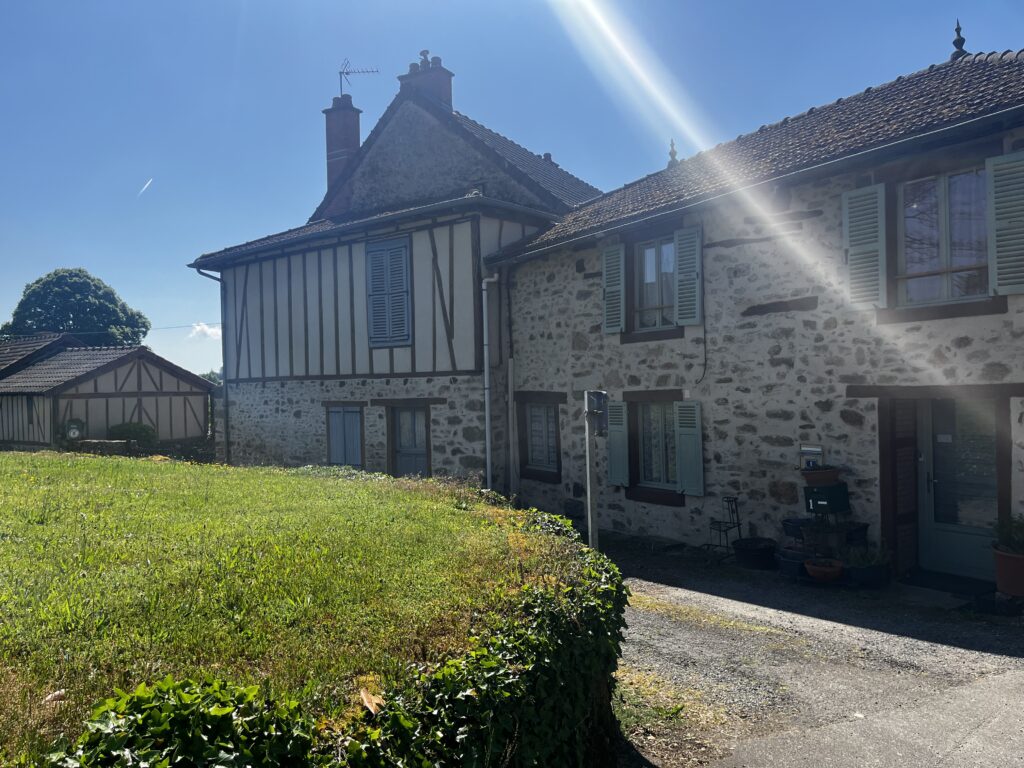
I left just after 7:30, and the first goal was to road walk about 2 km or so to the town of Les Billanges, where I would pick up the Camino route.
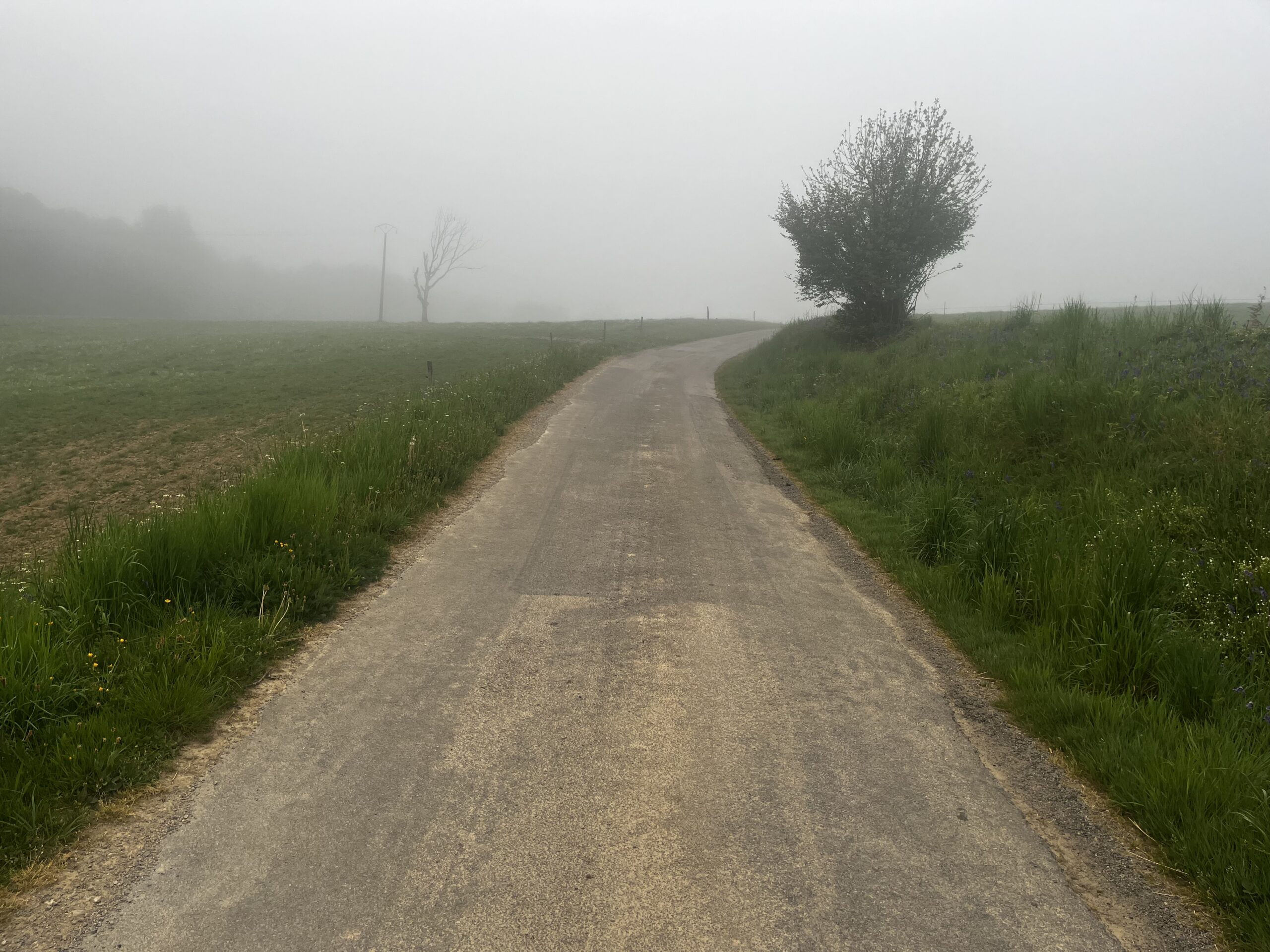
The morning was cold and misty, perfect for an invigorating morning walk. Off in the distance, I could see a pair of horses prancing around in their paddock.
By 7:50, I had regained the D 29. This is the road I walked much of yesterday afternoon, which goes directly into the village.
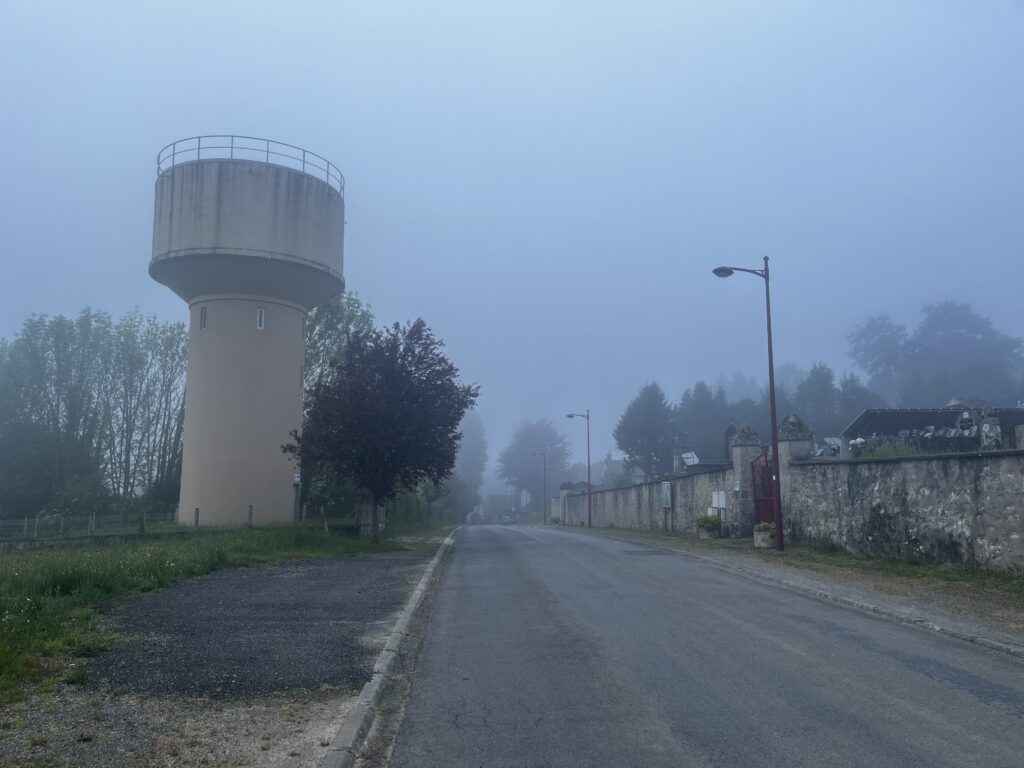
The mist seemed to close in all around me, as though I were walking in the middle of a soap bubble. It was a beautiful and eerie walk. Strange shapes loomed, barely visible in the mist. I’m sure they were trees, or electric poles, or houses, but as I walked they were simply shadows.
Occasionally, a car would zoom past me until their tail lights were just two red eyes staring at me from the blankness.
At about 8 AM, I passed the sign for the village of Les Billanges. I could see very little of it except for the houses immediately on either side of the road. It was here that I saw my first route marker for the Camino.
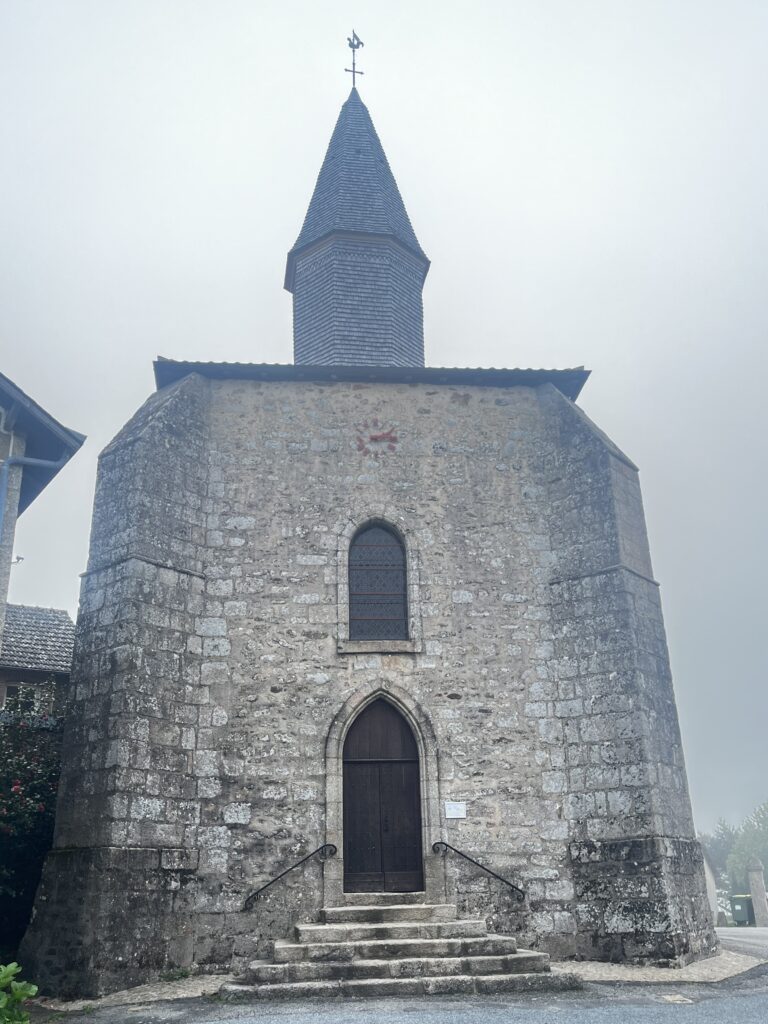
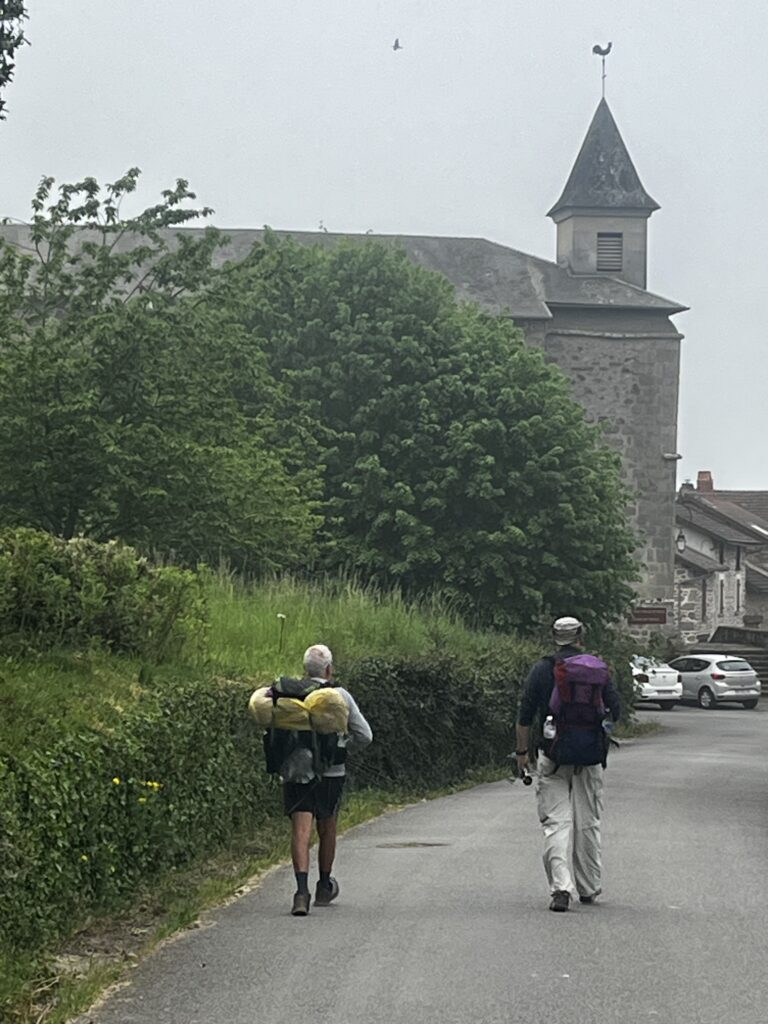
I arrived in the village center at about 8:10. I had hoped that on a Sunday the fortified Église de la Nativité de St. Jean Baptiste might be open. No such luck. And according to the schedule posted on the door, there were no Masses scheduled here during the entirety of the Easter season. None of the churches on the list that did have a Mass scheduled for today – and there were only two – are even on the route.
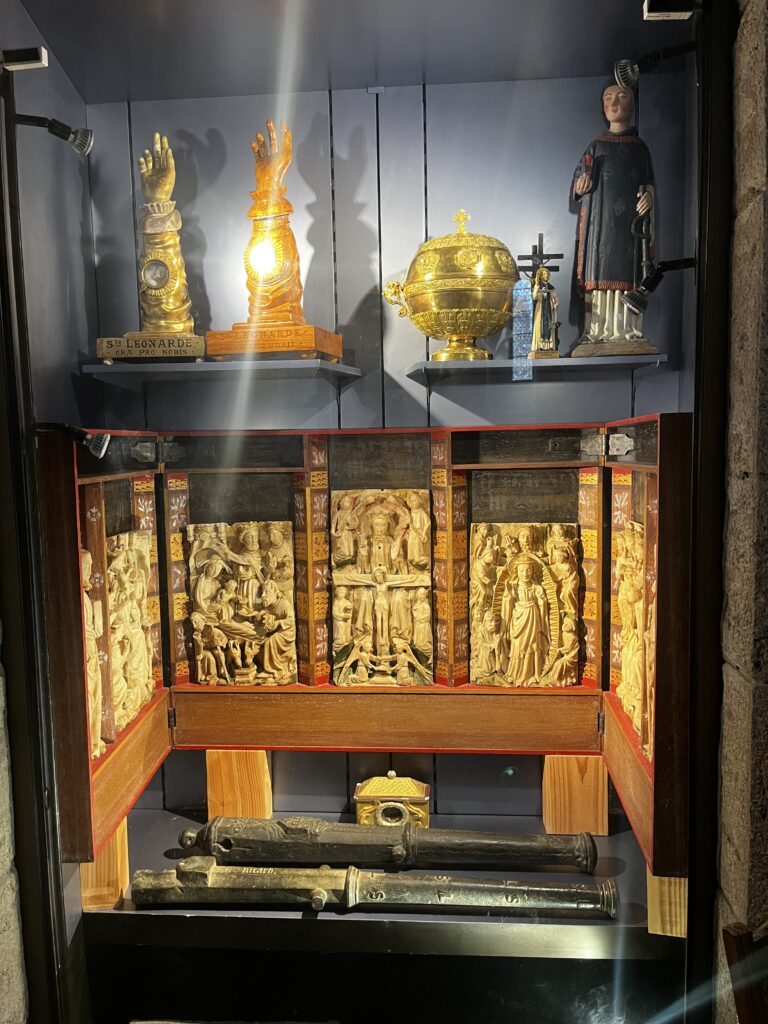
I had hoped for a Mass, of course, but at least a view of the stunning and historic reliquaries within the church. Instead, I prayed in front of the doors and walked on.
In the past two years, they have rerouted the Camino in this area, so it took me a hot minute to figure out what the proper route was. Eventually, though, I found myself walking down a a road of asphalt and gravel, heading for the now familiar Limousin countryside of alternating forest and field.
After about a kilometer, the Camino left the asphalt for a dirt road.
One year ago today, Francine was still walking. She was using a walker, and it was just around the hospital award, but she was absolutely bound and determined to get her strength back. This was also the day she received a bouquet of flowers from the Board of Directors of the American Pilgrims On The Camino. I still remember smile when she received it. It practically lit up the ward.
Although she was already in her fifties when she first walked the Camino, it became an absolute passion for her, and she absolutely fell in love with Spain.
After our third Camino, we both became volunteers on the American Pilgrims communications committee. She did some of her best design work for the magazine La Concha, and she served as an hospitalera in Spain twice.
She was scheduled for a third time, this time in southern Spain, but she never got the chance to go.
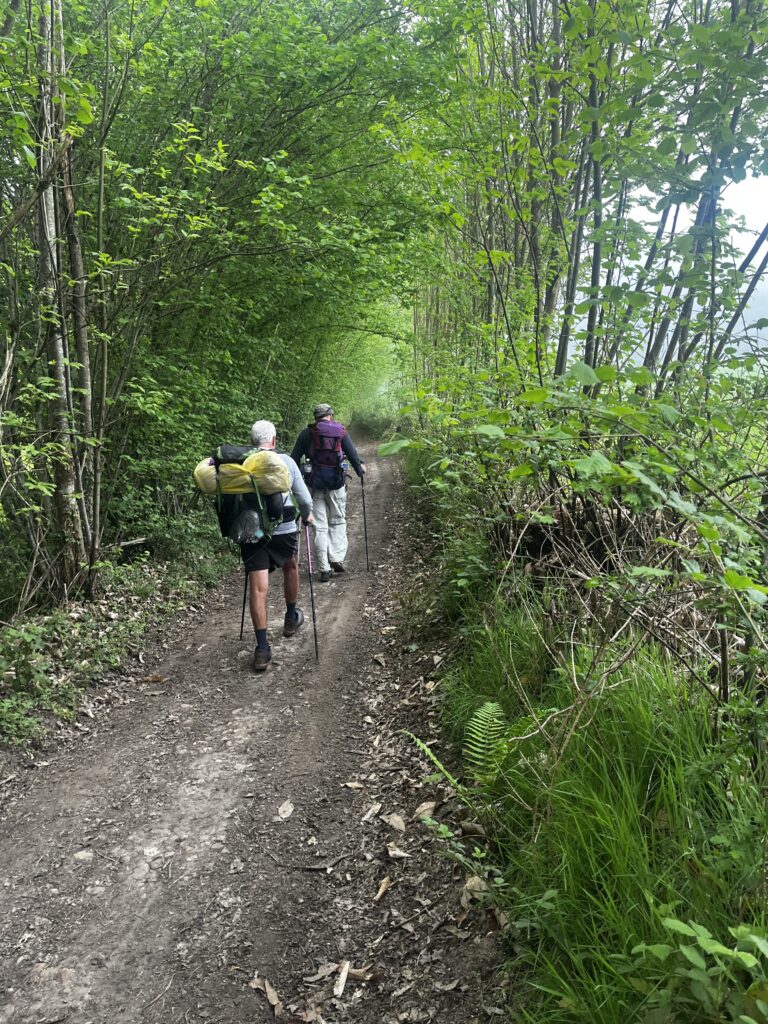
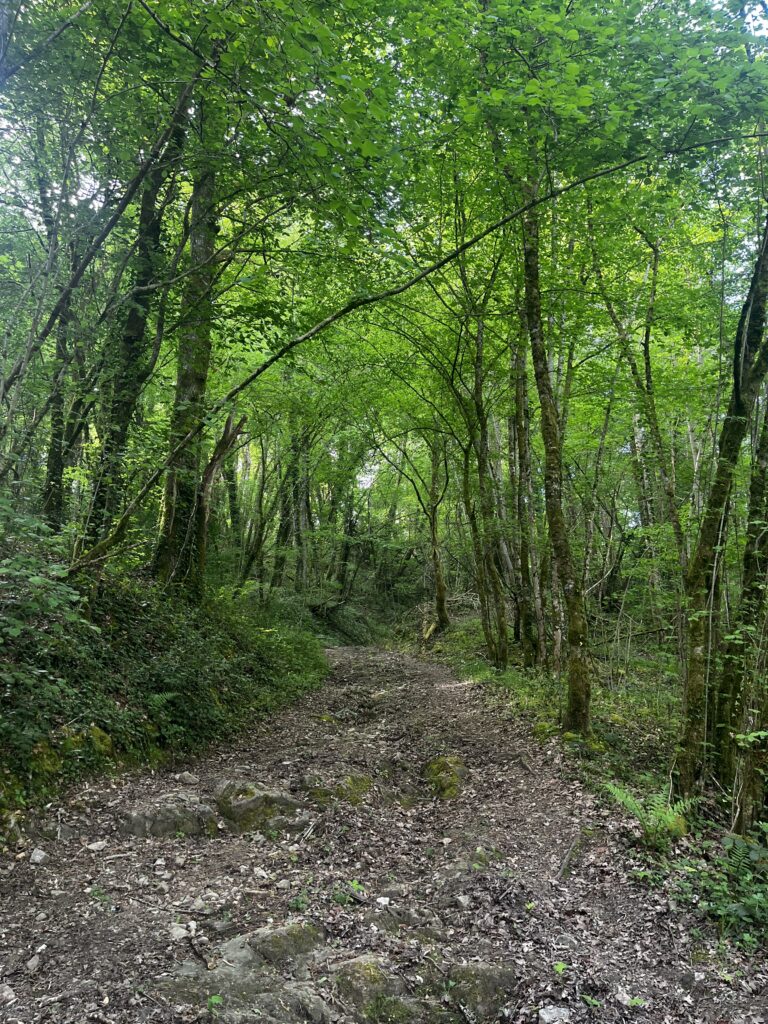
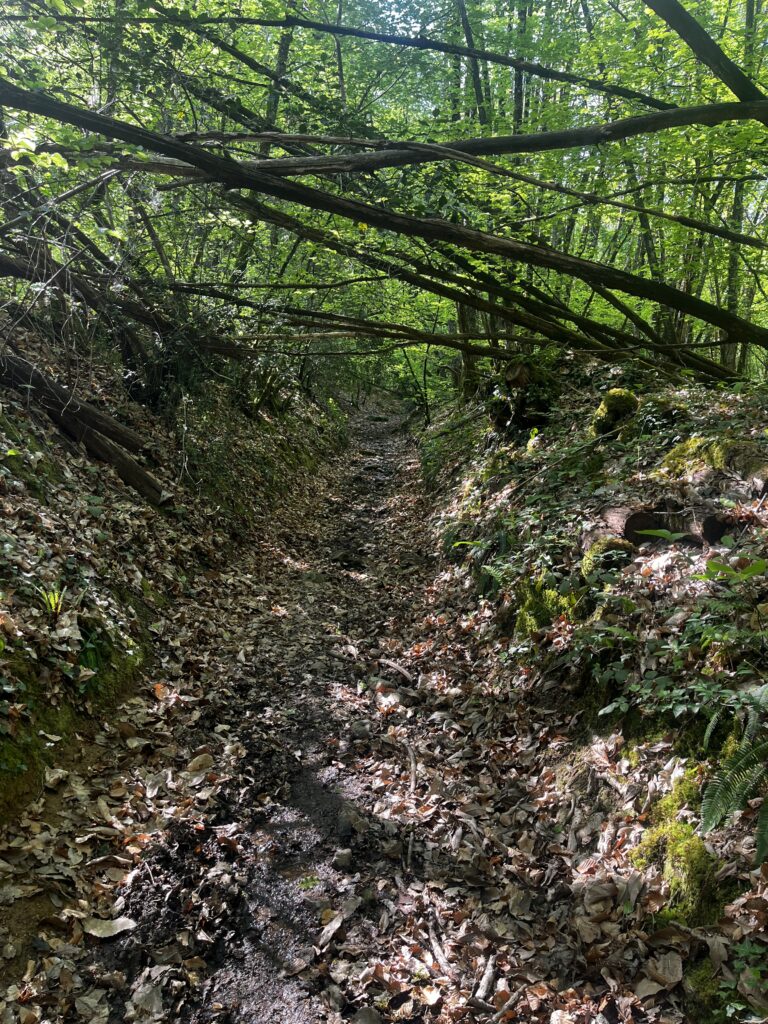
At about 8:30, the dirt road I was on plunged into a dark forest, and it narrowed into a path. The trees closed in around me.
It wasn’t long before I started seeing breaks in the trees, but at the same time, the path became a little steeper and a lot rougher.
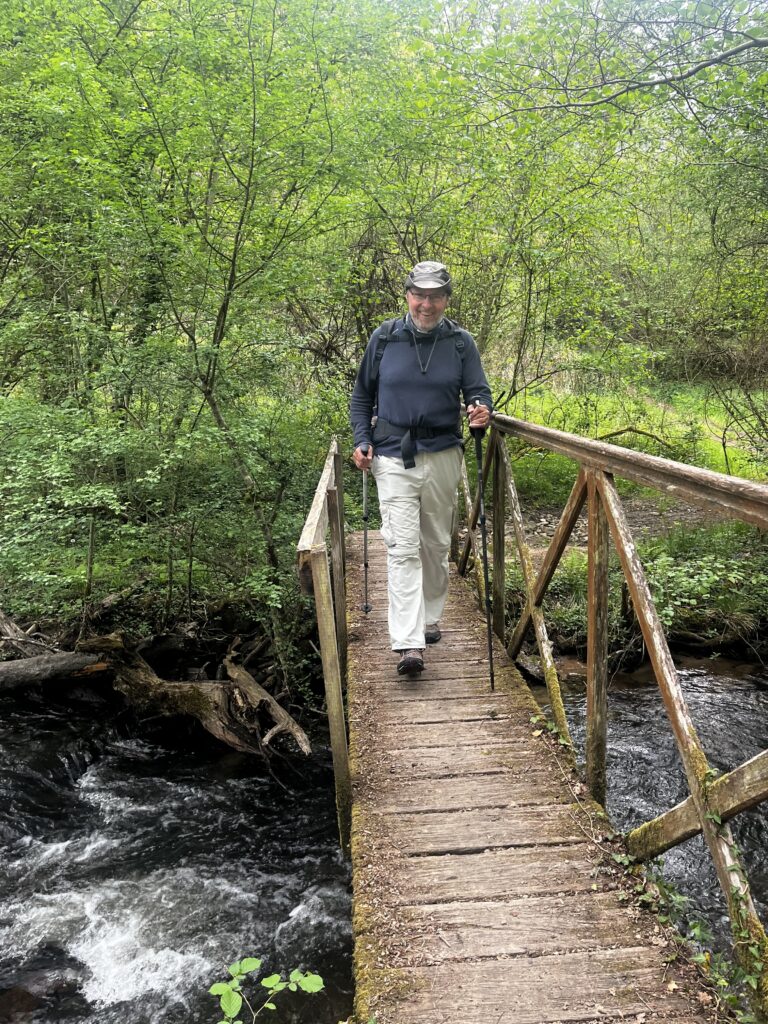
At about 8:35, at a small bridge over a stream, two pilgrims caught up with me – Philippe and our new Spanish friend Miguel.
By about 8:50 we were back on the asphalt, shortly thereafter we passed through the hamlet of Auziat. It was incredibly humid, it even though it wasn’t particularly warm, I was sweating. After the hamlet, the Camino returned to a dirt road through the woods.
This is Miguel’s seventh Camino. He started this one from the city of Namur in Belgium.
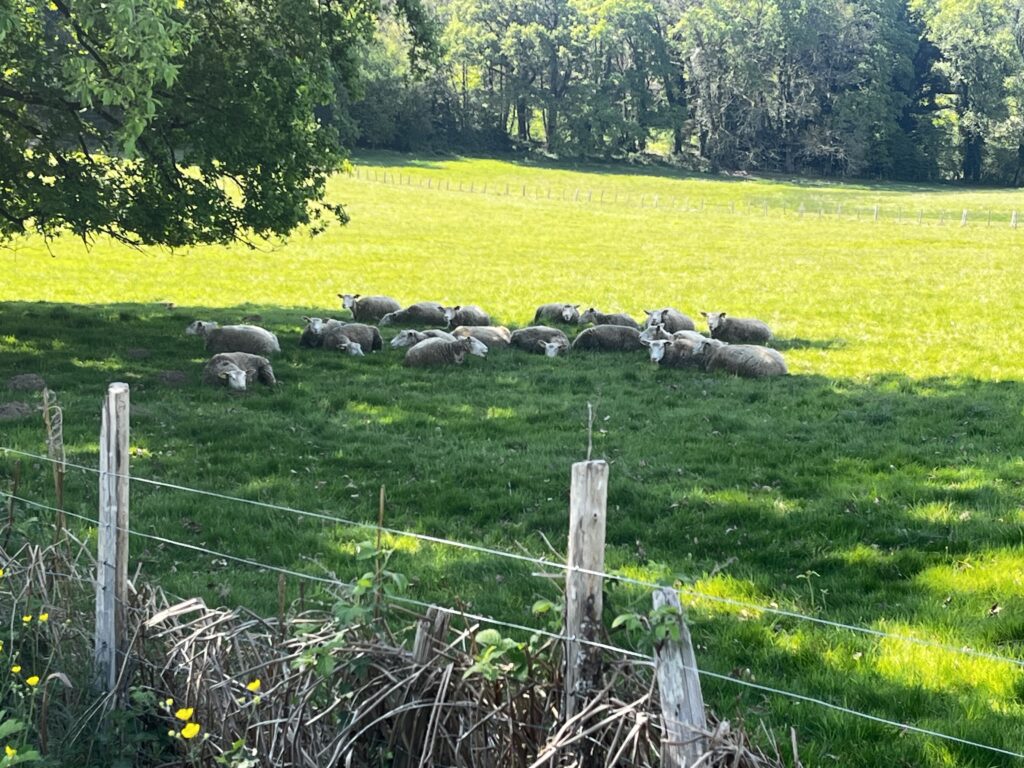
The road took us through forest and field, and at about 9:05, it merged onto an asphalt road. Shortly thereafter, we passed the hamlet of Chambon. Despite the presence of sheep in the nearby field, this place looked like a housing development.
Just about ten minutes later, we were already walking through the outskirts of the village of Saint-Laurent-des-Églises. As the name implies, this village used to have multiple churches – at least four – but now it has been reduced to one.
One which was, of course, locked, though judging by the shiny door handle, many people have tried to get in. There’s a metaphor there somewhere.
I prayed at the front door, and I took off my fleece before we continued. I’d been hoping for a second breakfast here, but no place was open on Sunday morning.
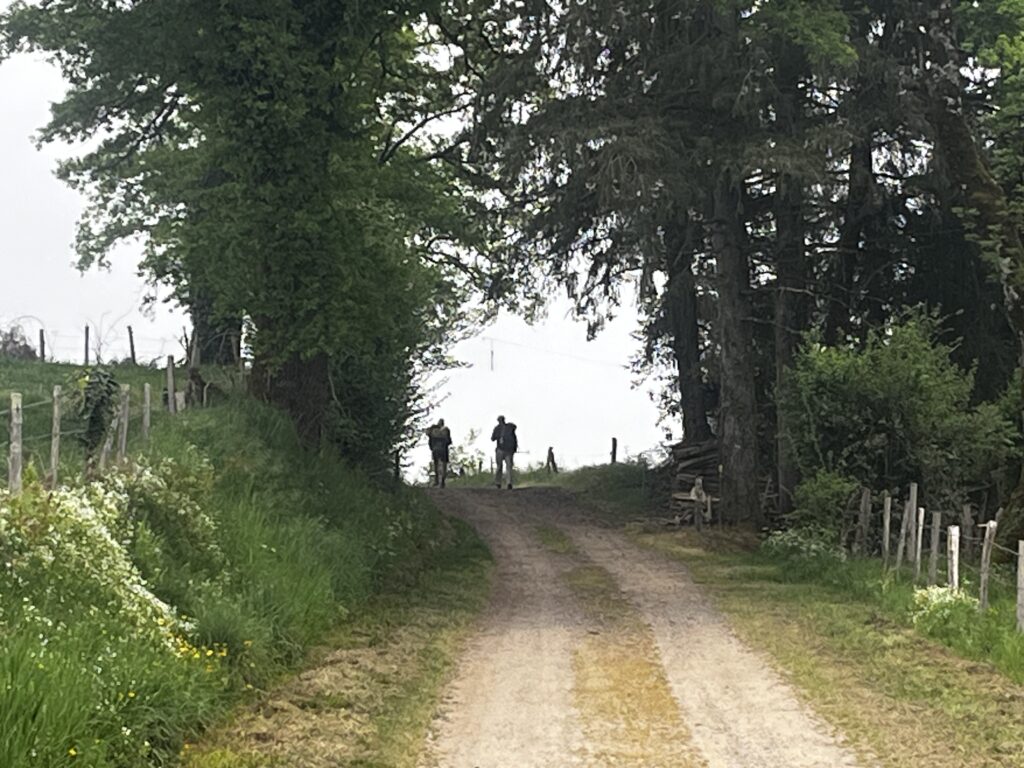
We left the village at about 9:30 on a dirt and gravel road into the mist. I let Philippe and Miguel get a little bit ahead of me so I could have some time.
The Camino turned down a narrow path into the woods, strewn with dried leaves. Francine seemed particularly close to me this morning, almost as though she were hiking by my side.
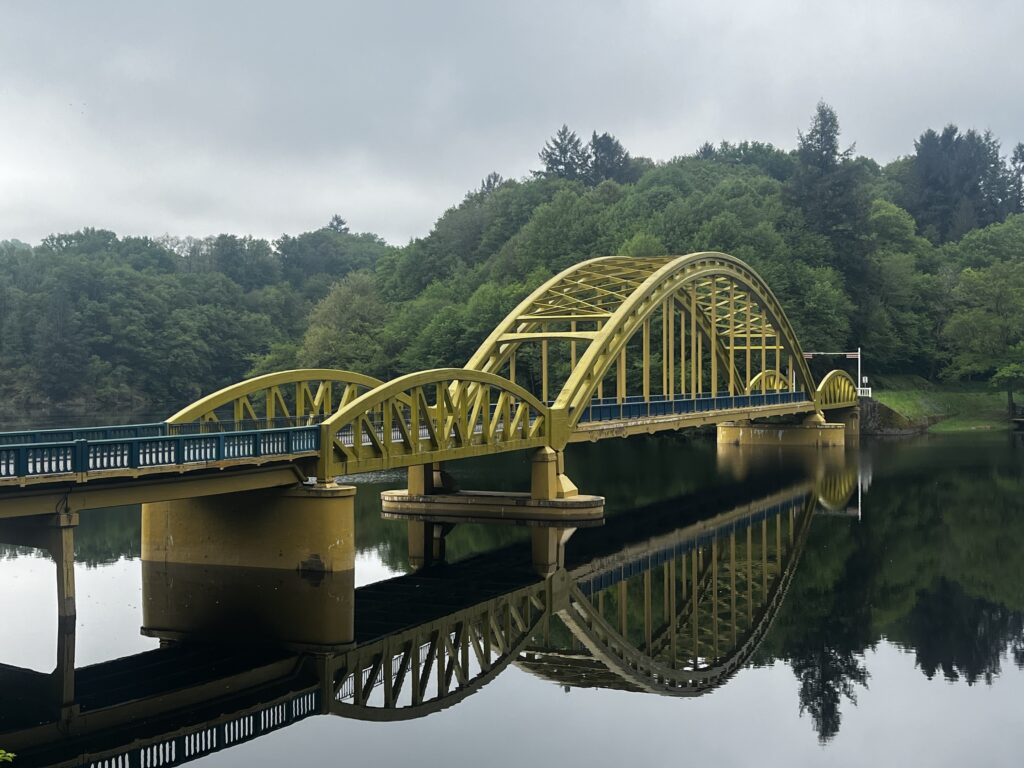
At about 9:45, a steep and treacherous bit of trail brought me to Pont du Dognon, a bridge over the River Taurion. Despite the name, it doesn’t have anything to do with the works of JRR Tolkien.
There was a restaurant here just opening, so I stopped for a coffee and some cookies on the terrace with a magnificent view of the bridge. I spent almost half an hour there before leaving. It was glorious.
And then I walked over the bridge on a narrow little sidewalk and crossed the Taurion. Mildly terrifying.
After the bridge, the Camino almost immediately returned to a forest path up to the rural hamlet of Le Dognon. From here, it was a pretty rough dirt road through forest and meadow. A great hiking trail, but I can’t imagine a car making it through in one piece.
I did see a jogger at one point, though.
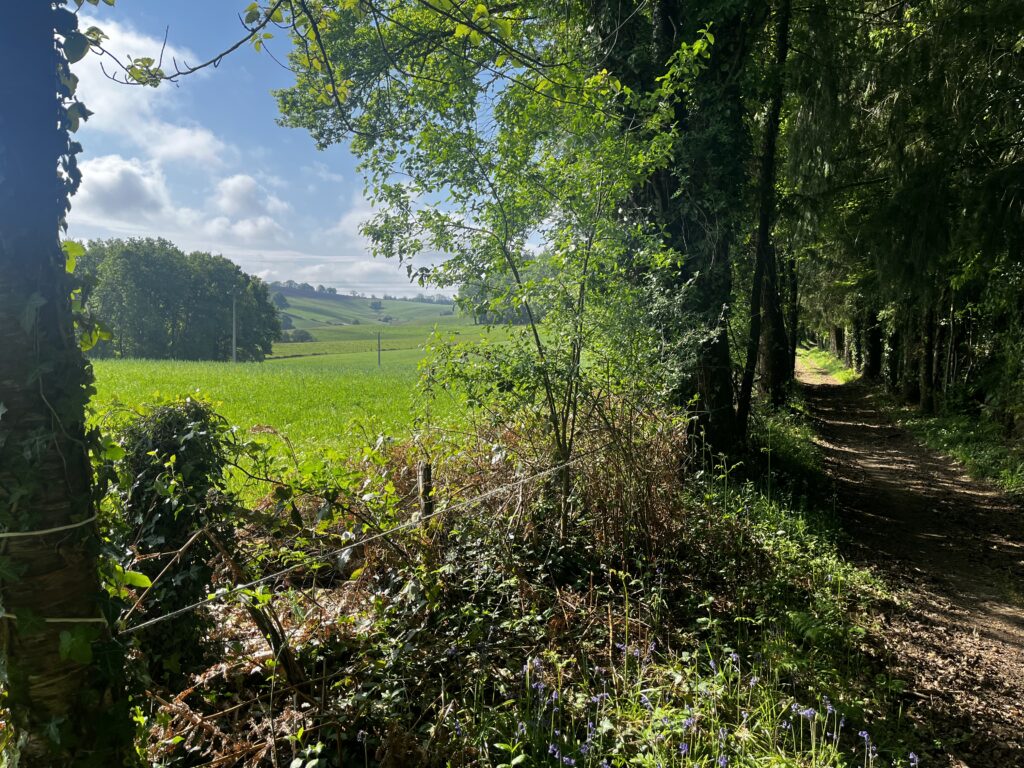
Despite the presence in the woods of what Francine used to call ankle mines (pinecones on the trail), it was a delightful walk. The mist was by now completely gone, except for a dim sheen on some of the far hills.
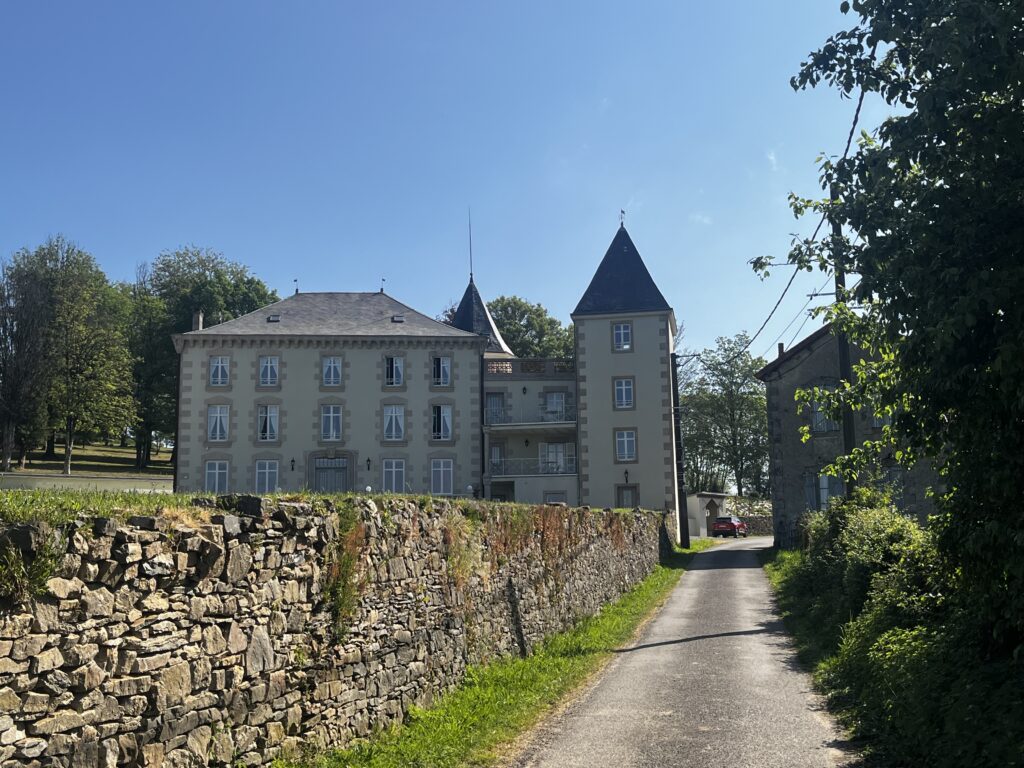
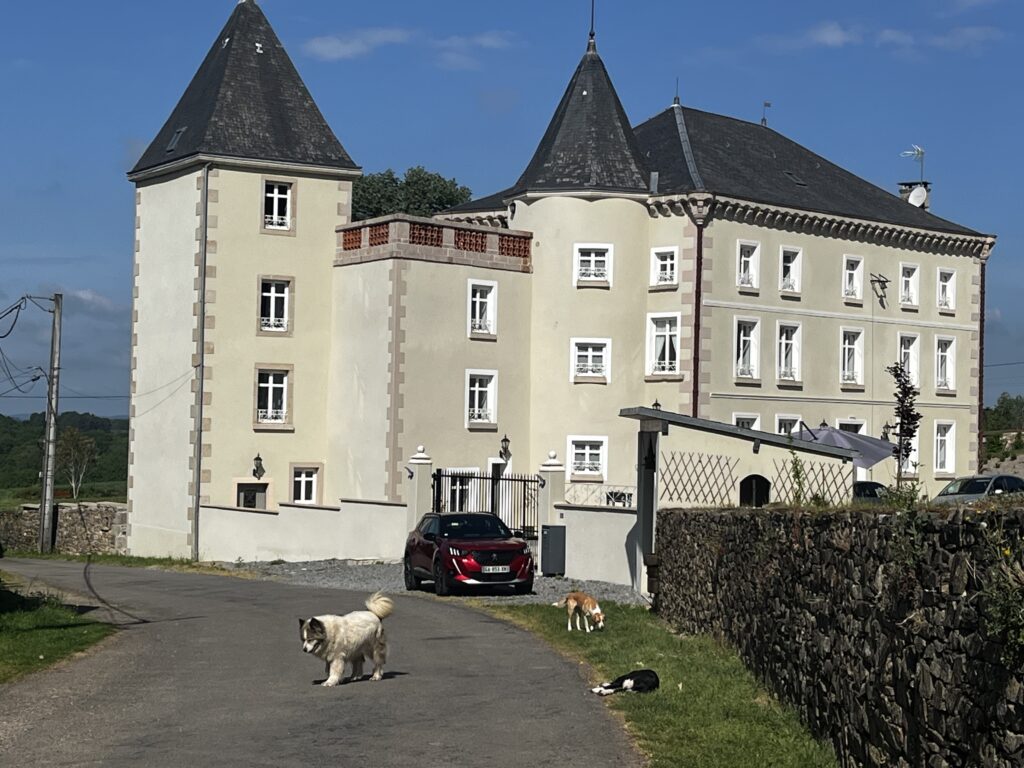
At about 10:50, the trail took me to the little hamlet of Orgnac. Again, no relation to Tolkien that I’m aware of. It was here that I saw a lady walking her horse. There is a lovely little château in this hamlet that seems wildly out of place amongst the more modest houses here.
Now that I think about it, the whole area does give off some serious Middle Earth vibes.
I had a momentarily tense encounter with three loose dogs. They eventually decided I wasn’t a danger. They stopped barking, and then just sort of wandered off.
After Orgnac, the Camino turned down another rough dirt road through forest and field. Parts of this section very much reminded me of our hikes in Point Defiance Park. I have not walked there since the last time we walked there together.
The forest path brought me through the hamlet of Le Peyrat and into the village of Le Châtenet-en-Dognon.
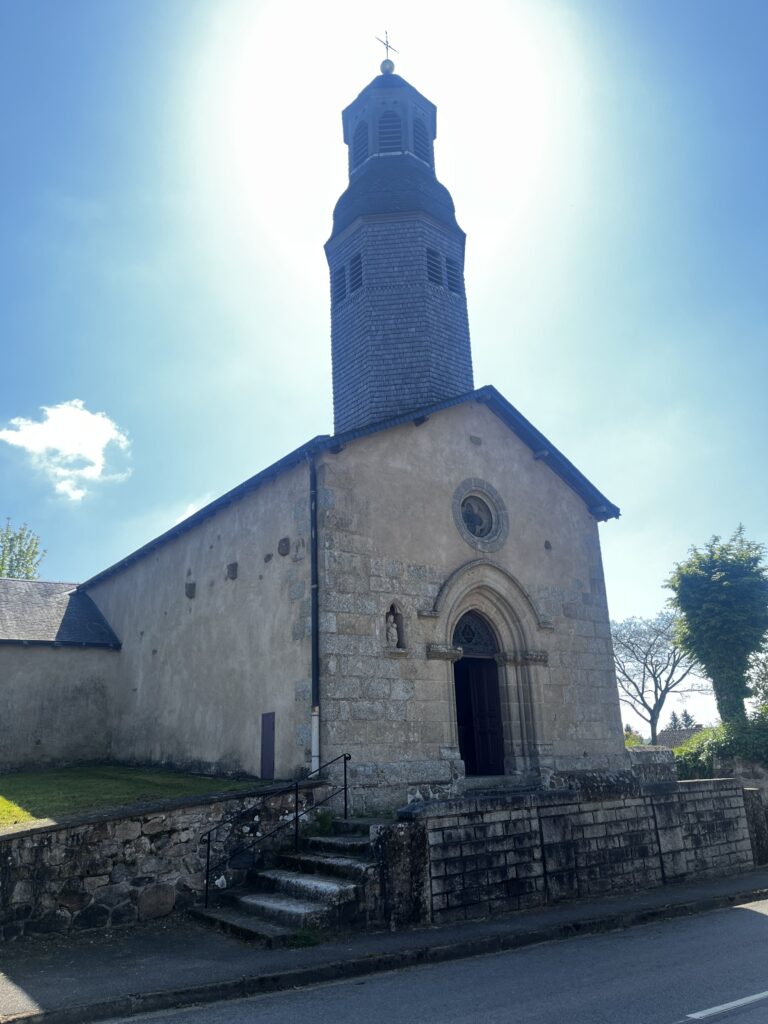
I arrived at the Église de la Nativité-de-la-Très-Sainte-Vierge at about 11:25, and I met Philippe there who was just leaving. Miguel apparently stops for nothing and was far ahead.
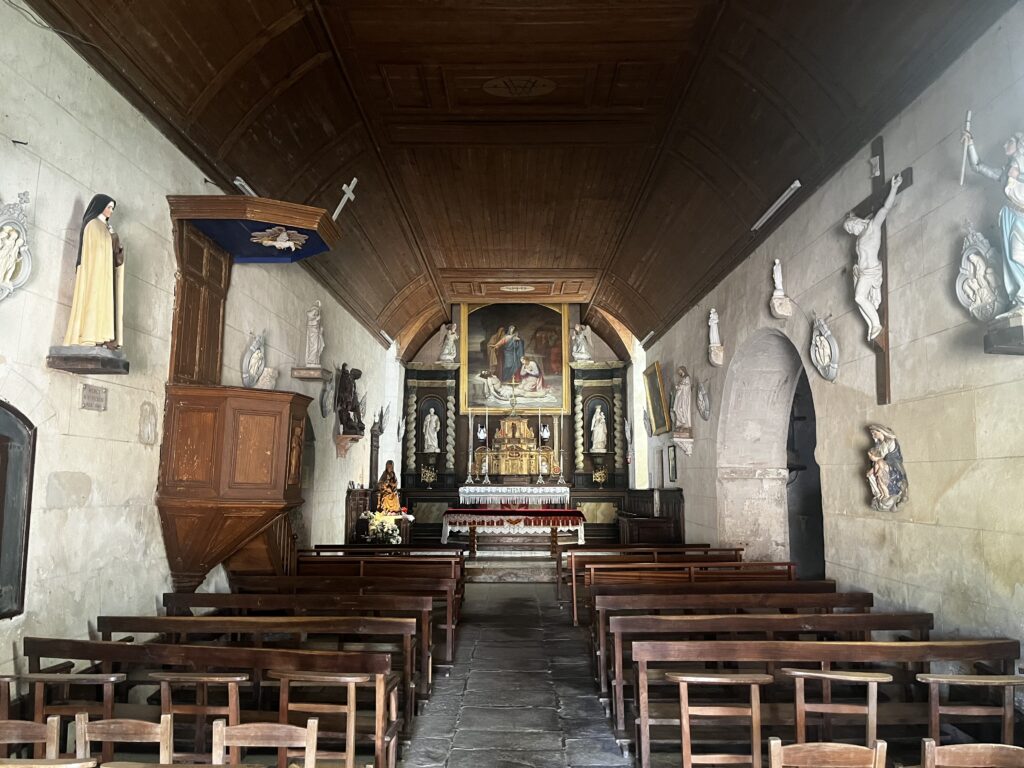
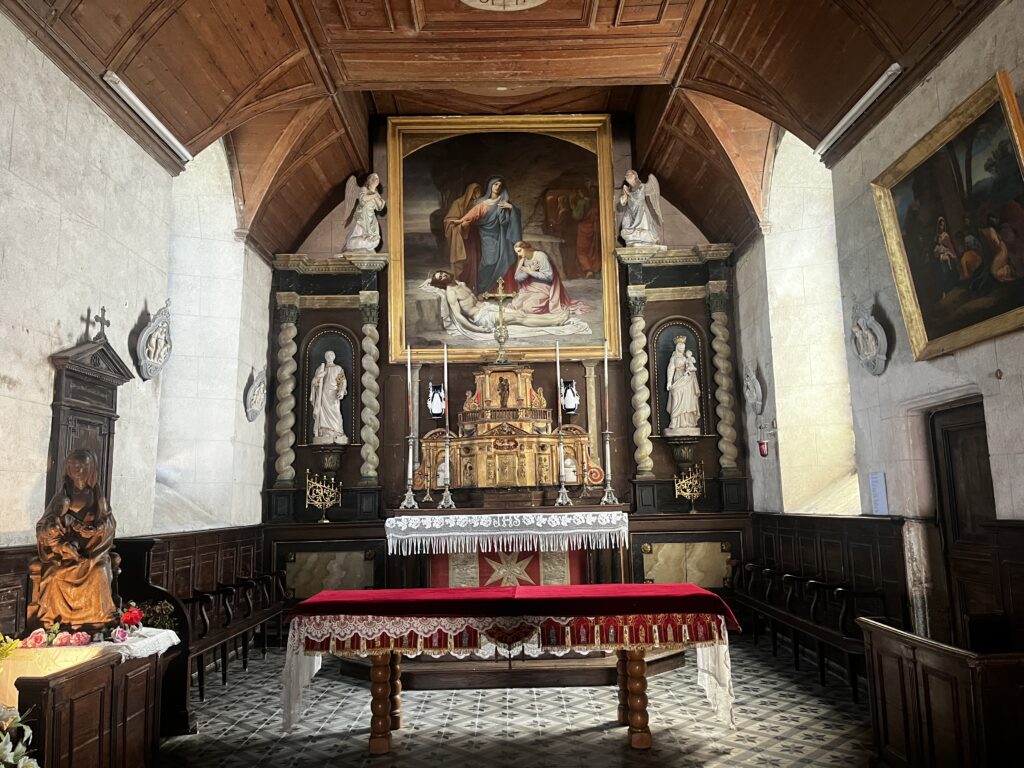
I don’t quite know how to describe this church, because there are parts of it I’ve never seen in any other church in France before. In theory, this is just a single vault with two side chapels, but the ceiling is coffered wood and the sanctuary is a baroque jewel that seems more Spanish than French.
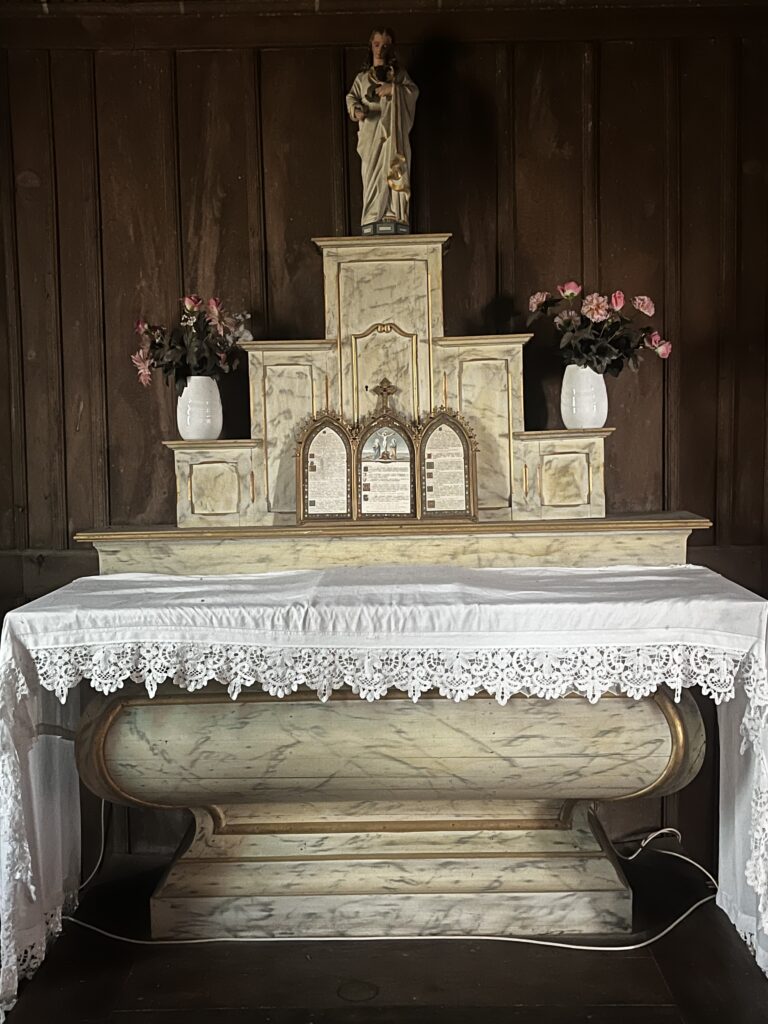
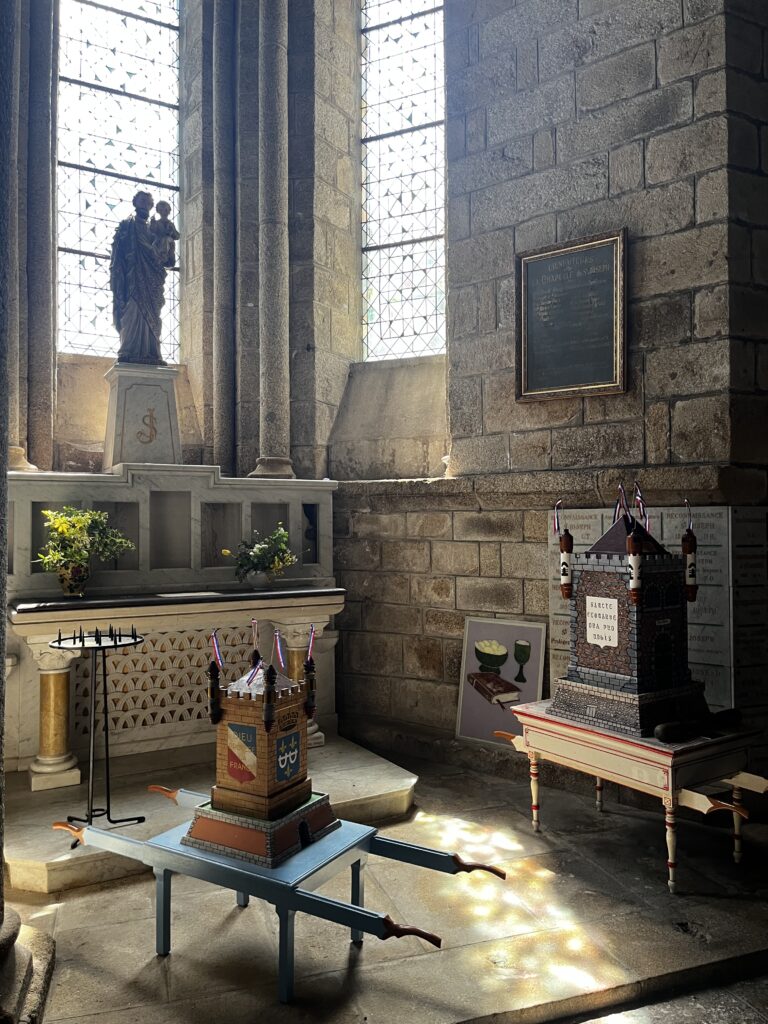
One of the side chapels, dedicated to Saint John the Evangelist and Apostle, is clearly set up to celebrate Mass in the Vetus Ordo, even to having the customary three layers of altar cloths. The floor of this chapel has reliefs of three crosses with coats of arms, almost certainly tombs.
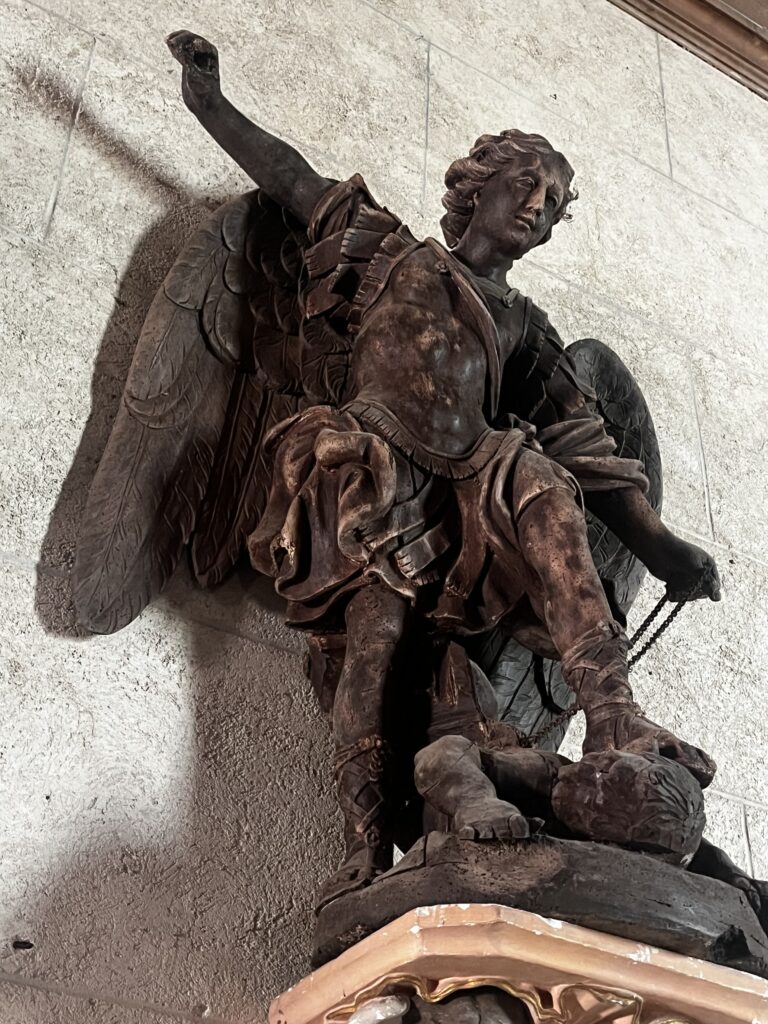
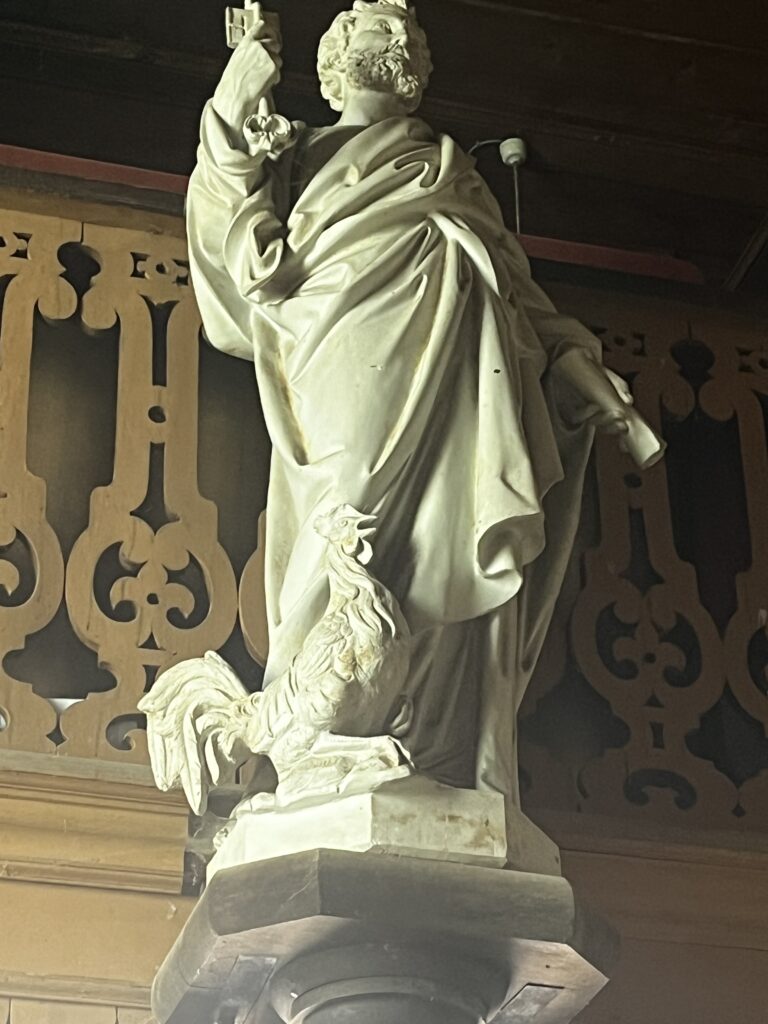
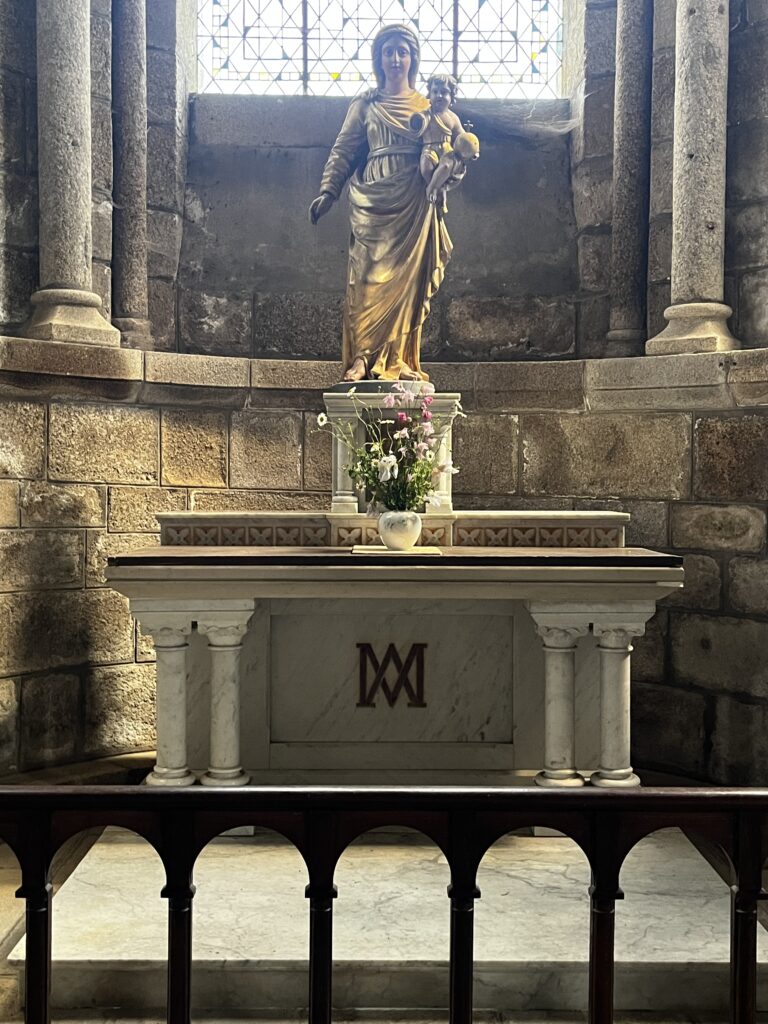
Some of the statues in the nave are the usual sorts of mass-produced plaster saints, but some of them are extraordinary, particularly the wooden statues of Virgin and Child and of Saint Michael, and a stone statue of Saint Peter with a rooster at his feet.
All in all, this is a remarkable little place. I spent an awful lot of time there. It was about 11:55 by the time I left.
I was hoping at this point to find some lunch in the village. No such luck. Instead, it was road walking out of the village.
In the blazing sun but with a cool breeze, the road took me through a string of little farming hamlets, each one much the same as the other: Lachenaud, Lourdes, Le Mountmolas, Clémensanne Nord.
At about 12:50, the Camino finally left the sun-drenched asphalt and headed down a rough dirt road into the forest. Praise God!
I was now more than 23 km into what on paper was a 22 km day, and I still had a long way to go. But I was walking in the shade of the trees dodging golden butterflies, so there was a bit of a spring in my step.
The road became a trail, which ducked in and out of the woods. I felt a sudden sadness, missing my beautiful bride again. I stopped and wrote a sad little poem, but I don’t think I’m ready to share it quite yet.
After a sharp switchback, I arrived at a place called Moulin de Lajoumard. It looked to me like any of the farmsteads I had passed along the way, but I am assured that it was once a water mill. I may be mistaken, but I believe the owner threatened to let loose his dog on me if I took any photos. He was definitely not pleased to see me walk by in any case.
Soon enough, I was roadwalking again, up and down the hills and in and out of tree cover.
About 1:10, I passed a place called Moulin de la Roche, which looked even less like a mill than the previous place.
About ten minutes later, I walked by a hamlet called Cadillat, which is far as I could tell consisted of a single house.
About 1:30, I came upon a vineyard and suddenly wondered how my little grape arbor at Pistachio House was doing. I took a moment here to rest in the shade there before the final push of the day.
At about 1:45, I walked through the scattered little hamlet of Lussac, which I think may be associated with the vineyards. I saw a dead end ahead and realized I’d made a wrong turn at the vineyards. I quickly backtracked and was soon on the correct path once more.
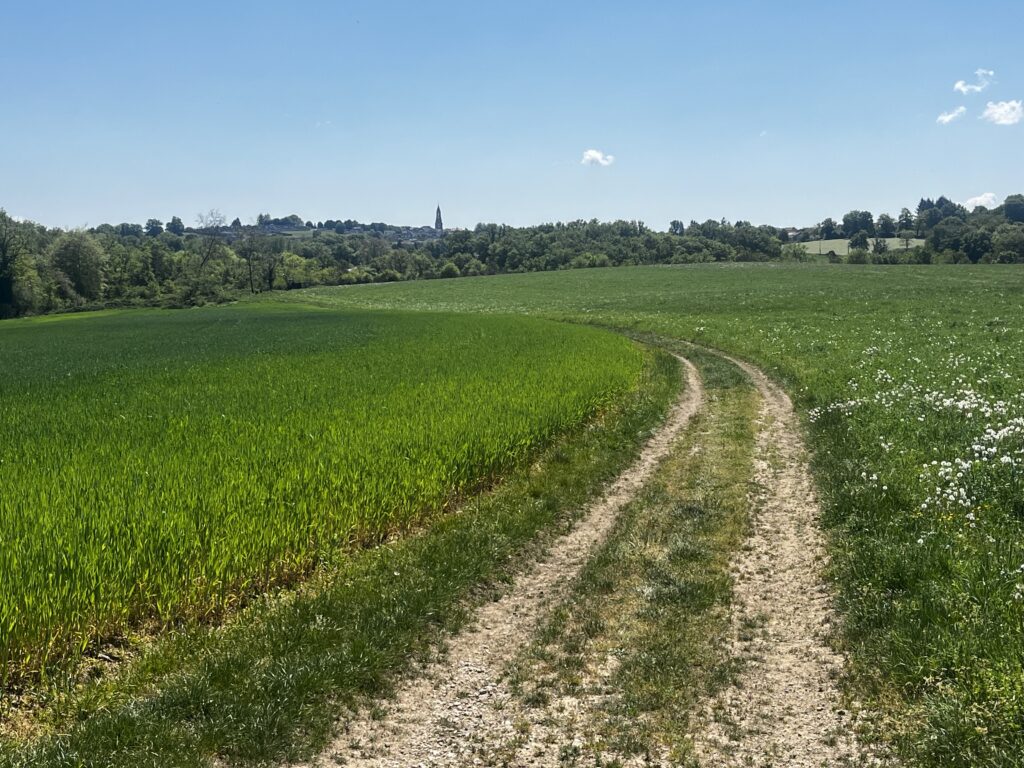
At about 1:50, as I passed through the farming hamlet of Neuvillard, I saw a city in the distance to my left. Could this be Saint-Léonard? It seemed a very long way off, indeed.
Within ten minutes, the Camino left the road for a sandy dirt track through the meadows heading straight for the city. The steeple already looked closer. As I walked down the track through field and forest, another one of those golden-yellow butterflies flew ahead of me, almost as though it were encouraging me forward.
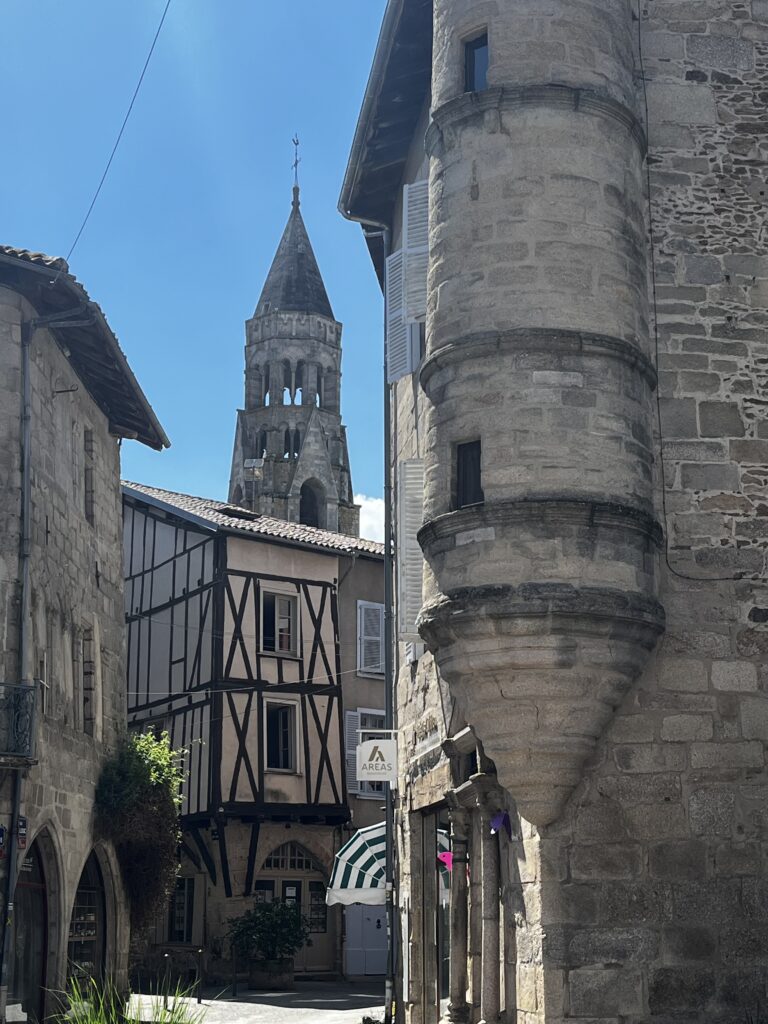
The Camino joined an asphalt road at about 2:10 as it climbed uphill towards the city. I entered the city ten minutes later, though it was 2:30 before I was walking through the medieval town center with its narrow streets and deep blessed shadows.
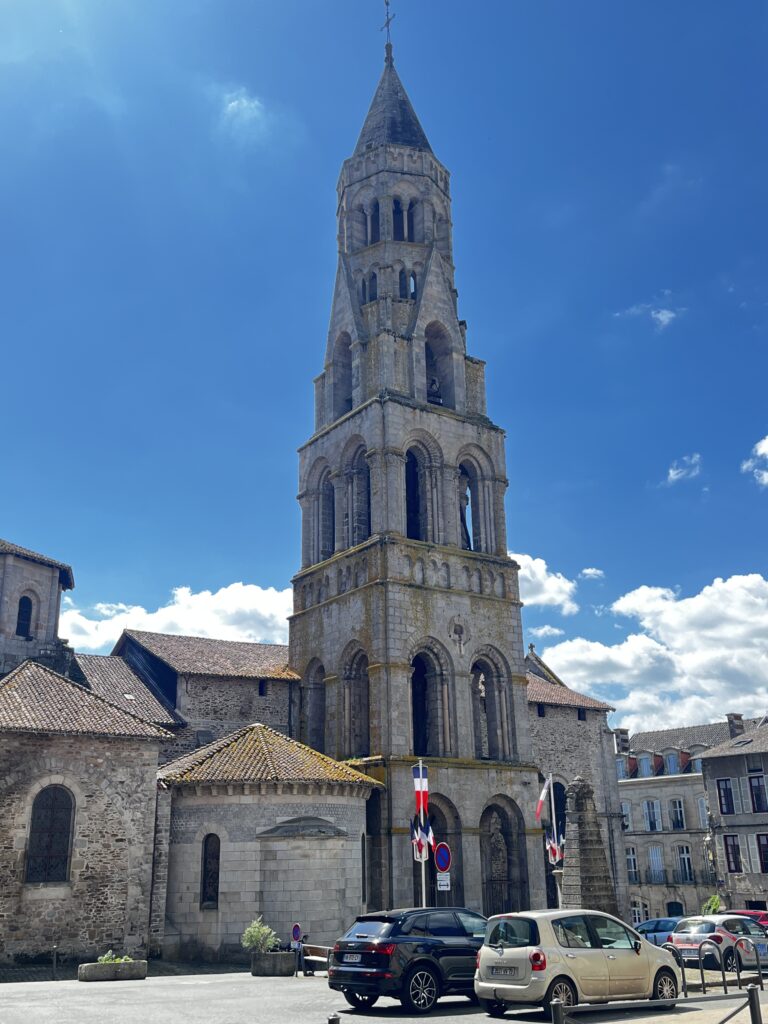
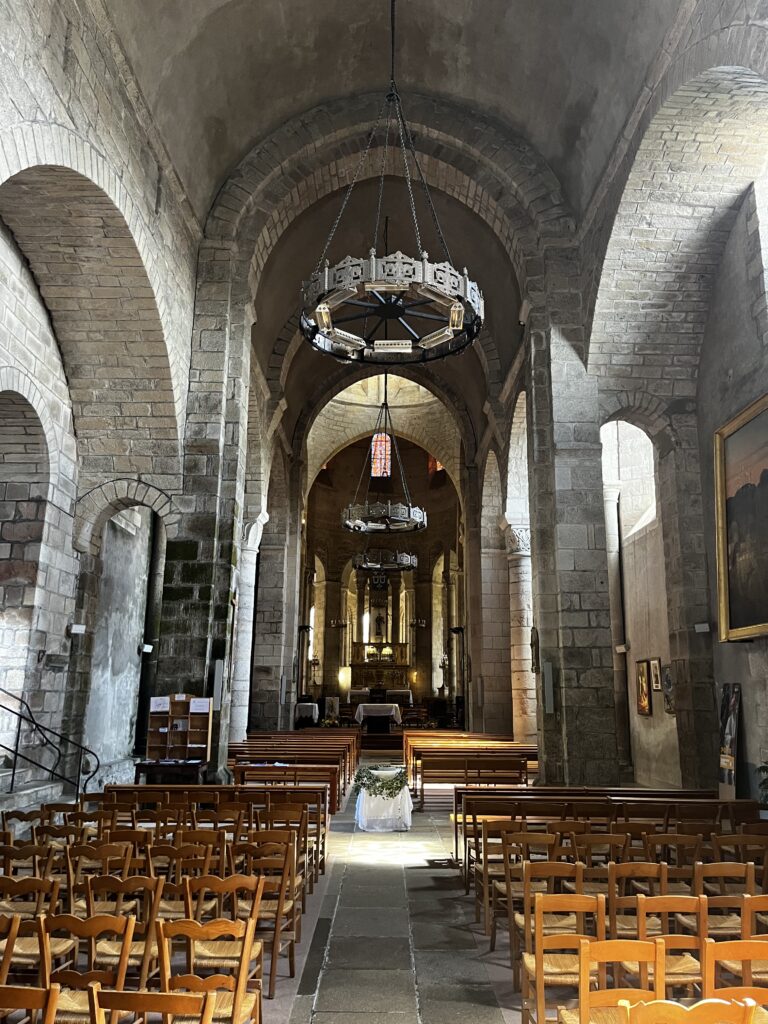
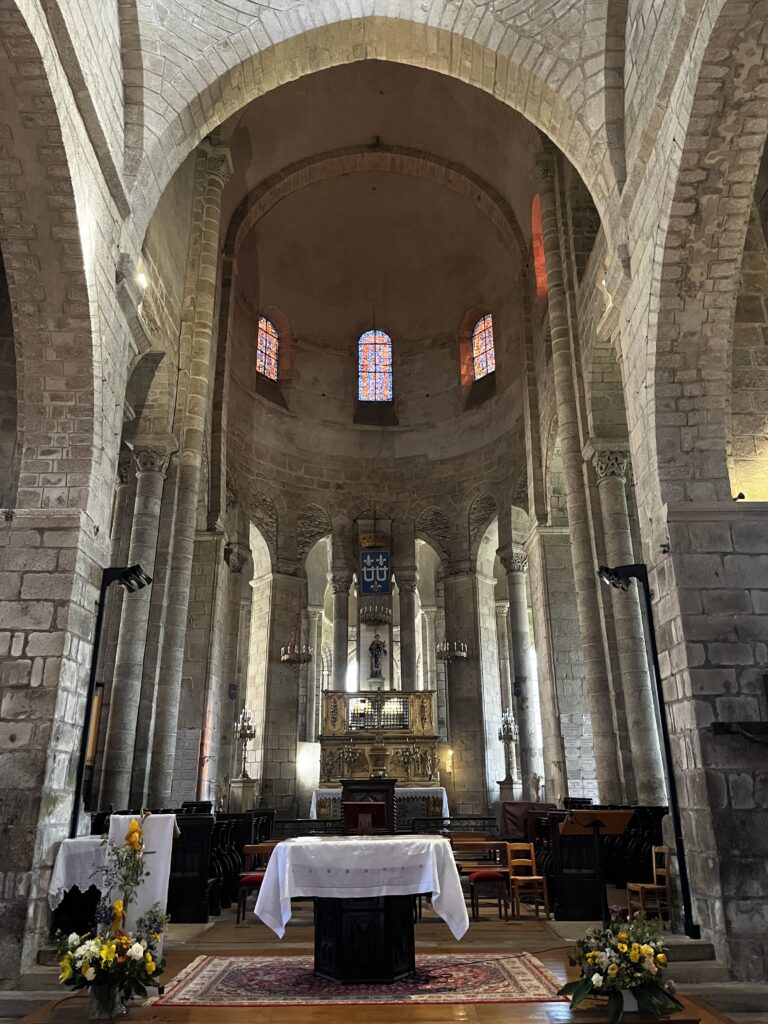
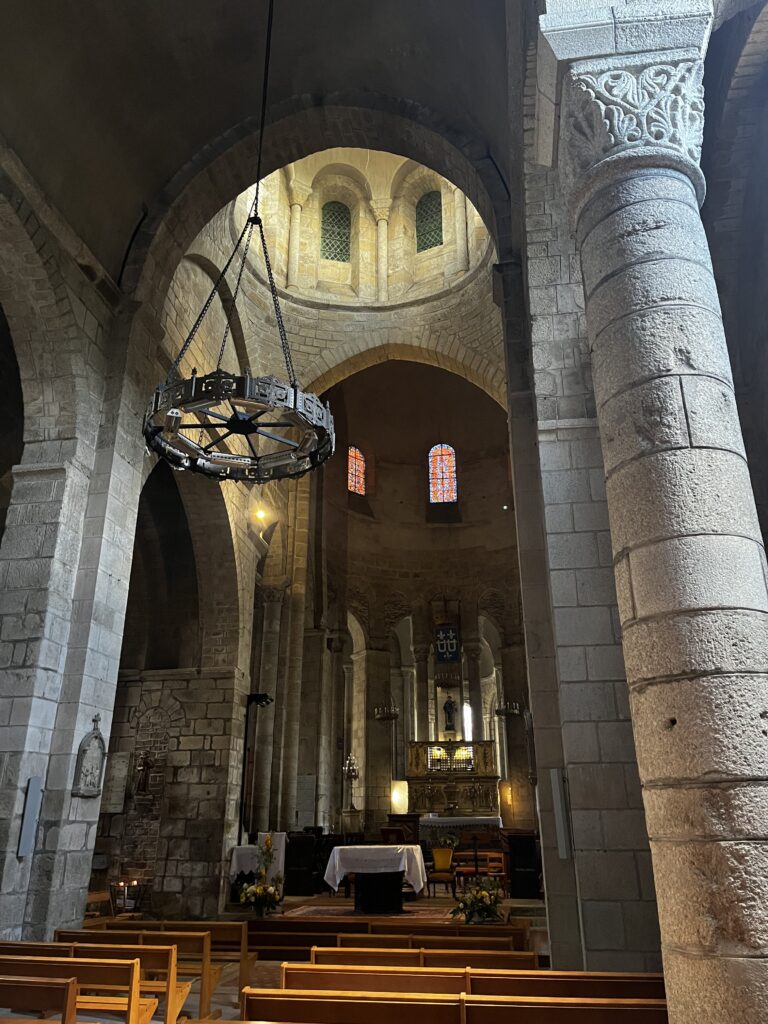
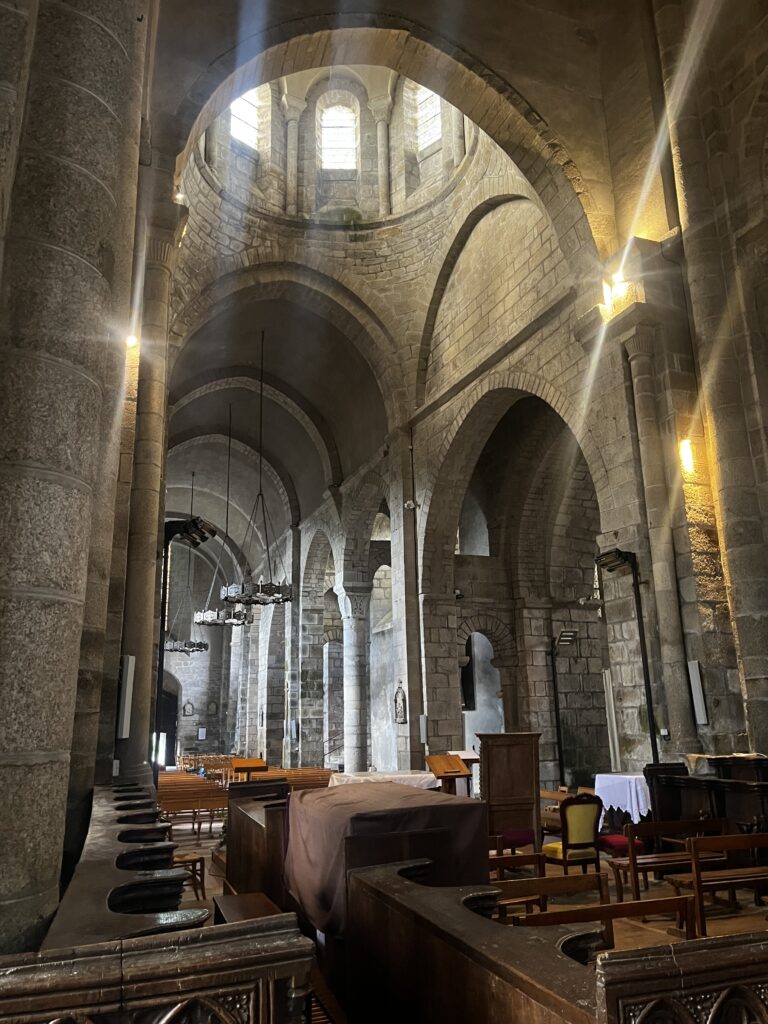
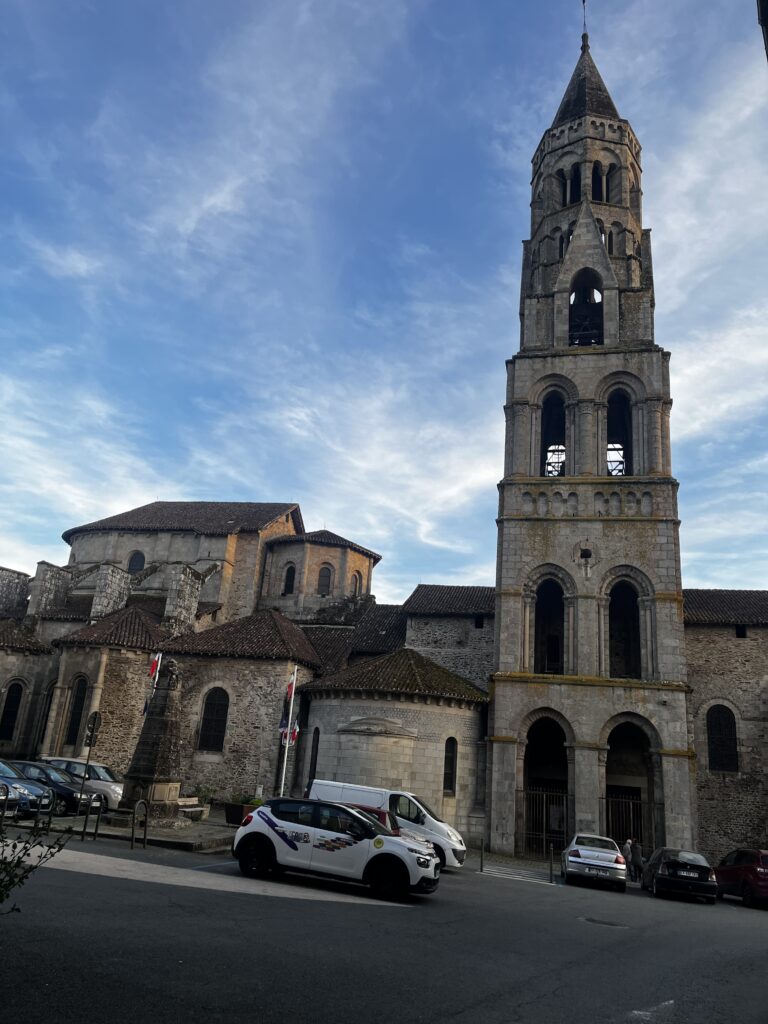
By 2:40, I was sitting in the church of Saint-Léonard-de-Noblat. Philippe was there when I arrived.
This is one of the great pilgrimage destinations, even having a long entry in the 12-century Codex Calixtinus, the first Camino guide.
Now, divine clemency has diffused the fame of Saint Leonard the confessor of Limousin throughout the length and breath of the world; of how his powerful intercession has released countless thousands of captives from prison. Their iron chains, more barbarous than one can describe, join together … hanging testimony to all his miracles.
Among everything else, the church building itself is a masterpiece of Roman architecture.
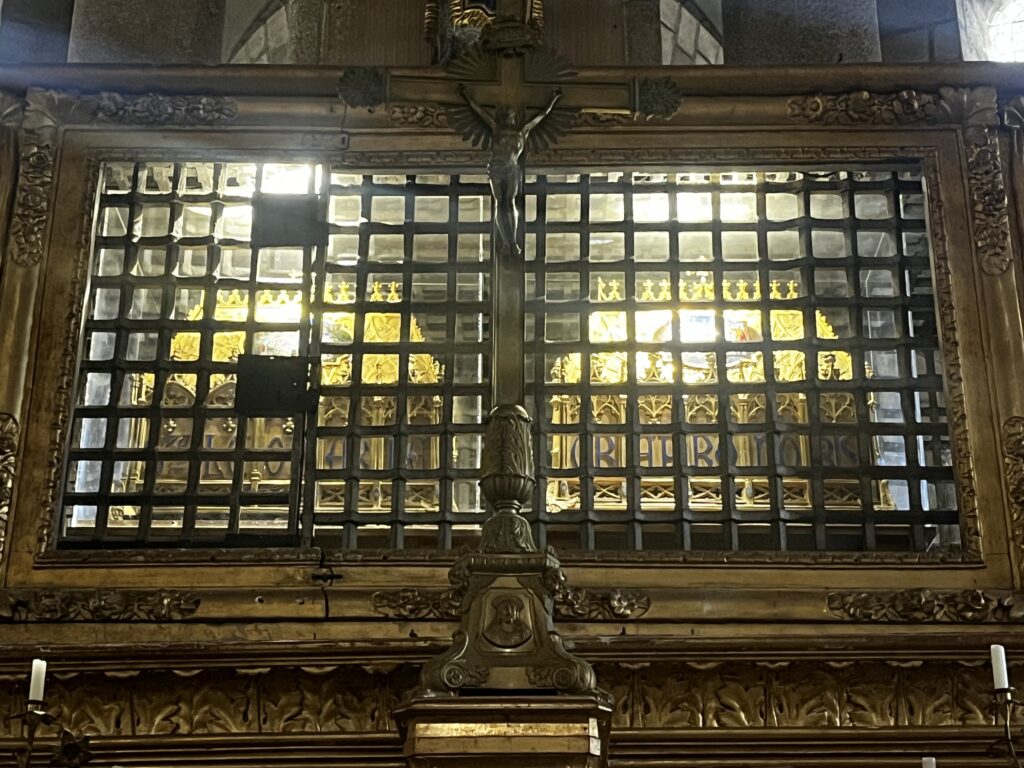
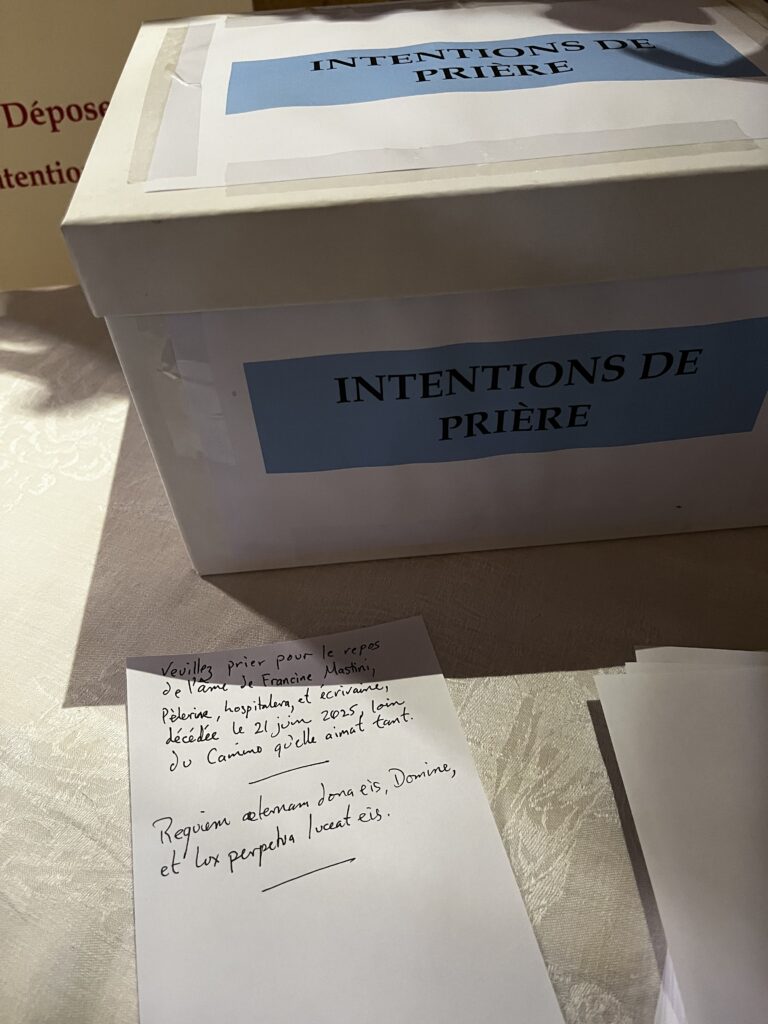
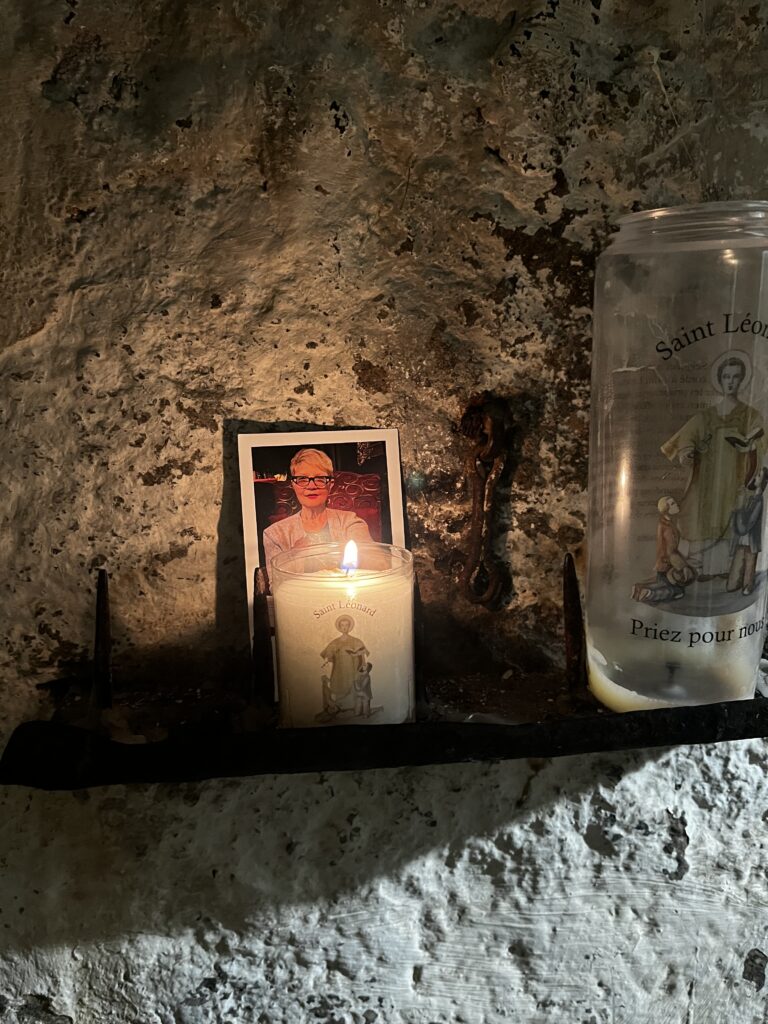
Pilgrims have been coming here, praying, and walking through the crypt and under under the relics for more than a thousand years. I joined them. I prayed here, I walked through the crypt under the relics, and I lit a candle for Francine there in the crypt.
And then I sat in silence there a long time.
As I was finally getting up to leave at about 3:30, Philippe walked back into the church. He found the gîte just meters from the church.
The gîte has a washer and a dryer, so in went all the clothes I wasn’t wearing, even my fleece. The fleece didn’t go in the dryer, though – that’s a lesson we learned on the Primitivo! Hopefully, it will be dry by morning.
Later in the evening, I returned to the church to pray Vespers. Philippe and I then tried to find some dinner. On a Sunday night.
Eventually, we found a place that normally only served drinks on a Sunday night, but they were willing to make an exception for pilgrims. I had a lovely plate of salad, meats, and cheese.
Date: 26 April 2026
Place: Saint-Léonard-de-Noblat
Today started: La Besse
Today’s Photos!
So much history in these magnificent medieval churches! Each Camino route has its own unique aspects it seems to me me from what I have read of your previous treks along with Dennis B’s and Ed H’s