
Via Lemovicensis: Endgame
This morning, I was out of the albergue before 6:30 in an effort to beat today’s expected heat. Katie gave me a hug and left just a little bit before me. The morning air was humid. For the second day in a row, I didn’t even bother putting my fleece on.
At this time of the morning, breakfast was out of the question even here, so my first order of the day was to get back onto the Camino route. I took a shortcut across the village.
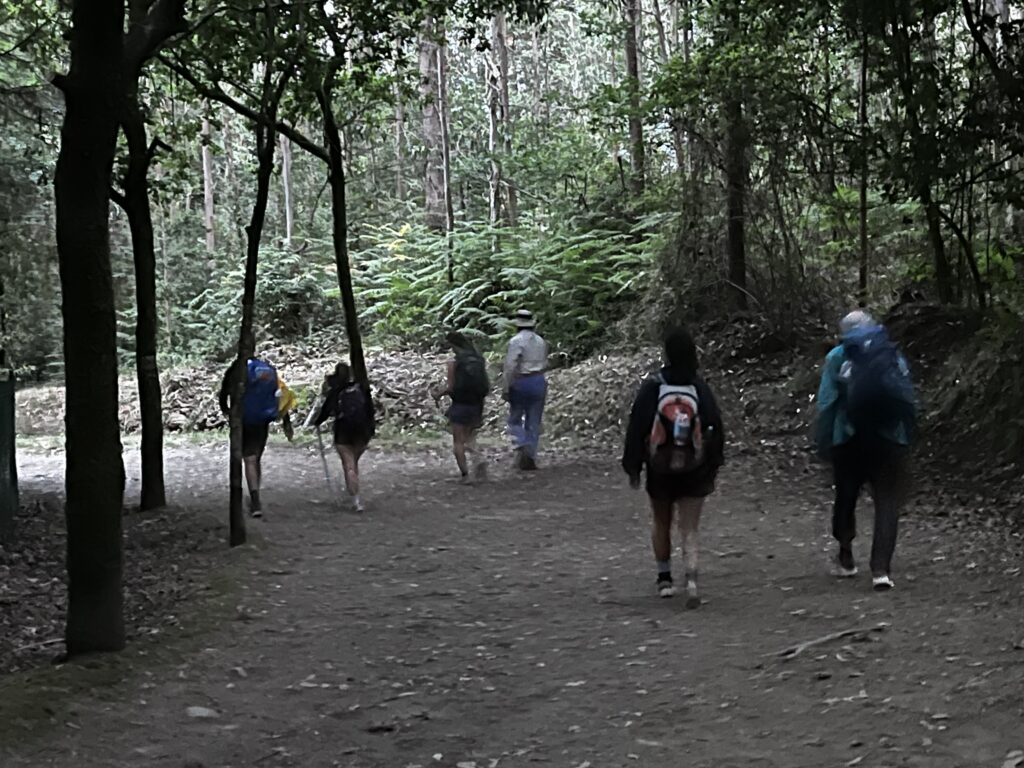
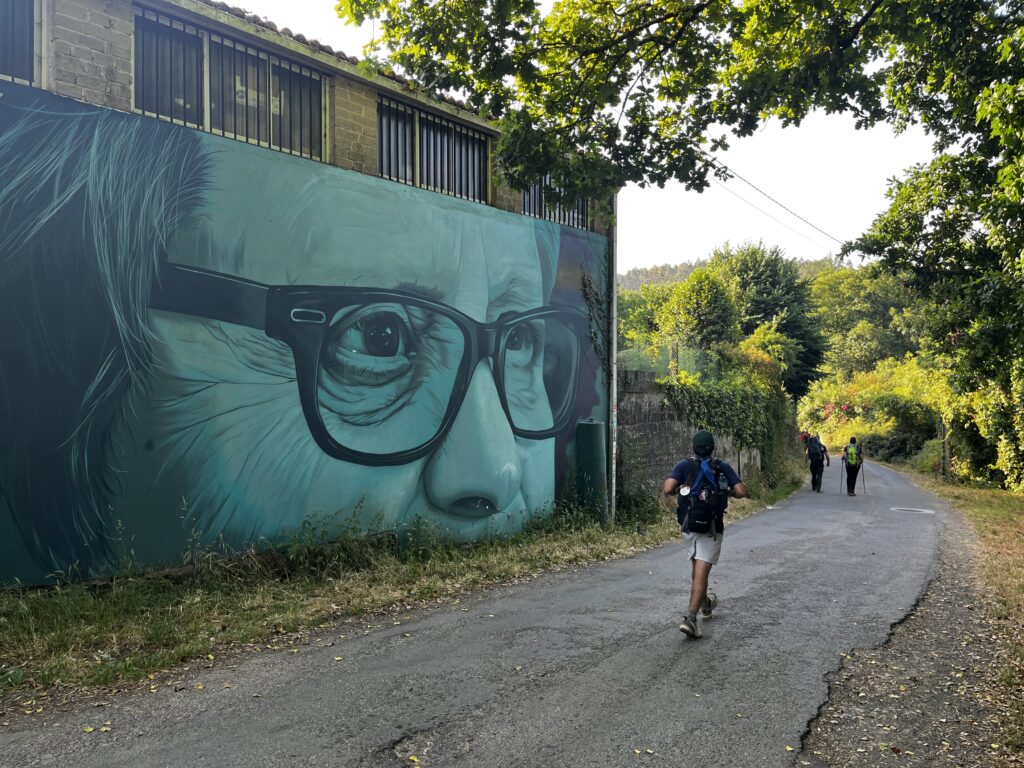
There were already plenty of pilgrims on the road before me. When I got to the route, I could see a group of five teenagers ahead. It felt right to be walking alone among the crowds.
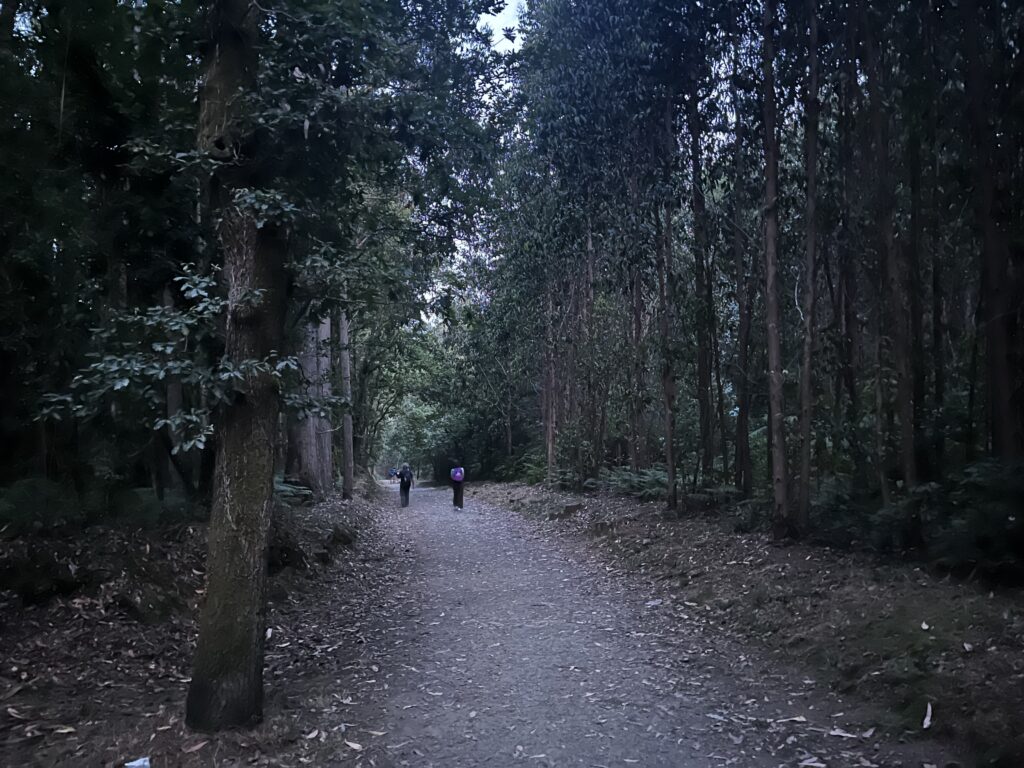
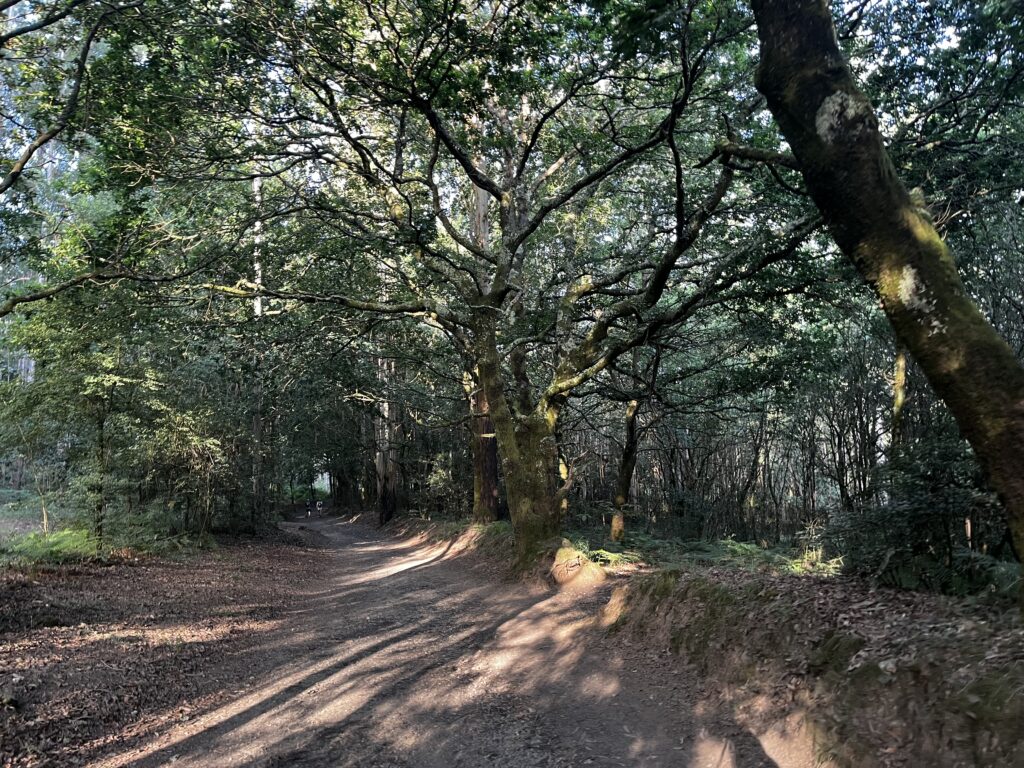
Within just a few minutes, I was back into the woods. The path was the same broad, smooth dirt of yesterday afternoon, and even in the dim light I didn’t really need to use my flashlight, although the kids ahead of me were definitely playing around with theirs.
One year ago today, my beautiful bride left this world for a better one. She never got to walk this Camino that I have been walking for 74 days, a route that she was obsessed with and, in large part part, would have loved.
Oh Lord, I miss her so much.
Bats. Bats flew past my head as I approached an opening in the trees and the sleepy hamlet of Santo Antón. The place had perhaps a dozen houses, one or two of which were derelict. One of these had grapevines growing, a tangled mess, on wires in front.
And then back to the woods, where light was slowly returning. It was still too dark to read the kilometer markers, but I could follow the yellow arrows well enough. And the path ahead was obvious in any case.
I remember vividly the last time I kissed her good night, told her I loved her, and said, “don’t you forget about me”. I took a photo of her sleeping as I left the room, and the thought flooded into me that this was the last photo of her I would ever take.
It was.
I don’t know how I could have known that. The thought had certainly never occurred to me before. About seven hours later I got the call from the hospice.
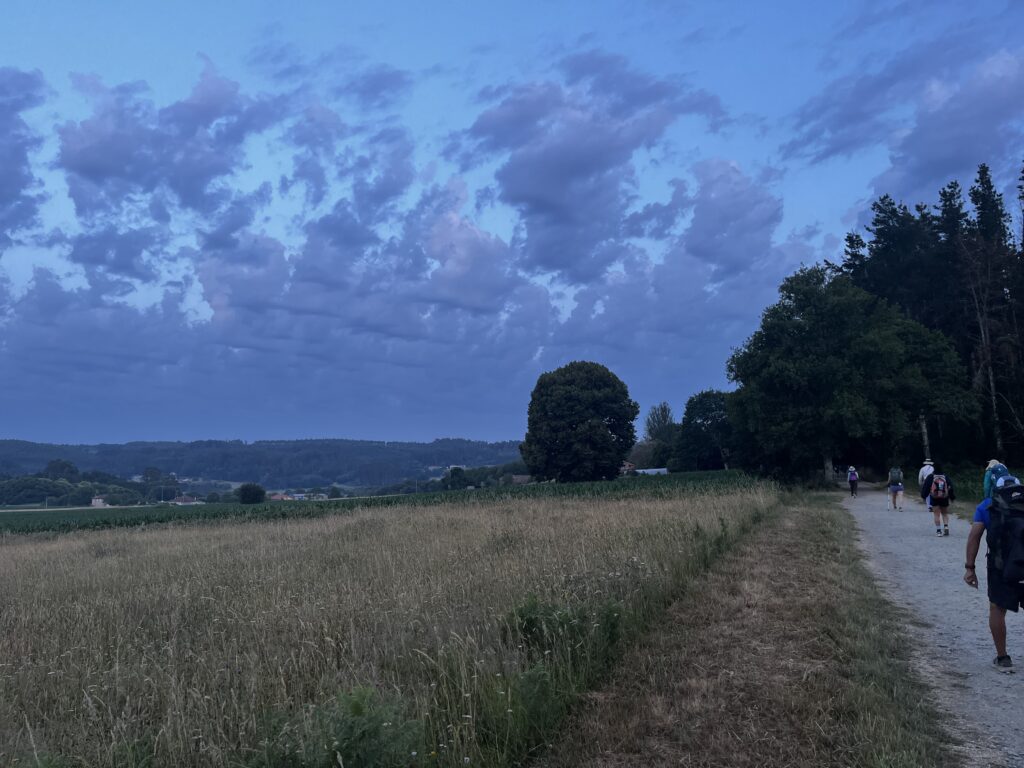
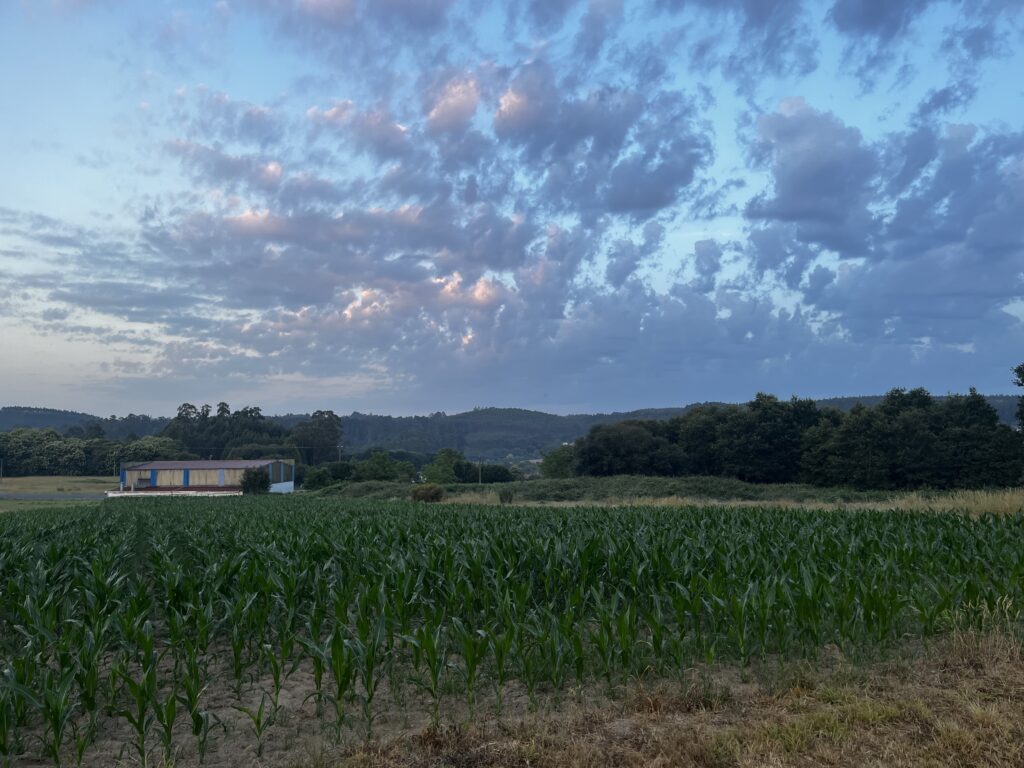
At about 6:55, I walked into the light of a cornfield and a meadow. The marker showed about 17.5 km to Santiago.
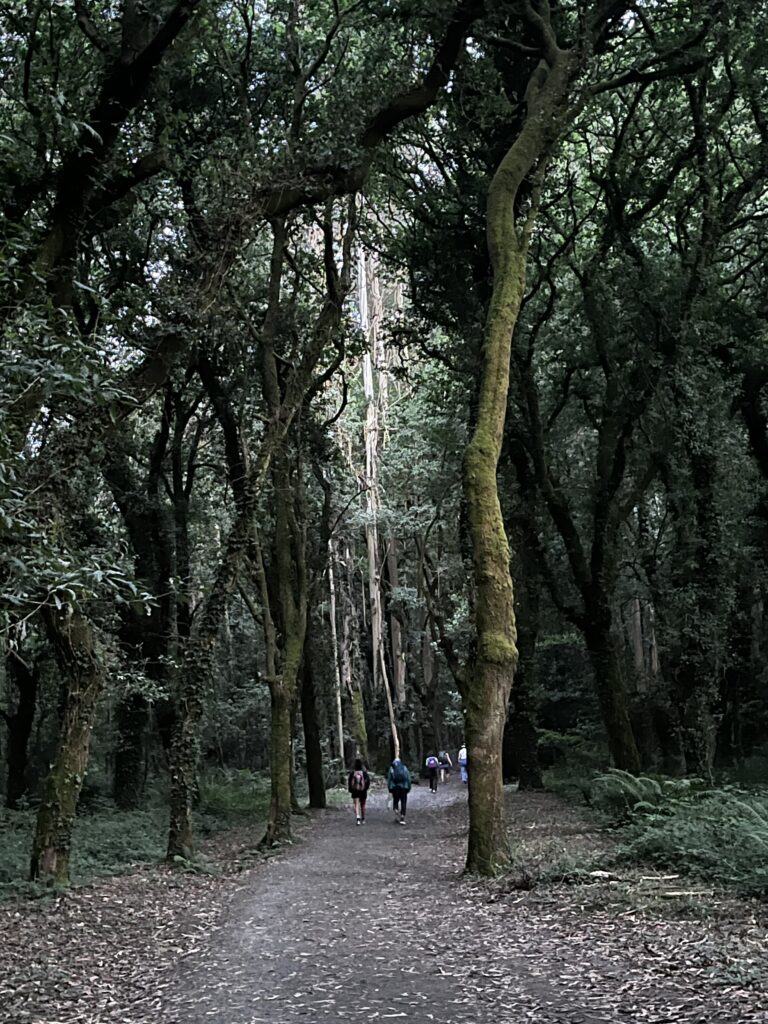
As the Camino returned to the woods, I was surrounded by seemingly never-ending stream of pilgrims walking forward to Santiago. I thought again of the idea of the pilgrimage as a sort of sacramental representation of our pilgrimage on earth, everyone walking towards the heavenly city.
Some were chatting and laughing, but most walked on in silence. Some had a spring in their step – we were almost there! – and some grimly trudged on.
Some, no doubt, like me were intermittently weeping for their own closely held reasons.
Sometime past 7 AM, I walked through the suburb of O Amenal. The houses now are largely modern and not built in the traditional Galician style.
I heard pilgrims chatting in Spanish, Italian, and English. The conversations, by and large, seemed cheerful and inconsequential. My heart felt light, but I wept as I walked.
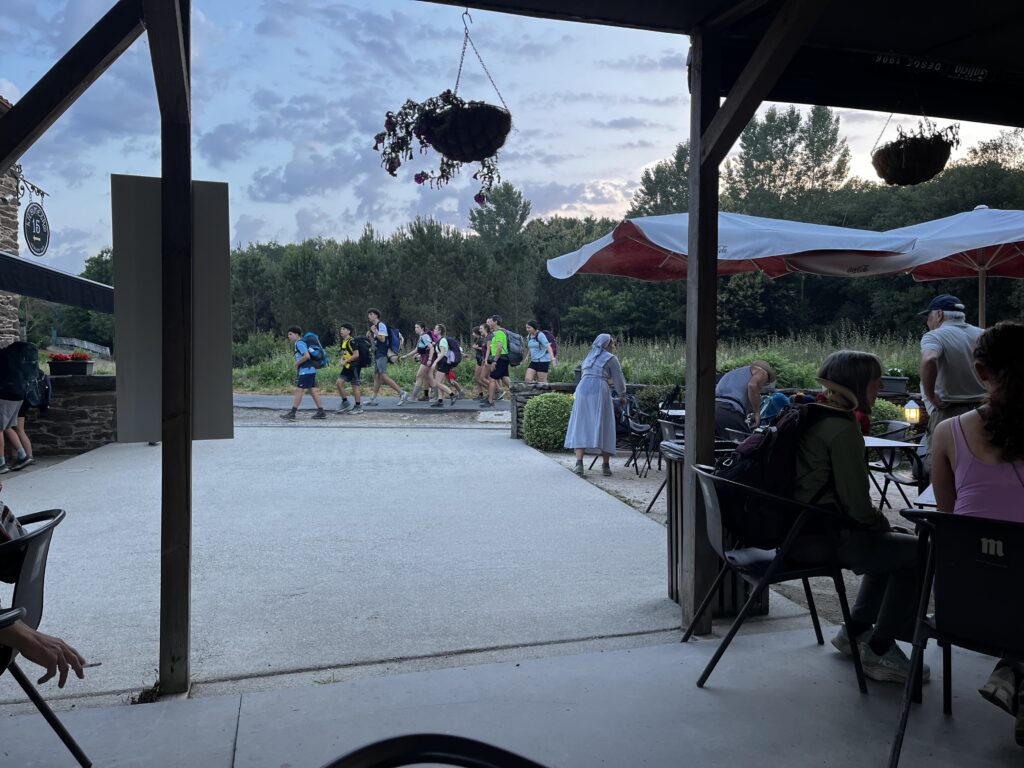
I took my breakfast at a place called Kilometro 15, though it was 16 km from Santiago. While I was waiting in line – and what a line! – I fell into conversation with a couple of American women from Virginia Beach. One of them gave me the gift of a handmade rosary.
As I ate my breakfast, the pilgrims passed in droves. By the time I finally left, it was 7:50. The Camino passed under a highway and then took me back into the dark Galician woods.
The cycle of light and dark continued, as the Camino would duck out of the woods and into the fields periodically before heading back into the woods again.
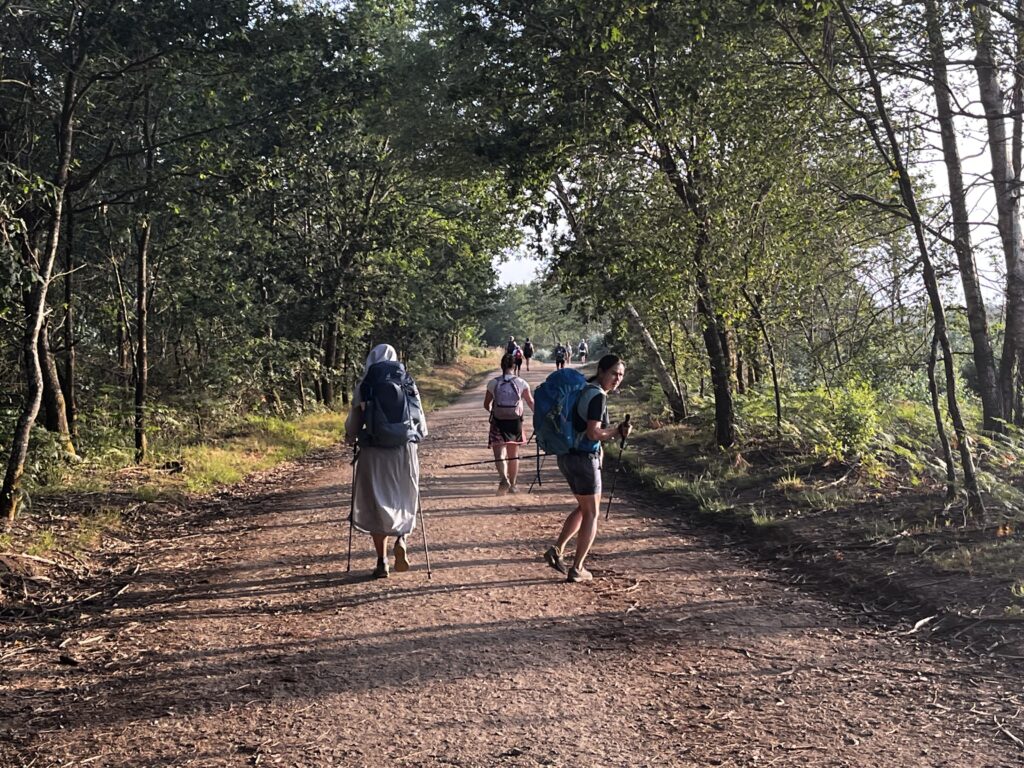
The kilometers flew by, and I began passing some of those pilgrims who had passed me at breakfast. Among them was a sister, walking in full habit and carrying a full pack.
My pace was broken when a young woman from the Philippines asked me if I would take her photo by one of the kilometer markers. She said she had been praying for a sign, and that she had just now received it and wanted to remember the moment.
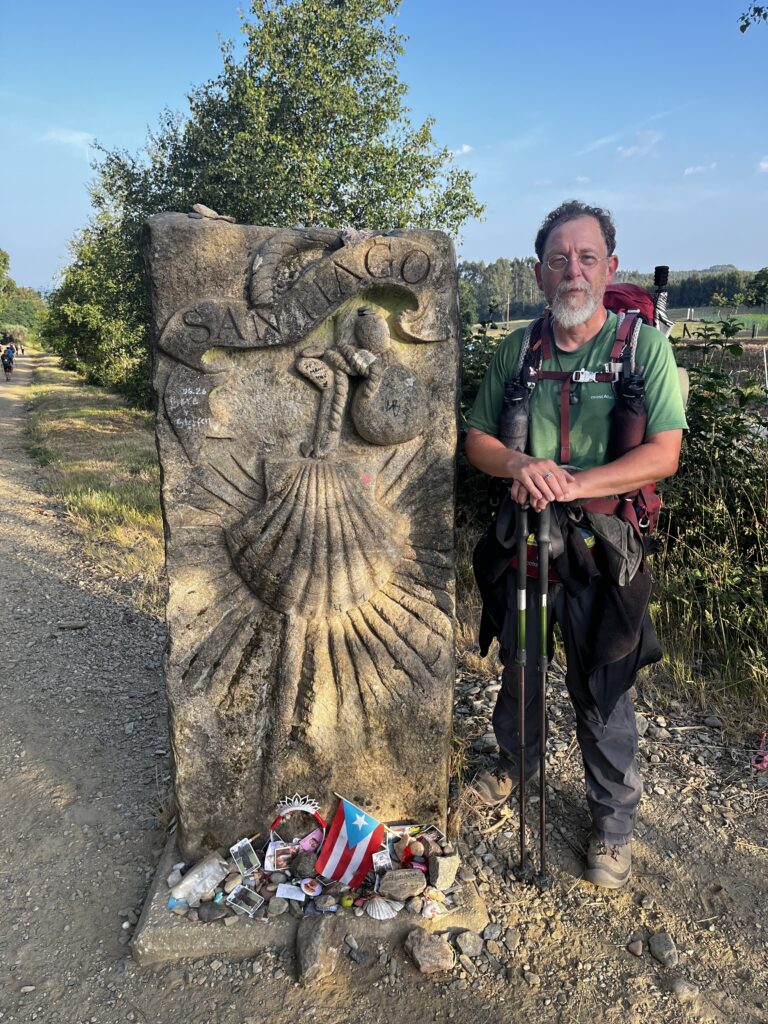
At just past 8:15, I entered the tiny but swanky suburb of Amarelle. There’s a big stone marker here announcing Santiago. It’s moved a few times over the years, but I think it’s been in this location at least since 2018. Francine and I have always had our photos taken next to it. For the record, it’s still at least 13 km to Santiago from there.
The Camino now began its trek between the highway and Santiago Airport, where my friend Adam would be getting off a plane in about nine hours. I’d actually been circling the airport at something of a distance for some time now, but this is where the Camino ran right along the fence line.
It was here that I passed the Sister for the third time. Apparently she doesn’t stop to take photos.
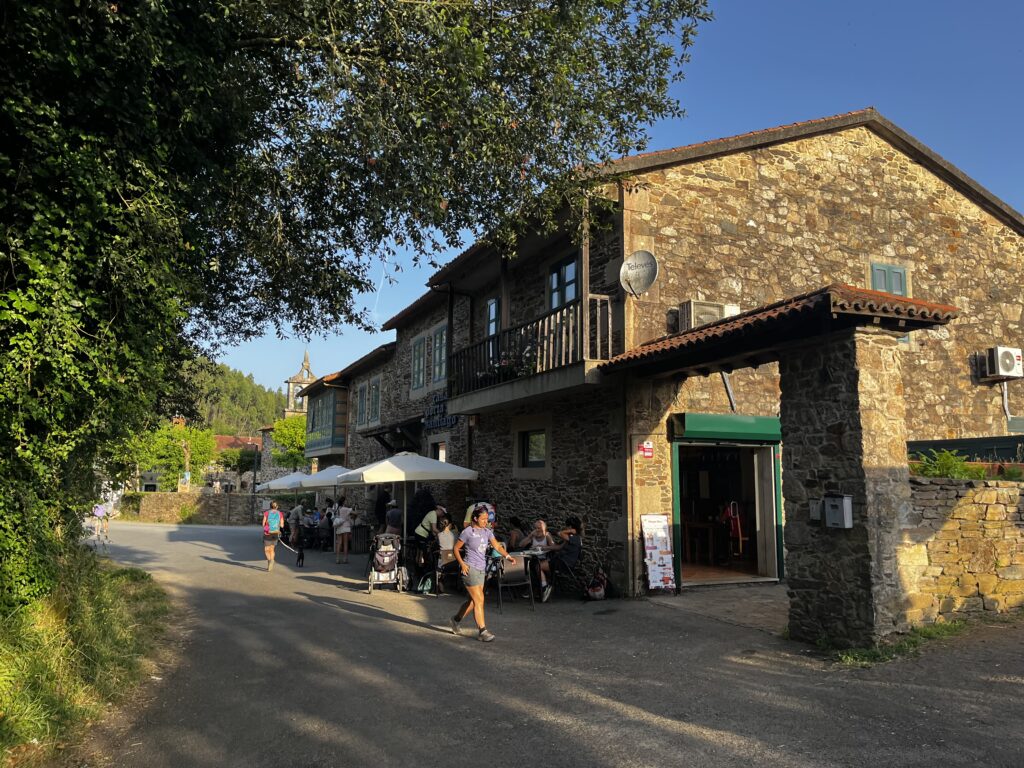
About 8:35, I entered the village of San Paio, where, as several signs will tell you, there are two bars.
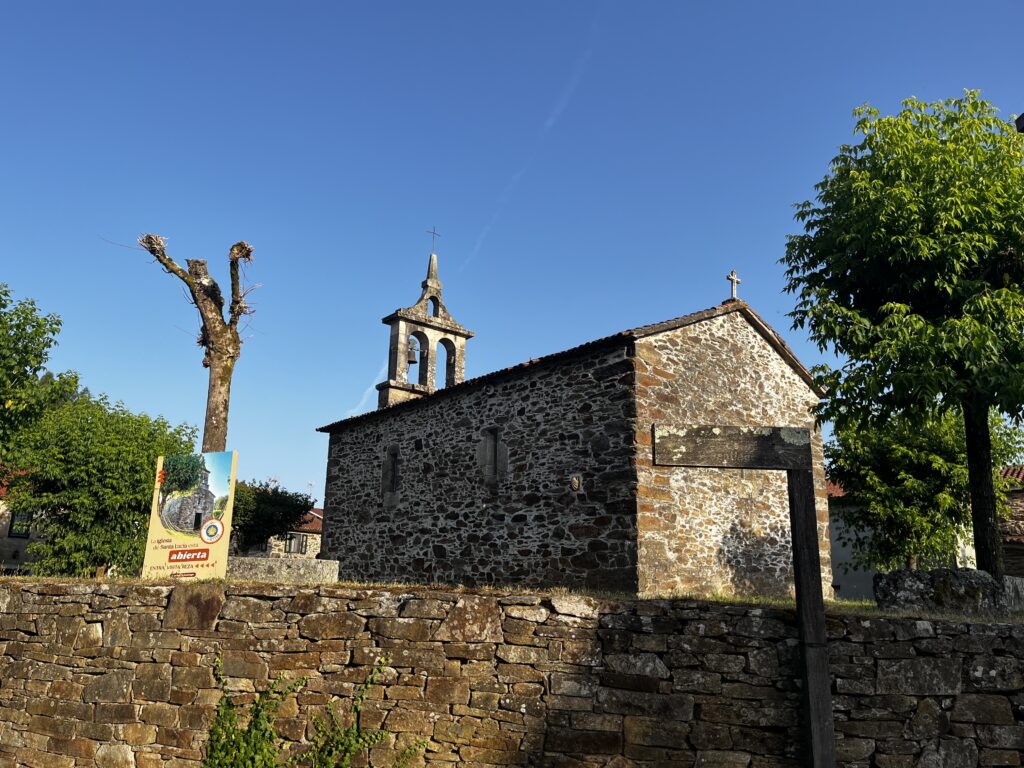
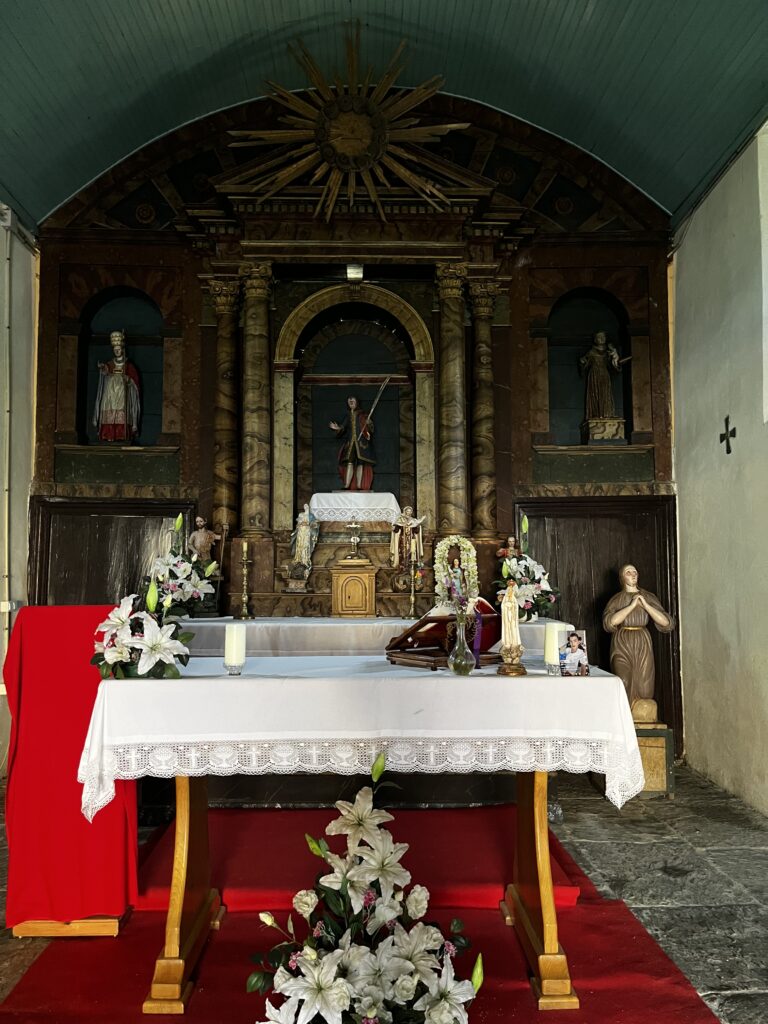
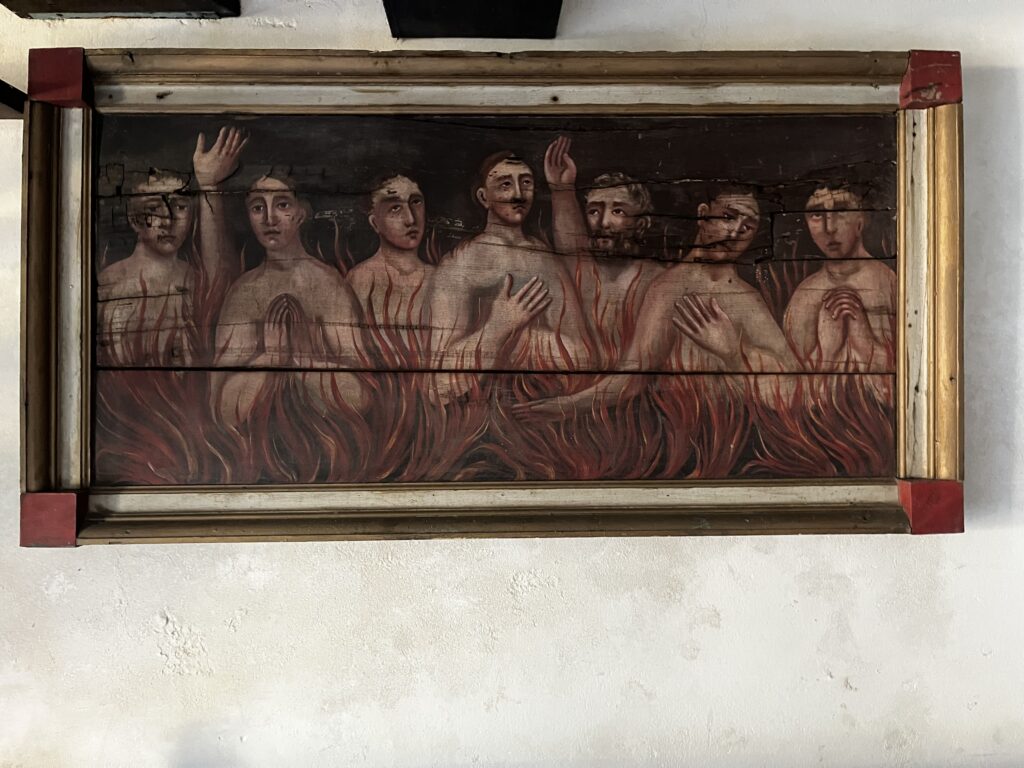
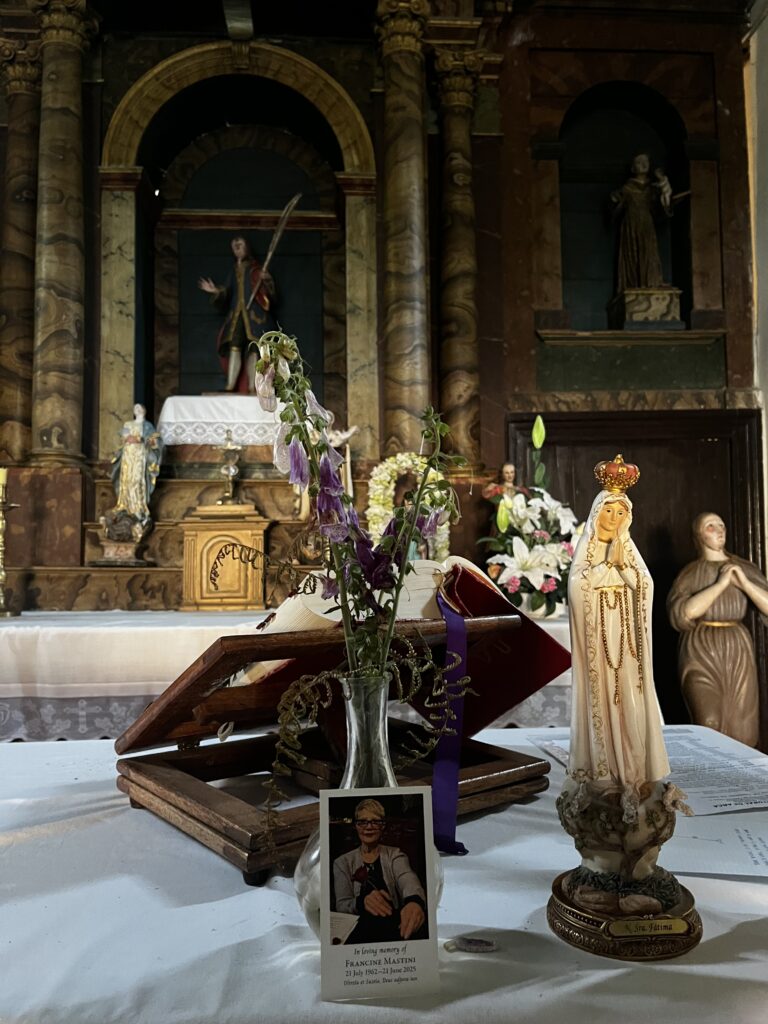
I visited the little church of Santa Lucía. There’s a fascinating painting in here of the souls in purgatory. The volunteers here were from the Italian confraternity, and they had music playing inside the church. Some of the choices were distinctly odd, such as an Italian cover of Simon and Garfunkel’s “Sounds of Silence”.
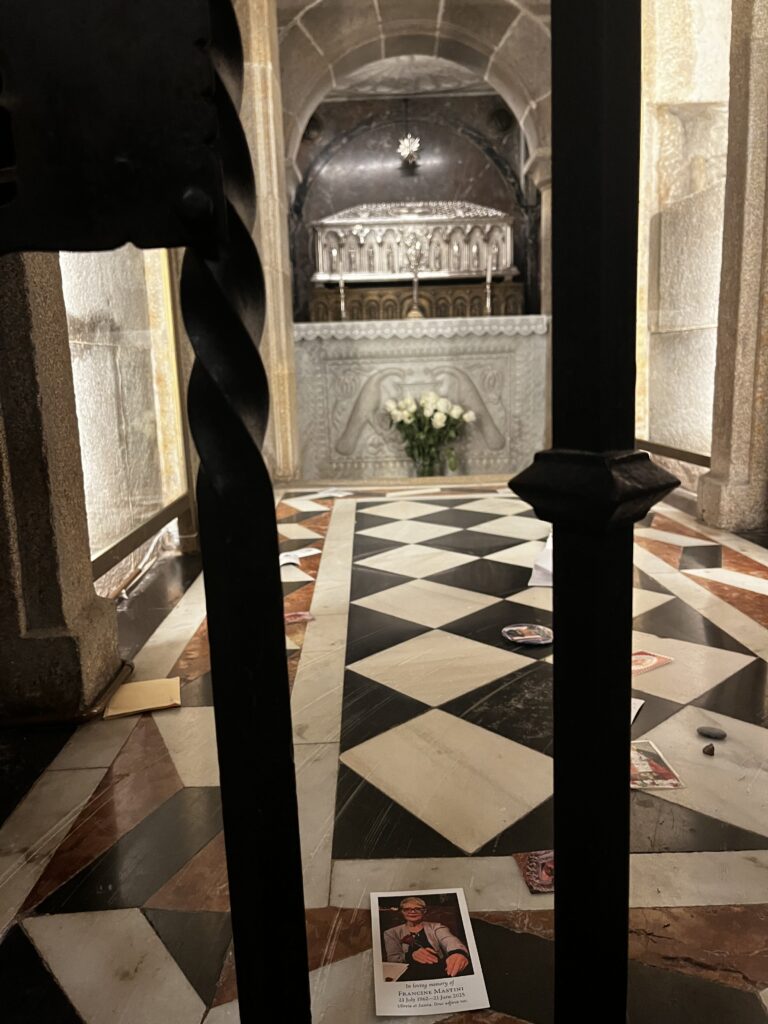
I prayed here, and I left Francine’s card on the altar next to the card of a young Italian man.
From here, it was sharply uphill on asphalt before the Camino returned to the dirt road through the woods.
At around 8:45, the Camino passed under a highway. The morning was already quite warm, in addition to being humid. My shirt was literally soaked through already. I was beginning to regret my decision to skip both bars. Orange juice would really hit the spot.
About 8:55, I was back on asphalt walking through the large suburb of Lavacolla. This had once been a little village, but at some point it became the host of an urban sprawl.
The village is mentioned in the Codex Calixtinus as the place where the medieval pilgrims would take their final bath in the river before walking into Santiago. In my original plan, I was to have spent last night here.
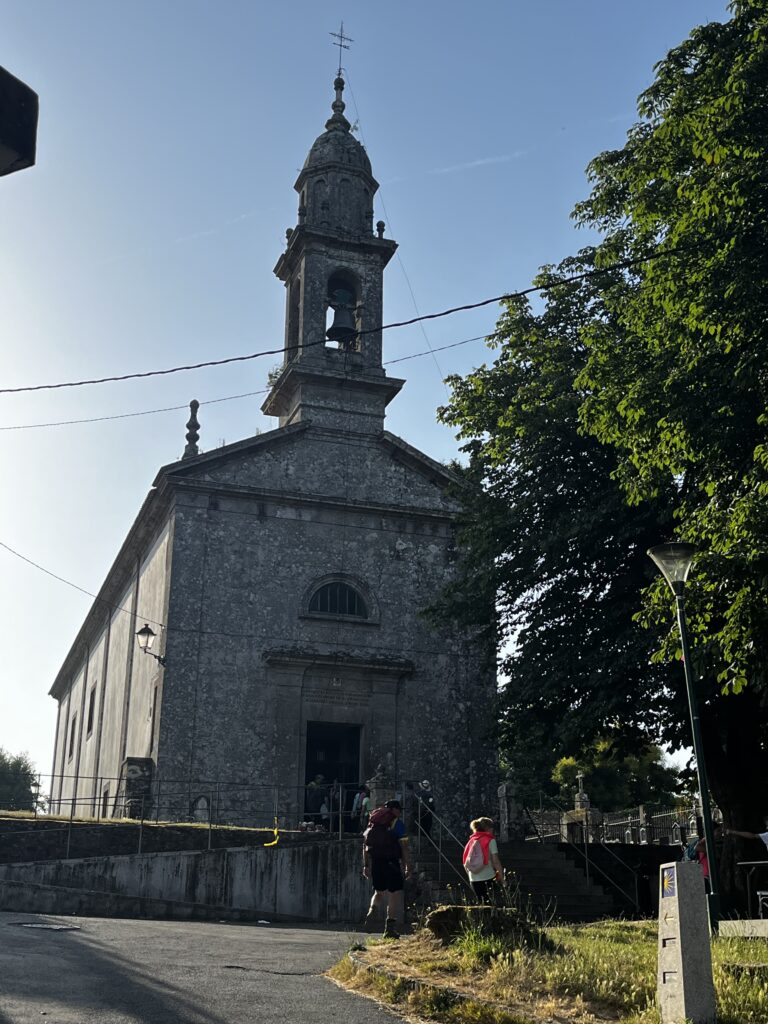
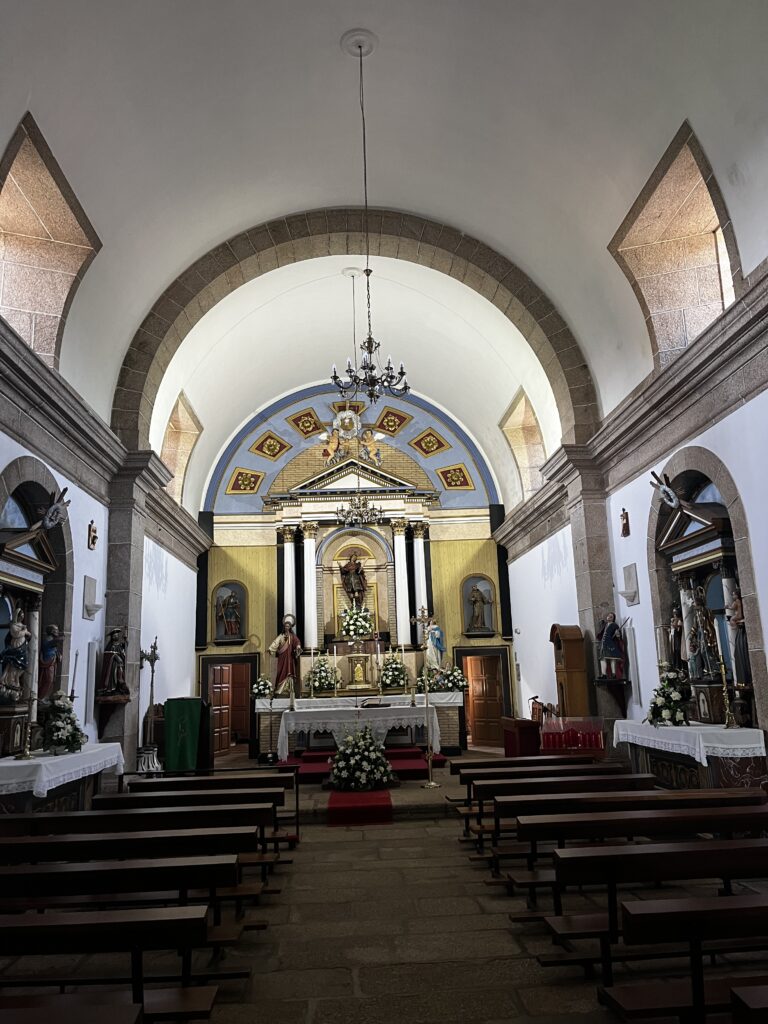
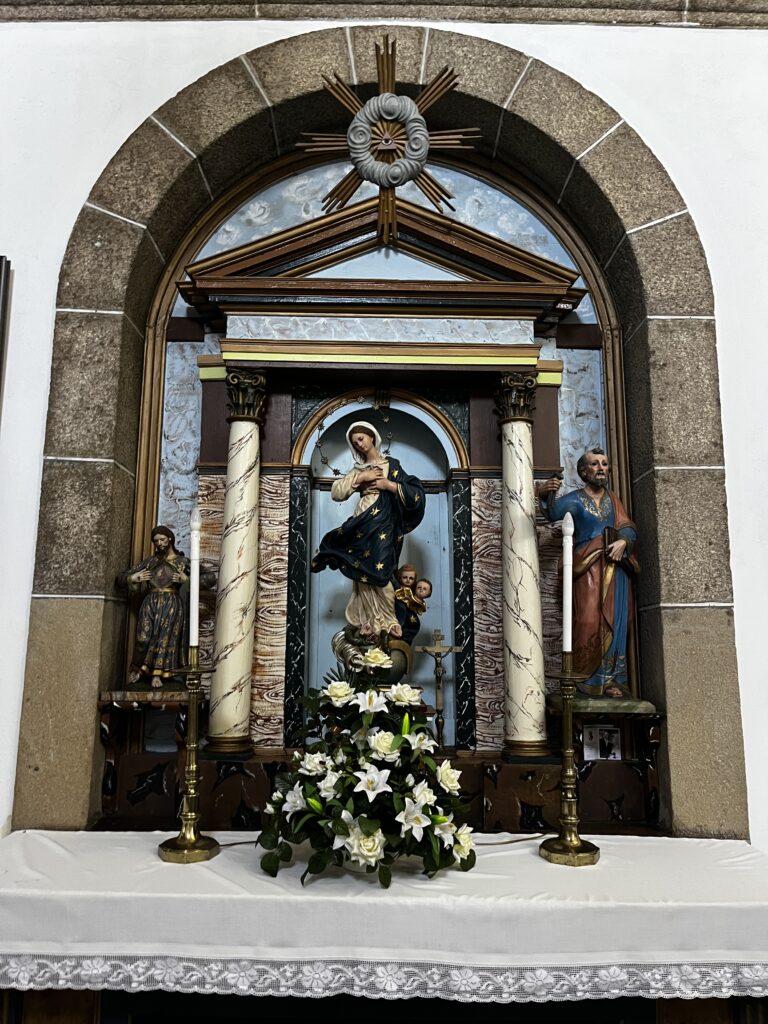
The village church at the top of the hill was actually open. The interior is neoclassical, and the art is painted in bright colors. It was a surprisingly pleasing place to pray.
I’m not particularly a fan of neoclassical, as it is too easy to use it as an excuse for iconoclasm or for classical fetishism, but this church did neither of those things, not remotely.
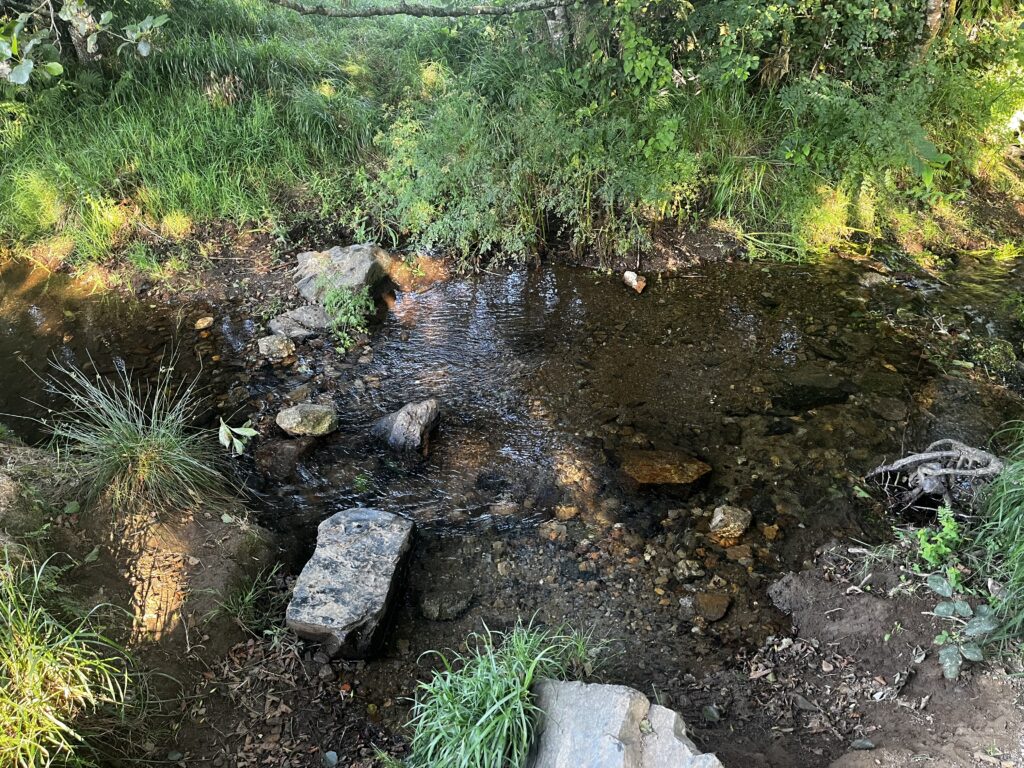
The river at Lavacolla is more of a stream these days. Nevertheless, I went down on the bank and ritually washed my hands there. I saw one other pilgrim do the same, but most everybody else passed by, heedless.
The asphalt road continued uphill.
At about 9:20, I passed something I’ve never seen before. Four men by the side of the road, clapping, dancing, singing, encouraging the pilgrims that passed them. If this was our initial welcoming committee, it certainly lifted my mood.
Ten minutes later I passed through the village of Vilamaior, where are some enterprising fellow had set up a trinket stand with exactly the sorts of souvenirs that you could buy in the shops in Santiago for two-thirds of his price.
I stopped in a familiar bar here for the overdue drink. I opted for Coca-Cola.
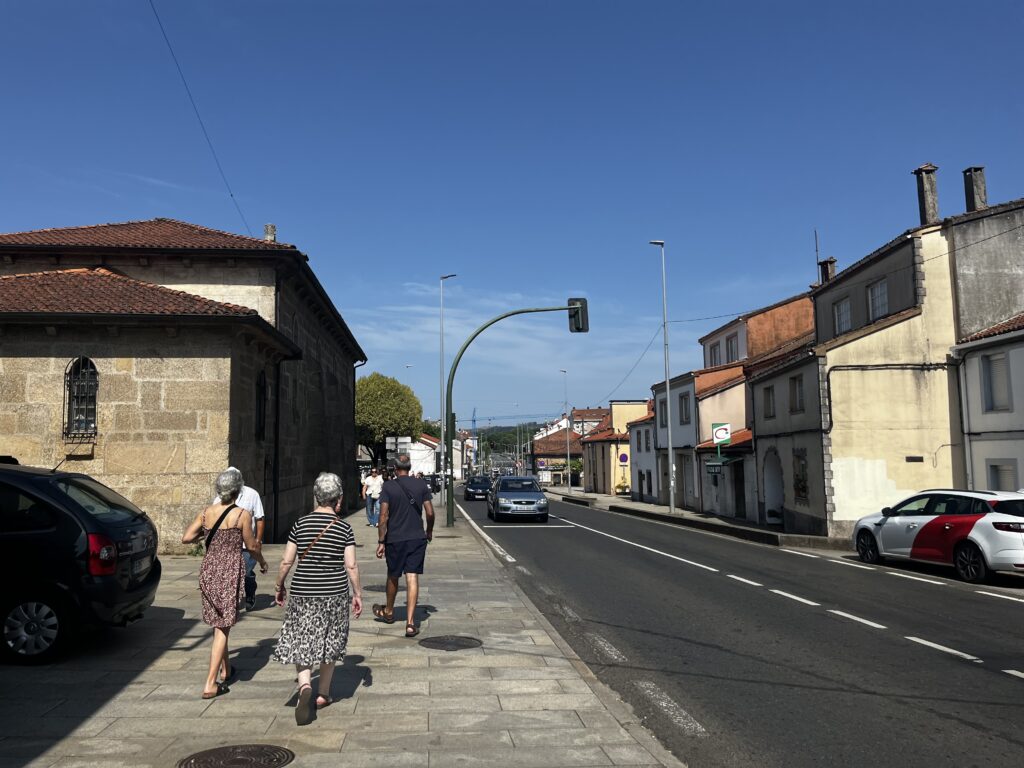
The Camino continued on or along the asphalt road, sometimes with a sidewalk, sometimes not. Tree cover became more sporadic as one suburb bled into another.
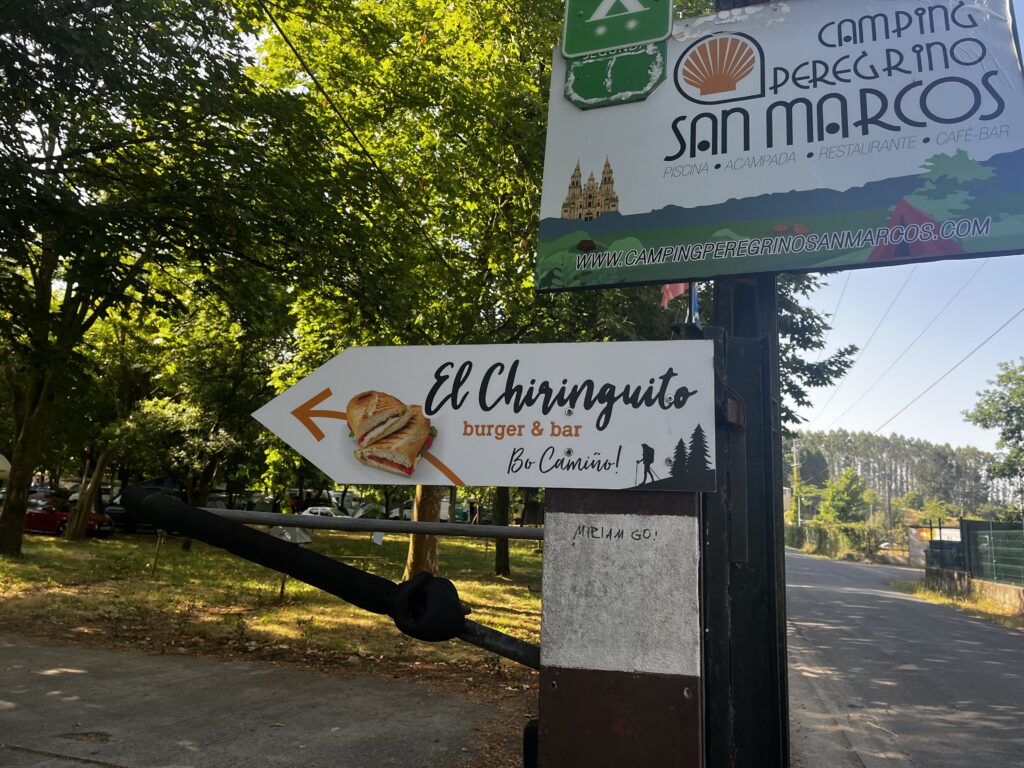
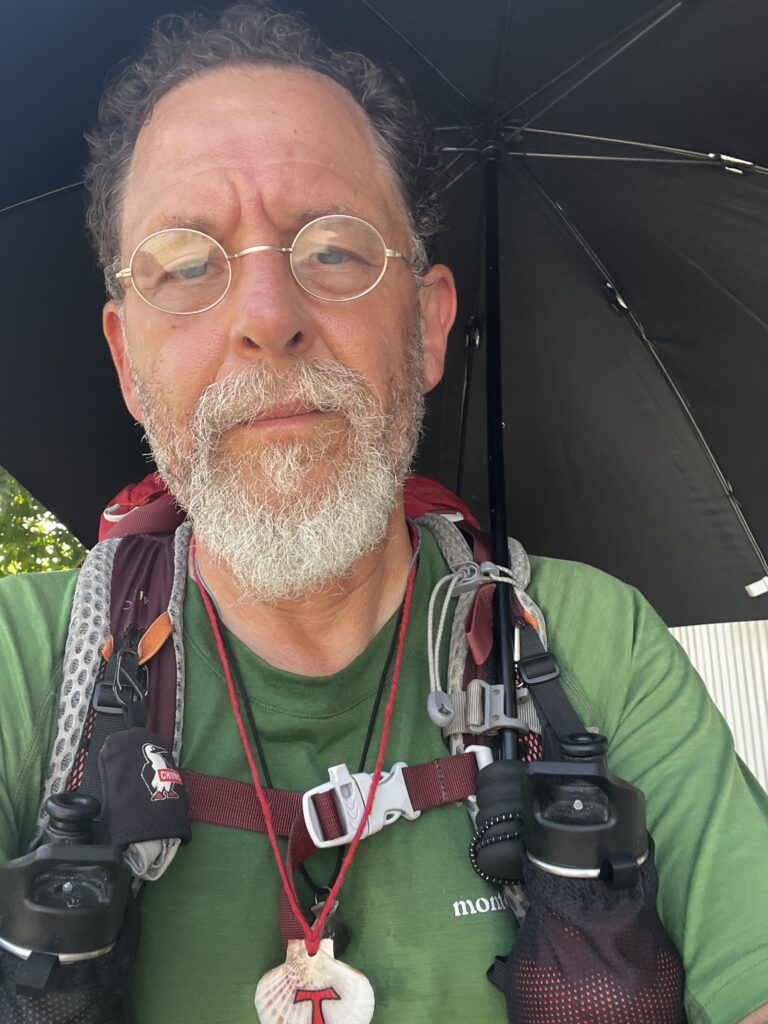
Finally, at about 10:10, I put up the umbrella. About ten minutes later, the road went through open fields as I approached the suburb of San Marcos, with its enormous campground and vacation center.
The sidewalk was more or less permanent now.
After climbing and descending a couple of suburban hills, I finally arrived at Monte do Gozo. This is the last hill; it overlooks Santiago. Medieval pilgrims could see the cathedral spires from here, and the tradition was to sing a Te Deum.
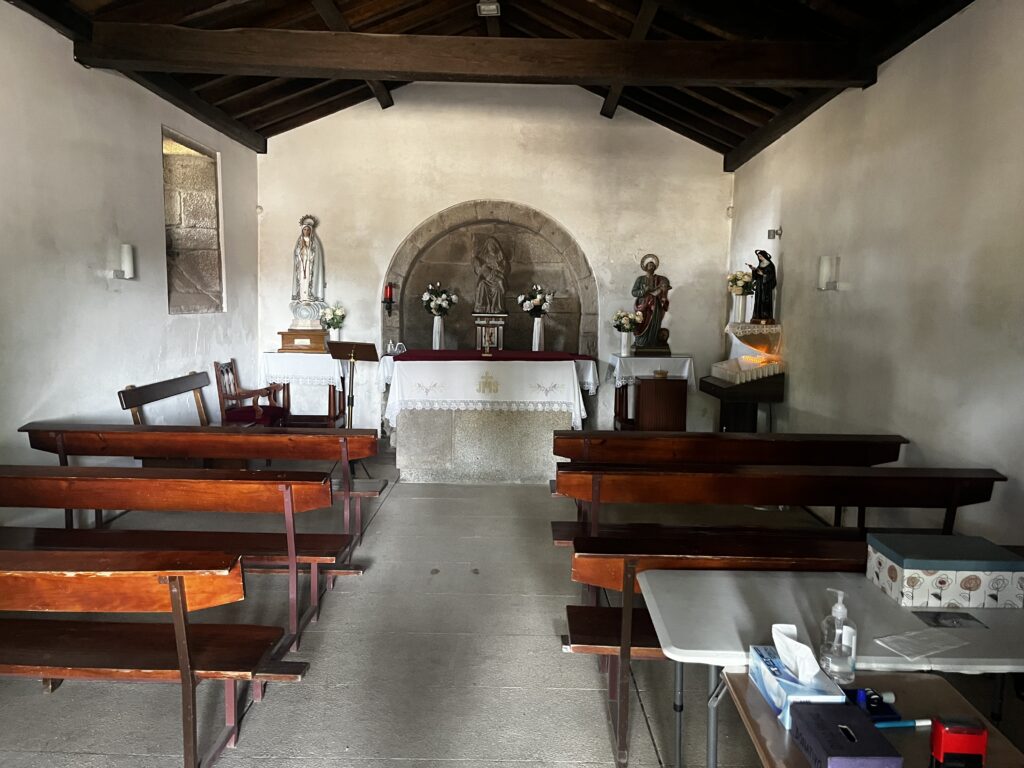
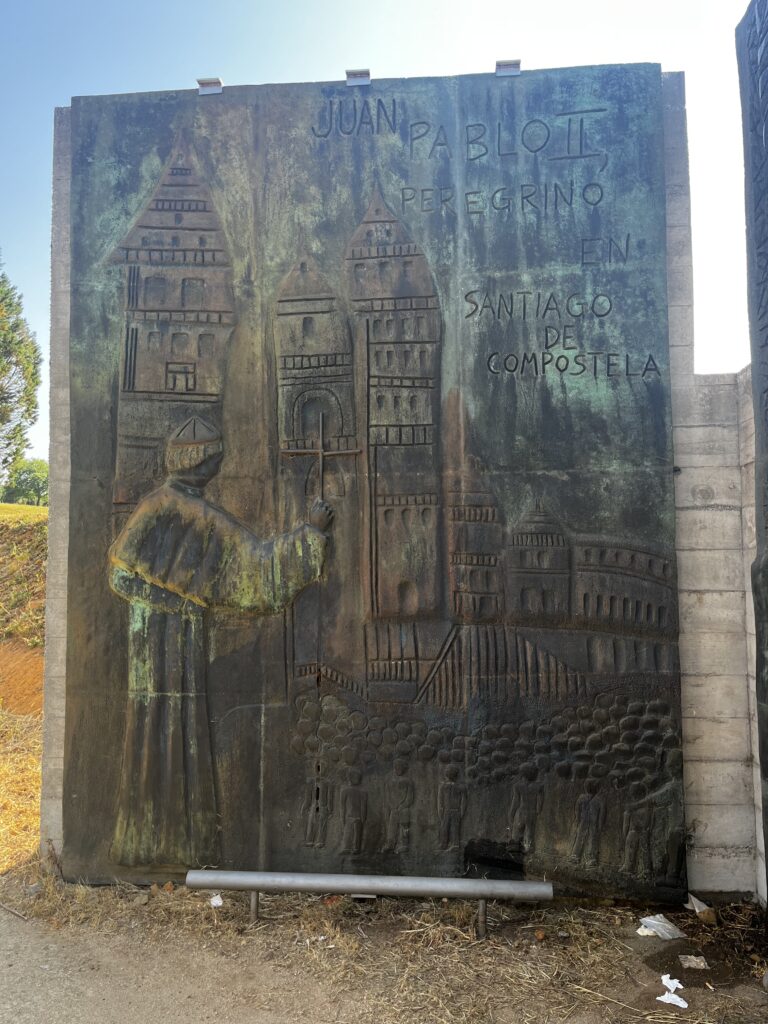
First I prayed in the little chapel of San Marcos. Then I departed from the modern Camino path down the old route, through a great avenue of fragrant fir trees and through the repurposed remains of a hilltop monument once dedicated by Saint John Paul II.
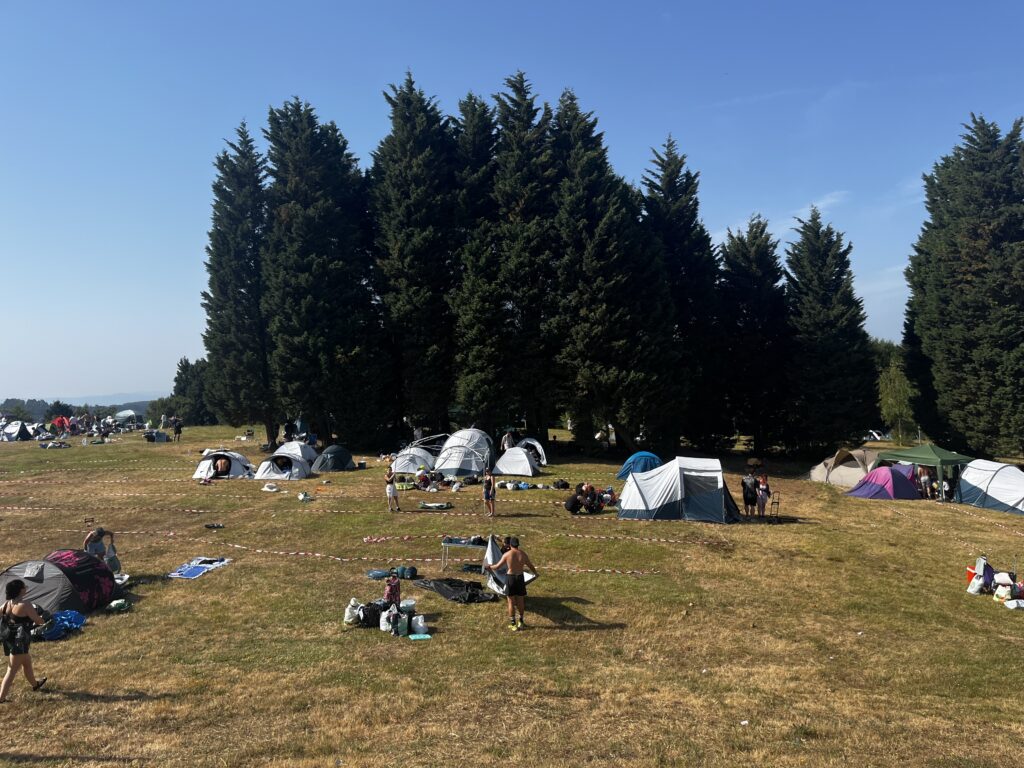
I then had to walk through an enormous temporary campground. There were massive celebrations over the weekend and continuing into the next few days for the summer solstice here, including concerts and fireworks. Apparently it also involves a lot of people camping here.
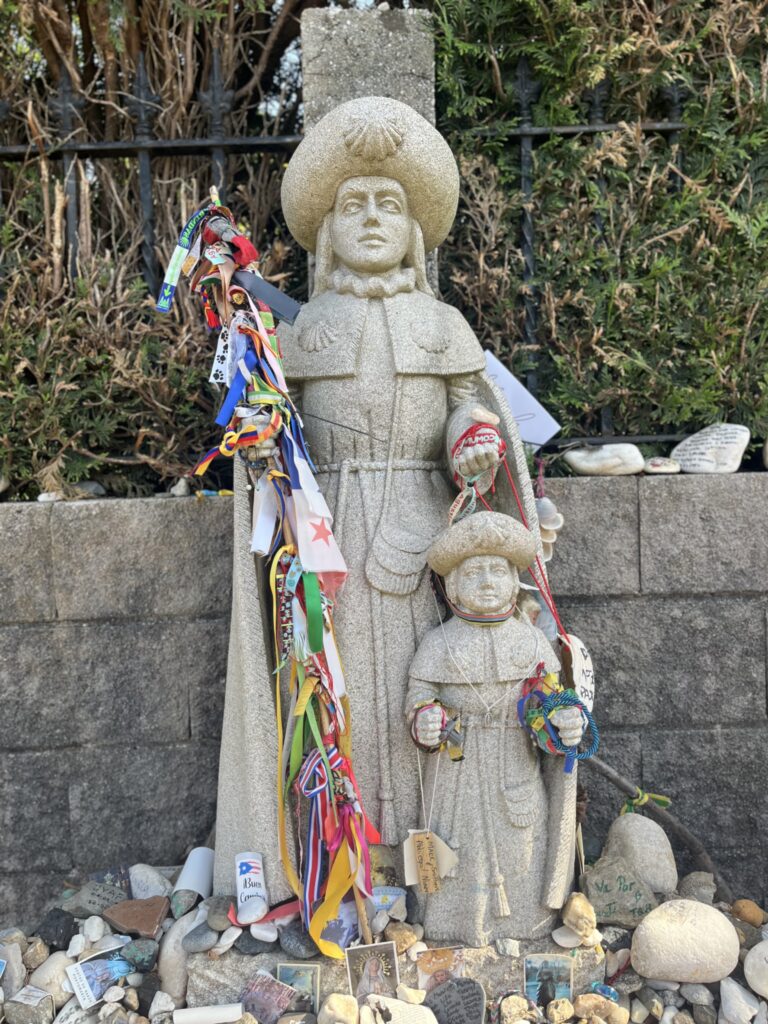
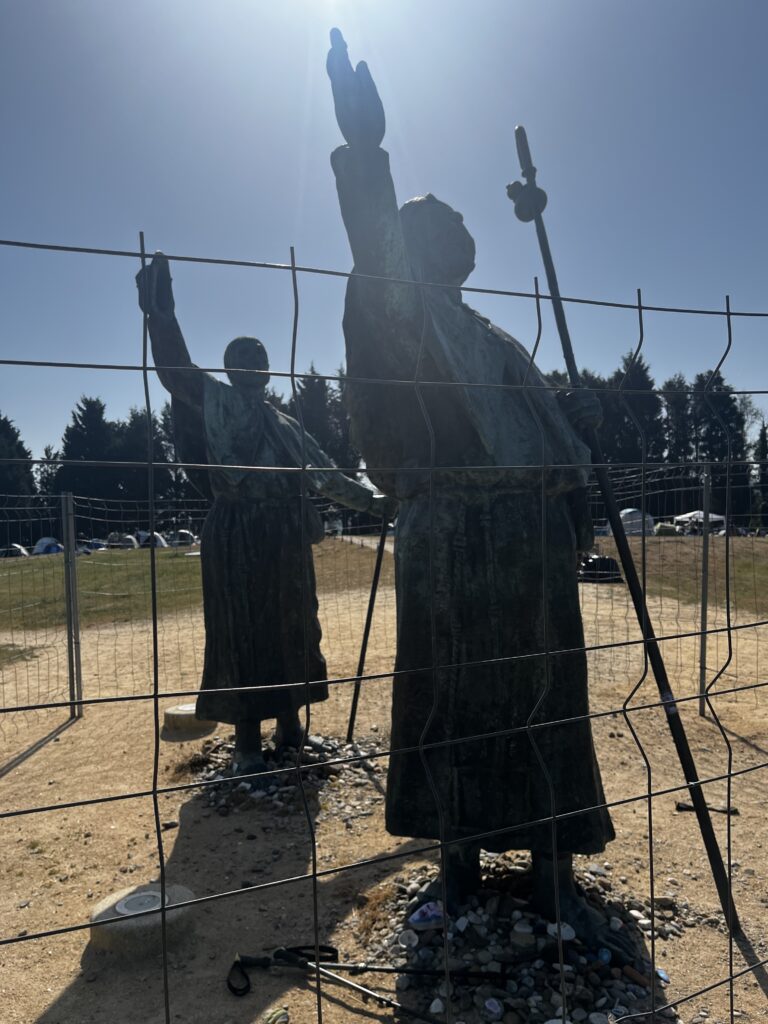
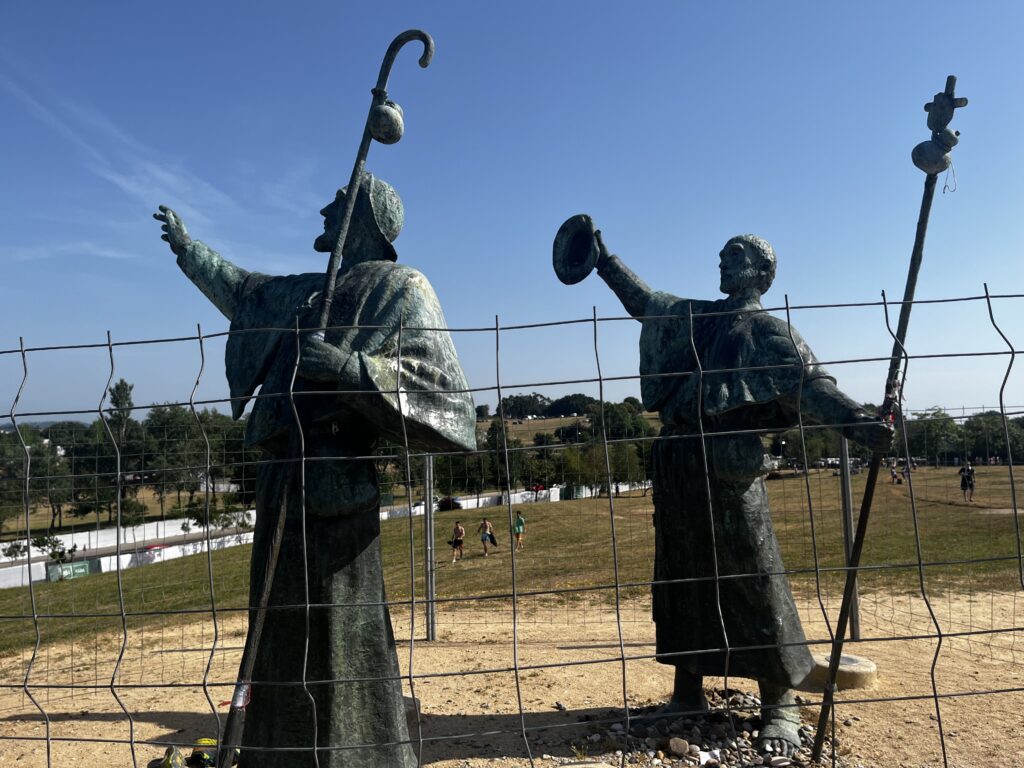
My object was the statues of two pilgrims sighting the cathedral for the first time. I suppose because of all of the campers, the statues had been fenced off.
From their vantage point, you could clearly see the cathedral. Tears came again. They have come so easily these past days, but they weren’t sadness this time exactly. My heart was full of gratitude, albeit still tinged with sorrow. By God’s grace, after 74 days, after a year, after two long Easter seasons, I had come to the holy city.
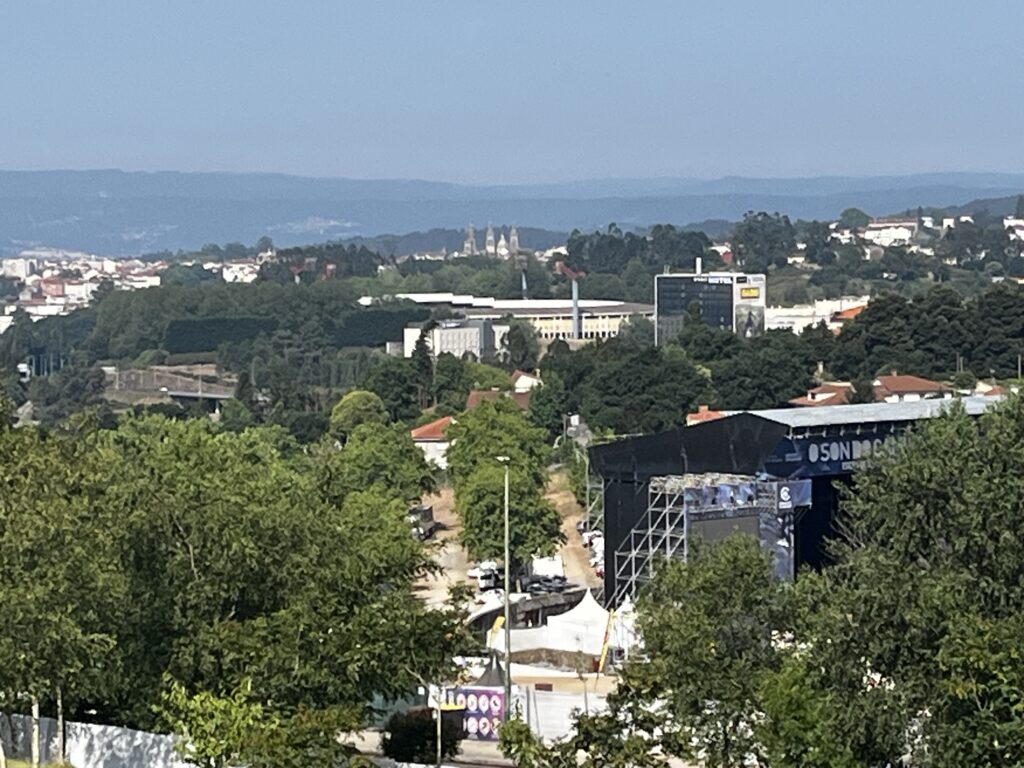
From the top of the hill, I could also pretty clearly see the concert stage and fairground being set up between me and the Camino.
I wasn’t actually sure the best way to get back to the Camino. Three years ago, I could take a shortcut across the park. Various temporary enclosures now made this impossible. The challenging part would be getting past the stage enclosure. I thought I saw a way from the top of the hill, and I went down to try it out.
In the end, I had to cut through the festival grounds; it kind of reminded me of the state fair in terms of size. This is going to be one big party.
Even with the umbrella nobody gave me a second look. This little diversion probably added two kilometers to my day. By the time I was back on the Camino, it was 11:15. Now would begin the great urban trek through the city of Santiago de Compostela to the cathedral.
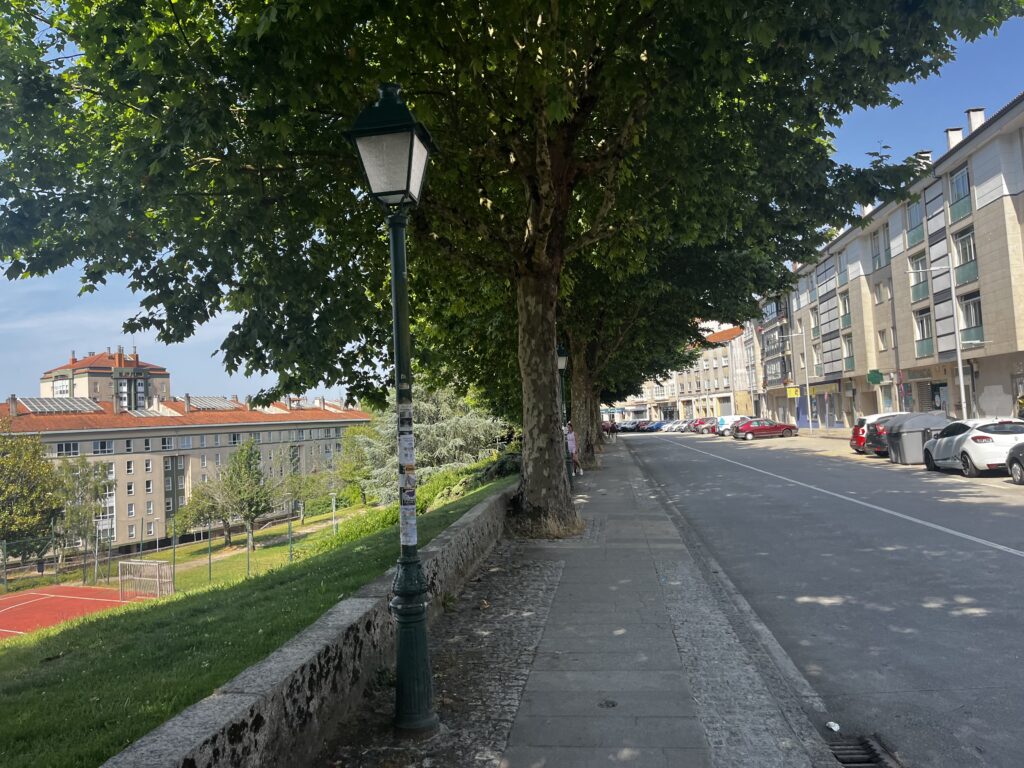
First, the long bridge over a six-lane highway. Then, the parks – and I swear they’ve moved some of the statues – and then the endless urban neighborhoods.
And somehow, tears again. I don’t even know why anymore.
At some point, I put on Francine’s shell that she had taken on Camino since 2018.
Instead of the cross of Saint James, it has the Tau cross painted on it. This particular form of the cross is used by the Franciscans, and it is traditionally the mark brushed on the door posts by the Hebrews to warn off the avenging Angel of the Exodus. And of course it looks like a T for Thom.
Francine thought it was poetry, both of our names symbolized on the shell and uniting us on our pilgrimage.
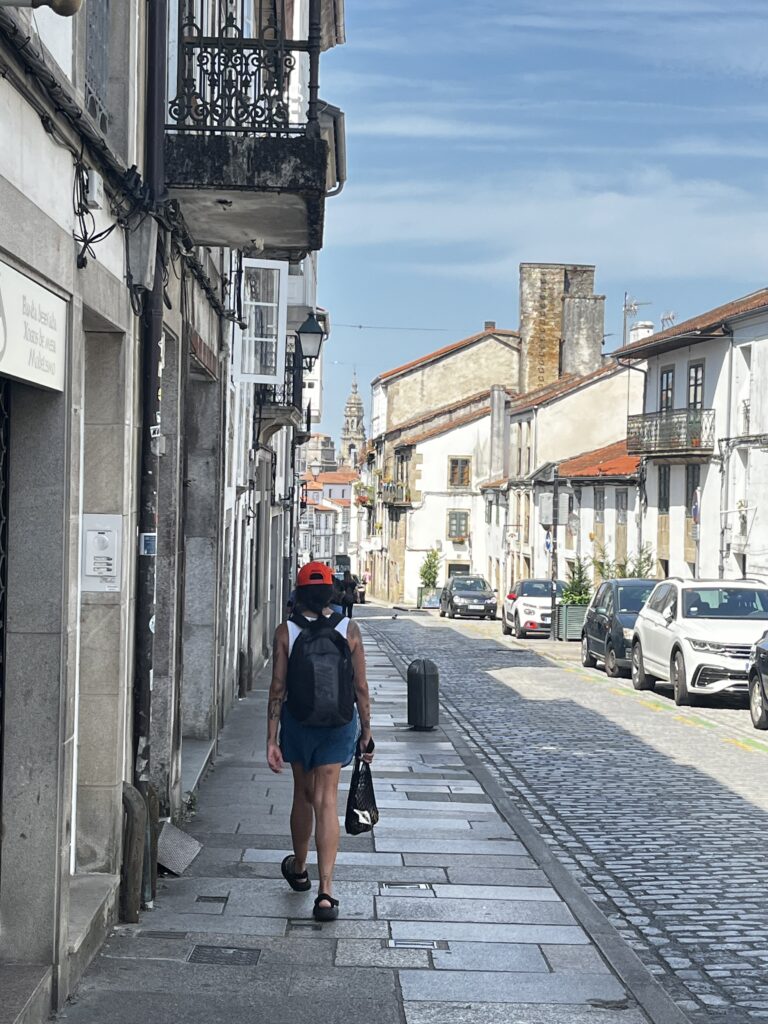
At about 11:45, as the Camino wound its way through the ever-narrower streets of Santiago de Compostela, I took down the umbrella. I soon caught site of the cathedral spires again, and I was reminded of an iconic photo of Francine and I on this very street, arm in arm, walking into Santiago for the very first time.
The bells were calling the people to the noon Mass. Since I had nowhere to put my backpack at the moment, I would have to wait until the evening Mass.
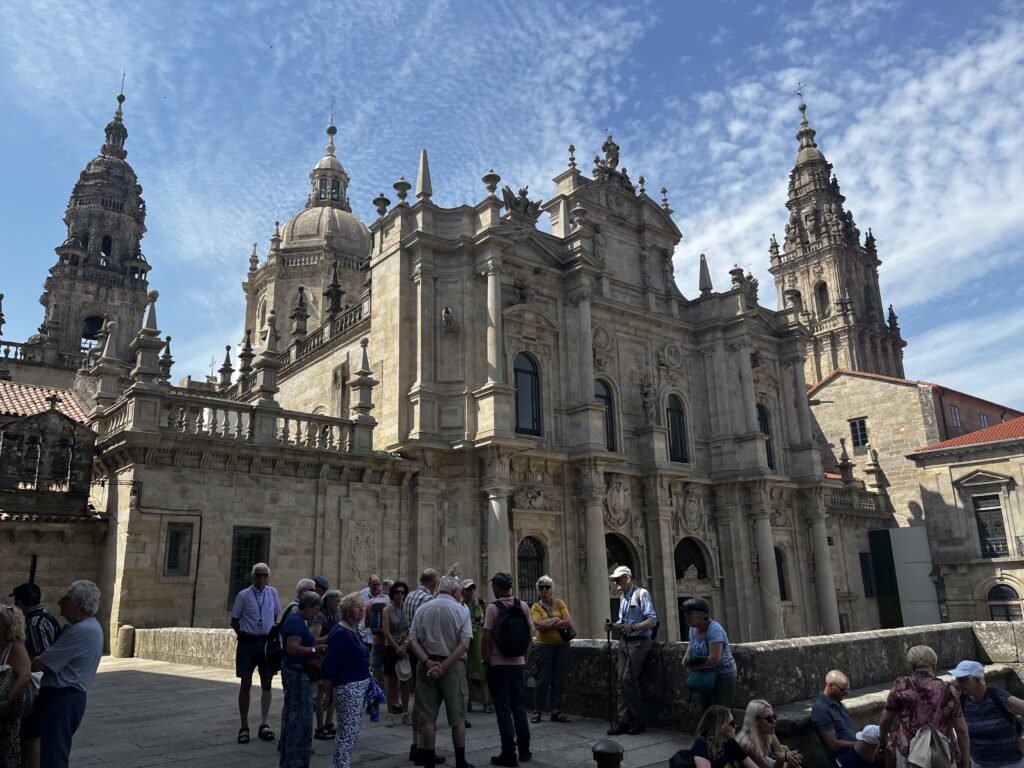
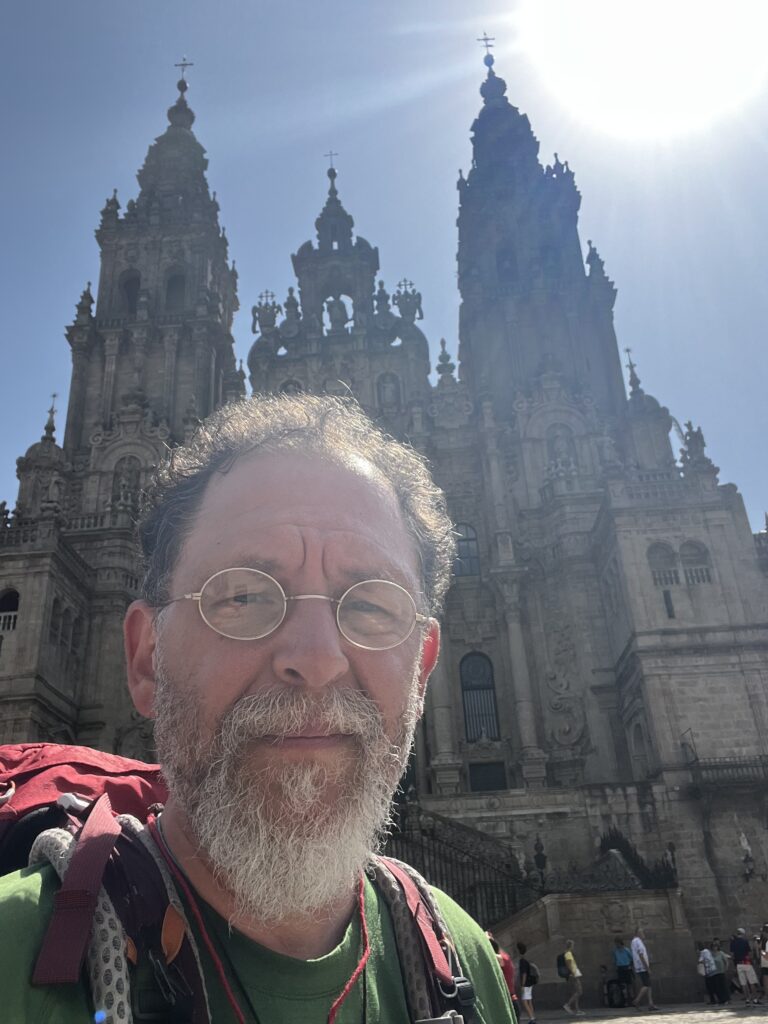
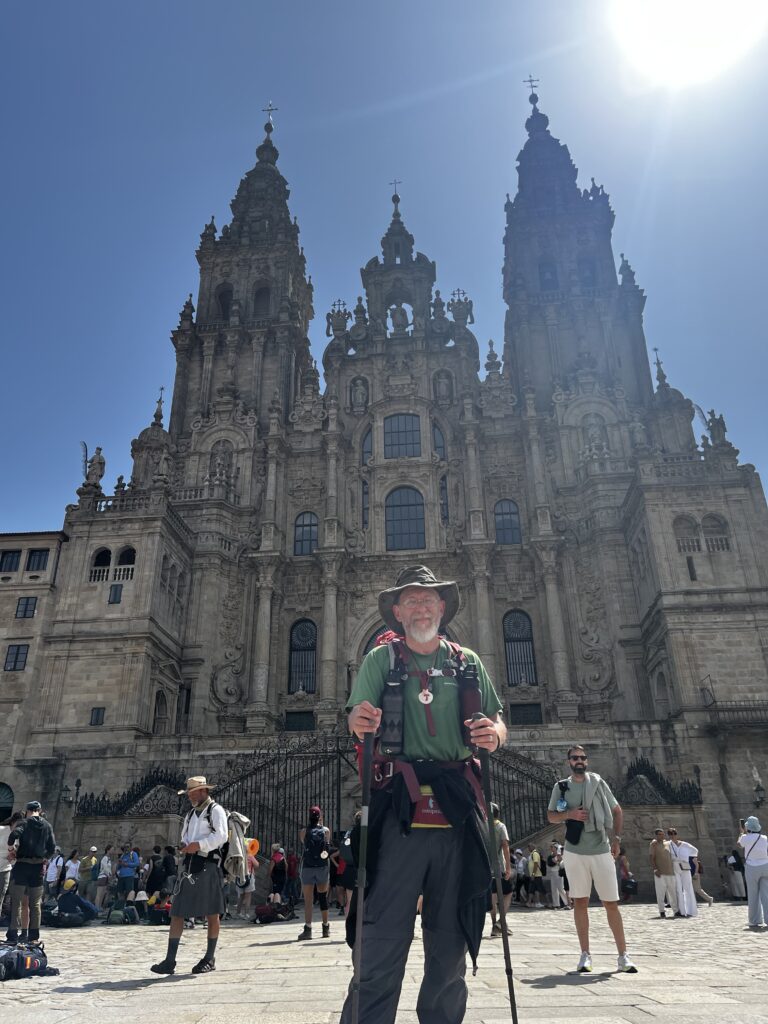
As the cathedral bells tolled noon, I passed through the gates to the sound of the Galician bagpipe and into the plaza in front of the cathedral. I was already crying so hard it was difficult for me to see.
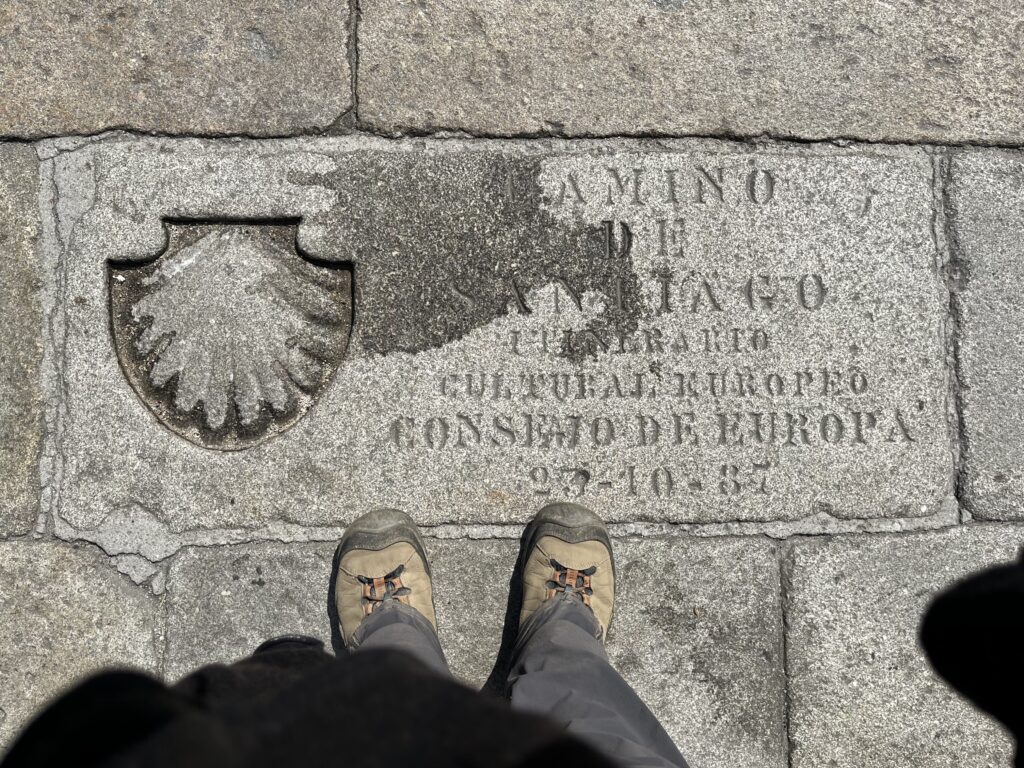
I turned and tried to look at the cathedral. I took a few steps, and suddenly Katie was there. She hugged me until I got hold of myself. I walked to the shell set in the middle of the plaza to officially end the walking portion of my pilgrimage. Kilometer marker zero.
And then I was weeping again. Moses and Veronica were there, and they welcomed me as well. Moses gave me a big bear hug at some point that almost knocked the wind out of me.
I took off my pack and just sat with them in the plaza for a few moments.
And then there were some more old Camino friends: Amy was there, as was Dale who got in yesterday. Amy gave me a hug, and Dale shook my hand, crushing it in proper Australian fashion.
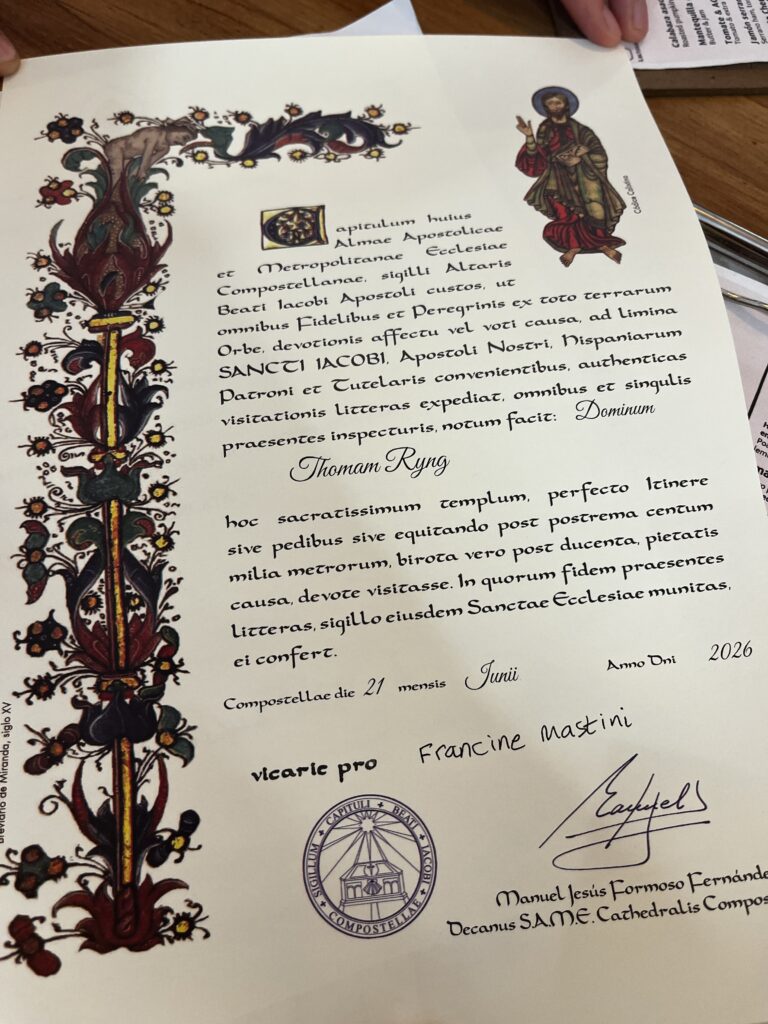
Katie, Veronica, Moses, and I made our way to the pilgrim office to get our Compostella certificates.
When my number was called, I greeted the lovely English volunteer with a “hello”, and a “this is going to be a little complicated”. She was very helpful and most understanding when I explained the situation and pulled out my paperwork (in both Latin and English).
Here’s the thing: I didn’t walk this pilgrimage for me. The cathedral recognizes the ability to walk for someone else, specifically someone who has died and therefore cannot walk themselves. This is called walking “vicarie pro”. The Latin means “in stead of”.
I had walked this pilgrimage for Francine, this pilgrimage she had so wanted to walk herself.
After we had all gotten our certificates, we went out to lunch to celebrate. I checked into my pensión at 2 PM and then took a long shower and a short nap.
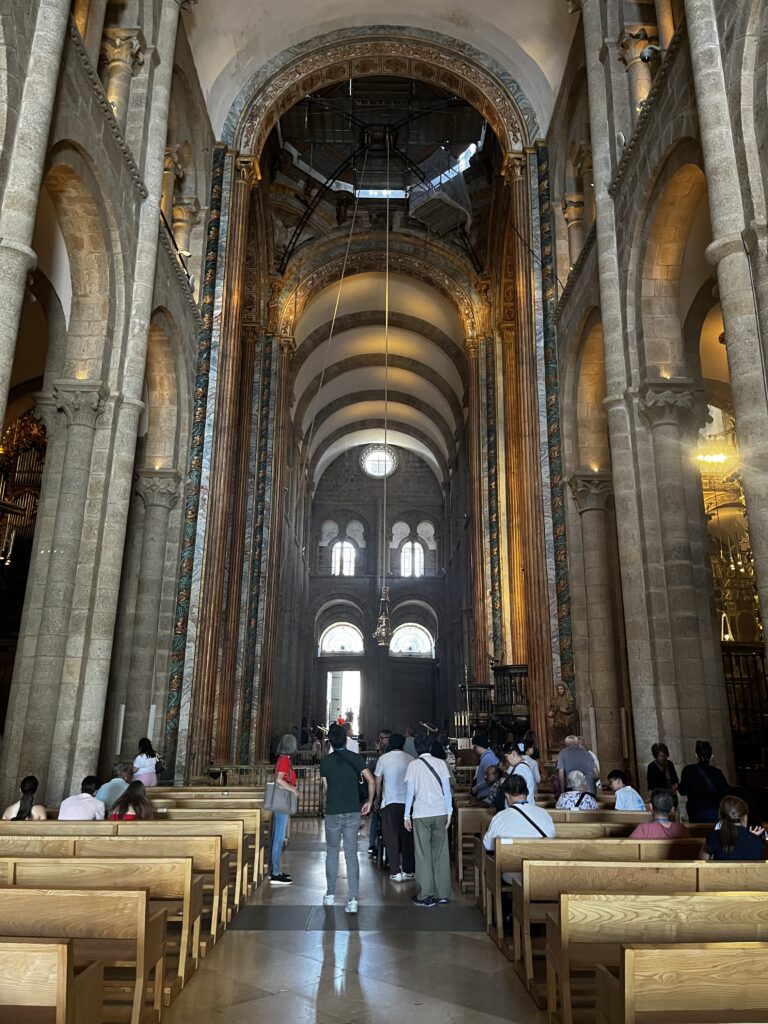
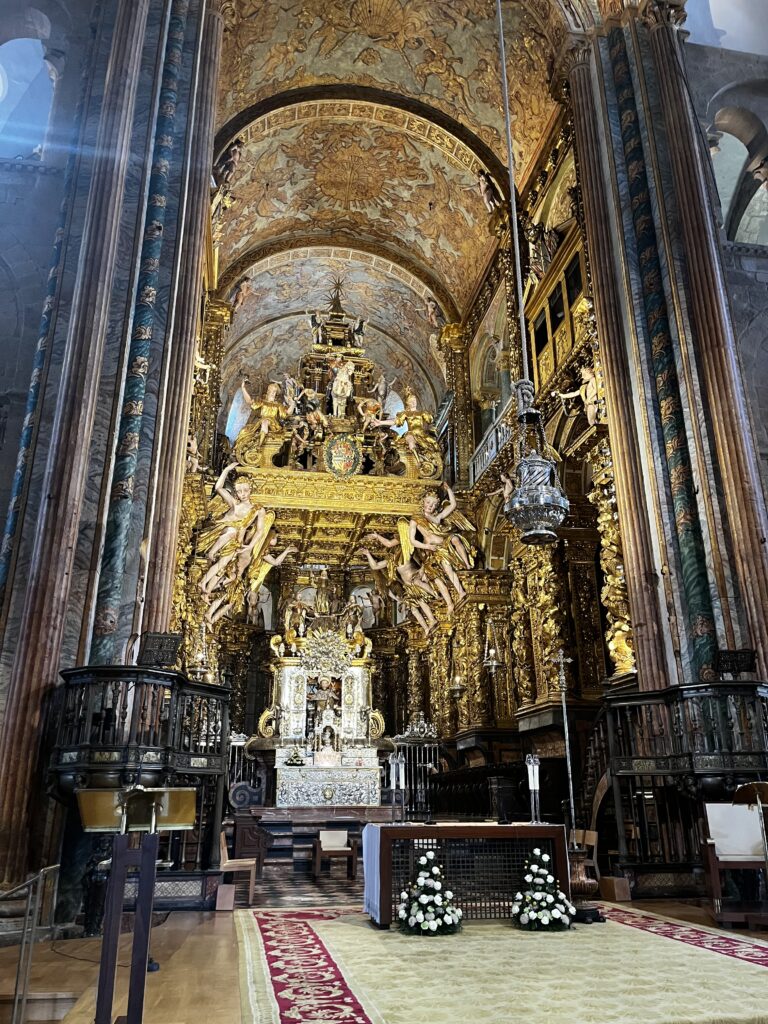
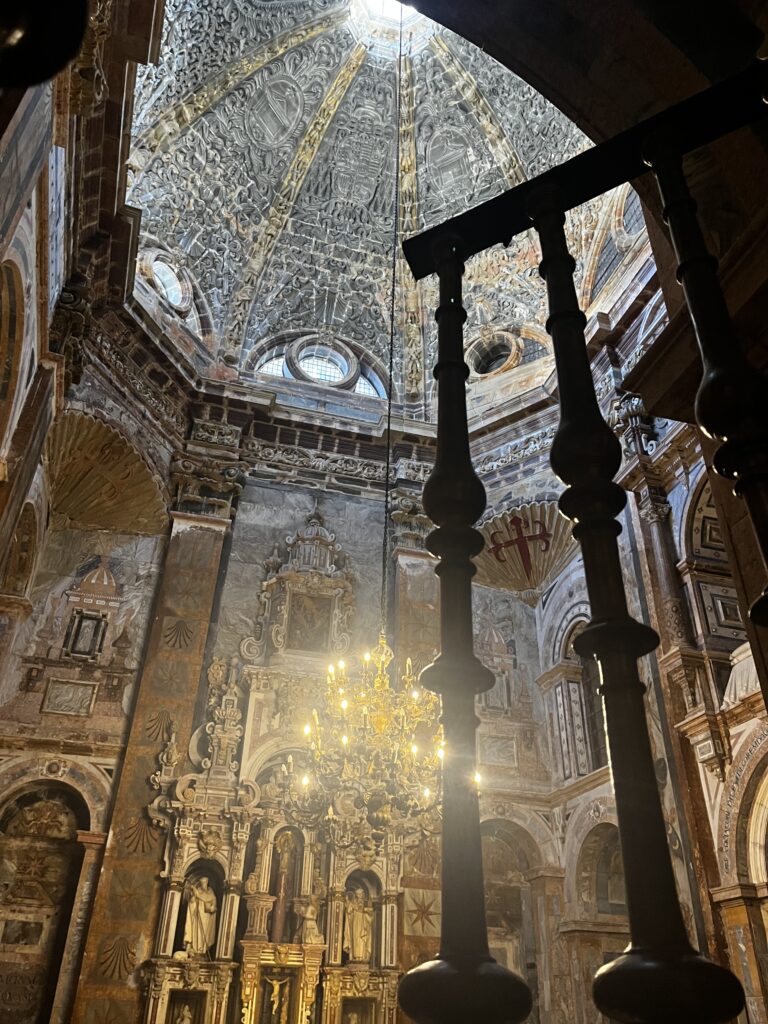
And then I went to visit the cathedral.
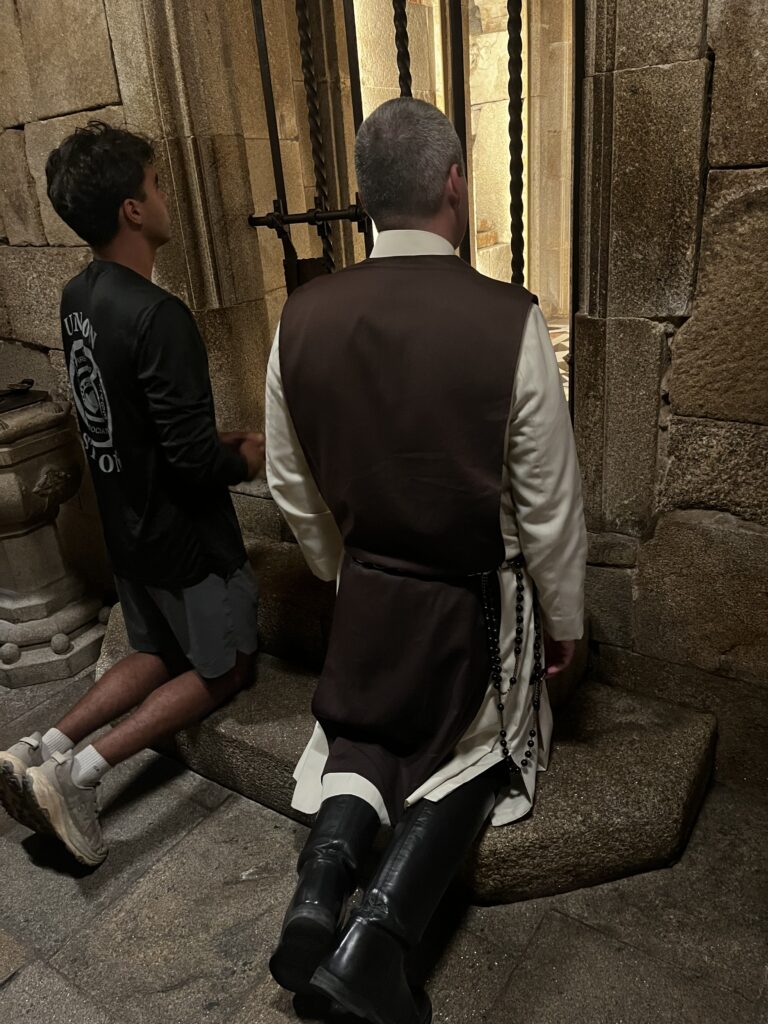
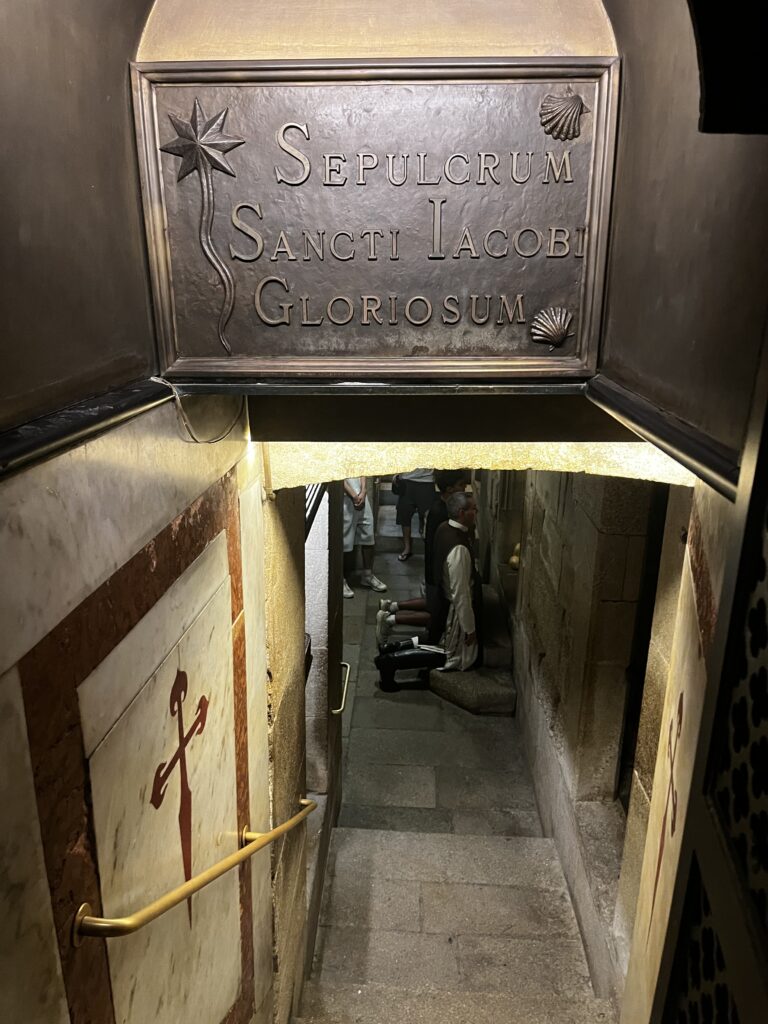
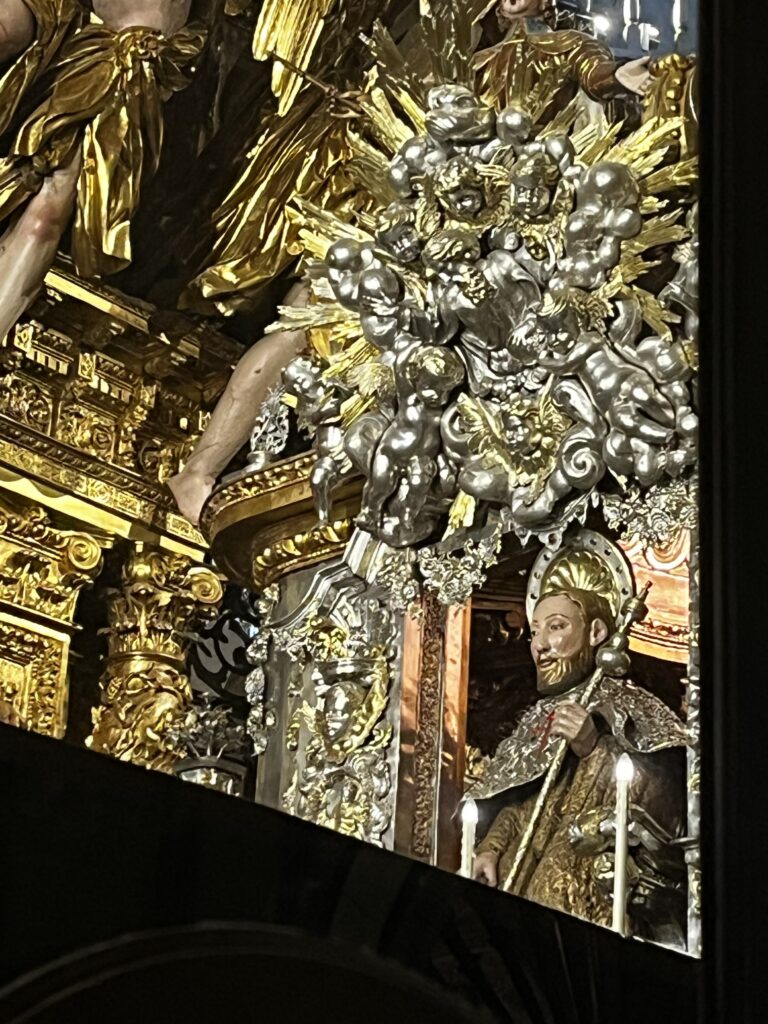
I prayed in the crypt, where the apostle’s bones are entombed, and I left one of Francine’s cards here. Then I climbed the stairs up above the high altar and hugged the medieval statue of Saint James, in accordance with the traditions of the pilgrimage.
I then went to Confession with a very sympathetic and wise German priest. He joked that he would prefer to hear Confessions in German, but everybody seems to want to do it in English.
I stayed for the 7:30 PM Mass. I saw that pilgrim Sister again.
After Mass, I met up with my friend Adam, who had flown from the United States.
Date: 21 June 2026
Place: Santiago de Compostela
Today started: Arca/O Pedrouzo/O Pino
Today’s Photos!
i
Outstanding journey, writing, and devotion to Francine! Has been a joy to follow this walk. God bless you Thom!
Thank you for sharing your Camino. Your word along the Way have been of great comfort to me.
Congratulations and well done. I am certain Francine is (and has been since her heavenly birthday) cheering you on as you make this Camino in her name. You have done so very well by her.
Thank you for this journey, Thom. Our GOD, the FATHER of widows will guide you through, as HE did on this camino! Be blessed, brother!
Thank you so much Thom. A tremendous and blessed pilgrimage, and those of us watching and praying have also been offered something special.
Peace.