
Via Lemovicensis: the Street of Hours
Once again, the forecast called for all rain all day. When I left the gîte at past 7:30 AM, it was raining steadily and cold.
I was the only pilgrim at the gîte last night. There were also two young ladies from the poetry festival, though I only actually ever saw one of them.
They were just starting to set up for market day in the town Square. The square is located where the medieval château stood once. My understanding is that after the 16th century it had fallen into ruin, and following the Revolution the remaining stone was auctioned off.
First to the Tabac for some pocket snacks for the long day. Then to the boulangerie for breakfast pastries. Finally to a café for coffee to have with my pastries. There is rarely one-stop shopping in France.
By the time this was all done and my coffee and pastries safely in my belly, it was 8:25 AM. Not great, but not terrible. The rain had stopped, but I didn’t trust it for a moment.
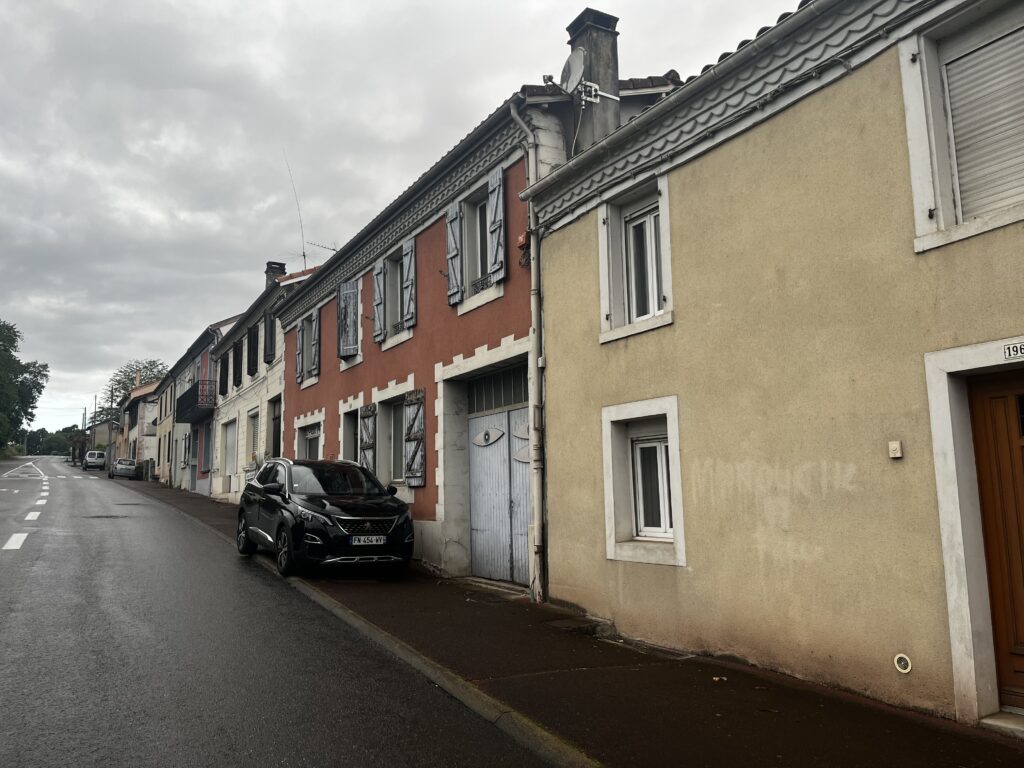
A bridge took me over the slow-moving River Louts as I walked uphill through one of the older and more rundown parts of town.
Gradually the houses got nicer and farther apart. At about 8:35 AM the Camino left the busy road for a much narrower and quieter one that soon took me out into farm country.
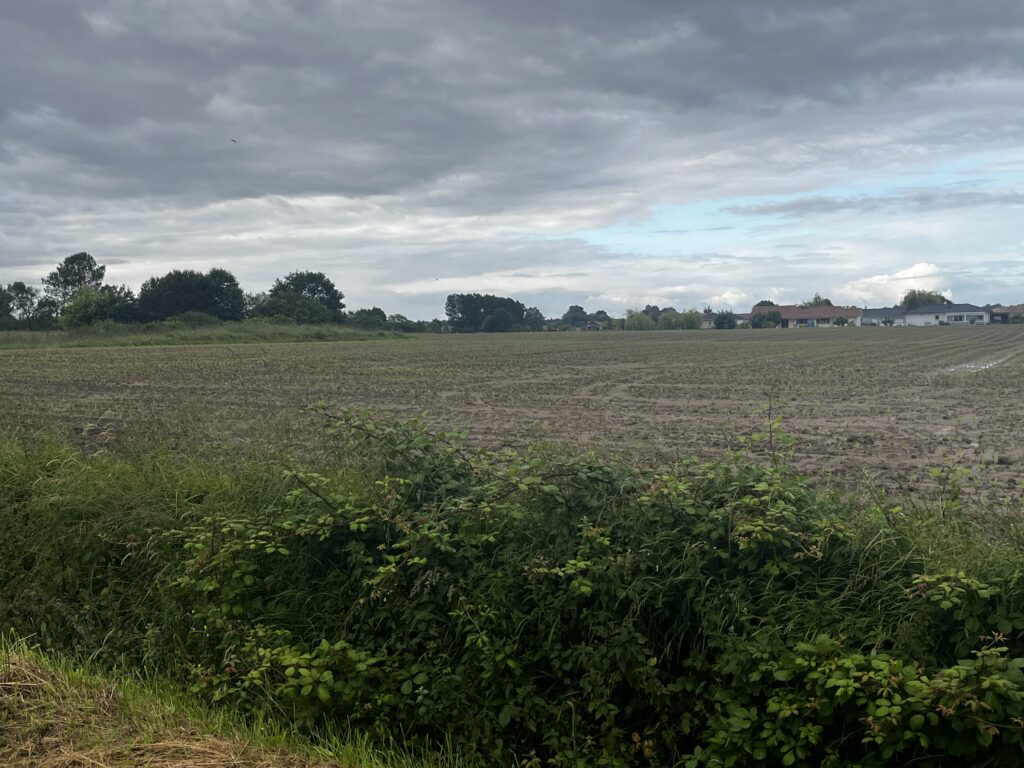
Like yesterday afternoon, the fields were hemmed in by trees and even suburban houses in places. Somewhere a rooster crowed defiance at encroaching suburbia.
Soon enough the Camino turned, and I was walking through suburbia. The sound of the rooster was replaced by the sound of dogs barking as I passed.
The rain began again.
Around 8:45 AM, I passed the sign telling me I was leaving town. The farmland began again almost immediately.
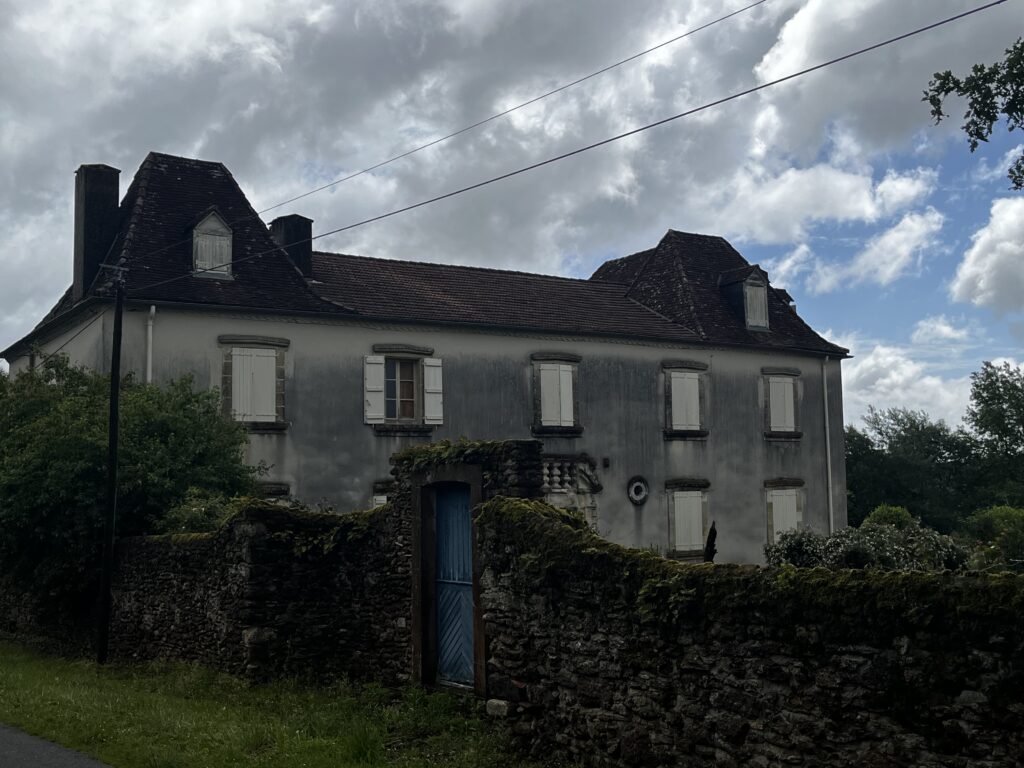
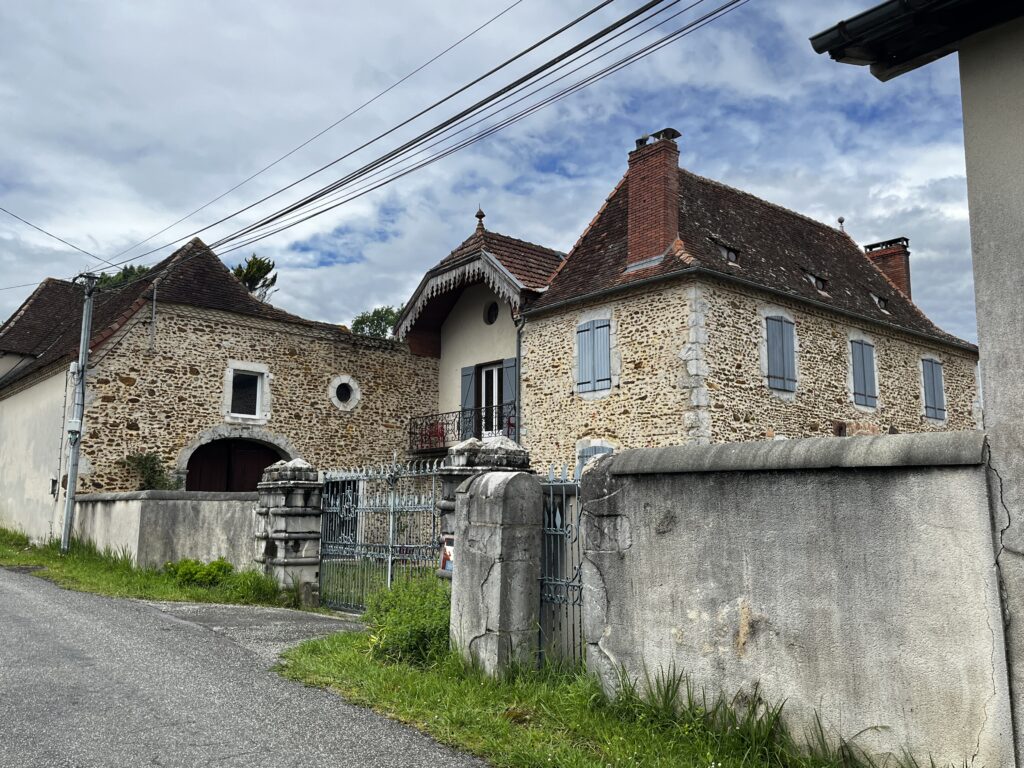
Just about 9 AM, I passed a farmstead that was a great deal nicer than most of the ones I’ve seen. It was a stone house, several brick outbuildings and garages, and the usual old beat up wooden barns and sheds in back. It kind of gives me the impression that it’s no longer a working farm, but that it’s been purchased and fixed up by somebody with wealth.
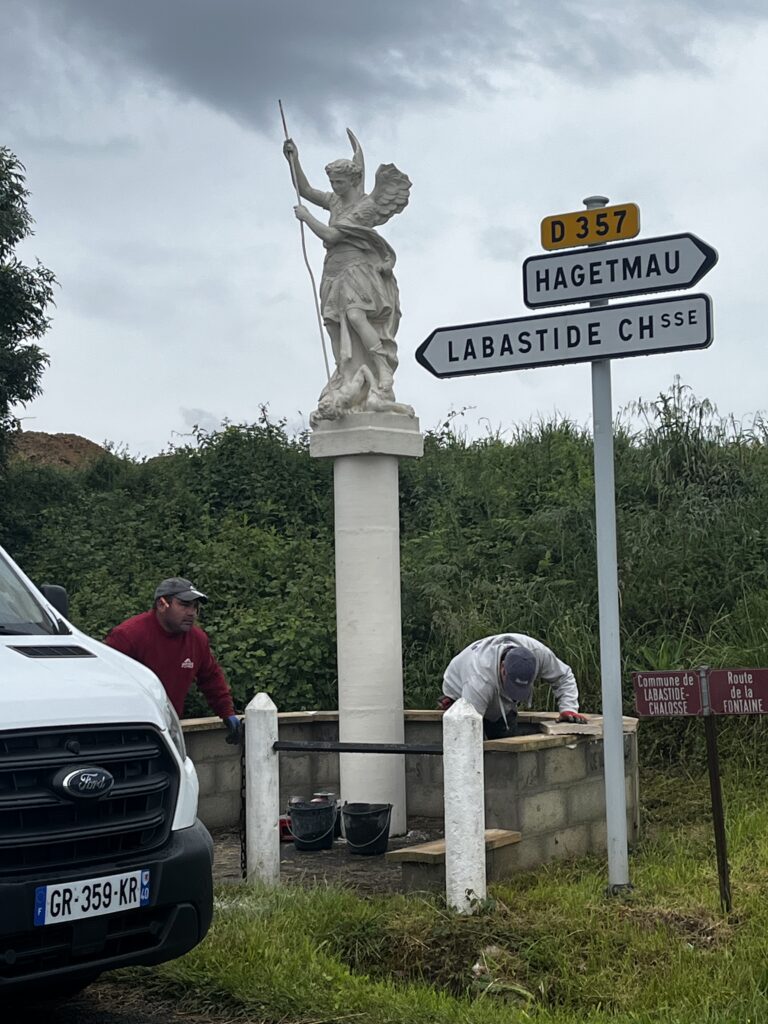
You often see roadside crosses or crucifixes on the Camino in both France and Spain. At about 9:15 AM, I passed something I hadn’t seen before: a roadside statue of Saint Michael slaying the dragon. I’d love to know the story behind this.
There were a couple of guys working on repairs to the little wall around it.
There was a derelict house maybe 100 m further on that looks as though it’s in the process of being renovated.
Maybe half a kilometer later, there was a roadside crucifix and houses, and just past 9:25, I walked into the village of Labastide-Chalosse. The church bell tolled 9:30 AM as I approached.
The whole center of the town was full of folks doing cleanup and repair work, everything from street cleaning to drainage repair to patching a pothole.
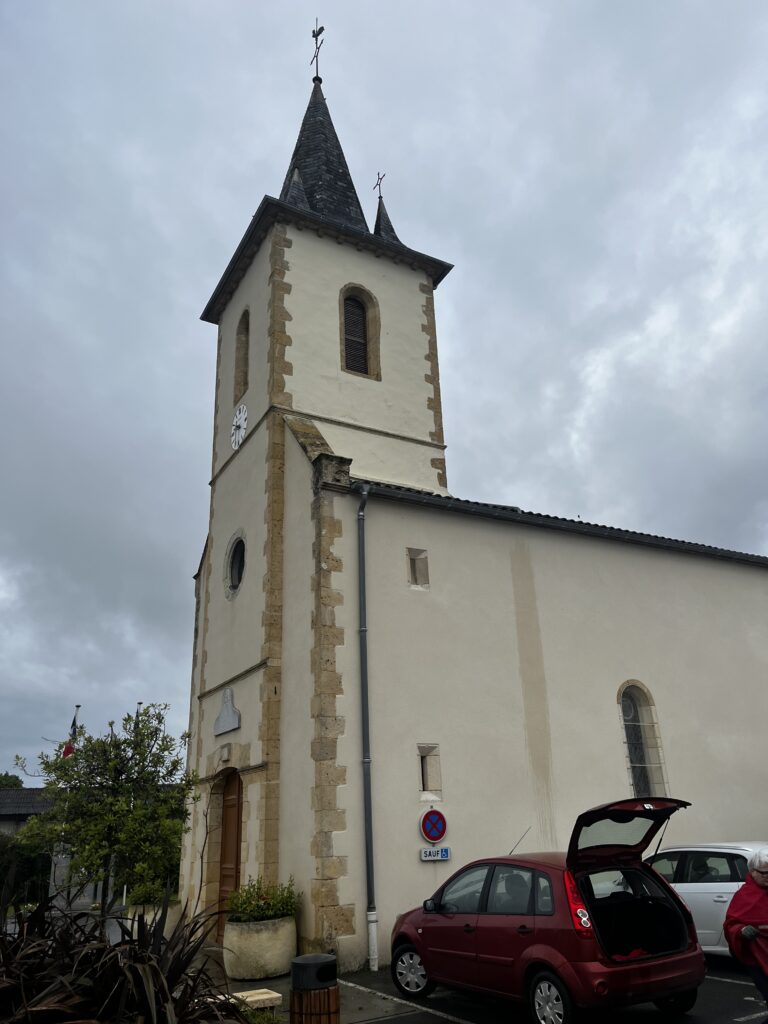
There was even a crew climbing onto the church roof on ladders.
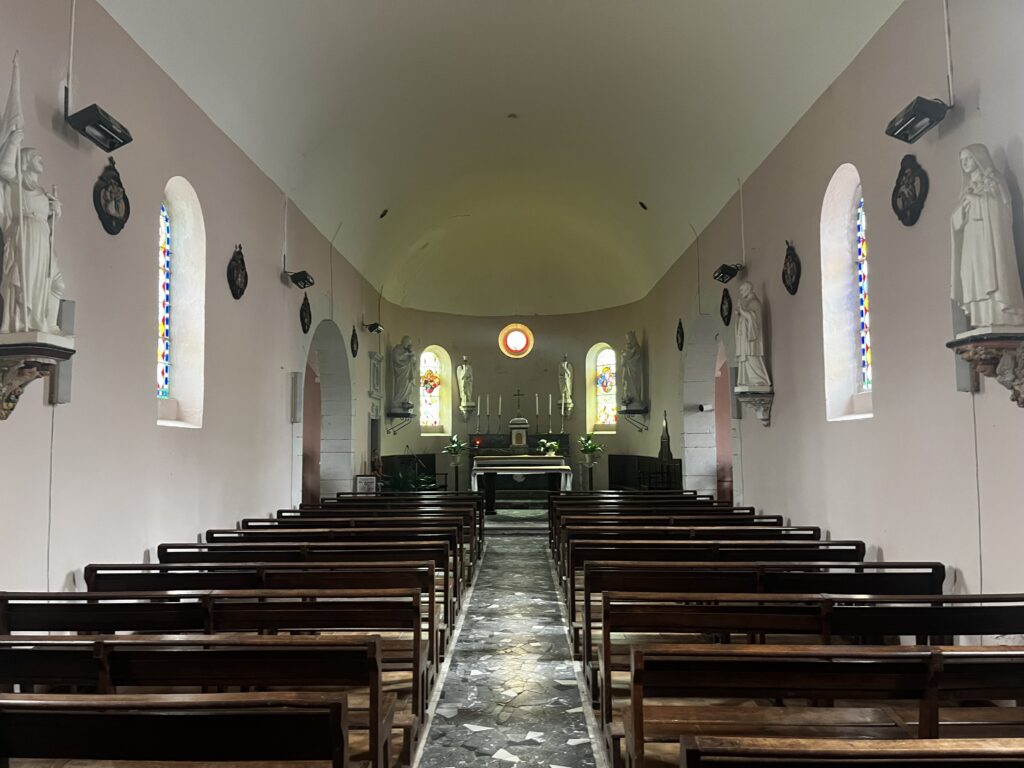
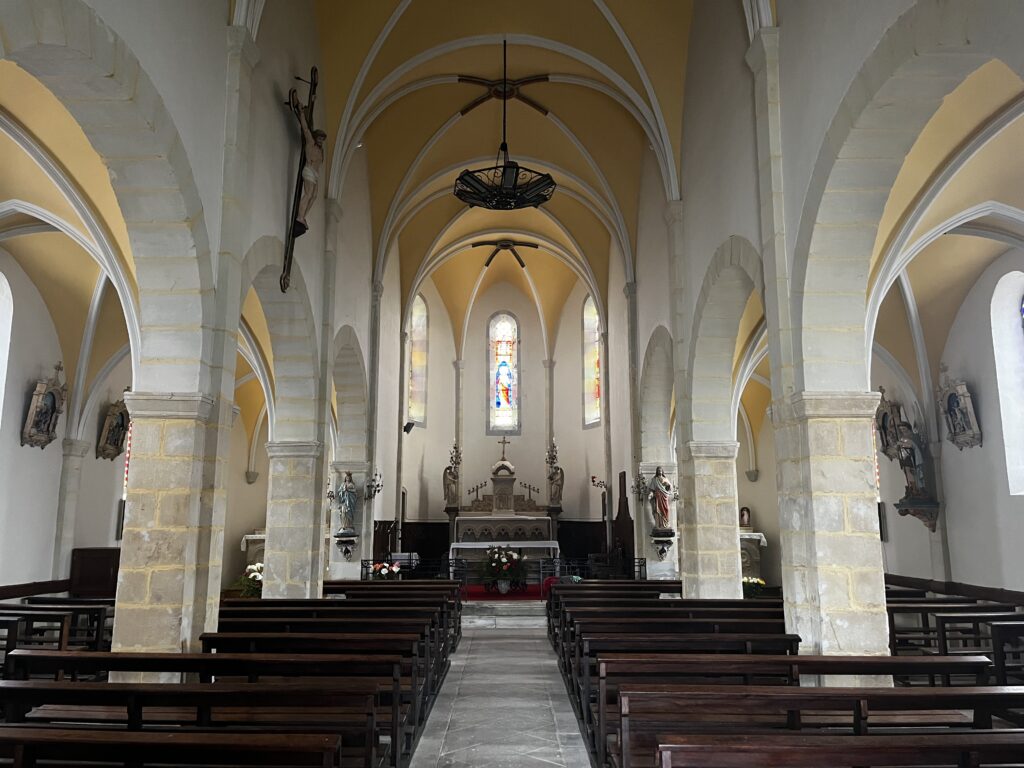
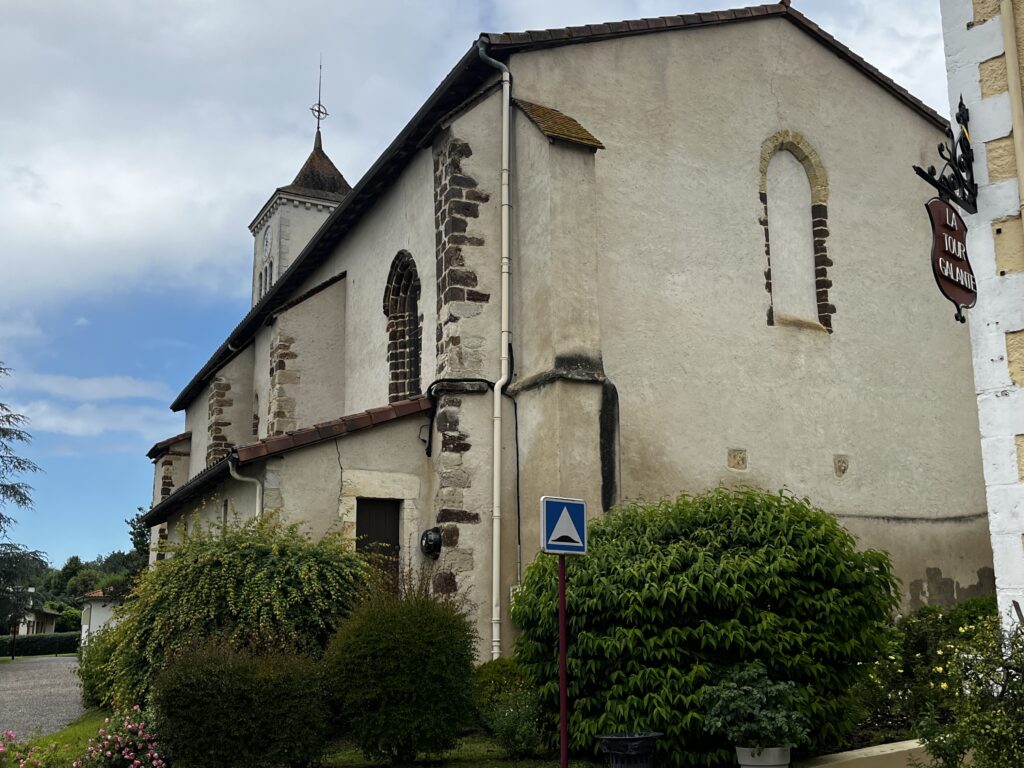
The little church of Saint-Vincent is an oddity. From the outside, you would expect it to be a typical 19th century French country church.
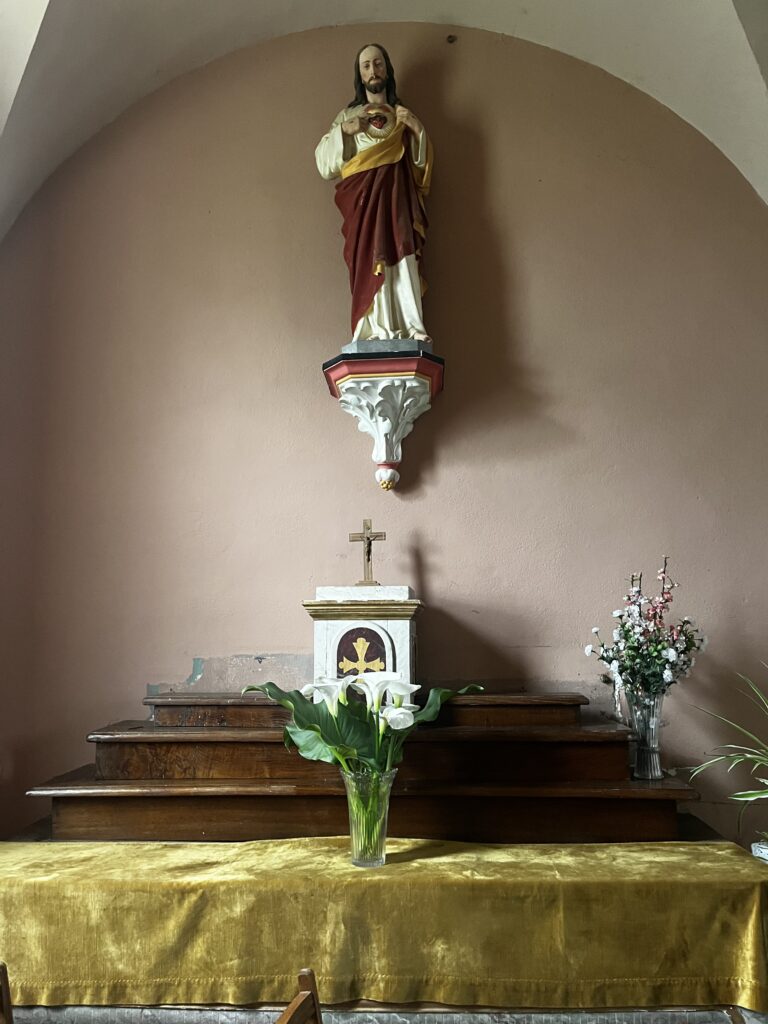
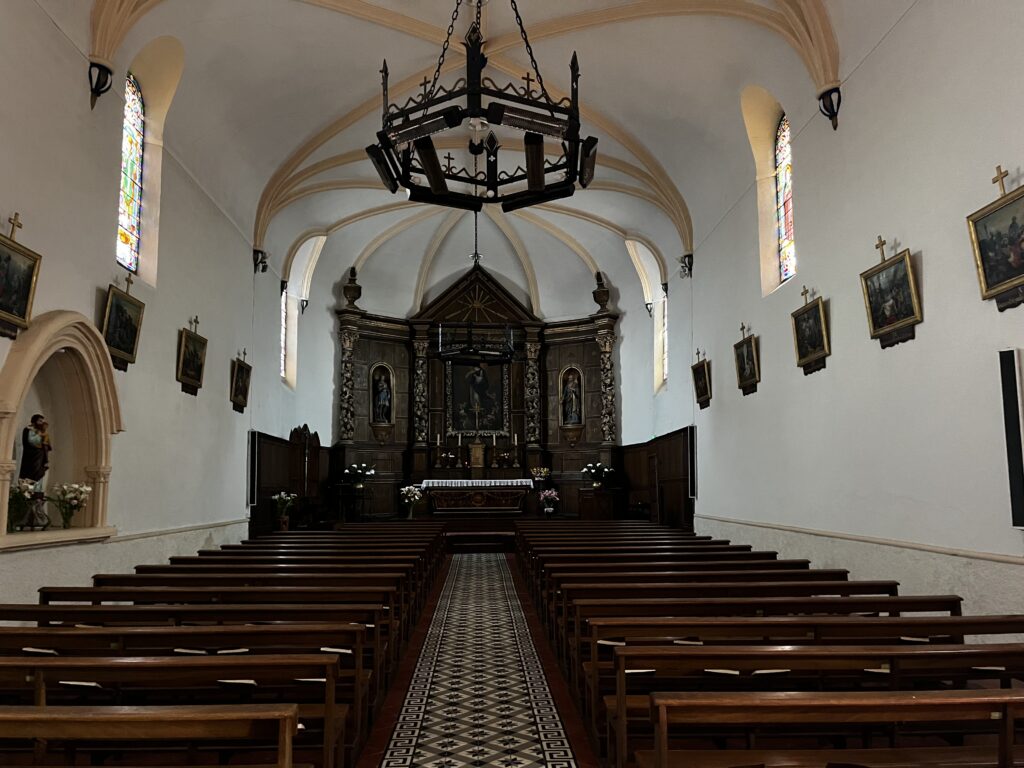
On the inside, however it looks older. Most of the furnishings are baroque, though I suspect the stained glass is 20th century. There is a rounded drop ceiling here which just screams mid 20th century to me as well, although there is proper vaulting in the side chapel. A real hodgepodge.
Unfortunately, I could only stay in there a moment before a cleaning crew arrived.
I spoke with one of the gentlemen doing the work, and this seems to be a community effort. I don’t know how often they do it – annually? quarterly? – but the whole village gets together to do maintenance work in the morning, and then has a long party/dinner in the afternoon into the evening.
What a great way to build community!
I wonder if the folks at the Saint Michael statue were part of this effort as well.
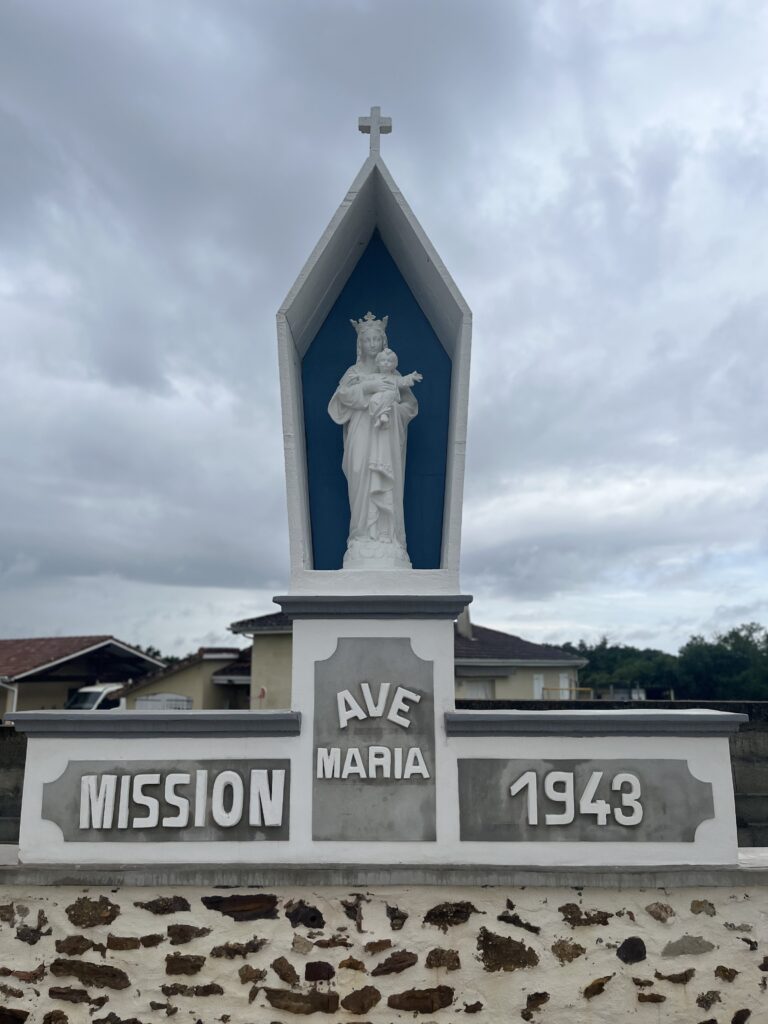
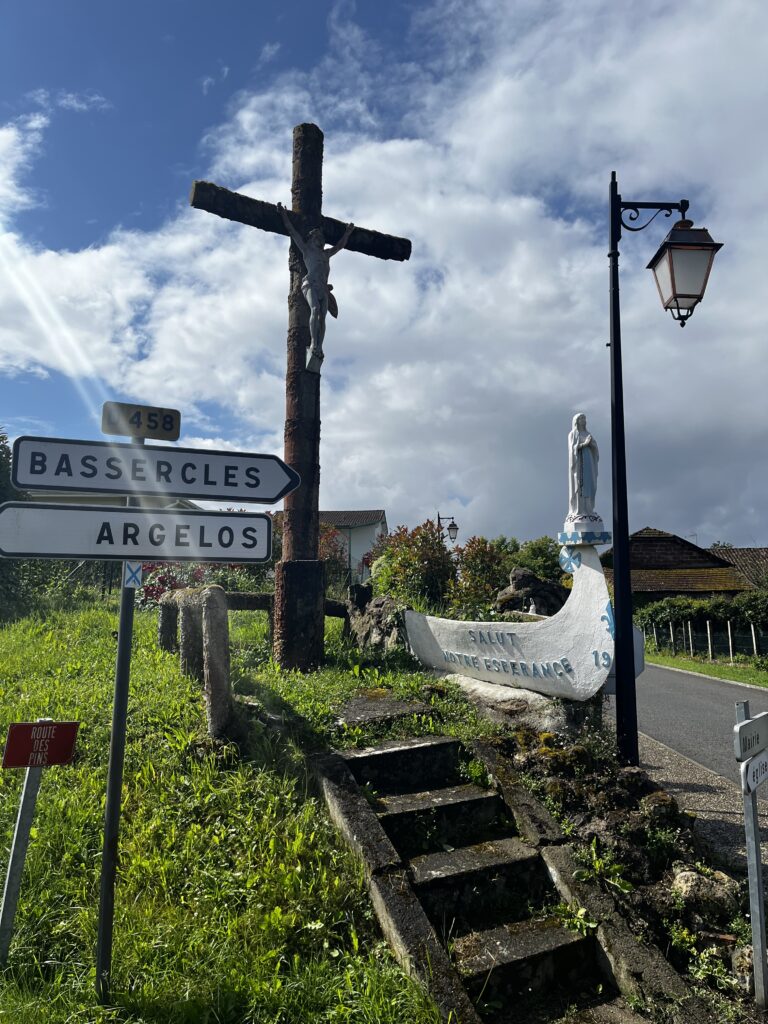
On the way out of the village, there’s a roadside shrine to the Blessed Mother celebrating a mission conducted here in 1943.
In front of the very last house, there’s another roadside crucifix identical to the one I saw earlier. These people are serious about their Catholicism!
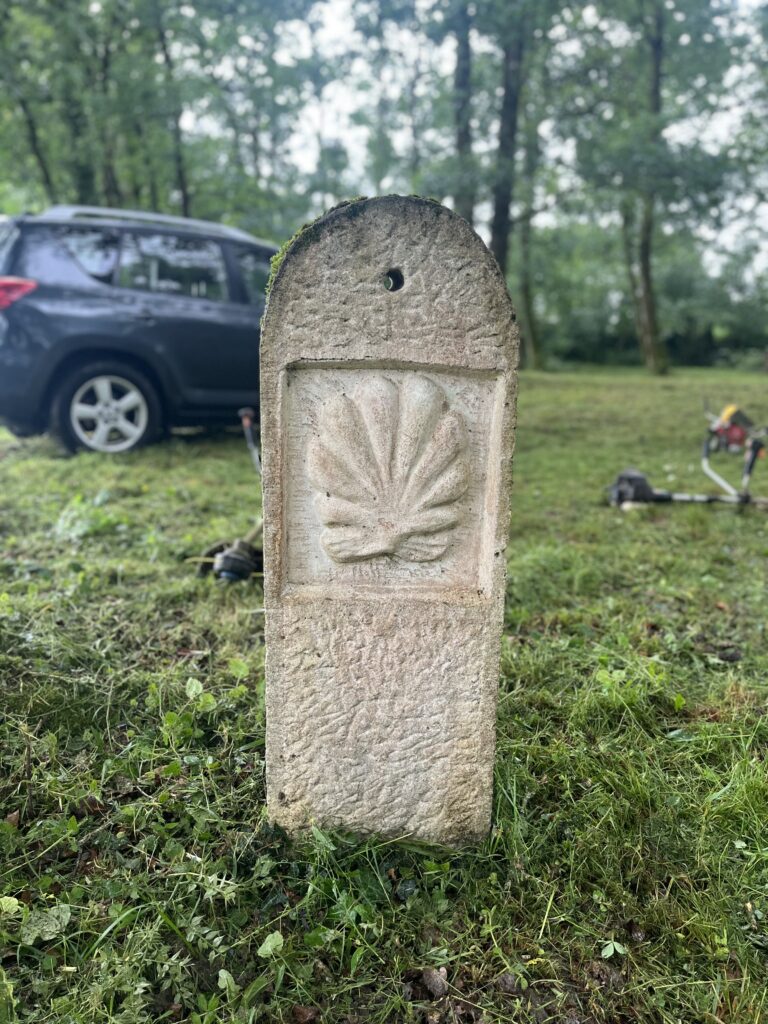
I ran into one final work crew that had cut the grass and trim the hedges in the field just outside the village that had a stone Camino marker. These guys had already broken open the wine bottles.
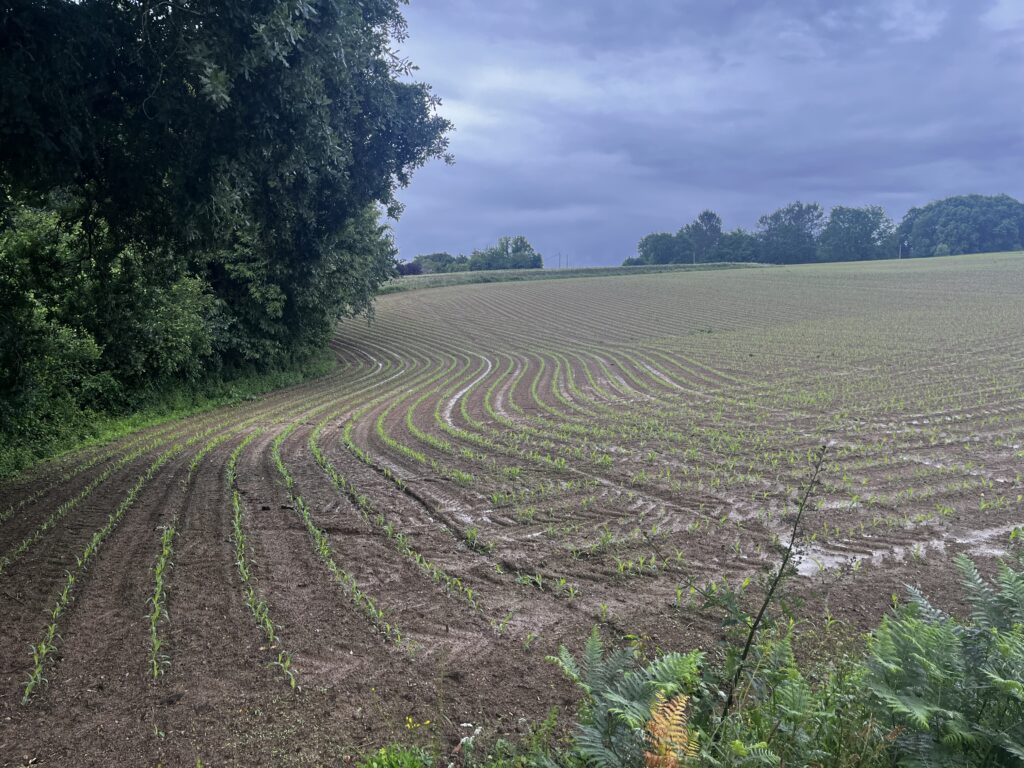
After the village, it was back to the countryside of small fields and clusters of woods. It started pouring rain.
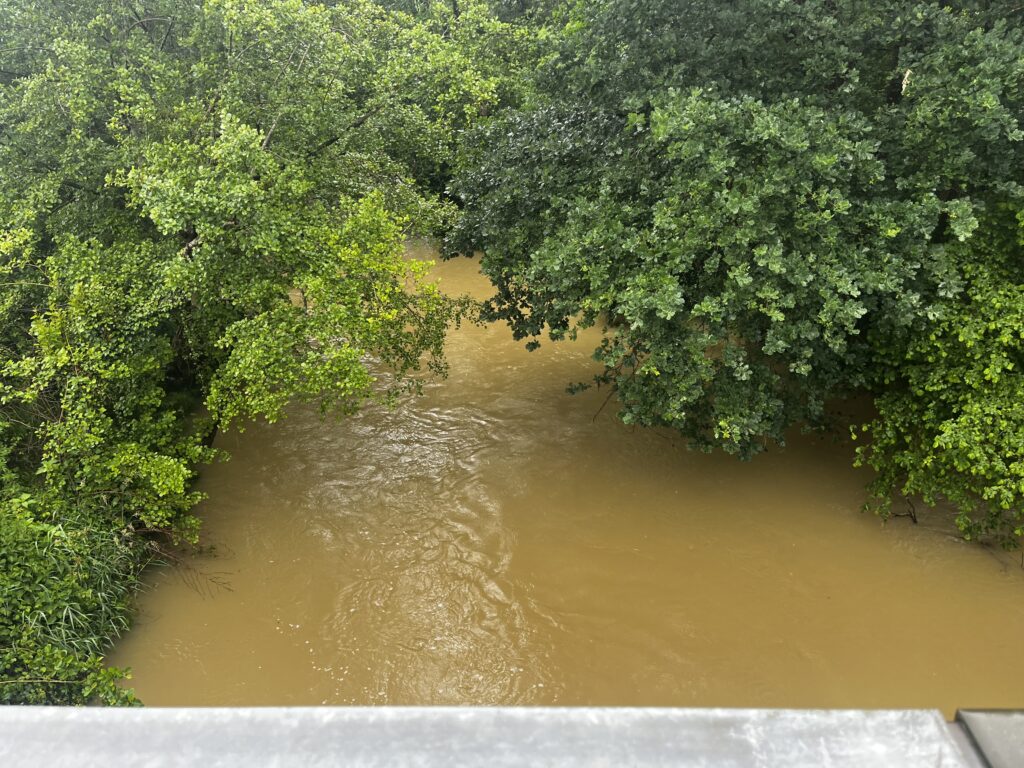
At some point past 10 AM, the Camino crossed a bridge over the River Luy de France. It was flowing fairly quickly here, I suspect as a result of the rain.
At about 10:20, as the road was taking me uphill through the woods, the rain suddenly stopped. It was like walking through a doorway into another room.
Today was supposed to be warmer than yesterday. It was not. The only time I was at all warm was in the poncho walking up hills.
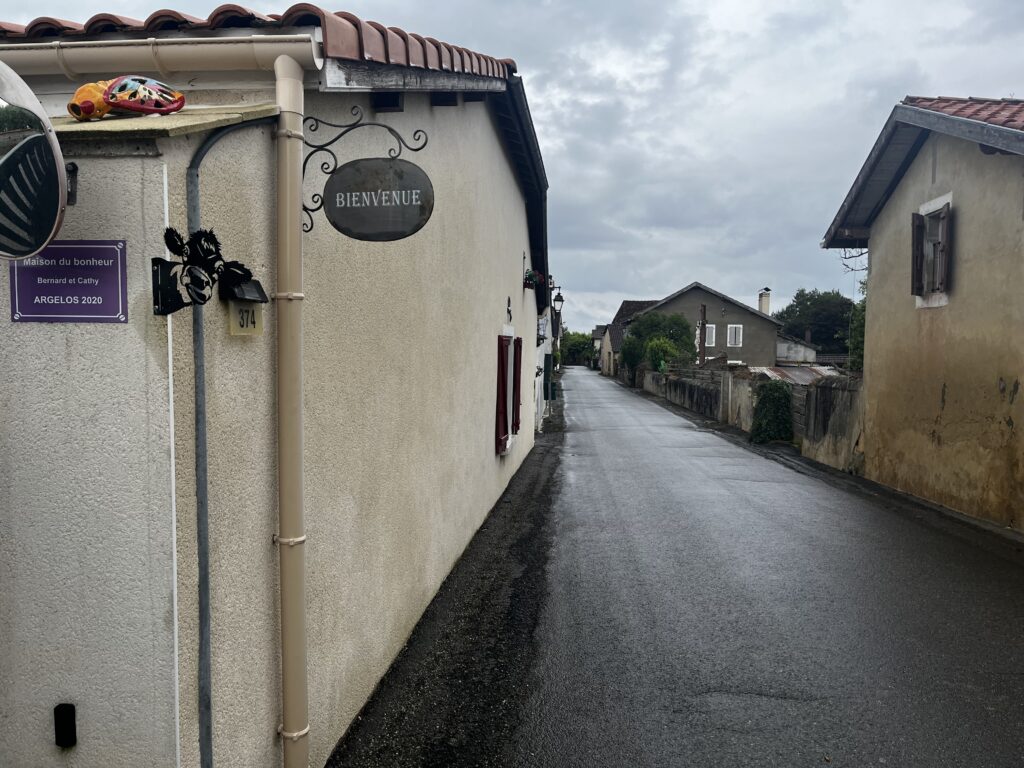
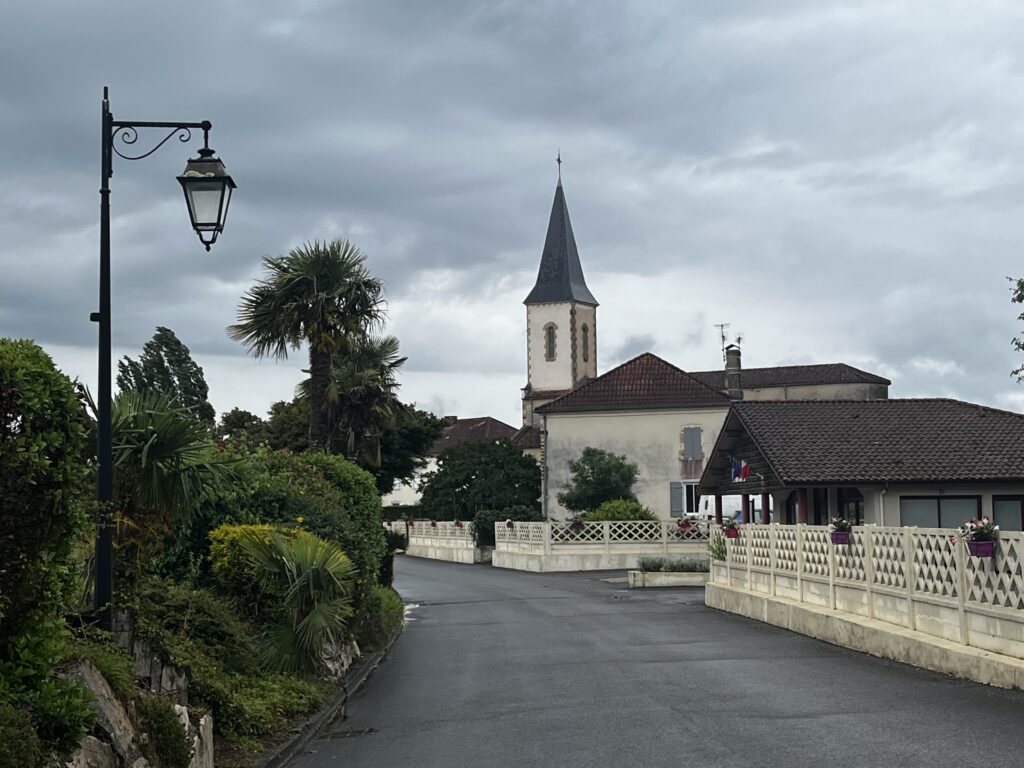
At 10:30, I spotted a steeple in the distance. Just a few minutes later I was walking into the village of Argelos.
The original 12th-century church of Saint-Barthélemy was demolished in 1875. Almost nothing of the original church was used in the rebuilding.
I actually had to leave the Camino to visit the church, and then after just a few moments I was shoot out by two ladies who were cleaning. Is the Saturday after Ascension cleaning day for all of these villages?
After this, the landscape was more forest and meadow than farms. There were also a lot more hills than I remember recently.
Around 11 AM, I finally had my second breakfast. This was a chocolatine that I had stuffed into a pocket. It was flat, but oh so tasty. I was probably about halfway into my walking day.
By 11:10 AM, after passing through a charming little country hamlet that might have been named Bounayre, the farms began to make a reappearance.
Just a few minutes later, I entered the village of Beyries (Veirias in Béarnais), where Herve spent last night. I was probably only three hours behind him, meaning he would probably be walking into our common destination for the day just about now.
The sun was out now, and the skies were mostly blue, though I did have my eye on a couple of dark clouds on the horizon.
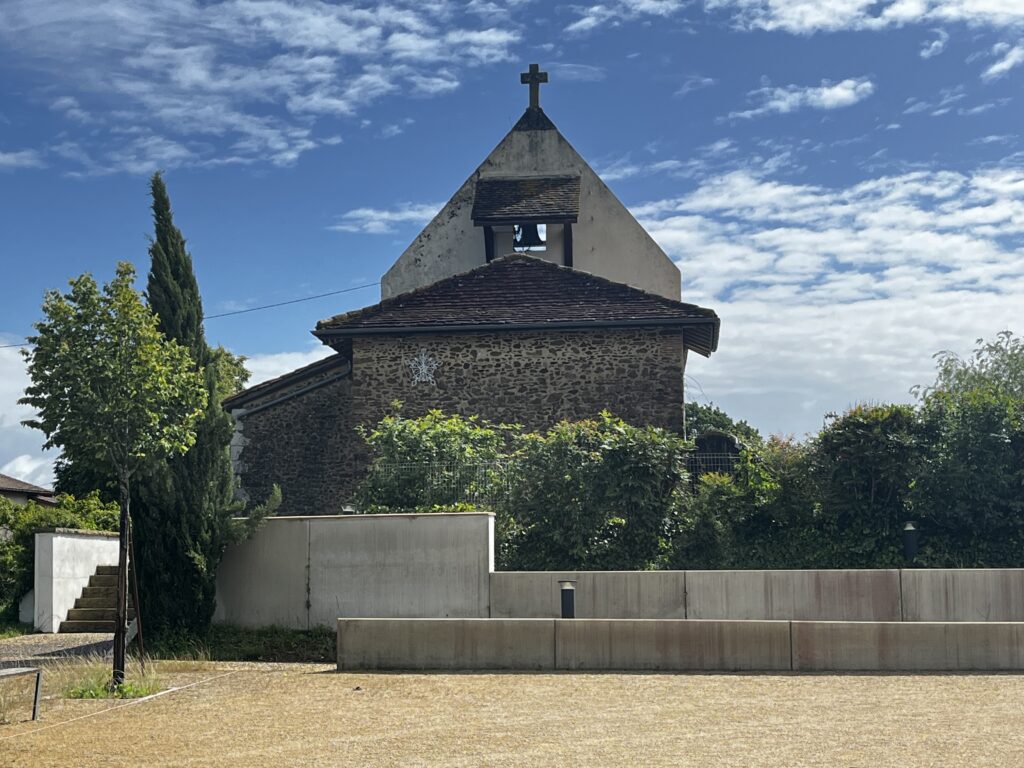
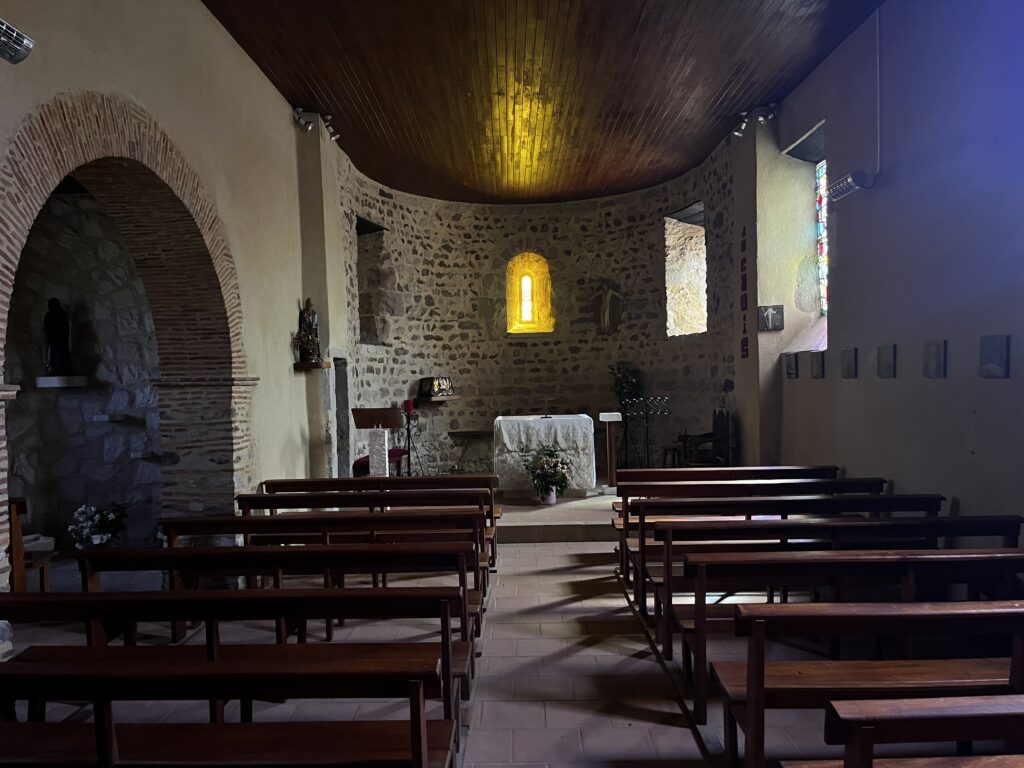
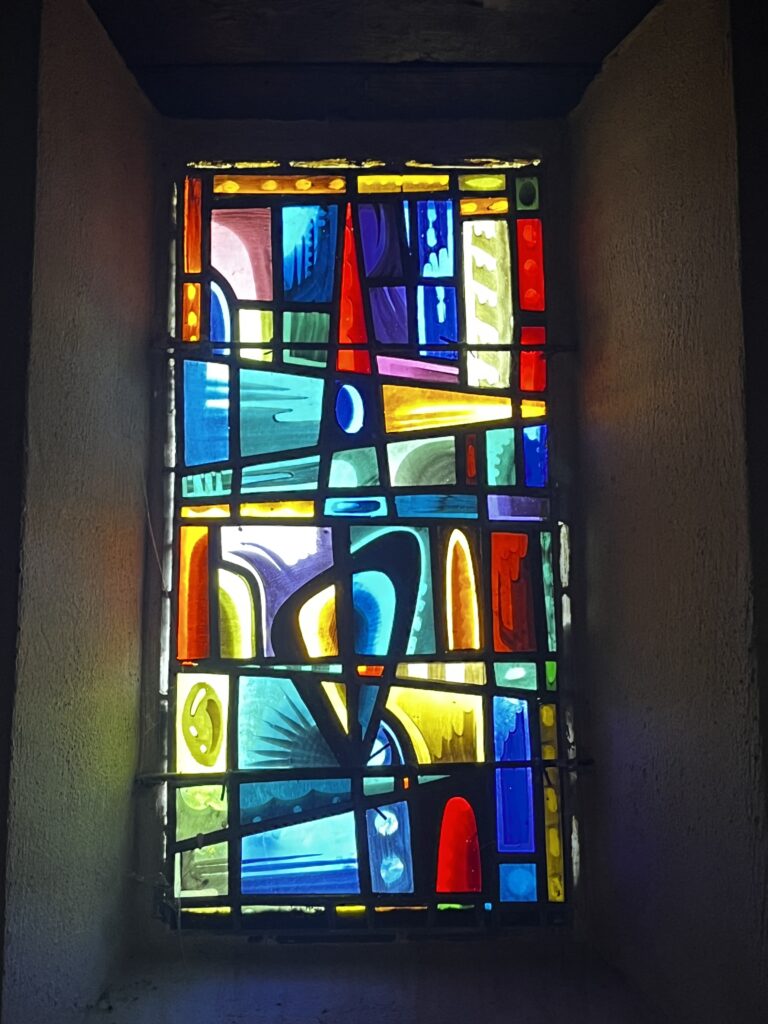
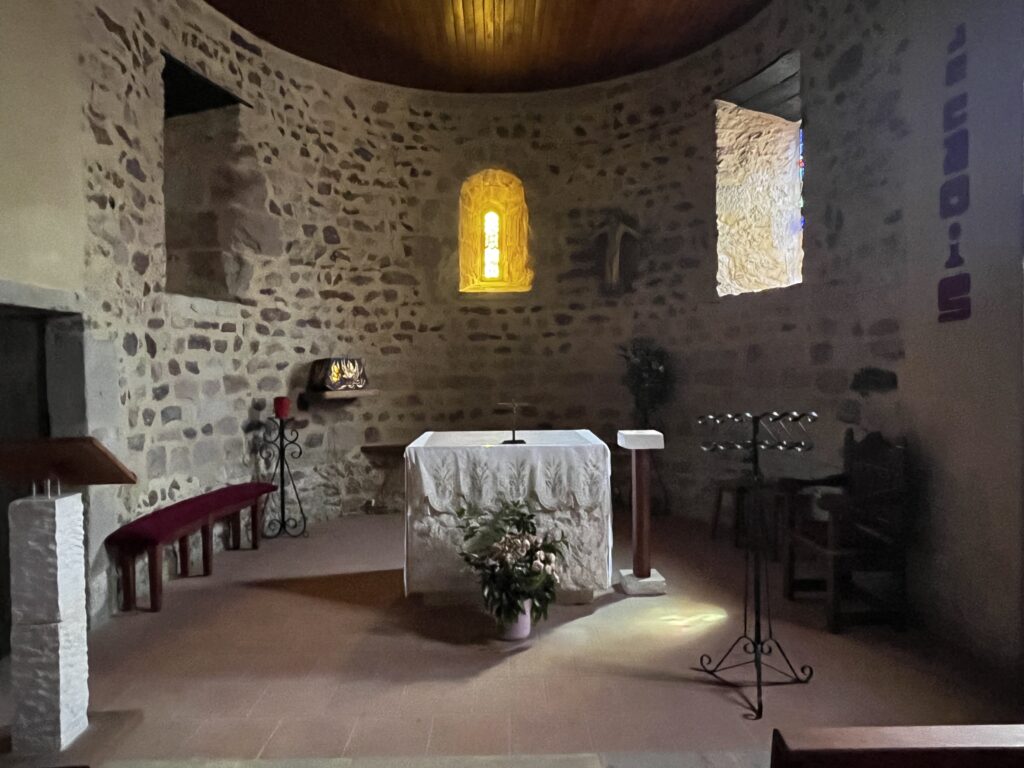
Again, the village church was well off the Camino route. It was tiny, almost a chapel, and the interior was mostly bare uneven stone. The interior furnishings and mostly abstract stained glass very much had the flavor of the 1970s.
The only crucifix in the entire building was the tiny metal one placed upon the altar. According to the worship aid near the door, the last Mass celebrated here was almost a month and a half ago. I don’t know how a place that looks so clean and tidy can feel so derelict. I didn’t stay long, and I hurried back to the Camino.
This proved a little more challenging than I expected, since according to my GPS, the Camino had actually turned just before the village. I ended up walking the entire length of the village twice, when I didn’t need to do it even once. This probably added an extra kilometer or so to an already long day. Not my finest hour.
Just after 11:45, I passed through the hamlet of Sahuqué. This place seemed more populated than the previous village.
Fifteen minutes later, I passed another compact complex of buildings which turned out to be an old manor called Château de Beyries.
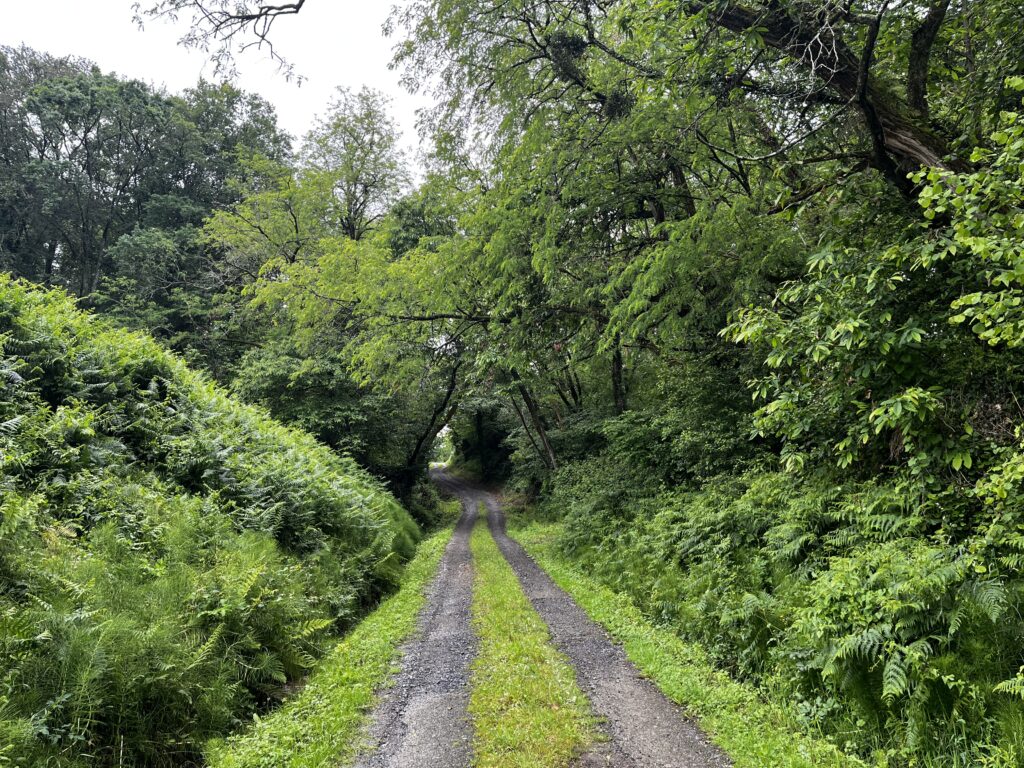
Just after this, the Camino left the asphalt for what I think is the first time today to follow a muddy dirt and gravel track into the trees.
And it was somewhere in here that I tried to start recharging my phone, and it refused.
By the time I rejoined the asphalt, sometime after 12:10, the rain had stopped again.
This eventually led me to the village of Sault-de-Navailles (in Béarnais, Saut-de-Navalhas or Saut-de-Nabalhes), where miraculously, my phone began to charge again.
If the large and well kept houses are anything to go by, this is a very prosperous village indeed.
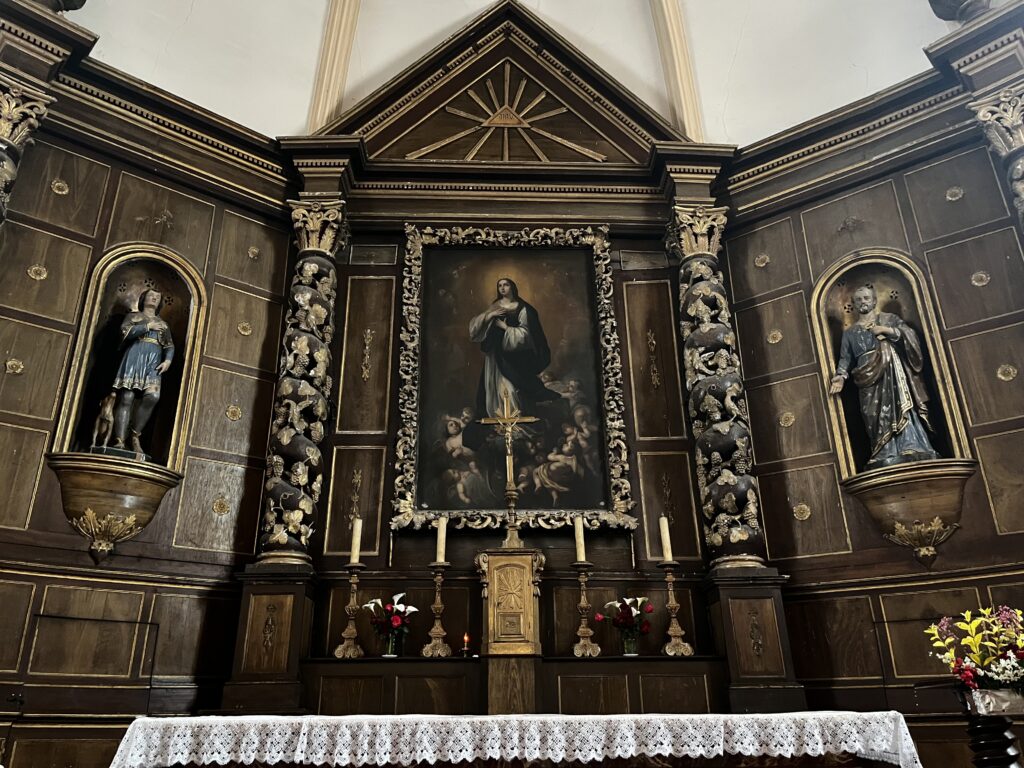
The church has a rather grand name of l’Assomption-de-la-Bienheureuse-Vierge-Marie. Though its architecture is simple, with a simple rectangular nave and some nice Neo-Gothic vaulting, the real treasure here is the sanctuary. This is a style of rectangular Baroque of which I am fond. The entirety seems to be made of walnut and lightly gilded.
The newer ambo has been constructed to match the walnut paneling. It was just a serene place, which is not a thing I say about the Baroque very often.
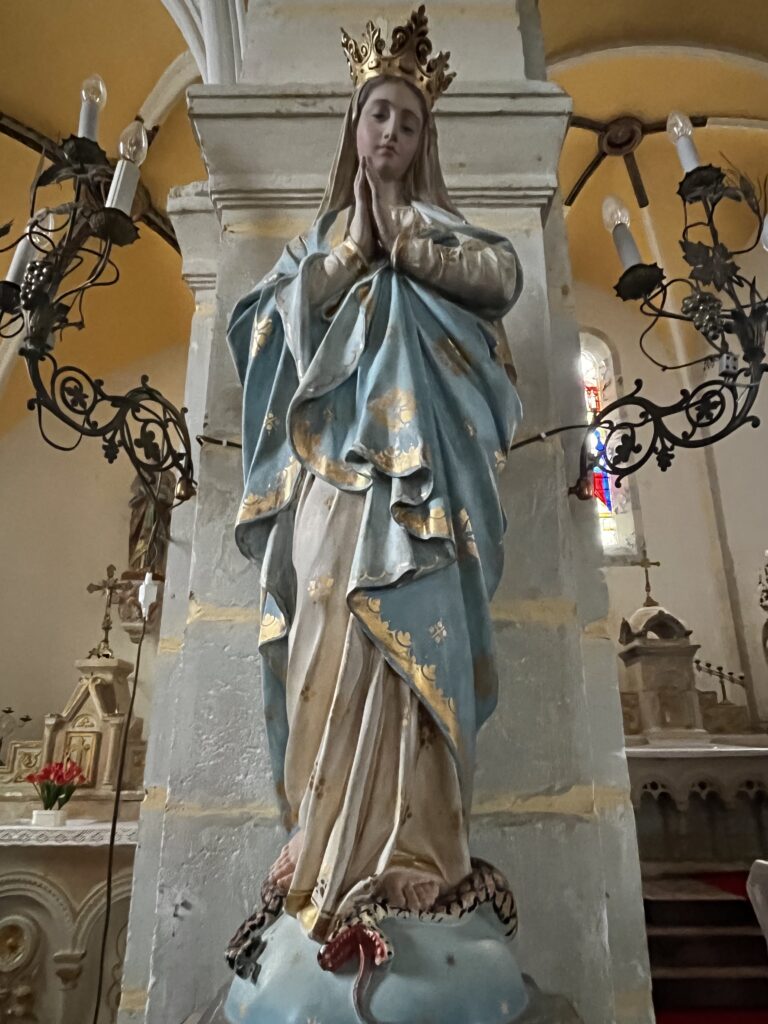
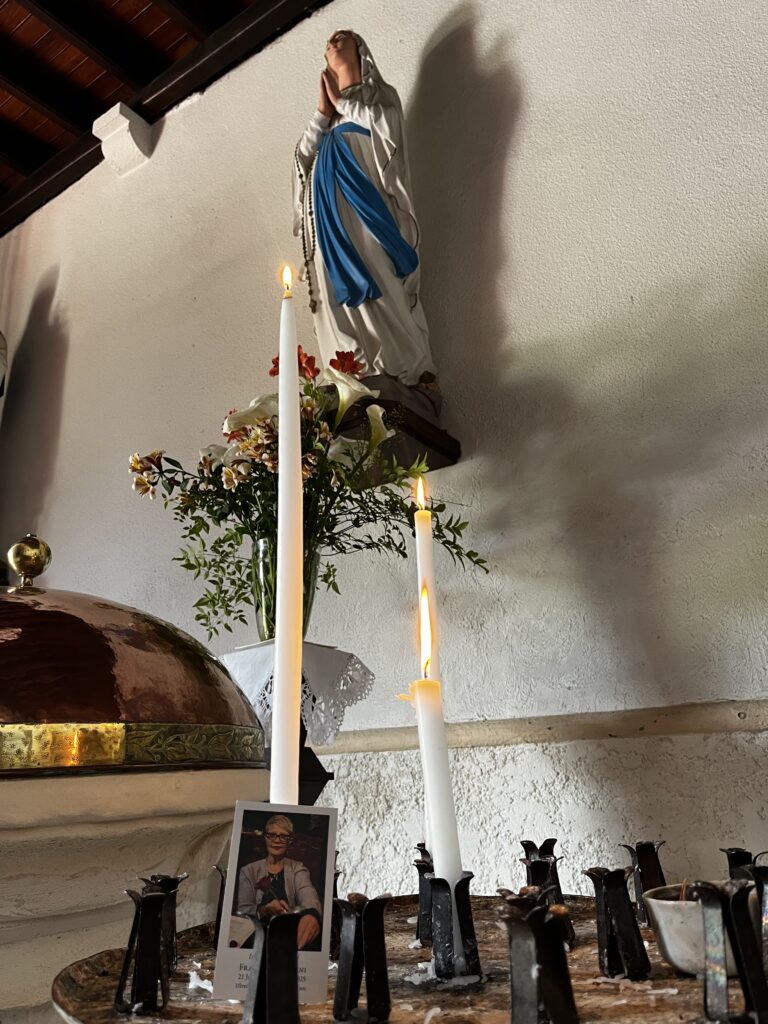
Since there was nobody with a mop and bucket to chase me out, I sat there and prayed a while. I lit a candle for Francine at a little shrine to our Lady of Lourdes in the back of the church.
I had 23 km down and 13 km to go on the day, give or take. I thought about stopping in the town’s restaurant for lunch, but the prices there were crazy expensive even for France. The children’s menu was more than I paid for dinner last night.
So instead, I walked on. In the middle of the town, I passed a large overgrown hill which contains the ruins of a medieval castle. Sadly, they’re so overgrown at this point you can’t even really tell.
The village just went on and on down the street the Camino followed. The village was neatly bisected by a broad river, Le Luy de Béarn, which I crossed over right about 1 PM.
The village more or less ended in a big roundabout, surrounded by small commercial district. There was another bar/restaurant here, but they weren’t open during the day on Saturday. So on I walked, grabbing some snacks out of my stash as I went.
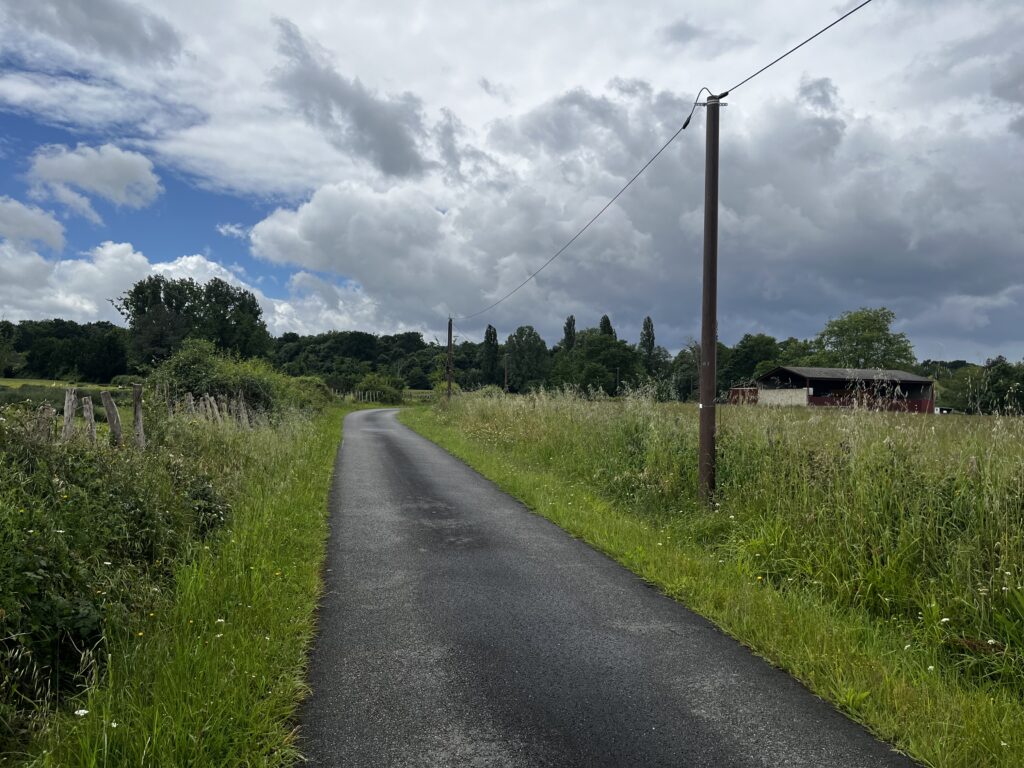
Now I had open fields on my left, and a string of widely spaced suburban houses on my right. There was a most welcome gravel sidewalk beside the two-lane highway I was walking.
The houses ended in a small field, followed more or less immediately by something that looked for all the world like a Costco. The Camino took me through the parking lot before leading me onto a little one-lane asphalt road through the rural edges of suburbia.
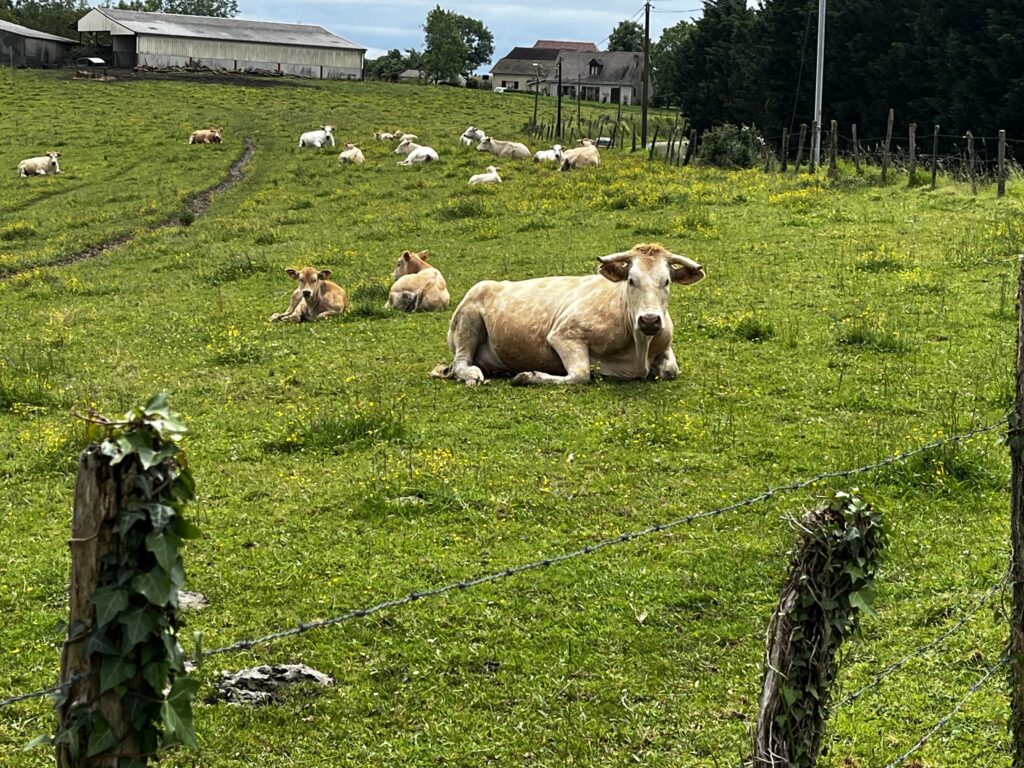
Soon enough I was back in the countryside. I even saw a couple of cows. They were so common in the early weeks of this Camino, and now they’ve become extremely rare.
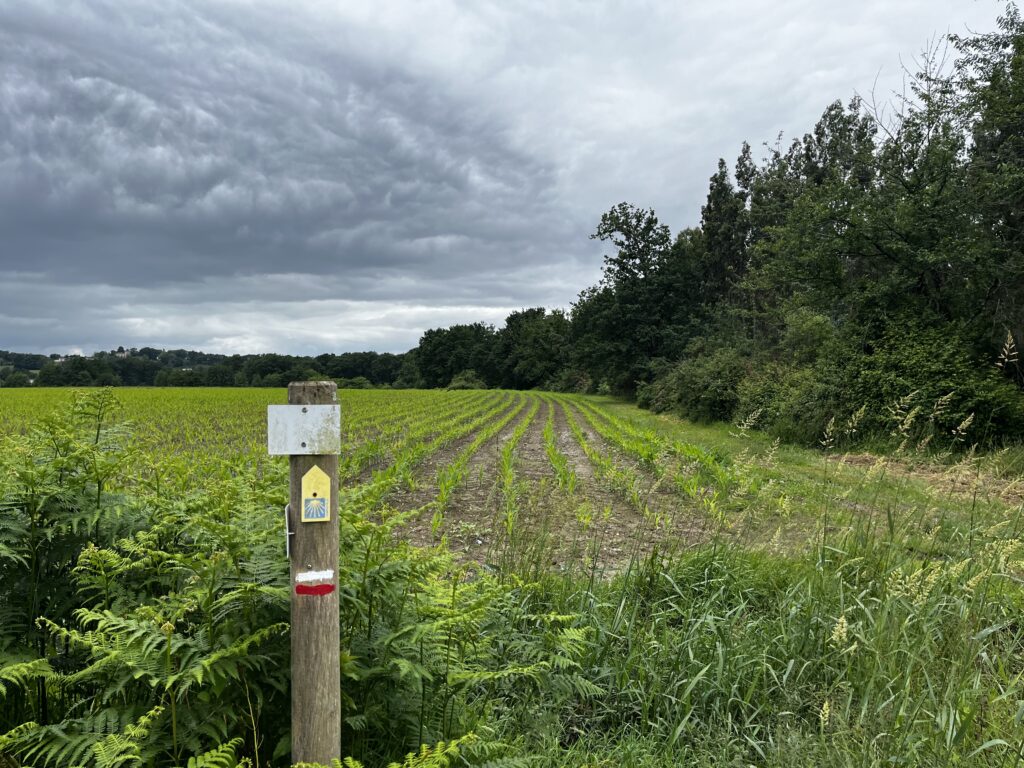
At about 1:30, the Camino once more left the asphalt for a muddy road. This one, however, included the option of grass instead of mud. Hooray?
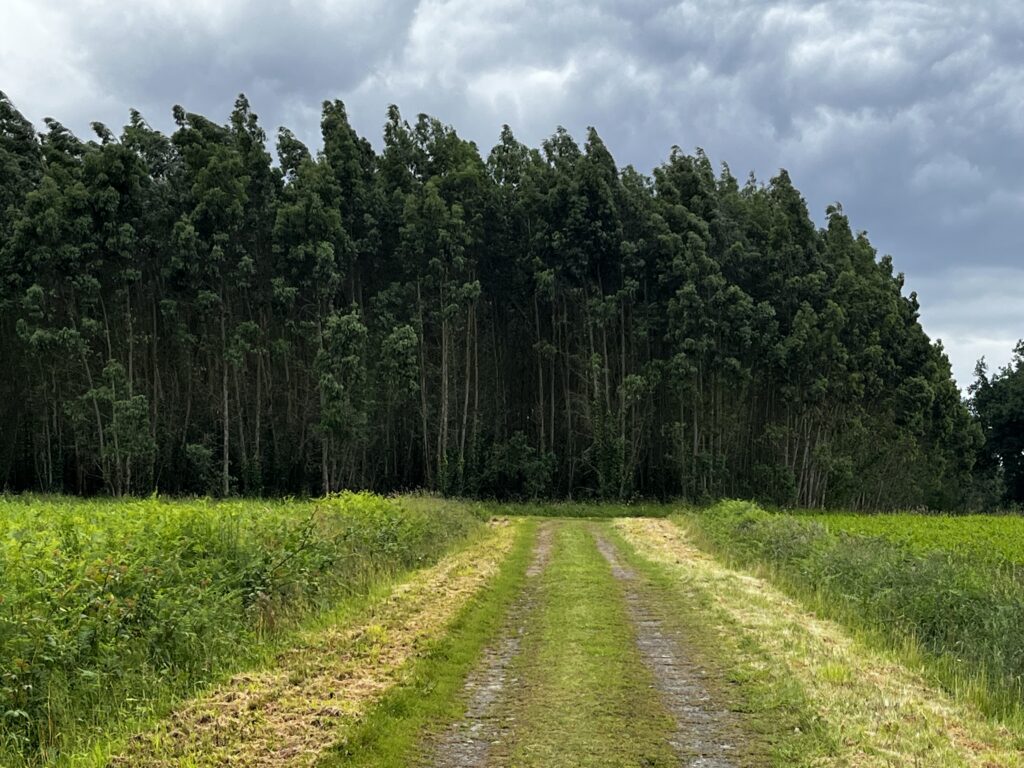
The wind was picking up again; I could see the swaying in the tall pine trees ahead of me.
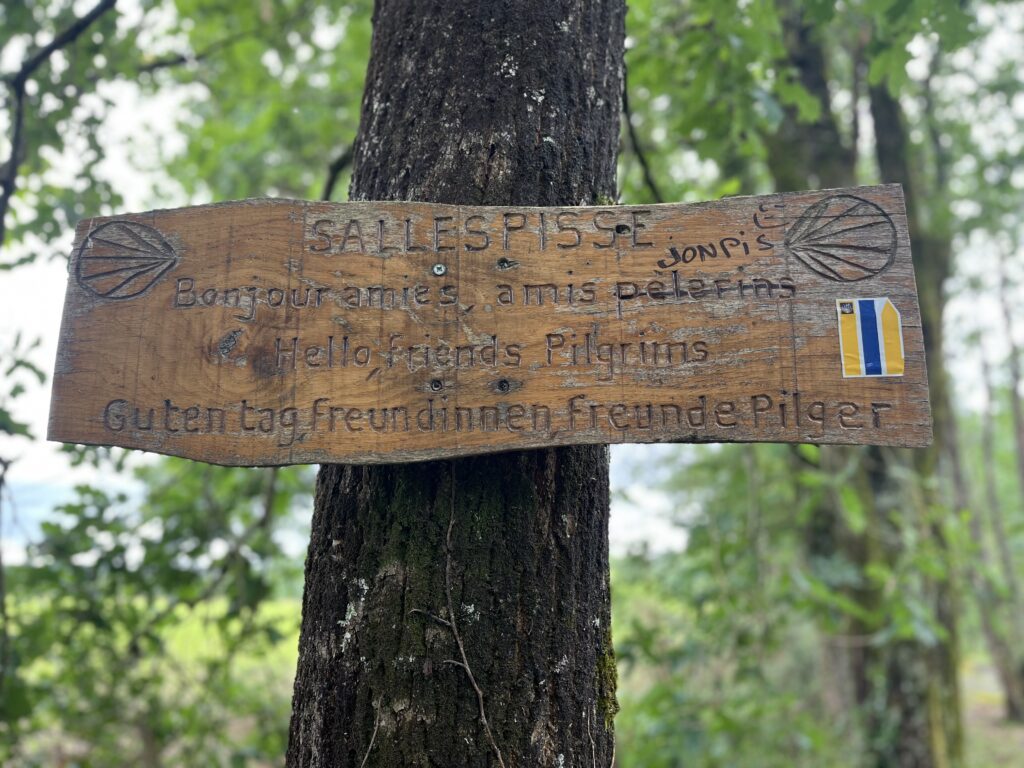
Fifteen minutes later, I was actually in the forest, sheltered by the trees and walking a dirt path. A wooden sign welcome to pilgrims to the village of Sallespisse, though of course there was no village in evidence yet.
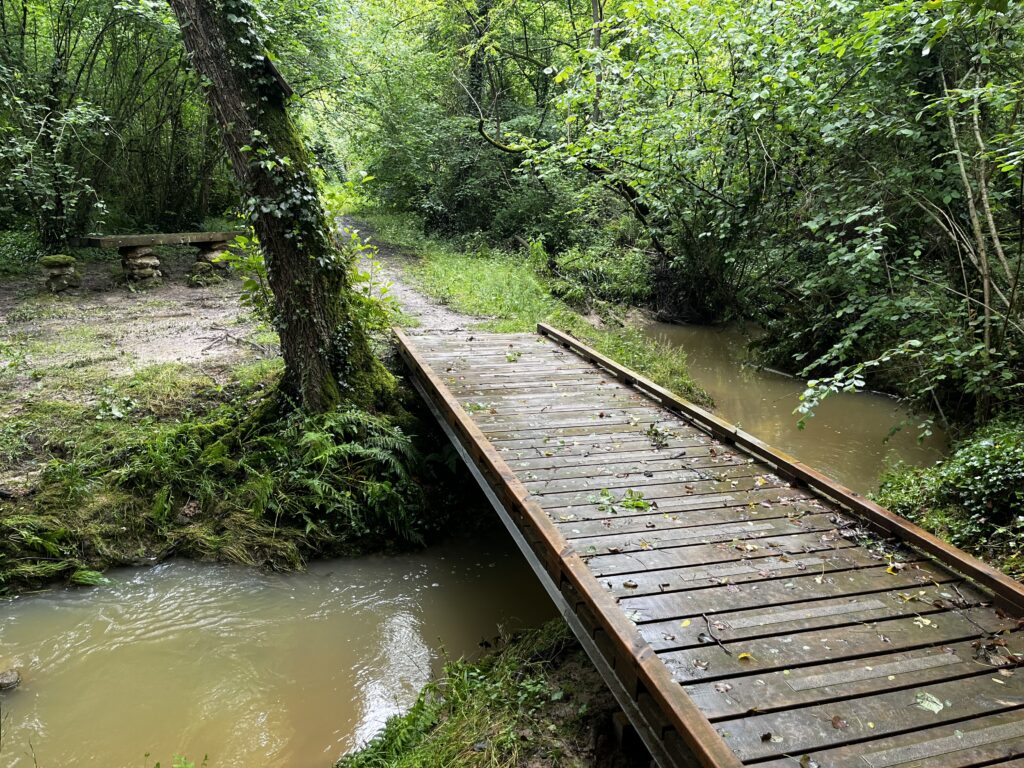
The path was a pleasant walk, though I definitely had to keep my wits about me as the mud was slippery. The Camino crossed over several streams on wooden bridges. One of them even had a bench to rest on nearby.
When the Camino left the woods for the fields once more, the path again widened out into a dirt and gravel road, full of mud and standing water. I already had mud spattered up past my knees.
At 2 PM, I was briefly on asphalt as the Camino passed through the hamlet of Tucou. The wind was really something now. Fortunately, I was soon back in the shelter of the trees, and the dirt and gravel path was slightly less muddy.
At one point, it inexplicably became rough asphalt, sometimes with gravel on top, as it took me uphill through the forest.
Near the top of the hill, the Camino merged onto a much smoother asphalt road. There have been a lot of hills the past couple of days – I wonder if this means we have started climbing the foothills of the Pyrenees? I feel like if that was the case, I would be able to see the mountains on the horizon.
I can’t remember when I started seeing them in 2023, but this seems about the right timeframe. Perhaps the geography here, along with the forest, are conspiring to keep them from view.
At about 2:10 I started walking through a suburban neighbourhood of the village of Sallespisse. The Camino route only sort of skirts the edges of the village.
Back in the rather densely populated countryside, I passed many farmhouses, farms, and even a small herd of cows.
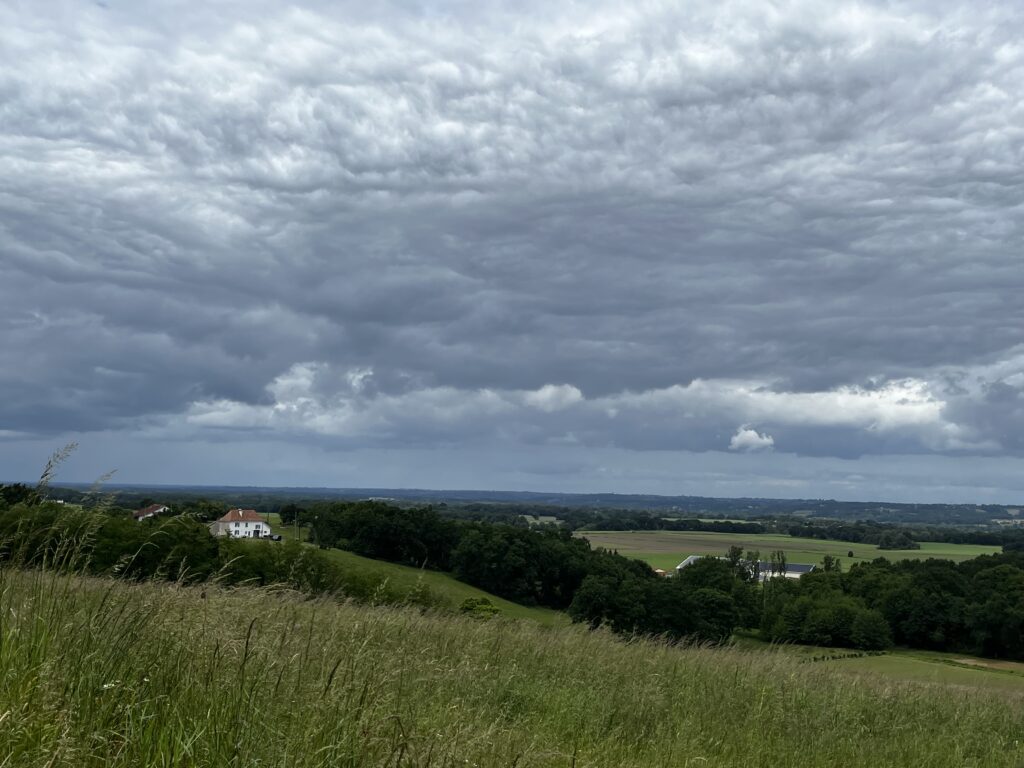
Whenever there was a large break in the trees, I could see valleys spread out beneath me. I think this confirms my foothills theory.
The terrain does seem weird weirdly familiar to me. I am now walking through the Département of Pyrénées-Atlantiques, which I also walked through in 2023. In just a few days, this route will merge with the Via Podiensis as we had into the mountains.
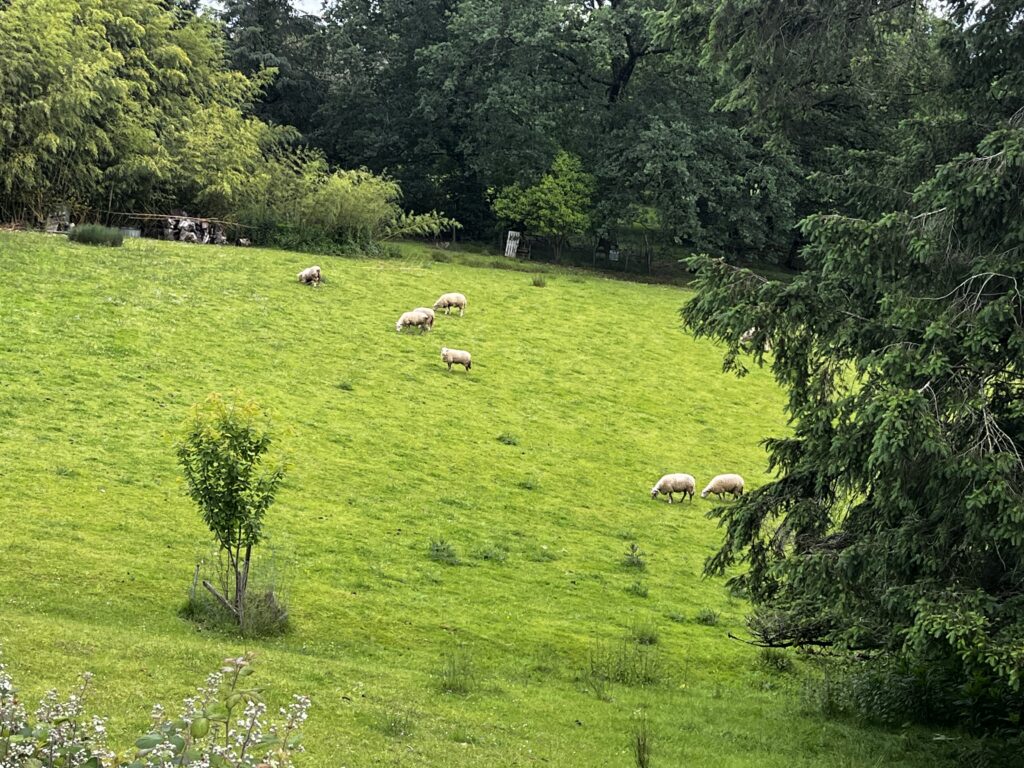
Sheep grazed in the valley below me as I approached the hamlet of Tradigou at about 2:45. The houses here seemed more suburban than rural.
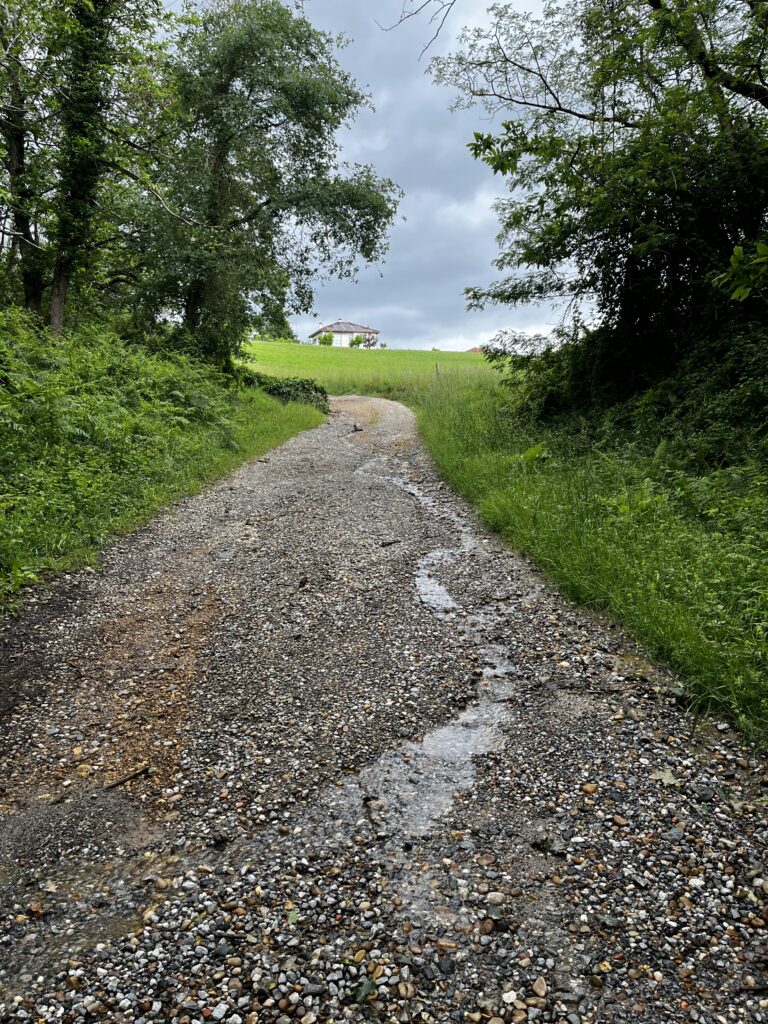
After a long uphill, the road gave up on asphalt in favor of gravel and stones and descended steeply into the forest. A little stream trickled down the middle of the road.
Eventually the stream flowed into the wooded valley on the right, and the road began to climb again. It became more mud and dirt and less gravel as it went.
The gravel, the mud, and the rain continued to come and go in unpredictable waves. My sense was that the forest road generally trend upwards.
Just before 3:10, the muddy road suddenly became clean, flat asphalt. I was seeing more Camino signage now, including more homemade signs.
Through occasional breaks in the trees on my right, I could see what I took to be suburbs or large villages in the distance.
The road was going down steeply now, and when the it broke out of the trees I found myself walking on a valley floor. Houses dotted the hills.
Then, of course, it was time to climb up the other side. I passed large suburban homes on my left, and open farmland in the valley on my right.
By 3:25, the houses were more or less constant on both sides, in interspersed with small farm plots or large yards. The feel of the houses is different, too. I don’t know that I can explain that, but they seem less French more similar to the houses you see in Navarra in Spain.
The houses grew closer together, until it was clear that I was walking through a neighborhood. Within a kilometer, it was pretty clearly an urban neighborhood.
Although I passed no sign, I was pretty clearly in the city of Orthez (Ortès in Béarnais).
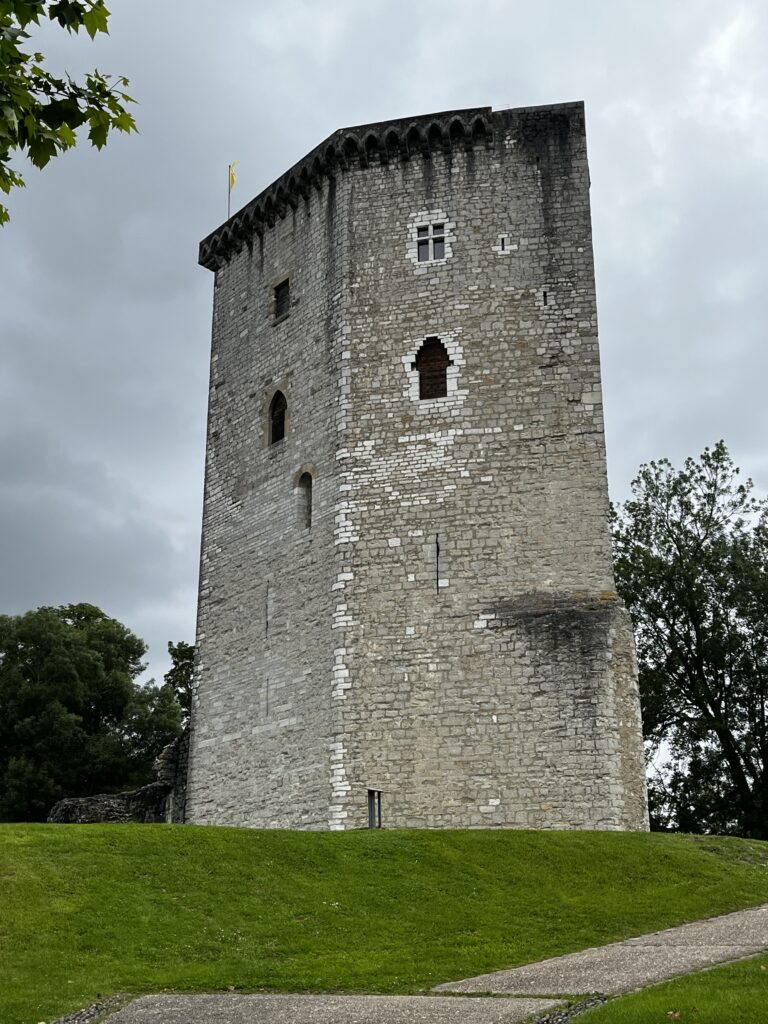
At about 3:35 PM, I caught first sight of a tower on the hill. This could only be Château Moncade. From here in the 13th century the Kings of Béarn ruled. Only the keep and a small part of the walls remain after being sacked in the Wars of Religion and then effectively auctioned off following the Revolution.
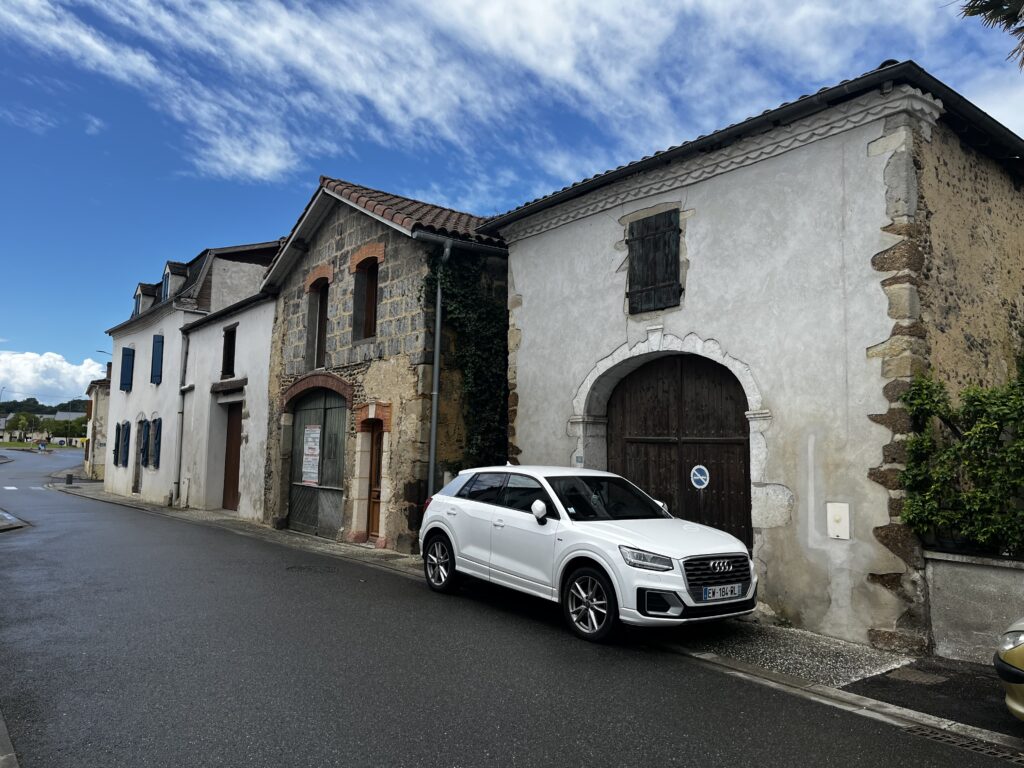
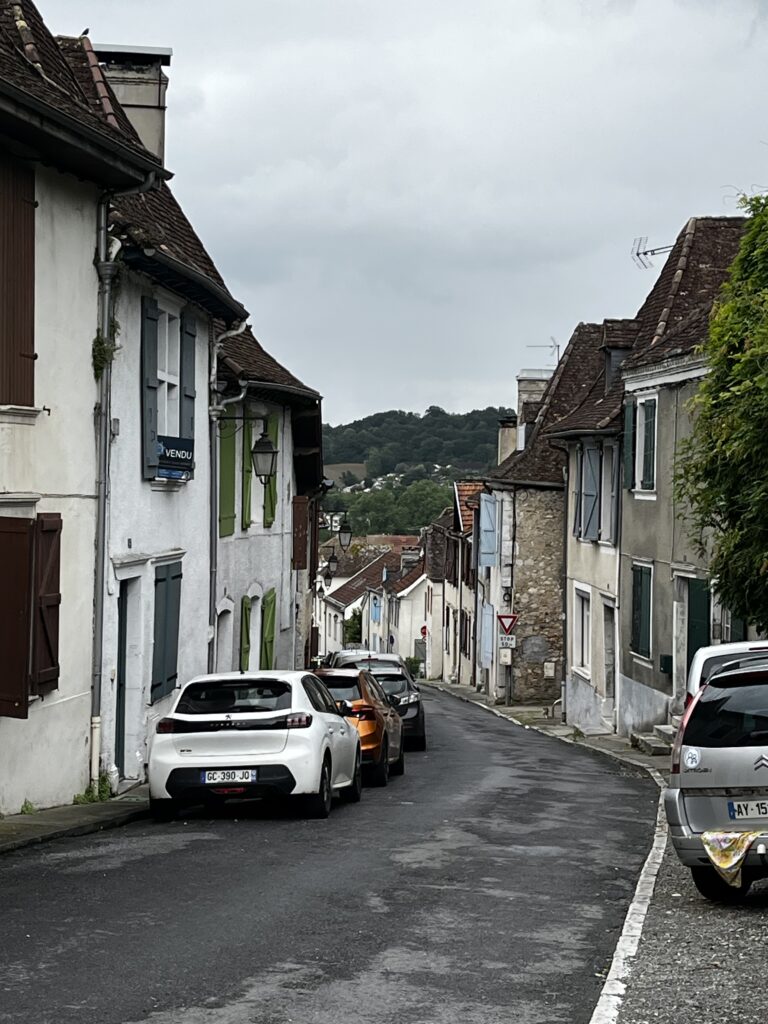
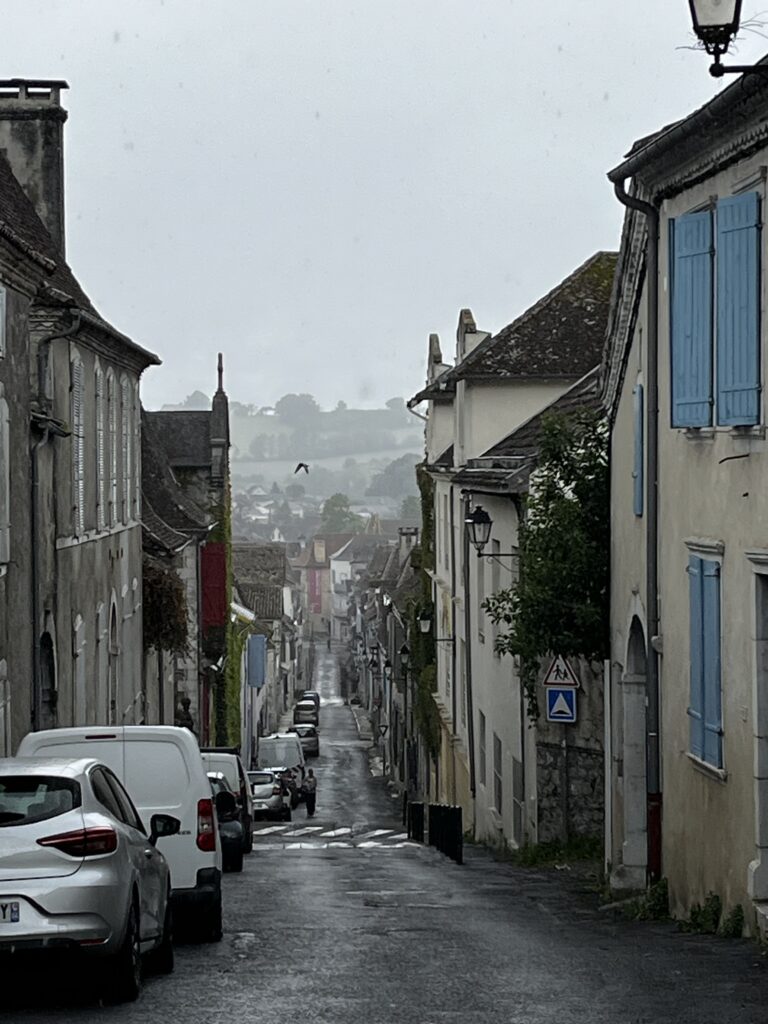
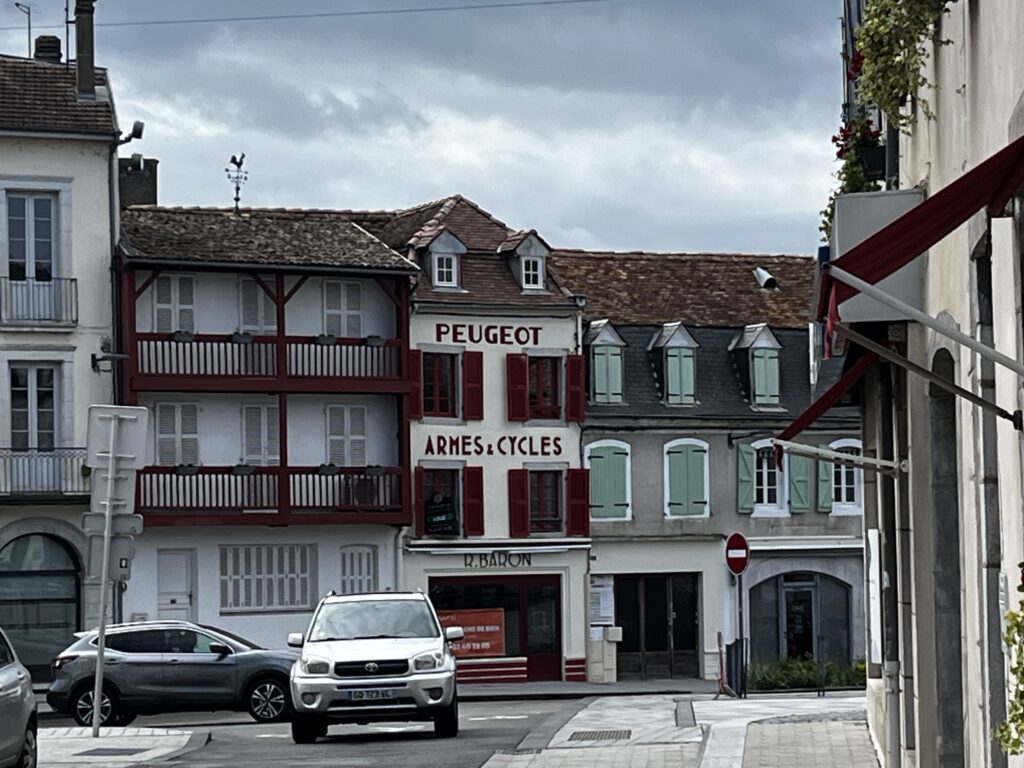
The street narrowed and was soon filled with wall-to-wall buildings in the medieval style.
I took the briefest of detours to visit the tower. Unfortunately, it is only open for visits during the summer months, but I did get to walk around the bailey a bit. The flag flying from the tower is the flag of Béarn, two red bulls on a gold field.
And then it was back to the Camino to try and find my gîte. The first step, was to head over to the tourism office to get the door code. This was easily accomplished, and I was informed that I took the second to last bed available. The last bed was claimed by somebody on the phone while I was in the office.
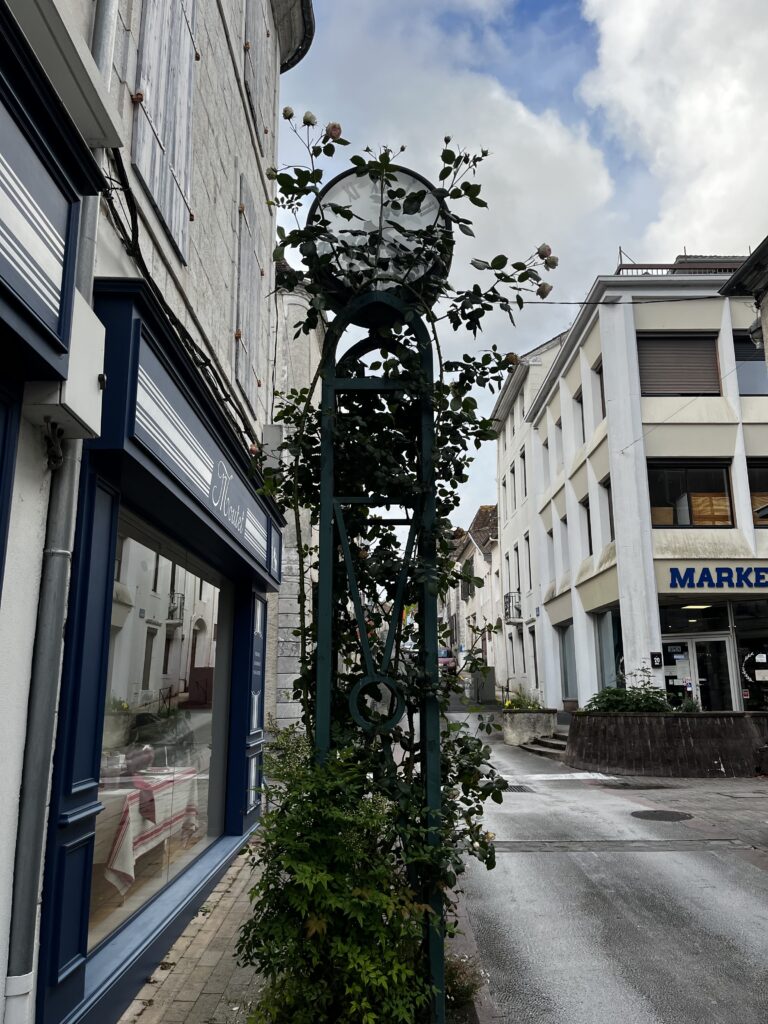
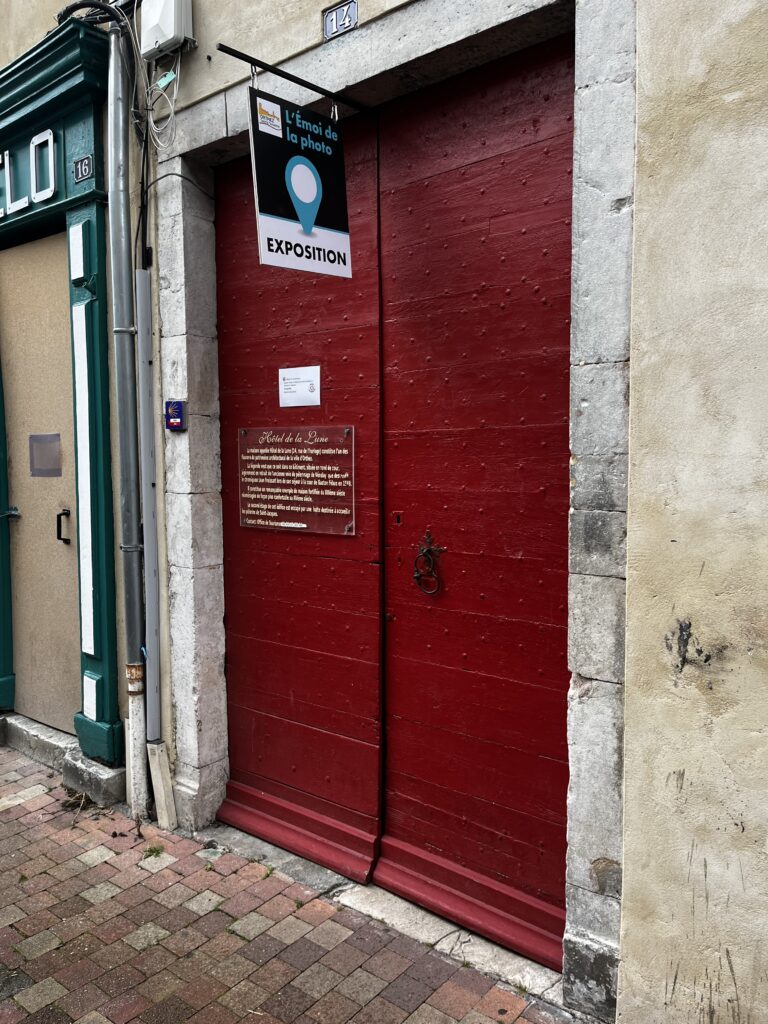
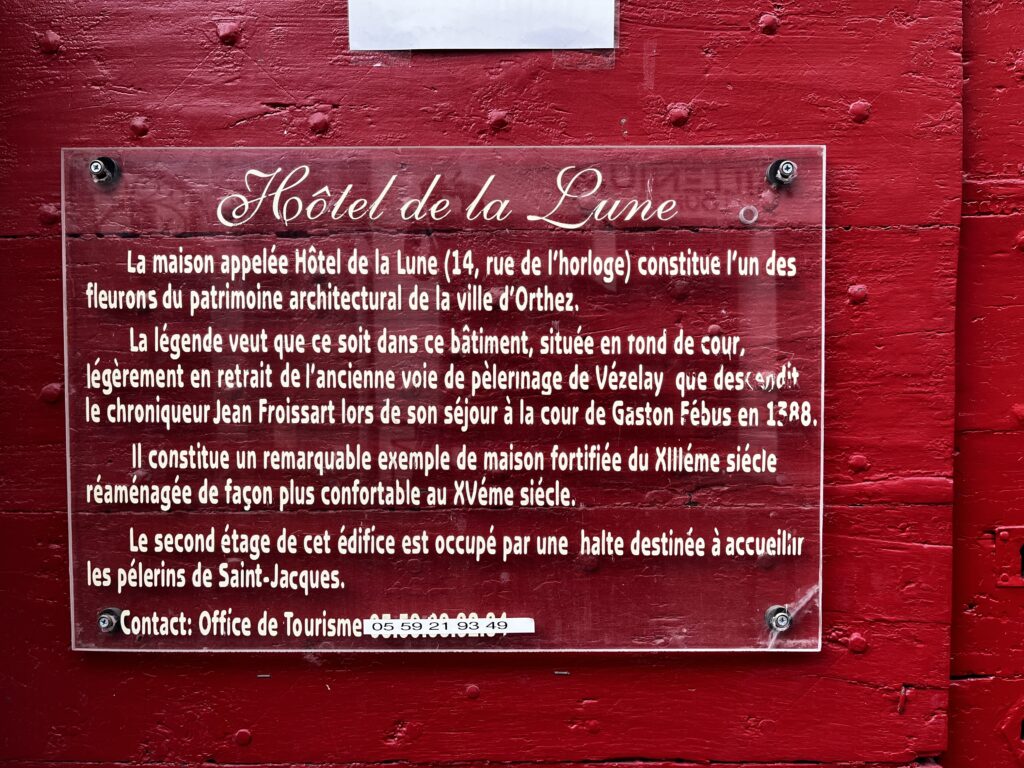
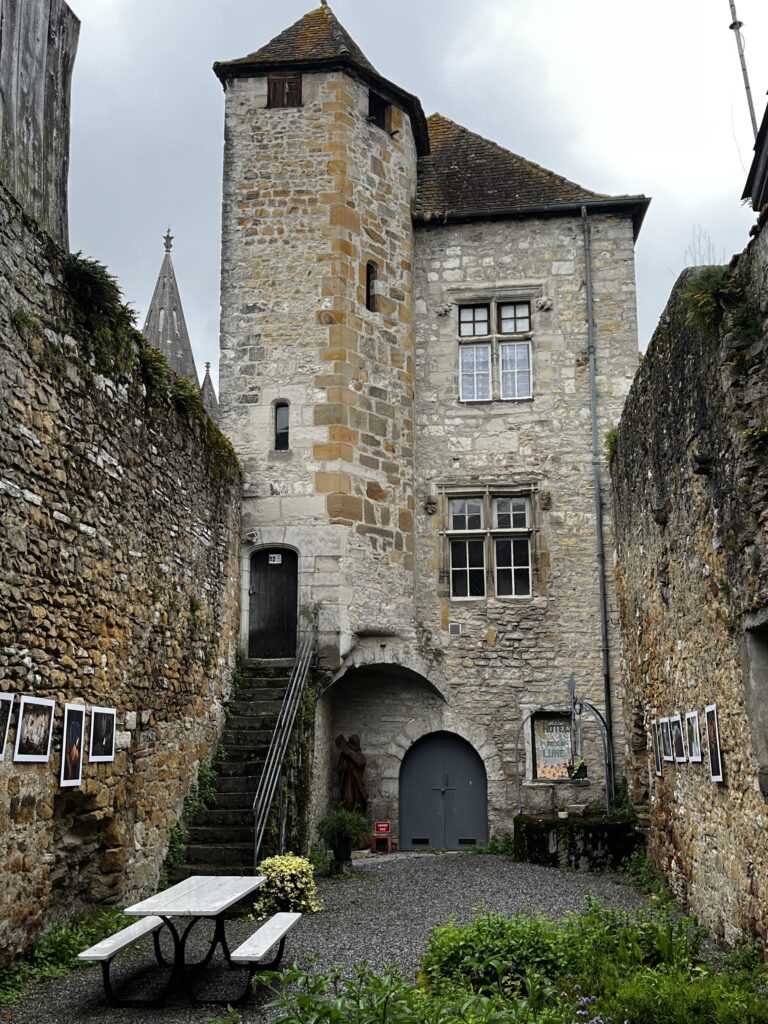
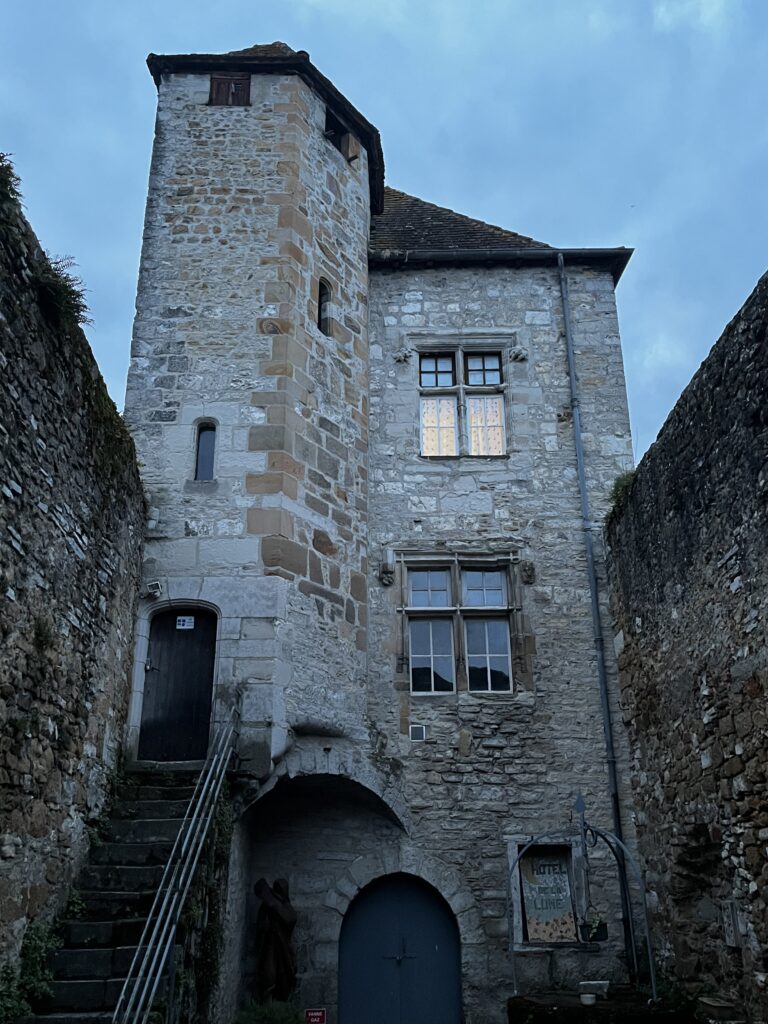
And then to the gîte. This location is something straight out of a Borges story, or perhaps something by Italo Calvino. It is called the Hôtel de la Lune and is located at 14 rue de l’Horloge. I am staying in the hotel of the moon on the street of the hours.
At street level, it’s a red door with a plaque. But open that door, walk under the house above it and into a courtyard, and you will see the actual building: a medieval tower.
It’s absolutely magical.
Herve and Michael are both staying here, as well as three other French pilgrims I hadn’t met before. After the usual pilgrim chores, Herve and I went to visit the church of Saint-Pierre.
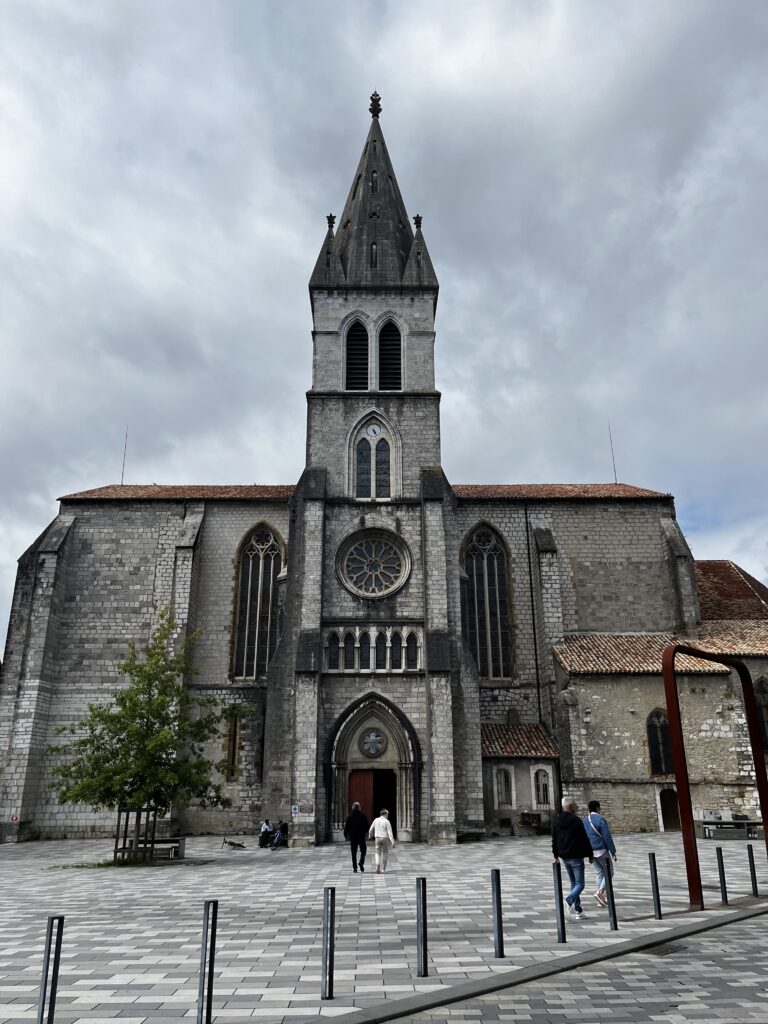
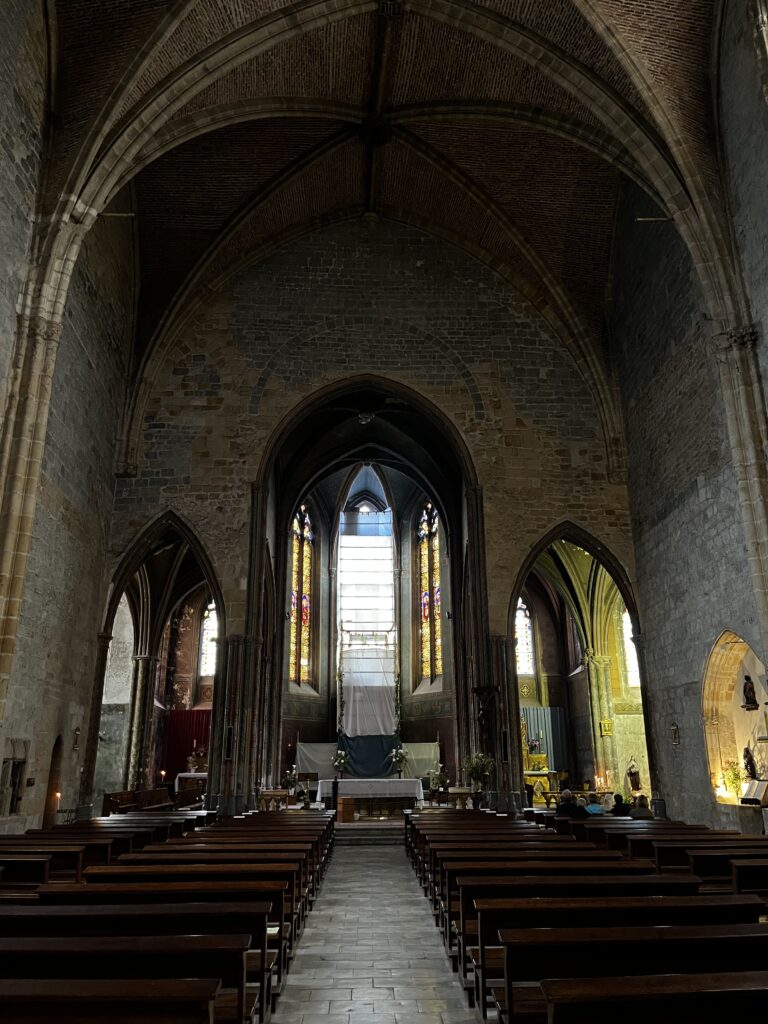
This the story of this church has familiar echoes from churches I’ve seen in the past few weeks. Built in the 13th and 14th centuries, confiscated and pillaged by the Protestants in the 16th century, restored and enlarged in the 19th century.
It has a sketch by Léon Bonnat for his panel in the Pantheon in Rome, “The Martyrdom of Saint Denis”.
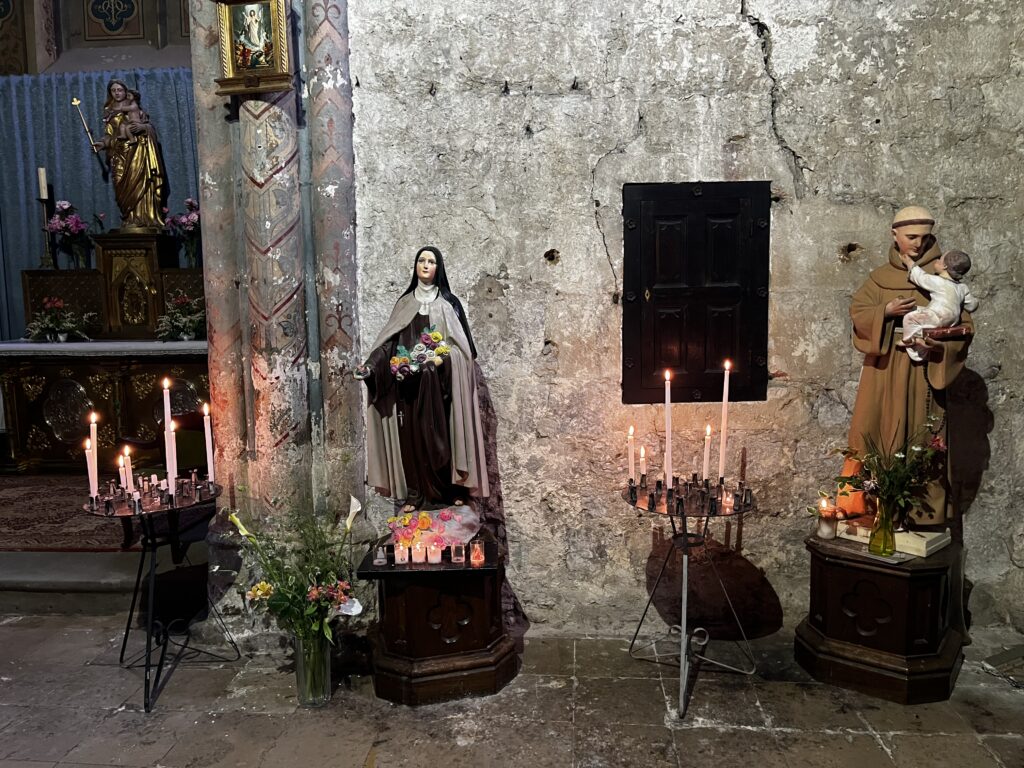
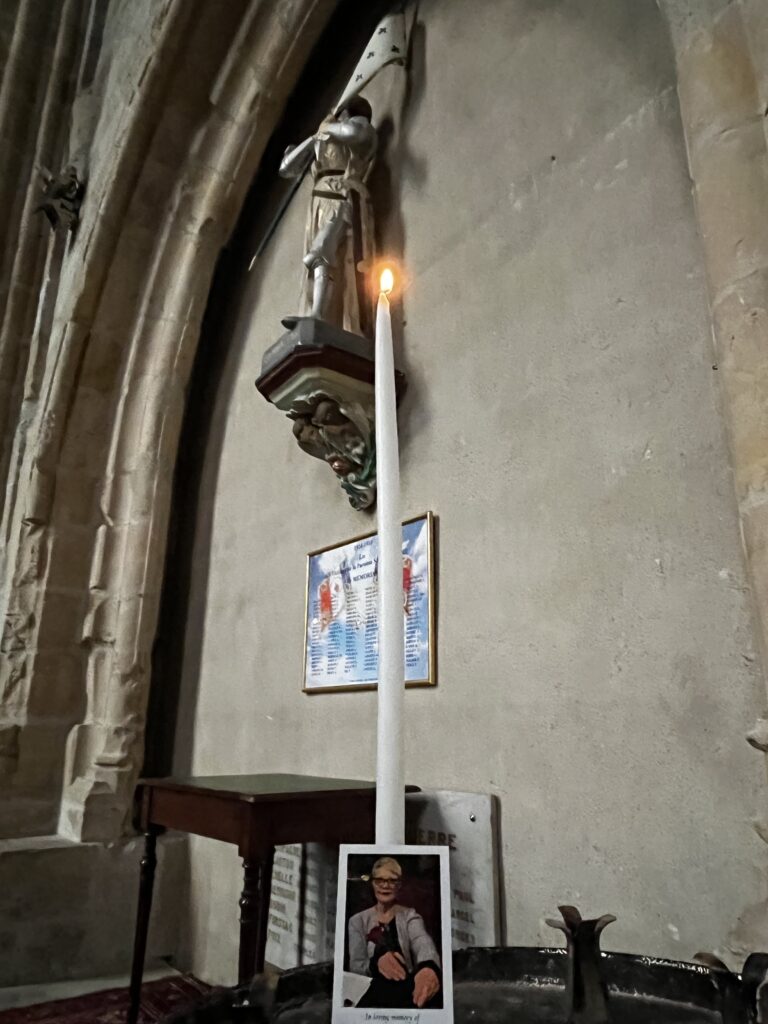
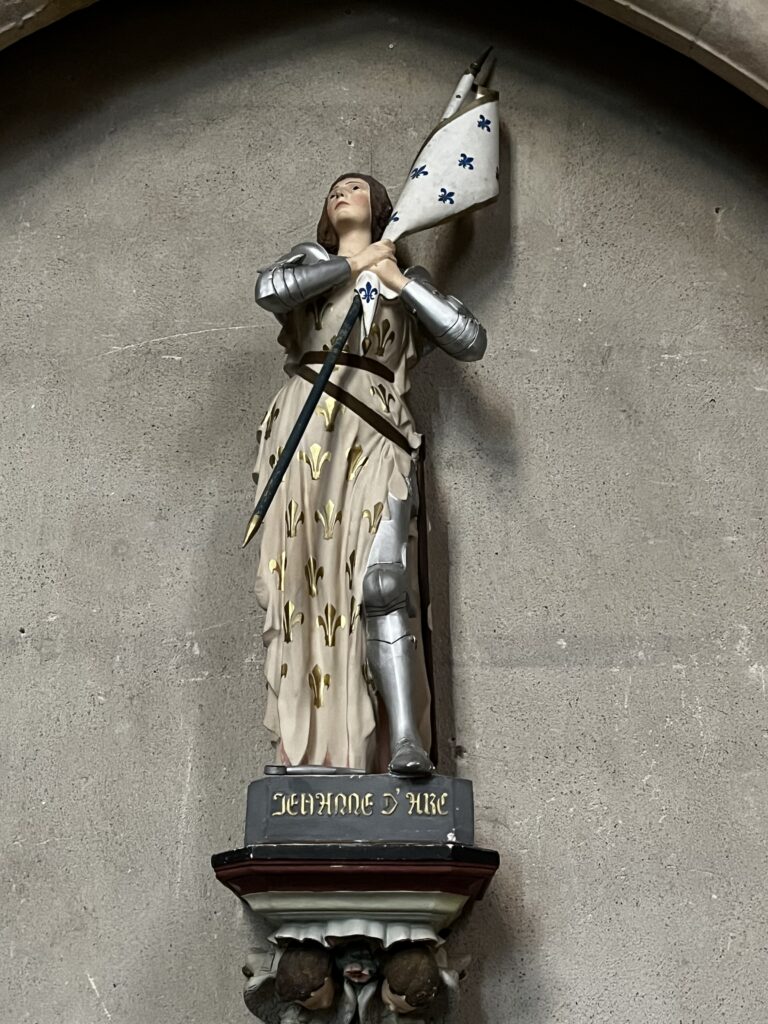
This is the first church I’ve seen where it was possible to light a candle in the chapel of Saint Joan of Arc. Since she is one of Francine’s favorite saints, this is where I lit the candle for her.
Date: 16 May 2026
Place: Orthez (Ortès)
Today started: Hagetmau
Today’s Photos!
A long walk for you on this day. Always impressed by the beautiful churches