
Via Lemovicensis: to Hagetmau and Reflections on Halfway
Today is halfway day. Not in terms of distance – that probably happened several days ago. No, this is the halfway point in days walking on this pilgrimage. It is also an extremely short day – the book says 16.2 km. I’ve done several days with double that length, so this is practically a rest day.
Tomorrow, of course, will be at least 28 km. That’s just how it goes sometimes.
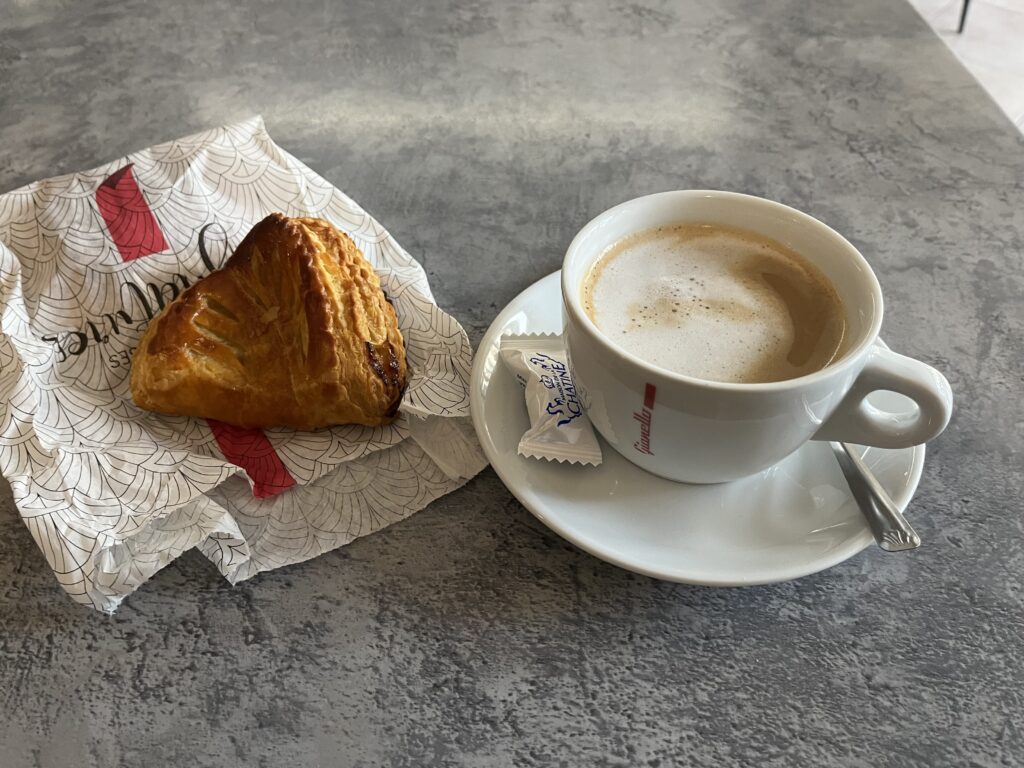
Today is also not a typical day in that my leisurely breakfast of coffee and pastries didn’t even begin until after 8 AM. The tourist office where I was to get my credential stamped wasn’t scheduled to open until 9.
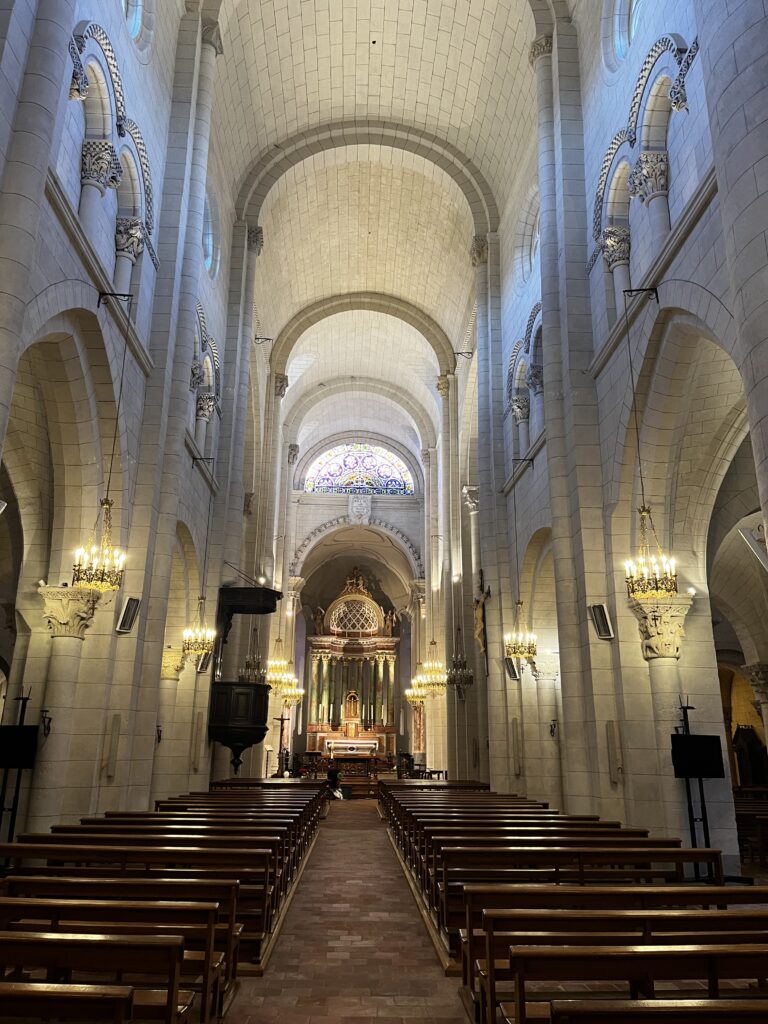
After breakfast, I returned to the abbey church to discover a platoon of ladies cleaning the church with brooms and buckets and mops and dust cloths and ladders. I prayed Lauds before heading over to the tourist office.
They were open! And they were happy to stamp my credential and backdate it to yesterday.
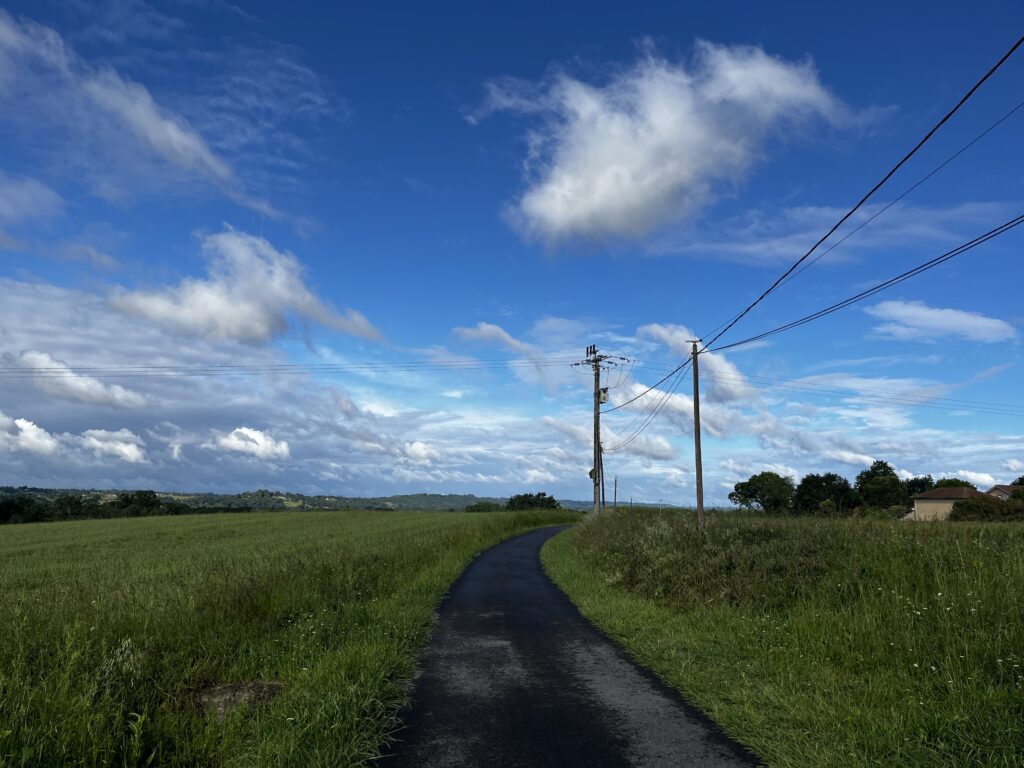
I finally started my tracker after 9:15, in front of the tourist office, and started walking the Camino. The air was cold, and the sky was blue with fluffy white clouds. The forecast, however, called for rain and possible thunderstorms later in the morning.
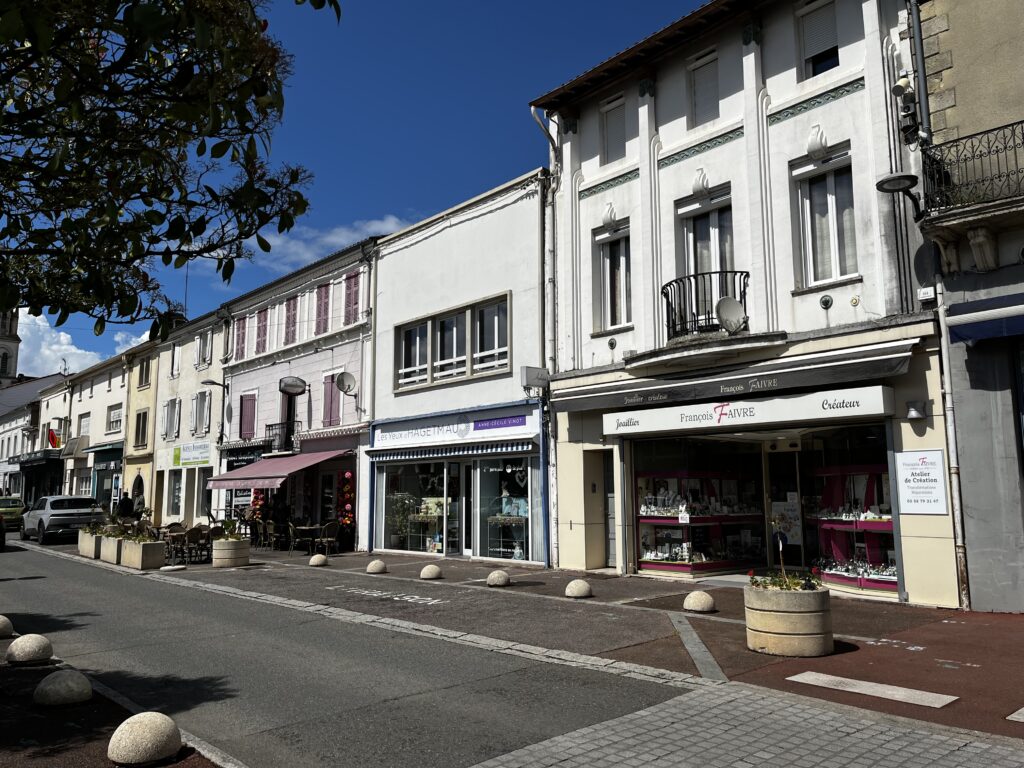
Shops were starting to open slowly on this four-day holiday weekend.
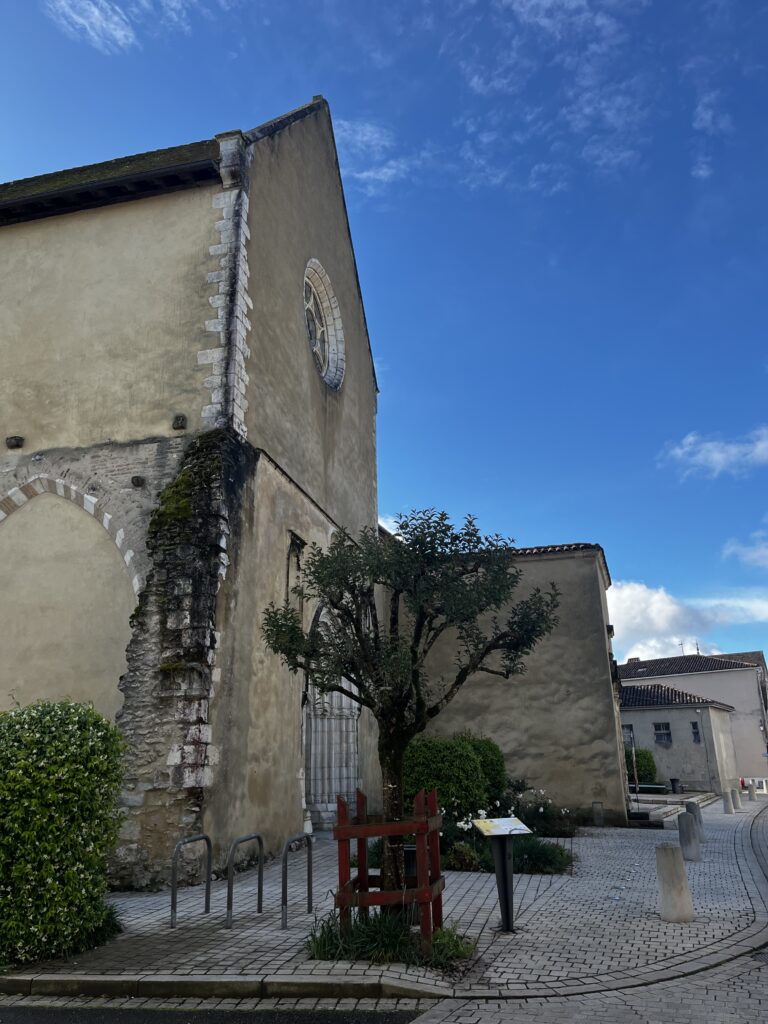
Within just a few minutes, I came upon a church I hadn’t realized existed. This is the remains of an old Dominican convent that was pillaged and seized during the Revolution. It’s now a museum and exhibition space.
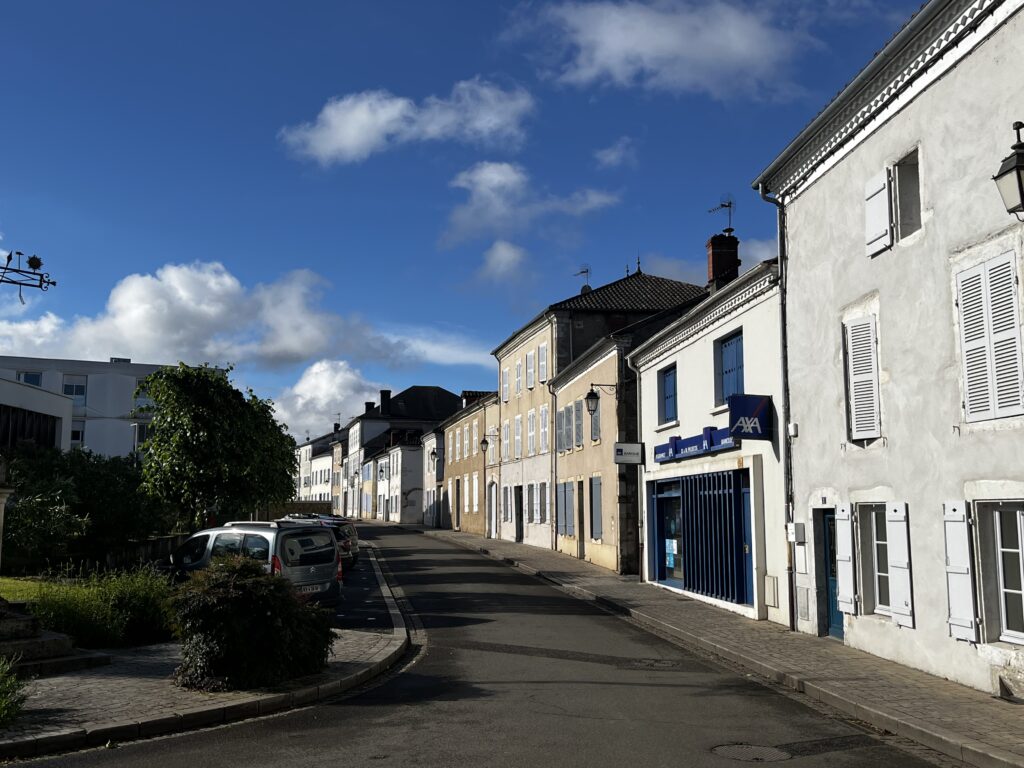
Except for the addition of a modern medical facility, the street I walked down doesn’t really look like it’s changed much since those days. And the whole street smelled of jasmine – it’s planted thick everywhere in this town.
After a few twists and turns through less dense residential neighborhoods, the Camino finally took me out into the more rural suburban ring. While there were still houses, they were often separated by wide fields or yards.
This morning, social media has refused to show me my memories of this day last year. Perhaps it’s just as well, as I can think about what the first half of this pilgrimage has meant.
The most honest answer, of course, is that I don’t know yet.
Certainly I have been challenged physically, mentally, emotionally, spiritually. I have made new friends of my traveling companions. Some of them have already left the Camino for this year, and some are continuing on other routes. Some, perhaps, I will see again. I certainly hope so. And I hope that I will keep in contact with some of them even after I have returned to Pistachio House.
I have revisited those terrible days a year ago and tried to put them in some sort of perspective. At the time, it was a dizzying and terrifying roller coaster most days, and it has been valuable to look at those experiences one year later. I should say, that doesn’t really make it hurt any less. Less sharp, perhaps, but still there. More of a hammer than a knife.
I’ve also reflected, and will continue to reflect, on how best to fulfill my promises to Francine.
I passed the last of Saint-Sever’s homes, and I now found myself roadwalking through farmland. It was about 9:40 in the morning.
I am starting to fulfill the first promise now: to go on all of the adventures that we had planned.
This particular Camino was almost an obsession with Francine. This spring, after spending a few days in her beloved Paris, we would have walked the northern branch from Vézelay to Gargilesse – the one section I will not have walked – and then returned next year to walk the southern branch, the year after to walk another few weeks, and so on.
Instead, I’m walking the entire distance from Vézelay to Santiago in one go.
But there will be other adventures, perhaps not soon. I suspect it will take me a long time to finish processing this one.
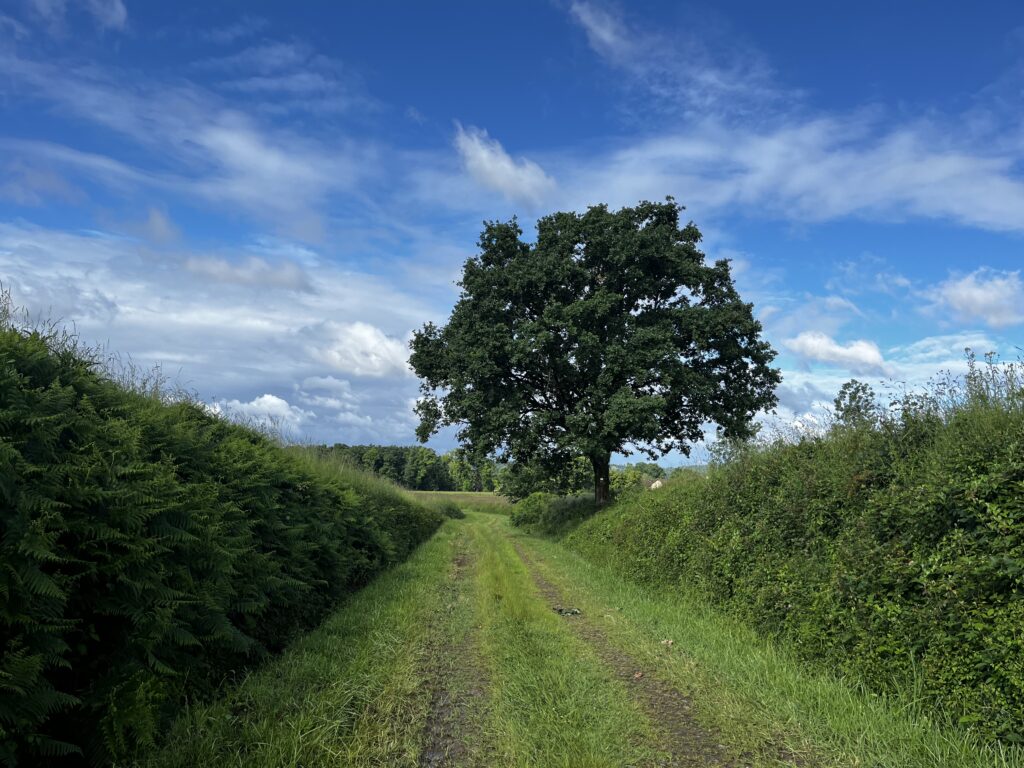
The Camino turned off the asphalt and onto a road of dirt and grass. It was wet, but fortunately not muddy, and I could avoid the long grass pretty well.
The second promise was to finish the projects we had planned at Pistachio House. I have already made a good start on this, both in the attic and the garage, though some adaptations must be made for the fact that this will be a house for one person, and not two.
I have tried to keep these adaptations to a minimum. The biggest one concerns the attic, which we had planned to turn into a studio space for Francine and a guest bedroom. I have no need for a studio, so instead this will become the non-fiction portion of the Pistachio House library.
We have bookshelves or book piles in every room of the house. Some rooms will retain their bookcases, but I’m planning to move most of the fiction to my office and most of the non-fiction to the attic library.
Francine’s office will eventually become a guest bedroom. For now, I’m using it as a staging area as large piles of things get moved around the house or to thrift.
This will probably be the last room that gets redone, as it will be the most difficult to deal with emotionally.
At about 10 AM, the Camino returned to the asphalt at a little farmstead. I met two hikers going the opposite direction.
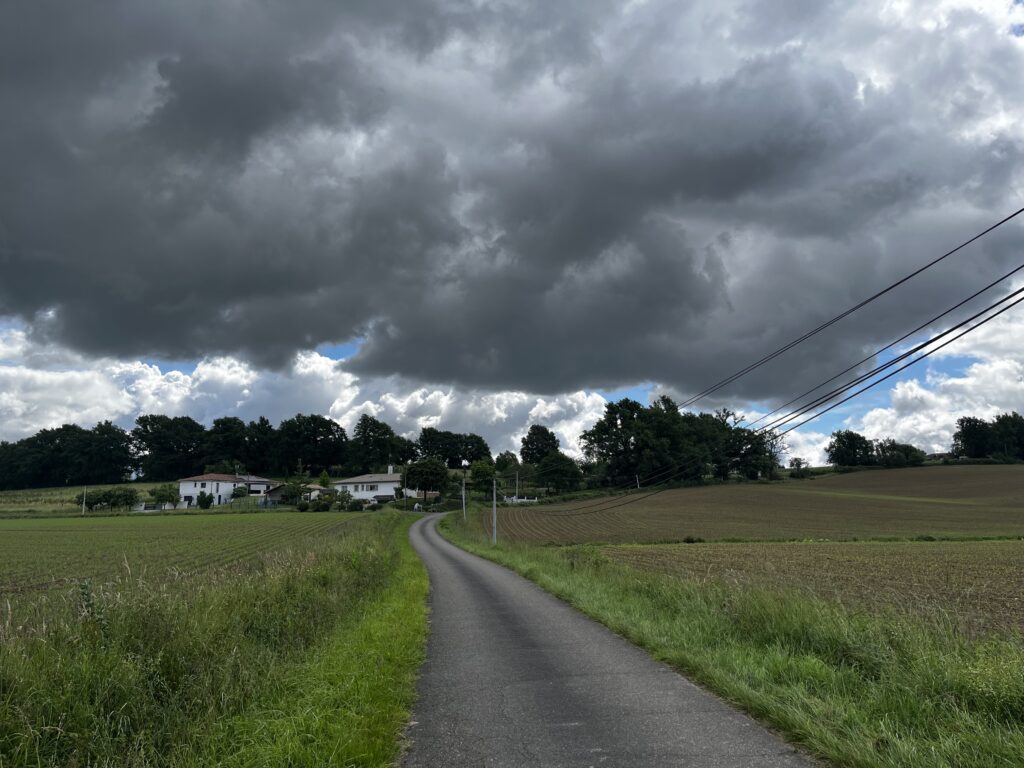
After this, it was roadwalking through farmland. In the distance were hills and trees, but my immediate surroundings were fields, the crops already knee-high after the spring rains.
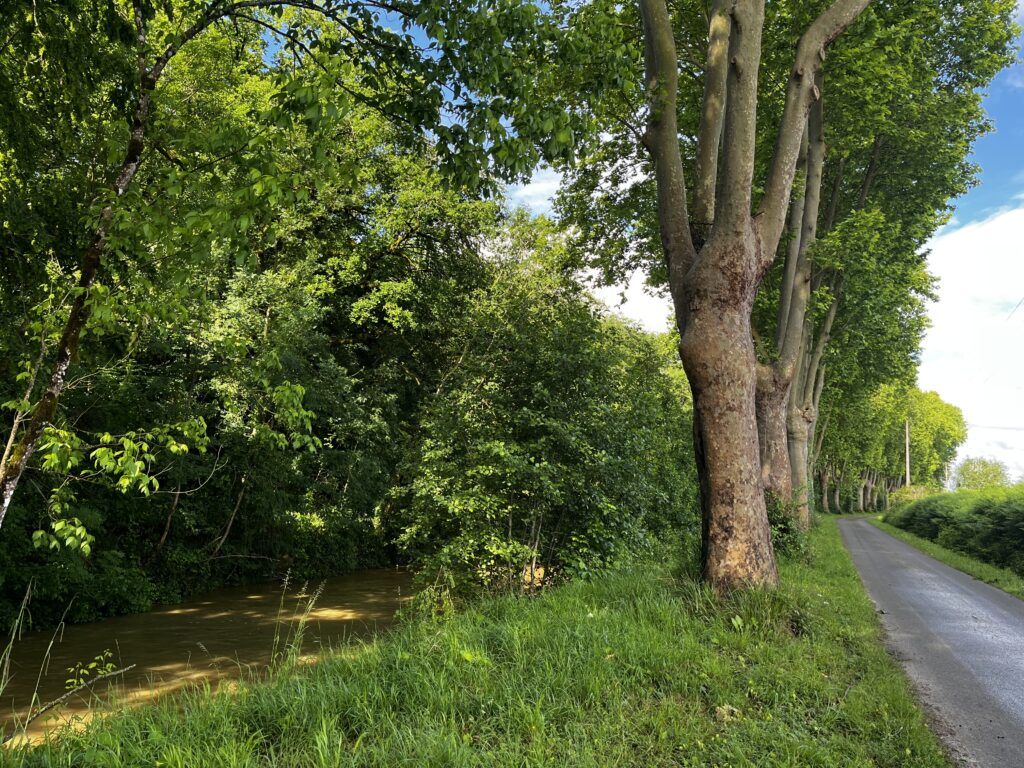
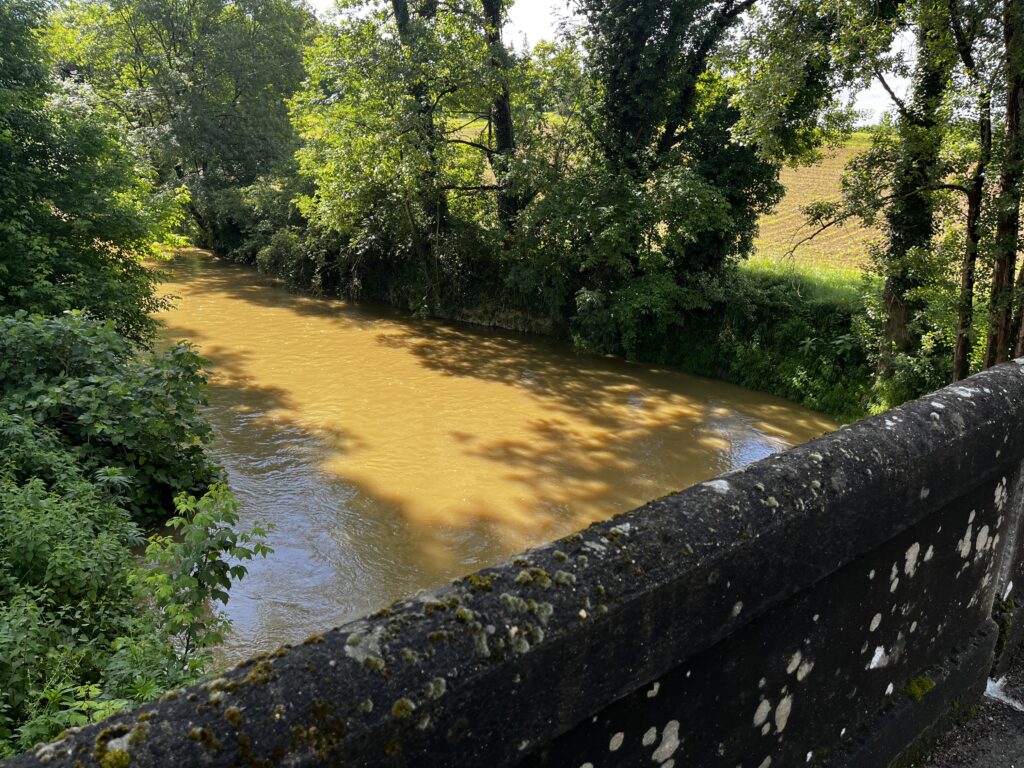
At about 10:15, the road started following the course of the muddy River Gabas off to my left. Trees lined the road on that side, and it reminded me of an overgrown version of the river park that led into Saint-Sever yesterday.
Just a few minutes later, the Camino crossed over the river on a bridge of steel and concrete.
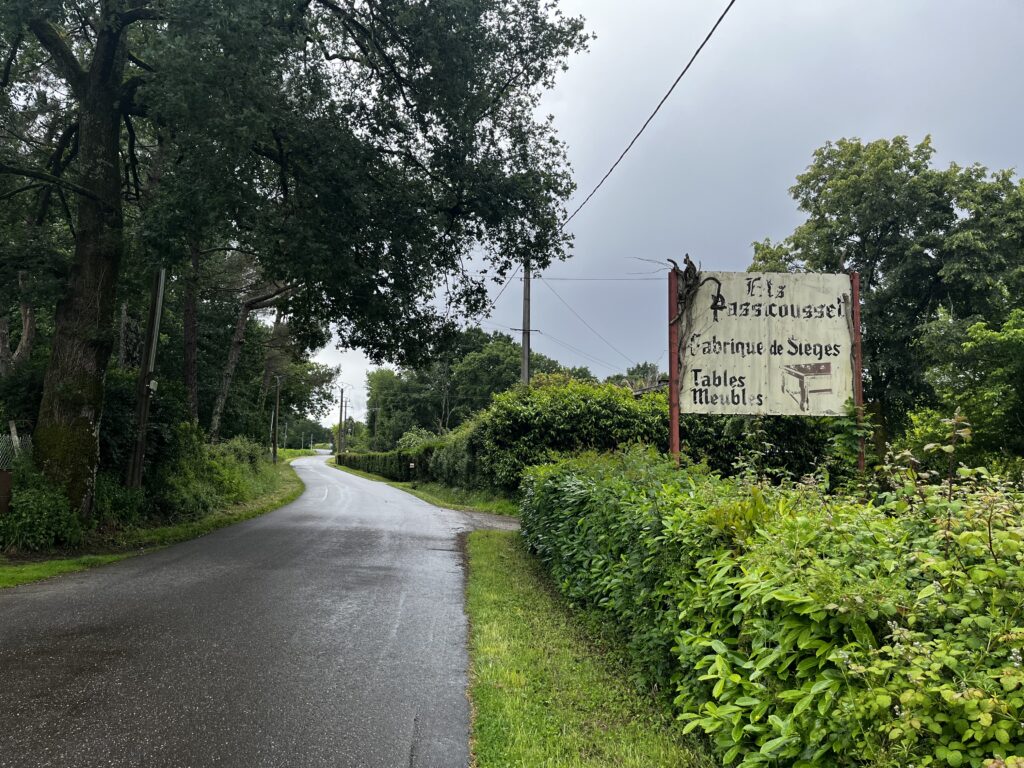
Every now and then as I walked through the farm country, I would pass a farmhouse or a collection of buildings that in other regions would typically have a little sign with the name of the hamlet. That does not appear to be the case here.
The third promise I made to Francine is more difficult, in that I’m not entirely certain how best to proceed. In part, maybe that’s what this Camino is for.
I passed through several unnamed hamlets. In one of these hamlets at about 10:40, the Camino left the asphalt for dirt and gravel once more.
This quickly disintegrated into a grassy trail around the edge of a farmer’s field before returning to the road and bringing me into the village of Audignon.
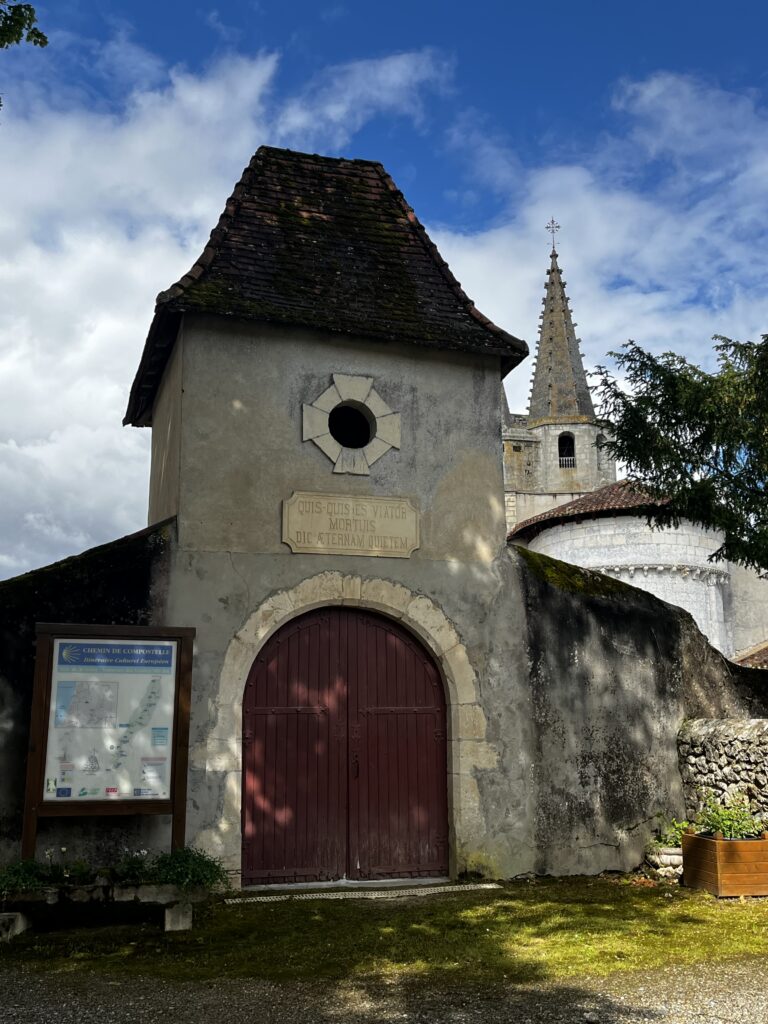
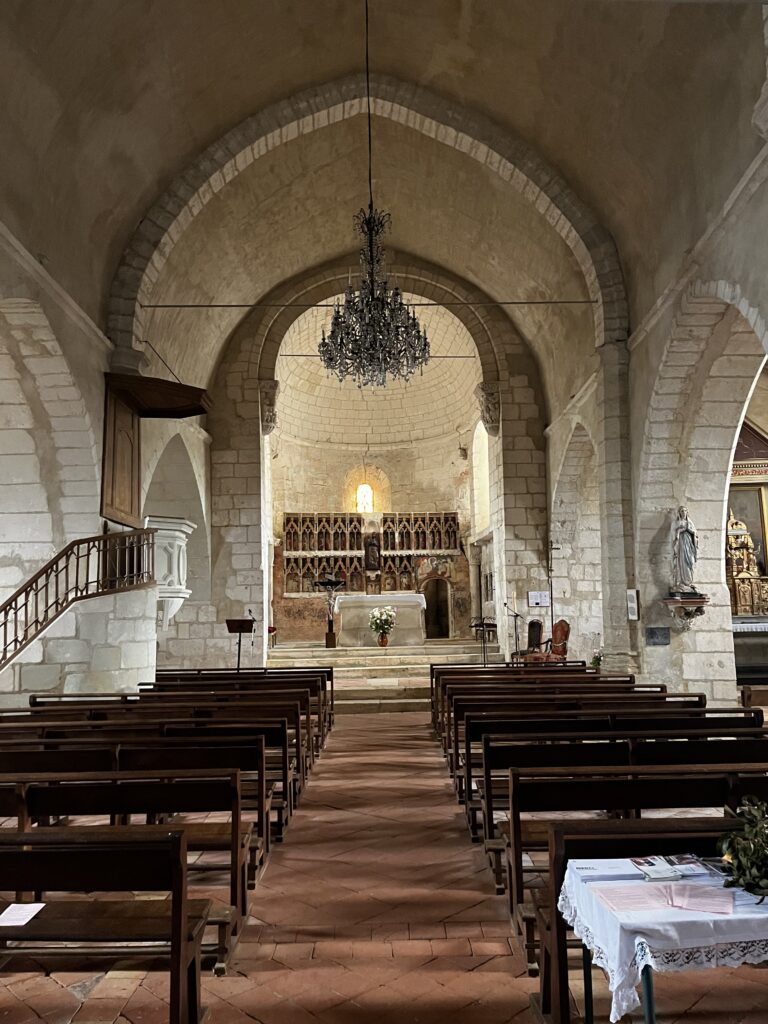
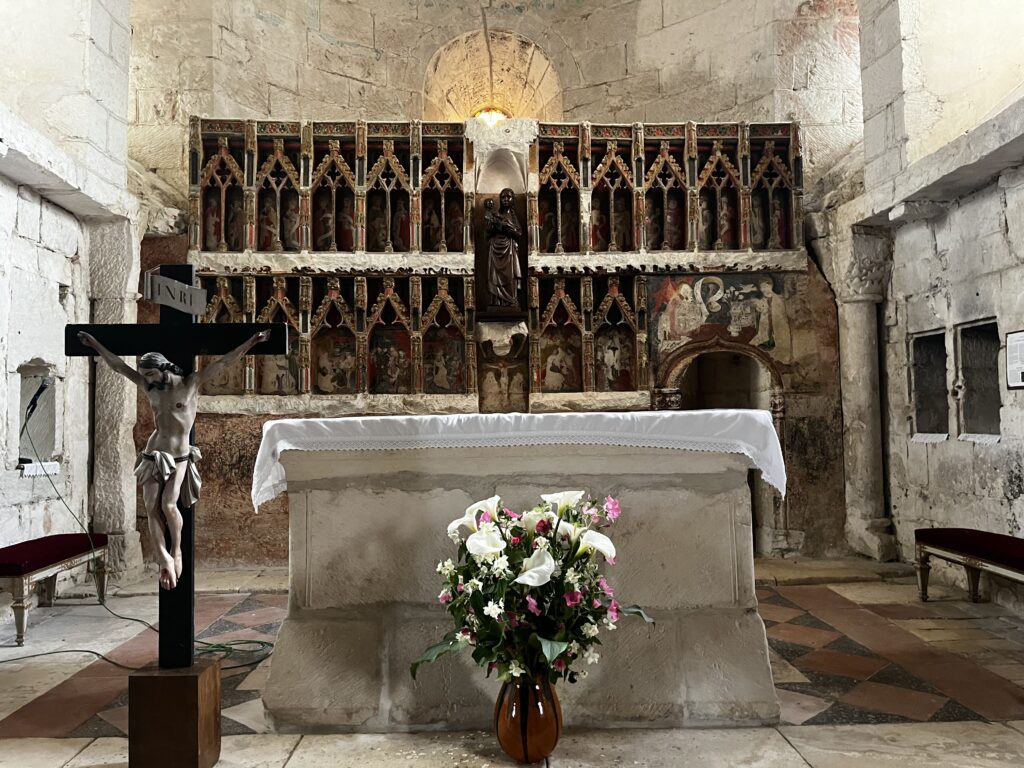
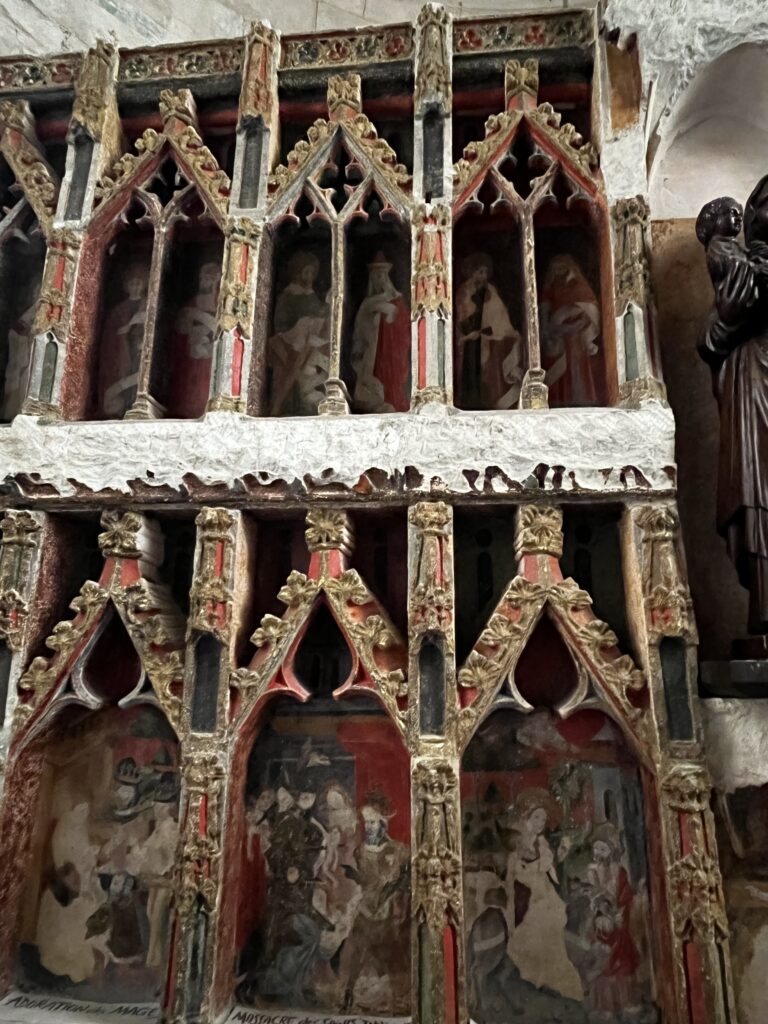
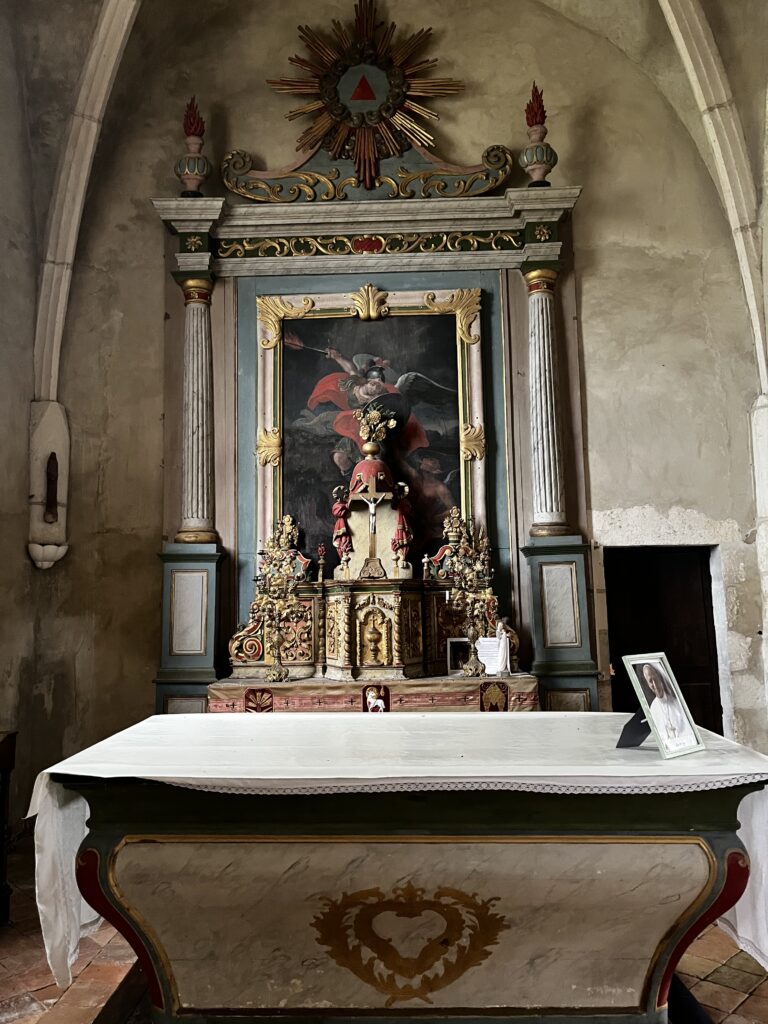
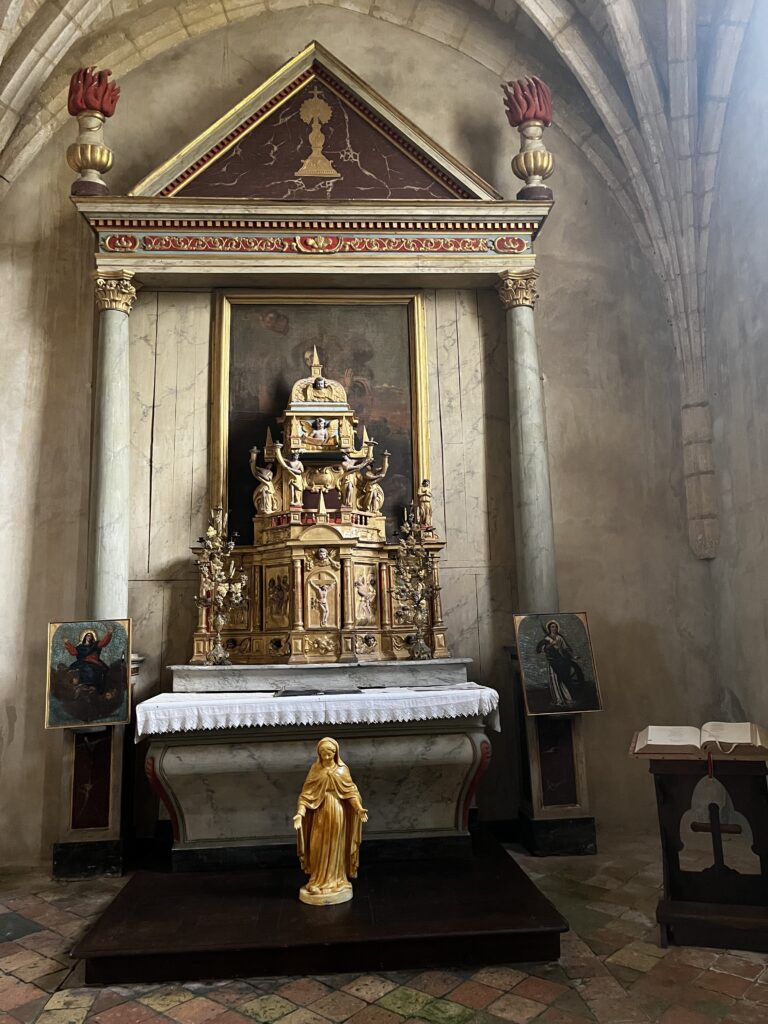
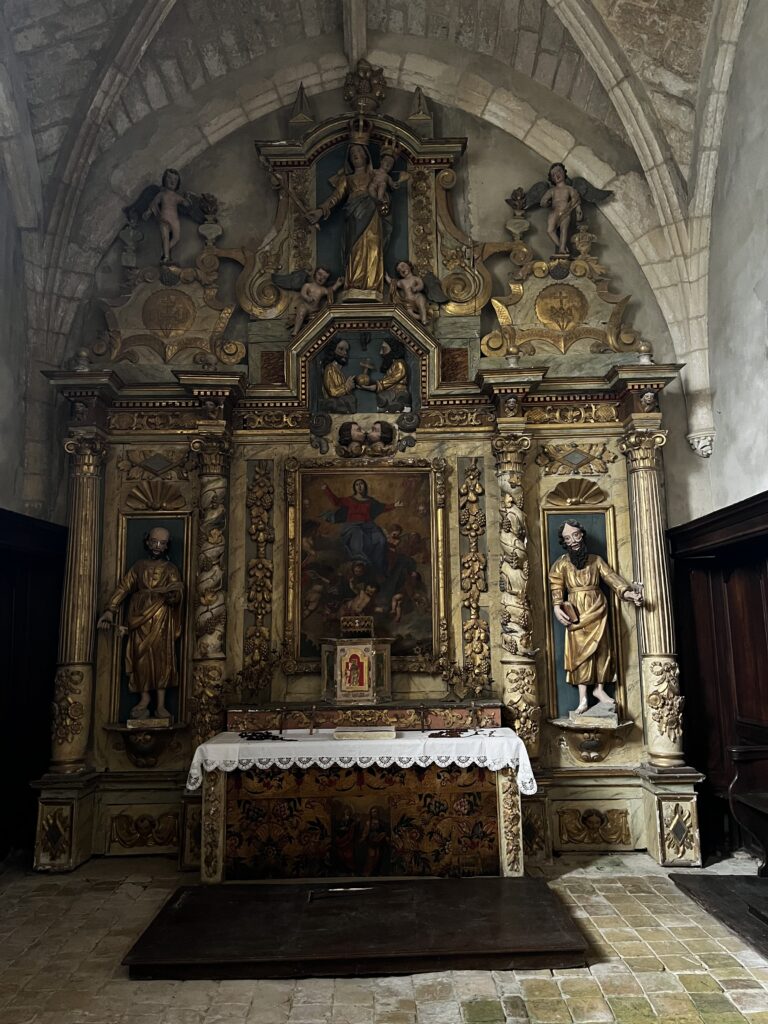
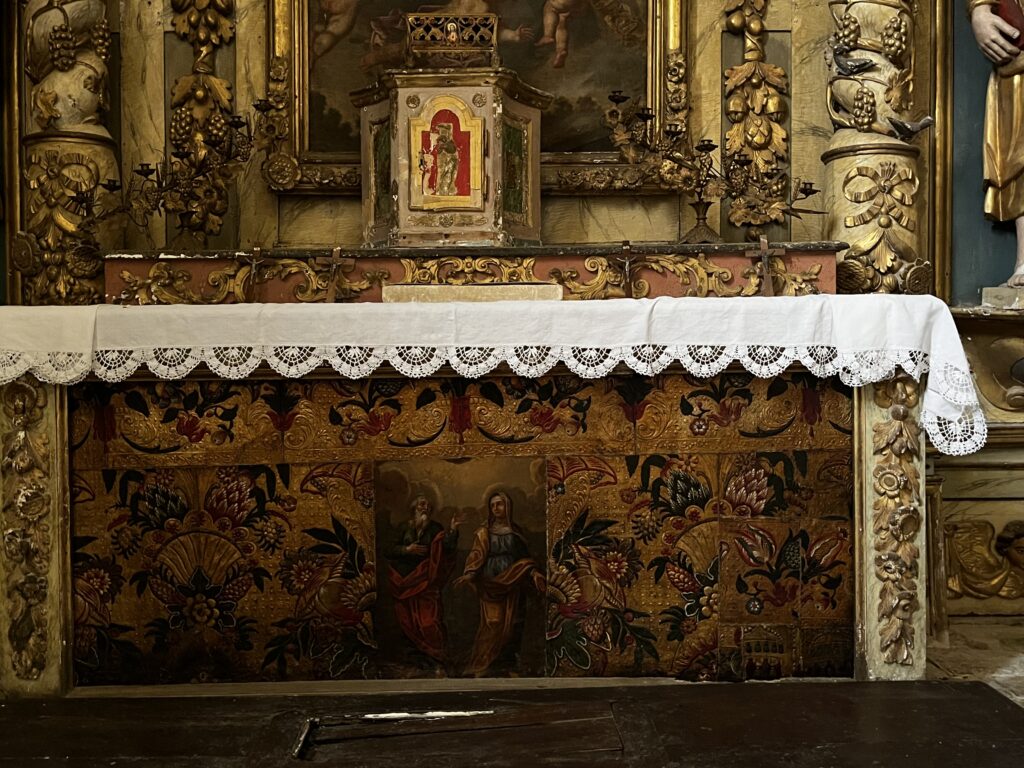
I entered the little 11th-century church of Notre-Dame at about 10:55 AM, and I was utterly unprepared for what I found there. The altarpiece in the sanctuary is a Gothic masterpiece, albeit badly in need of restoration. The remainder of the chapels here are Baroque, and one of them would not be out of place in the grandest cathedral. Again, they’re all very much in need of restoration, but they are amazing.
It was 11:15 before I left the church.
The third promise I made to Francine was to live. She also extracted this promise from family and some visitors, “make sure that husband of mine lives”.
Up to now I have been surviving. Even that was in question in the early days, when despondency and aching sorrow had taken hold of me to the point where it was difficult most days to get out of bed.
Were it not for the promise, I very well could have wasted away like the protagonist of some 19th century romantic novel. Some days, the only reason I could think of to continue on was my promise to Francine.
Those darkest of days are, I hope, behind me now. Even in the weeks leading up to my Camino, there were still days when it was difficult to get out of bed. But it was not every day.
But surviving is not thriving. And to me, the promise to live does not mean merely to survive. The trouble is, I don’t really know how to do that.
I don’t know how to live alone anymore. After twenty years of living with Francine, where her presence informed everything that we did just as much as mine did, I still feel unmoored and adrift.
Of course, my first priority must be to find paying work. Nothing happens if I can’t pay the mortgage and the bills.
Next, I have a couple of books that definitely need to be completed.
But I suspect an awful lot of Francine’s concern was the social aspect. And of course, it doesn’t help that she was our social planner. I’m terrible at those sorts of things. I’m exactly the guy who says to you, “let’s get together sometime soon”, and the next time we meet is randomly at an event seven years later.
One of the reasons Francine wanted to build a pub in our garage (see promise two) was so we could have regular, open-house potluck gatherings of friends and acquaintances. We used to do this at our apartment before we bought Pistachio House, the one with all the 13s in the address. We would have Friday the 13th parties.
She always wanted to return to doing something like this at Pistachio House, but although the house is large, the rooms are somewhat cramped. We needed to reclaim some additional space by building patios in the backyard and by building a space in the garage. This was part of our “five-year plan” that we were still working on twenty years later.
So maybe that’s one thing.
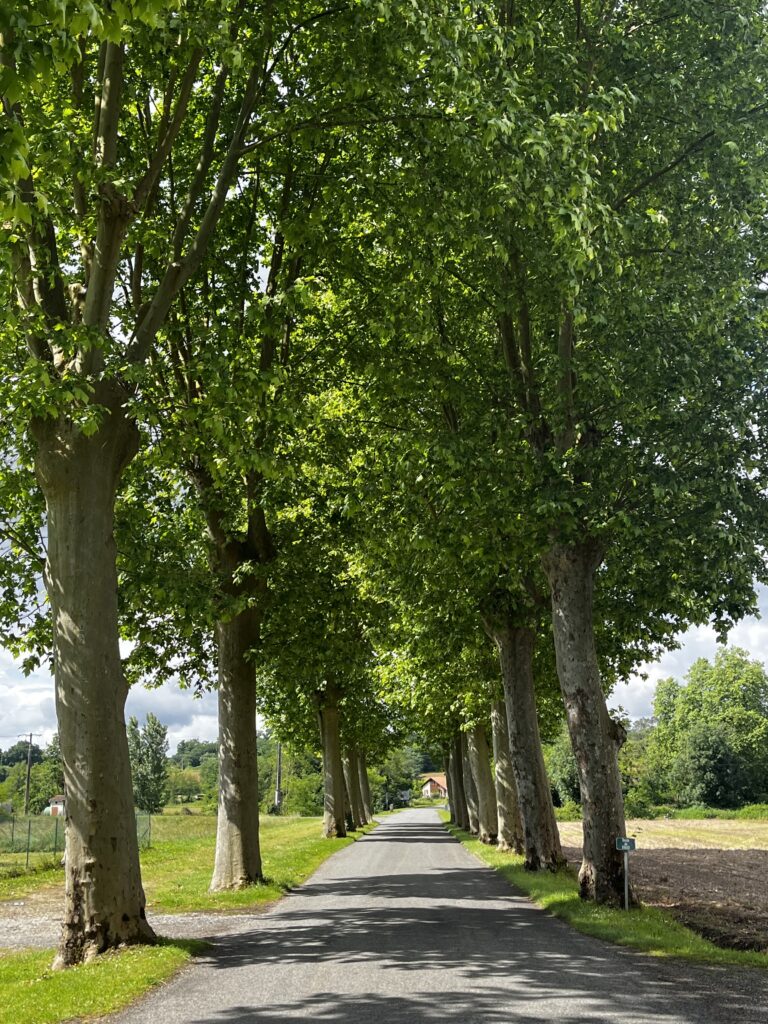
The Camino left the village by way of an asphalt road through another colonnade of old trees.
There were definitely more trees in general now, with the fields being smaller and more hemmed in.
I finally passed through a hamlet with an actual name, Manoir, sometime before 11:30. Curiously, it did not have a manor so far as I could tell.
About ten minutes later, near yet another unnamed hamlet, I found a pair of sunglasses in the grass by the side of the road. I’m pretty sure they belong to Pierre. I picked them up with the hope of getting them back to him. We should meet again in Orthez tomorrow.
The air was getting colder, and a dark cloud hovered above. Was the predicted rain finally going to put in an appearance?
Around 11:45, I passed through an extended farming hamlet of more than a dozen farm houses and suburban homes. It looked like there was even some new construction set to begin.
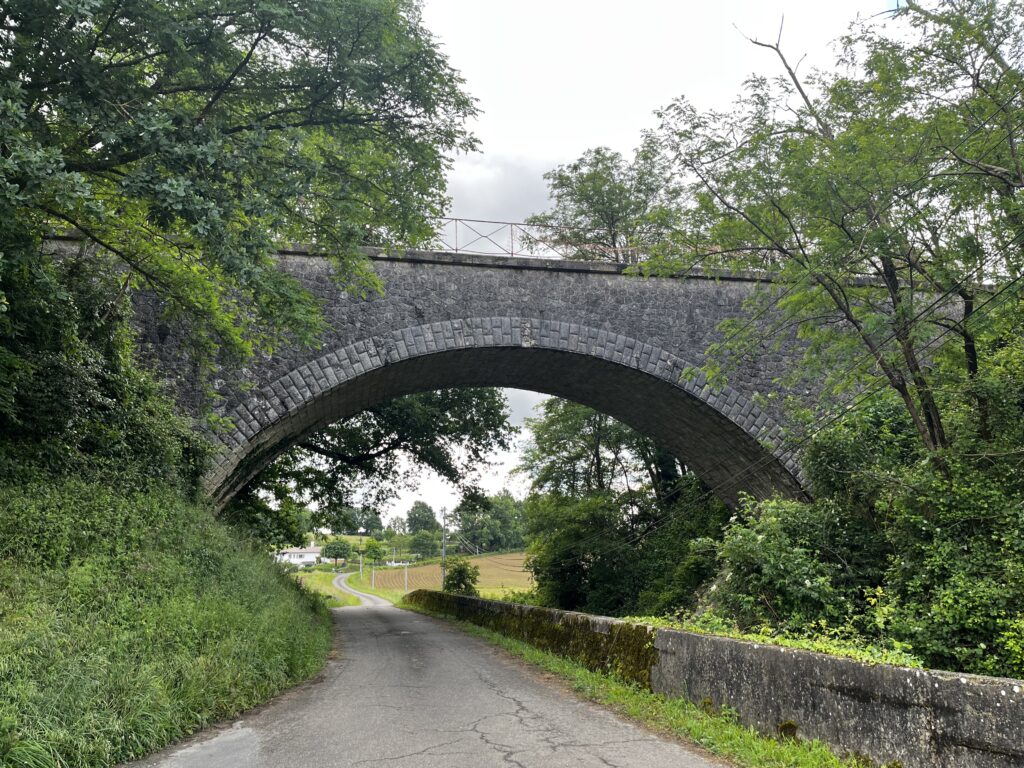
From here, the road wound downhill into the woods briefly before returning to farmland. At 11:55, the Camino passed under an arched railroad trestle.
Just after this, I passed through another large hamlet with no name. This one definitely had more of a suburban character, and I wondered if it’s an outlying neighborhood of the next village.
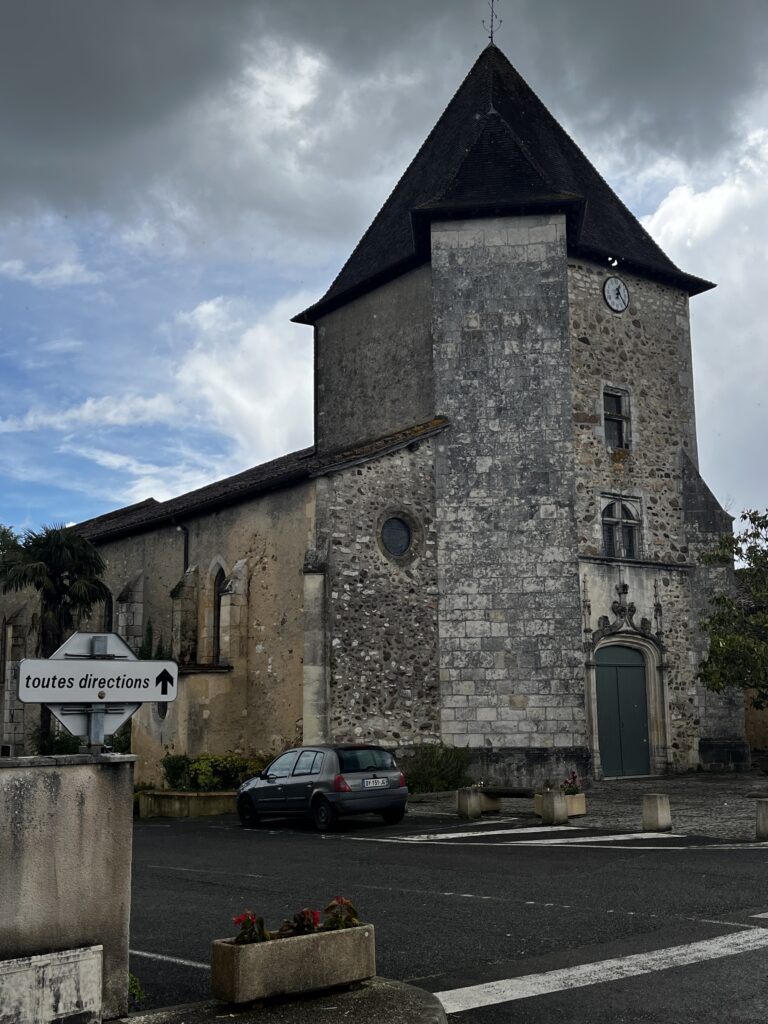
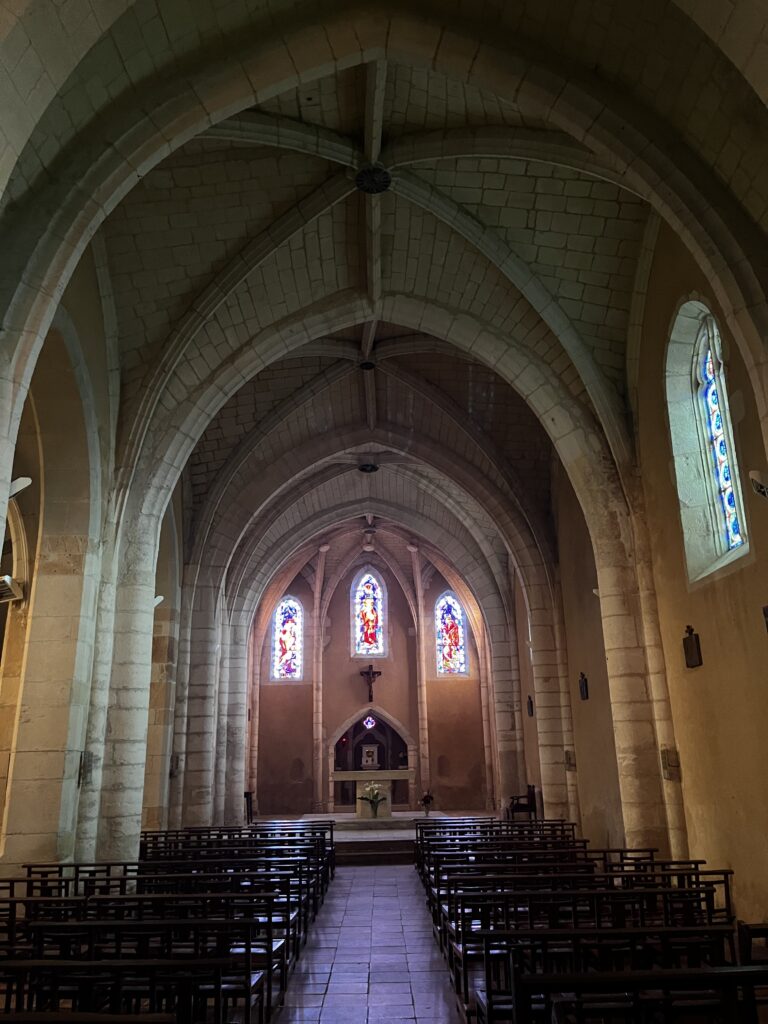
The road eventually took me uphill to the village of Horsarrieu (or Horcs Arriu in Béarnais). It was raining by the time I arrived at the little 15th-century church of Saint-Martin at 12:25, a sweaty mess.
The original 12th century chapel here had been taken down to its foundations during the Hundred Years War.
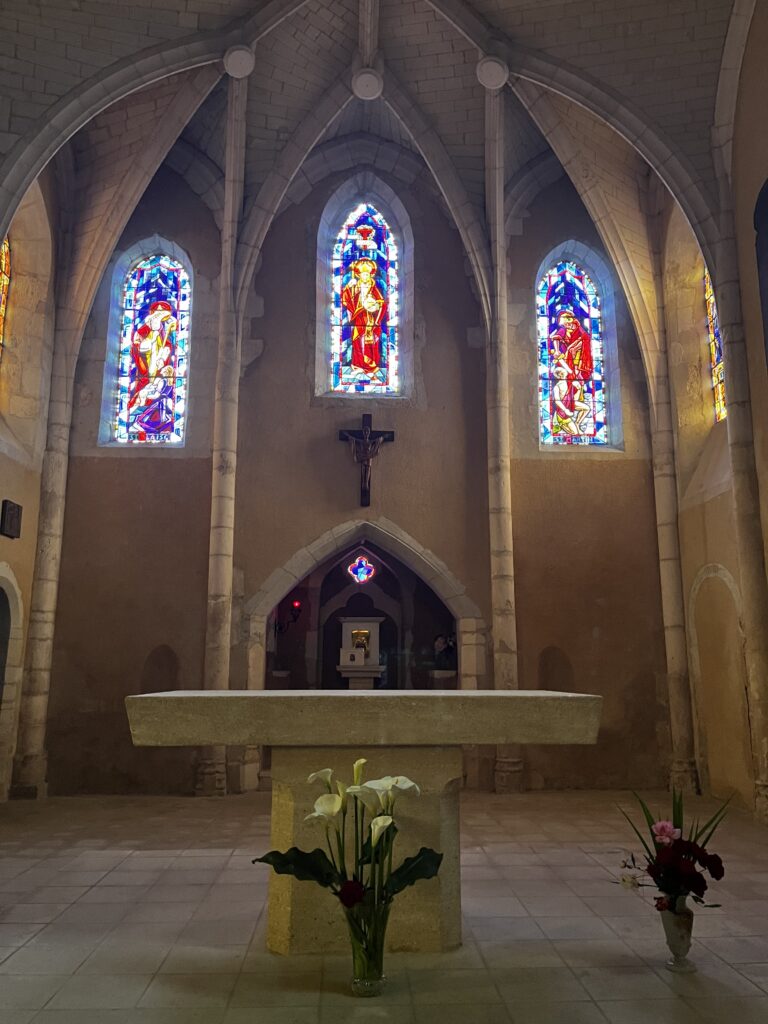
The successor church, even through countless renovations and additions through the centuries, retains its simple lines. The 20th-century stained glass is surprisingly good. I sat here a long time.
The Lord often speaks to me powerfully on Camino. I am very fond of Saint Augustine’s observation that “it is solved by walking”. He’s not wrong. And of course, I am a Benedictine oblate attached to Saint Martin’s Abbey, and I am constantly reminded of the first word of Saint Benedict’s Rule: listen.
While pondering the question of how I would “live”, I was reminded of Saint Paul’s words to the Galatians (2:20), “I have been crucified with Christ; it is no longer I who live, but Christ who lives in me”.
After Francine’s funeral, one of the things that kept me sane and semi-functional was service.
I volunteer at my parish in both catechesis and the sacred liturgy, both because I love these things and the Lord seems to have given me some small talent in these areas, but most especially because they seem to be the most useful way for me to serve the people of God.
After a few encounters on my pilgrimage from Le Puy in 2023, I felt the Lord was calling me to promote the divine office in a more particular way. This I’ve tried to do, with Solemn Sunday Vespers now chanted in my parish during Lent and (once) Advent.
Despite jokes over the years to the contrary, I do not believe I have a vocation to the monastery, but the reciting, or better yet singing, of the divine office in community is a time and place where I feel the Lord is closest to me.
Off and on, Francine and I have promoted or even attempted weekly Vespers in our parish since shortly after my baptism more than twenty years ago, now. Sometimes these efforts have been successful – or spectacularly unsuccessful – but they have always yielded good fruit.
When I can, and when I won’t disturb others, I often (partially) sing my office in churches along the Camino. I have also done this in my parish, if I’m there early enough before the Sunday evening Mass.
With the imminent publication of the revised English translation of the Liturgy of the Hours, the days are perhaps coming when singing (or even just reciting) solemn (or even simple) Sunday Vespers in our parishes might be a good next step.
After all, Vatican II specifically called for this. After more than sixty years, I think we are past due to begin implementation.
With the simple version, you don’t even need a celebrating priest or deacon, which I know can be a scheduling concern.
When I finally left the little church of Saint Martin, it was after 12:50, and the rain had stopped. The only bar or café I passed in the village was closed.
Shortly after I left the village, it began to rain, and even briefly to hail. The houses didn’t stop at the village border though, they continued for quite some time. And there was plenty of new construction going up.
After this, it was roadwalking in the rain through farm country with occasional farm houses, unnamed hamlets, and the sometimes small stretches of woods.
At 1:20, I came to an enormous roundabout bordering what appeared to be grain silos and a distribution facility. There were many semi trucks going through the area.
I did not enjoy road walking through this. Fortunately, I was only on the highway for a few hundred meters before the Camino diverted down a much less busy road.
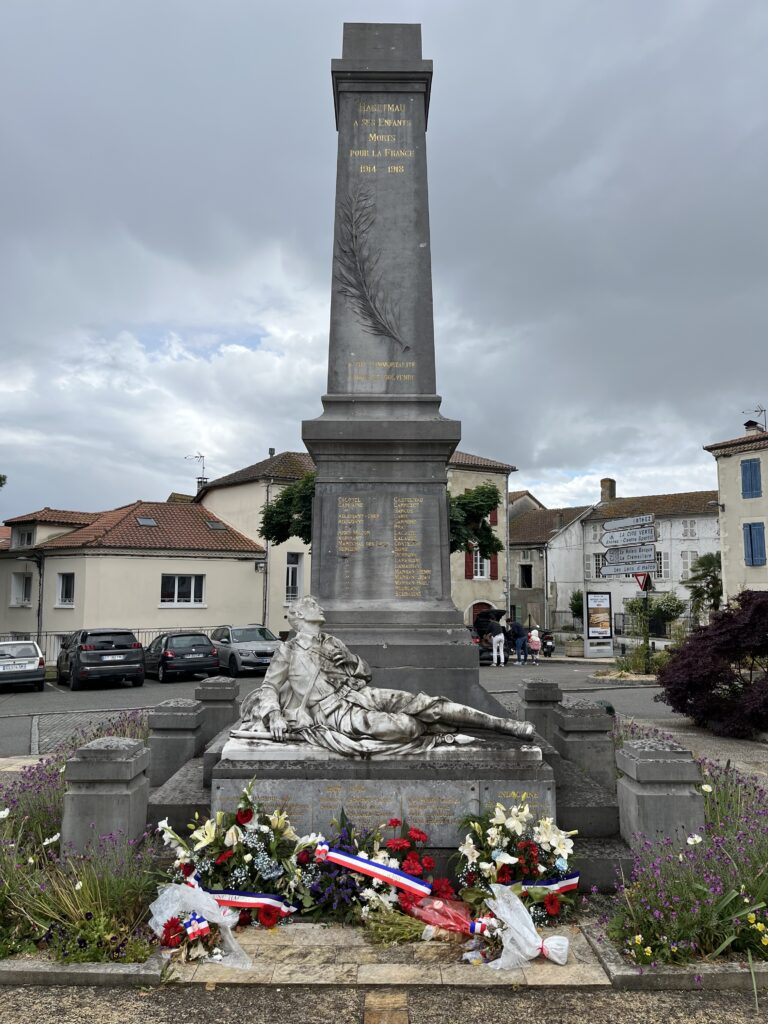
Within minutes, I had passed the sign announcing the city of Hagetmau. The area was still pretty rural here, with a smattering of houses and one very large filling station. The rain had stopped.
Gradually, the urban density increased, and I was soon walking through a suburban-style neighborhood, complete with a large structure containing the municipal tennis courts.
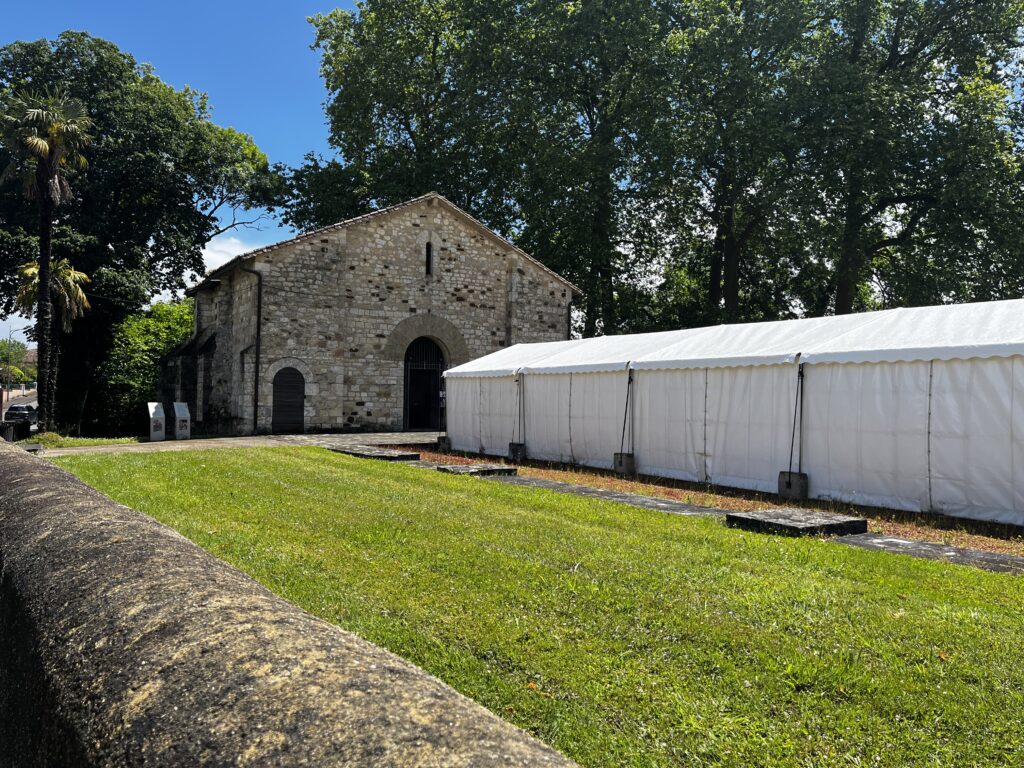
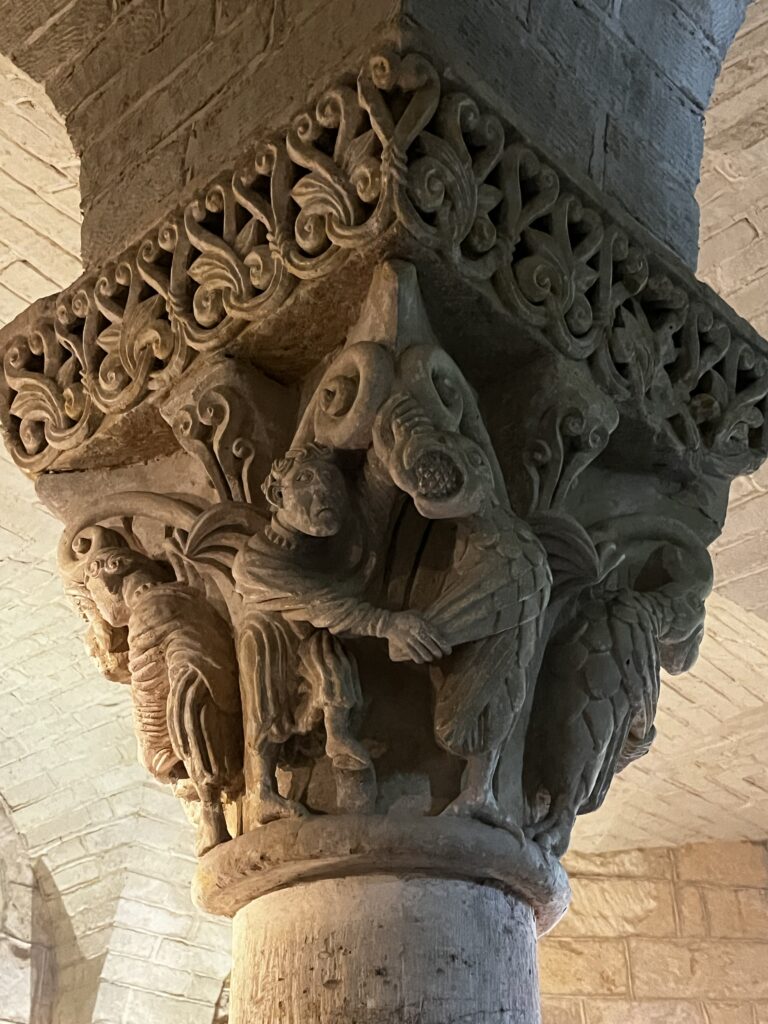
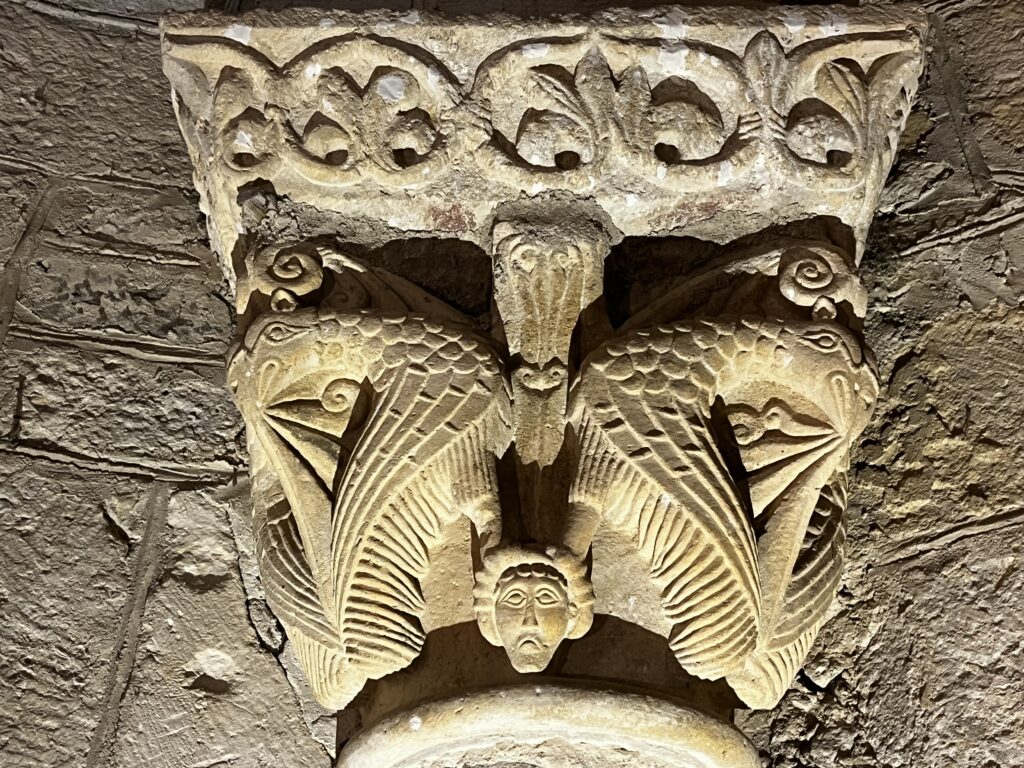
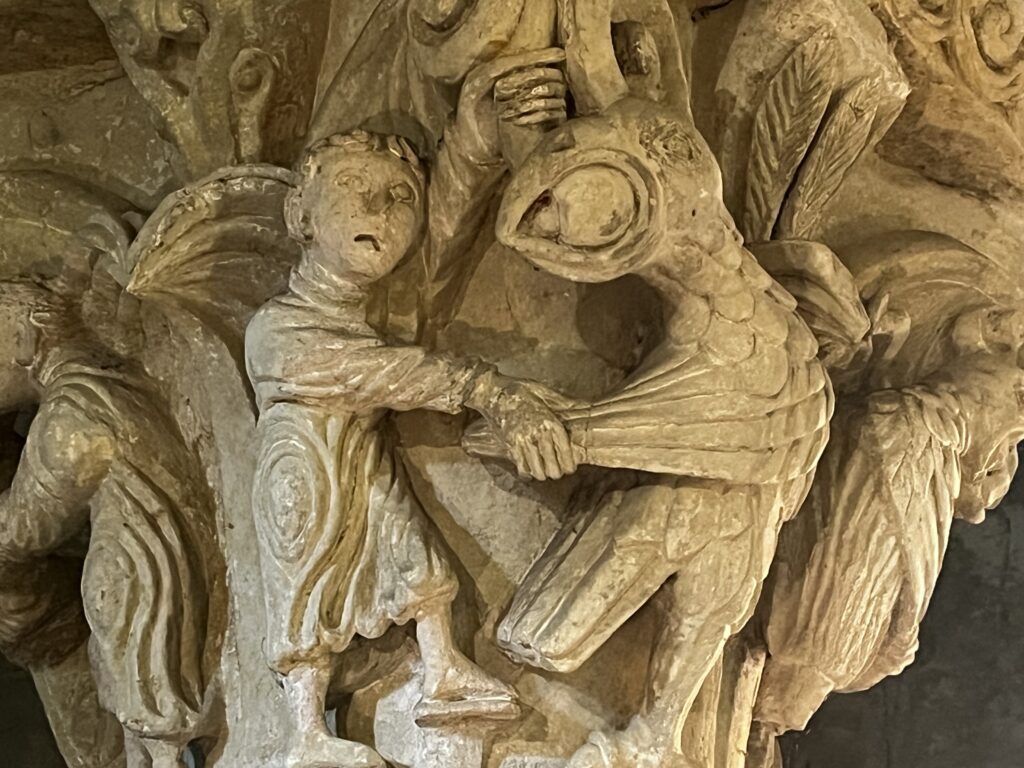
At about 1:40, I diverted from the Camino route to visit the crypt of Saint Girons. He and his companions were sent by the pope to evangelize this region in the fourth century. Visigoths didn’t much like this. The crypt is all that remains of a once massive 12th-century abbey that was largely destroyed during the Wars of Religion, when the Protestants sacked the place and scattered the Saint’s desecrated remains. The church itself was disassembled block by block following the Revolution.
The original monastery on the site was founded during the time Charlemagne, when the Emperor himself ordered the construction of a mausoleum above the martyr’s grave.
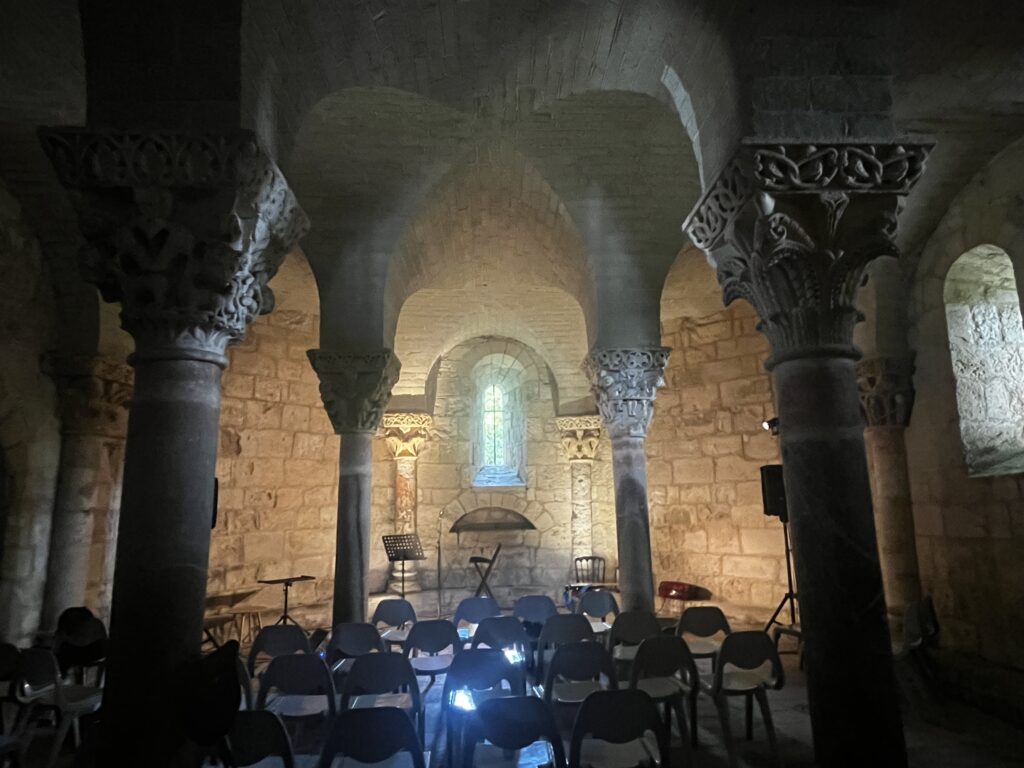
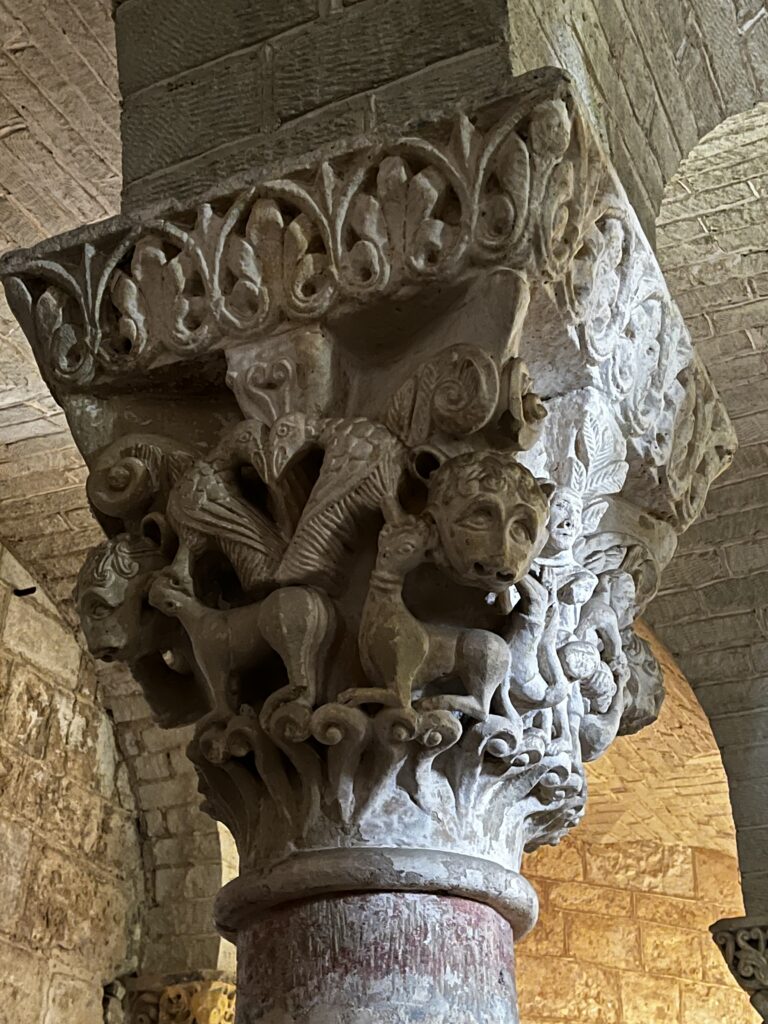
Somehow, part of the church crypt survived, and its Romanesque capitals are a thing of wonder. I can only begin to imagine what the abbey itself was like in its prime.
When I arrived for my visit, there were folks setting up for a poetry and music festival, with a stage in the crypt itself set up with amplifiers and electric guitars.
On the one hand, I’m kind of appalled at this use of the (formerly) sacred space. On the other hand, normally the crypt is only open during the summer months, and if it had not been for this, I would not have gotten to visit it at all.
Now the plan was to find the municipal gîte, which was on the way to the town center. Upon arriving, I was greeted by a young lady named Lucy who I soon learned was not actually an hospitalera. She was here for the poetry festival, and the town had put her and her friend up here.
Which was all well and good, except that at some point I would need to get my credential stamped, and I would need to pay for my stay.
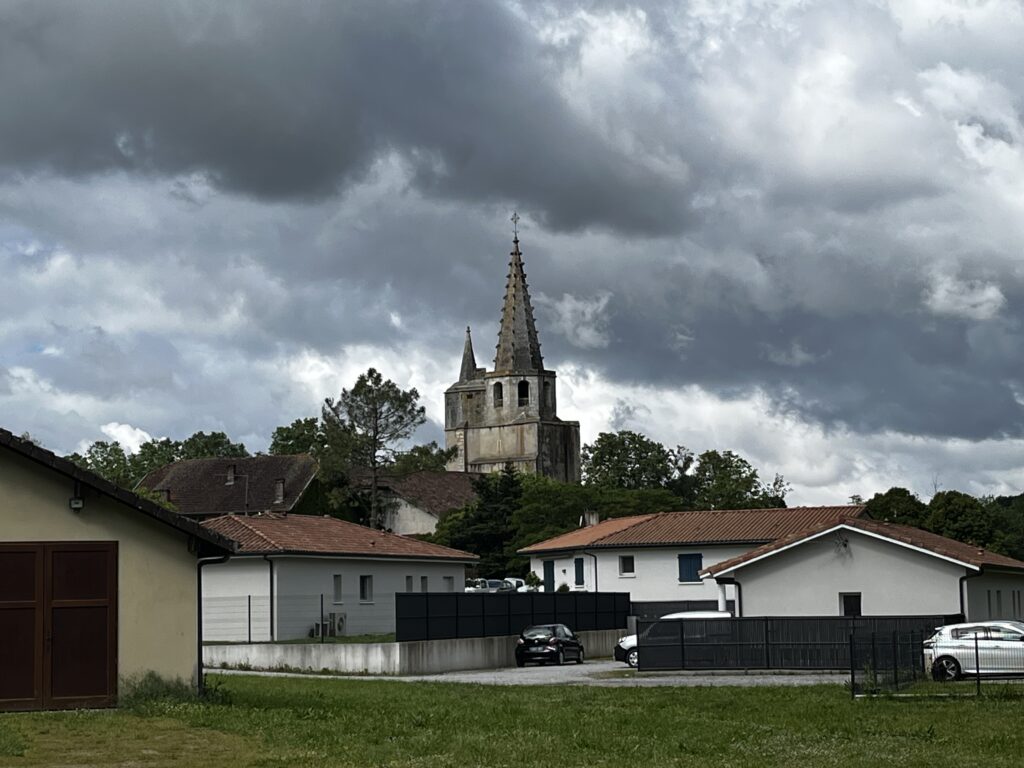
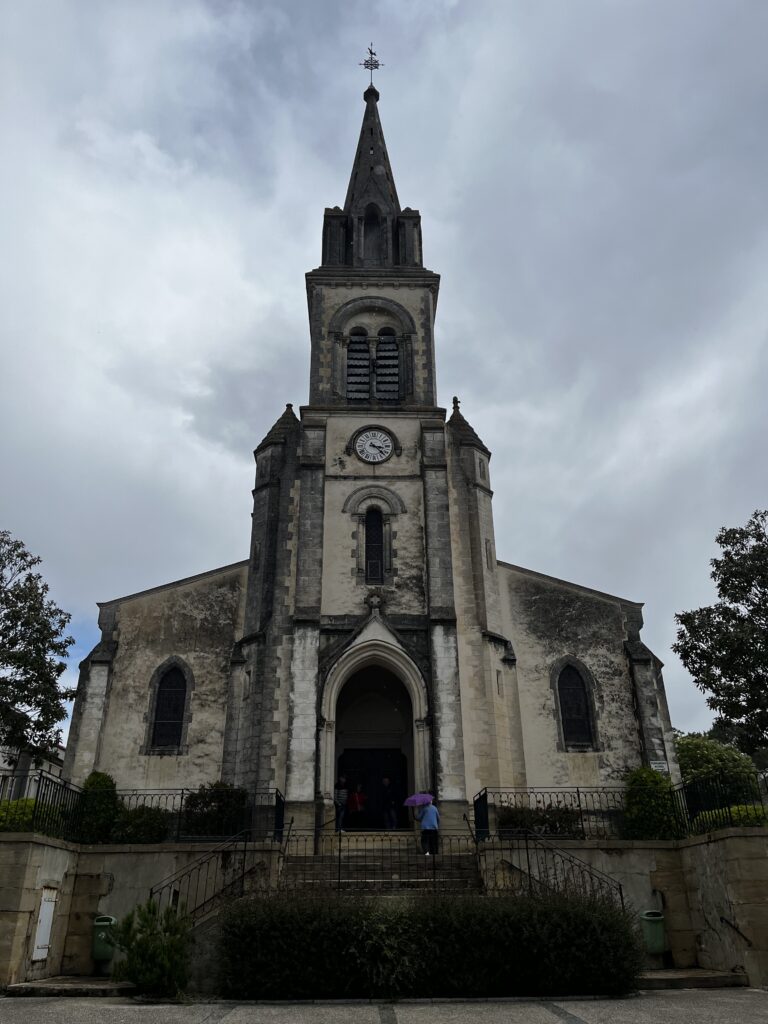
After the usual pilgrim chores, I headed into the town center. Just past a gentle curve in the road, I could already see the spire of the church.
It started to drizzle. I reached the church at about 3:25. The group of people had taken shelter from the rain under the porch of the church. The front doors were locked, but just to be sure I went around the sides to see if I could find an open entrance elsewhere.
There were three other doors, one of which I suspect leads to the sacristy, and they were all locked as well.
So I went over to the tourist office to see if they could help me with my credential and my payment for the gîte. They sent me – and I swear I am not making this up – to a swimming pool almost a kilometer away from the gîte and well off the Camino.
I walked over and got things squared away. By the time I was leaving, the rain had stopped and the skies were blue and sunny again.
It was now past 4 PM, and I still hadn’t had lunch. There was a bar over by the tourist office with a sign advertising tapas. I was willing to give French tapas a second chance, now that I was two days closer to Spain.
The tapas turned out to be a lie. Well maybe not a lie, maybe an exaggeration. Tapas is served there, but not at this time of day.
If nothing else, I got some writing done.
Another thing that I’ve been considering in the “make sure you live” category is hosting a small group at our parish.
This idea of small groups of parishioners getting together at someone’s home for specific reasons – whether that’s a Bible study, a book club, a prayer group, or something else – is something that we are starting to promote.
Francine would have adored this idea. She would often talk about the synagogue she once belonged to having such groups of families, who would get together frequently for fellowship and to share holiday duties.
And she was behind anything that would promote community.
Of course, my two ideas for the focus of such a group involved catechesis and liturgy.
Back when we were parishioners of Saint Rita, Father Sacco would host casual evenings in the rectory going through the Catechism of the Catholic Church paragraph by paragraph. Somebody would read a section, and we would discuss. It was brilliant, and I think it would be great to resurrect it.
The other possibility comes from something that our liturgy commission at Holy Rosary did. When the commission began, Father Maurer gave each of us a copy of Ratzinger’s The Spirit of the Liturgy.
That book changed my outlook on and relationship with the sacred liturgy in a profound way. I’d love to have a “liturgy geeks book club” that started with this book and expanded from there, perhaps even diving into source materials.
I suspect the Pistachio House library (when completed) would be a great place to host either of these.
At dinner, I learned that the event at the crypt is a three-day poetry festival called Moins les Murs, which means something like “minus the walls”.
Date: 15 May 2026
Place: Hagetmau
Today started: Saint-Sever
Today’s Photos!
A beautiful walk for you today. Thank you for sharing your very personal remarks of the grief you have been through this year, so many of us at SP have been praying for you! I would be interested in being in your small group on catechism and liturgy.
Thank you! I very much appreciate the prayers. It’s the best thing we can possibly do.