
Via Lemovicensis: Out of the Galician Mountains
Somehow I managed to leave the albergue right about 6:30. I was hoping there might be a place open in the village for breakfast. There was a place scheduled to open at 6 AM, but they were not. Perhaps they were hung over from Spain’s World Cup game last night.
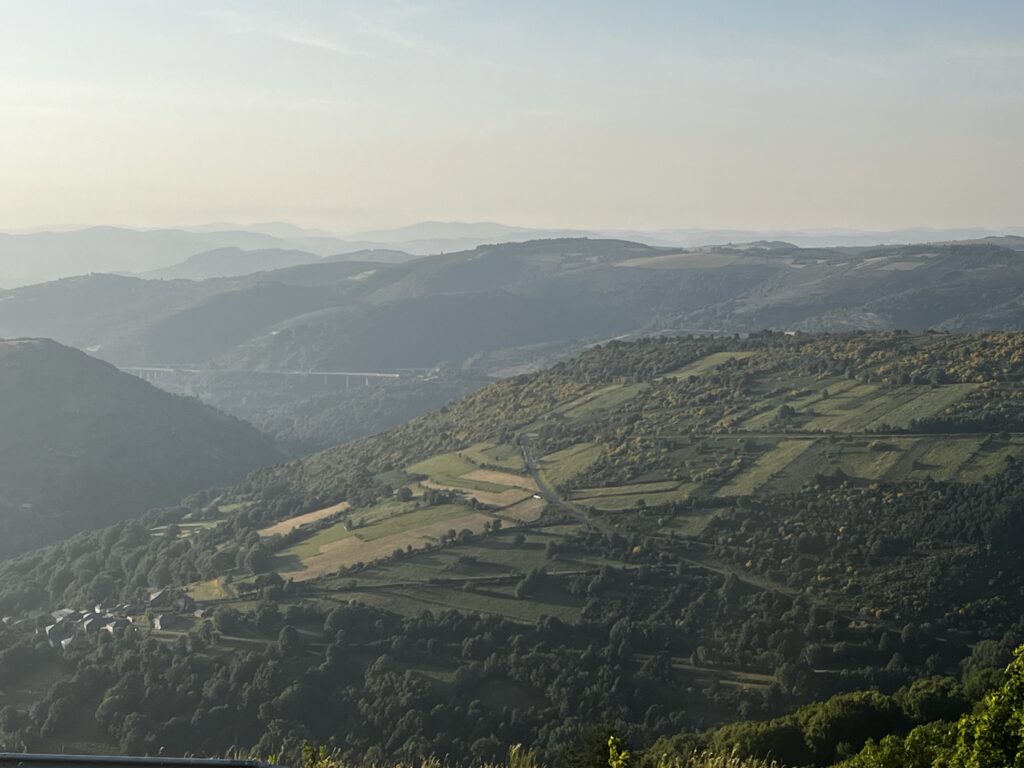
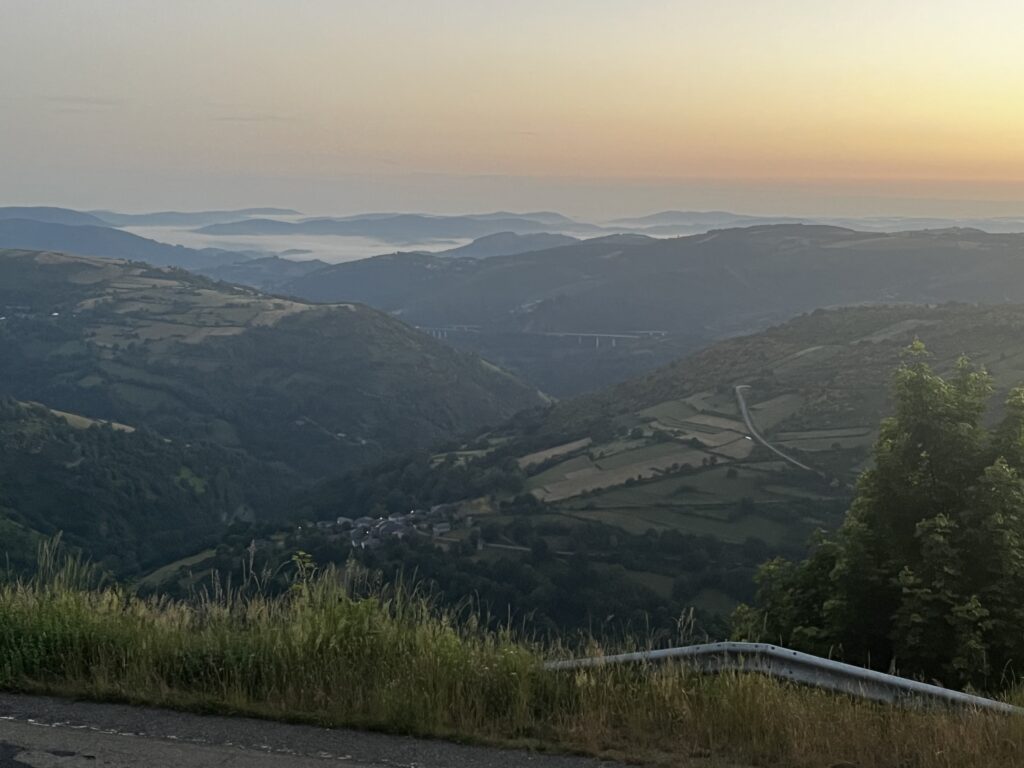
Well, I’ve done this before. I set off down the road in search of food and coffee. first, though, I spent a few moments admiring the view from the top of O Cebreiro.
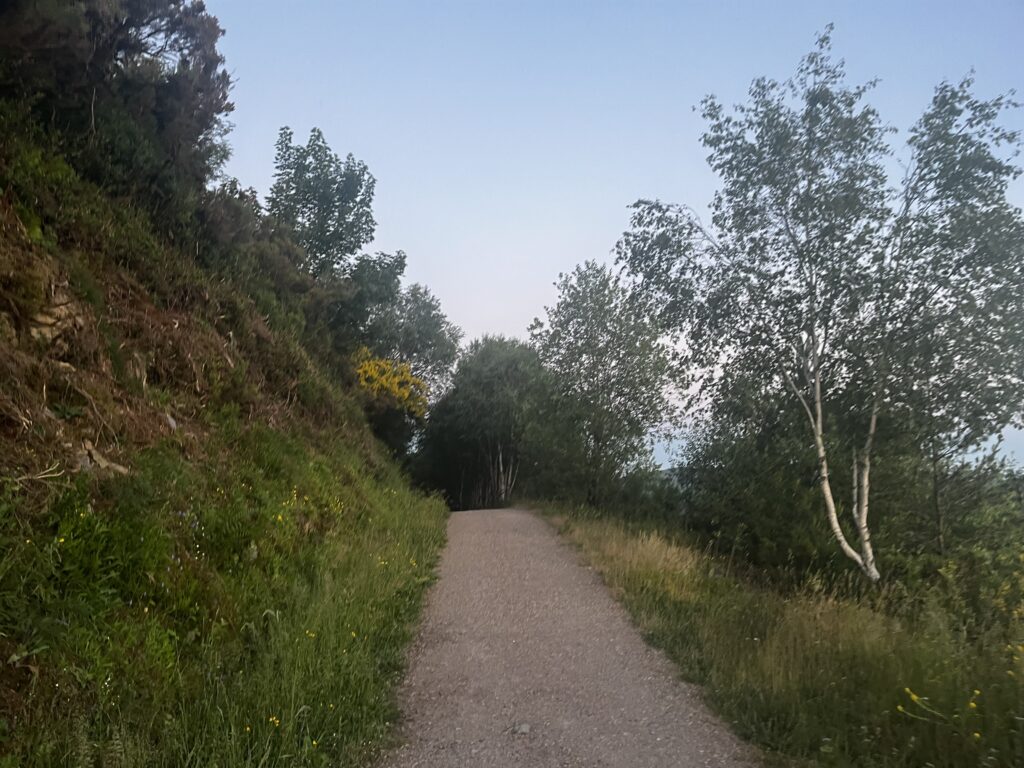
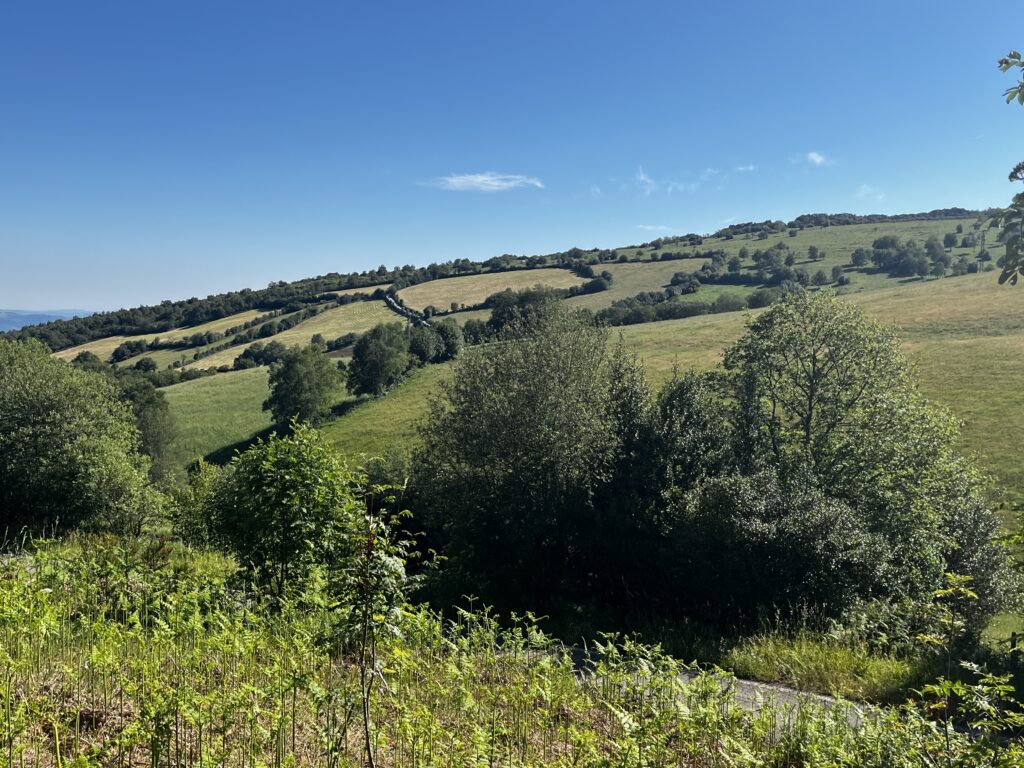
The path out of town was compressed gravel through the woods. The tree cover on the right side was pretty thin, and I could catch glimpses of the wide valleys below. The sky was hazy, and the air was not nearly so cool as I would have liked.
Although any number of unfamiliar pilgrims left the village around the same time I did, I very much walked alone. My mind naturally turned to previous Caminos. Three times I walked out of O Cebreiro with Francine. And there were others of course, Anja, Rebecca.
There are some deceptively steep ups and downs in this little section, but fortunately they don’t last for very long.
As the Camino moved a little deeper into the woods, I was passed by two speedwalking Italian pilgrims wearing day packs. Man, those guys were moving!
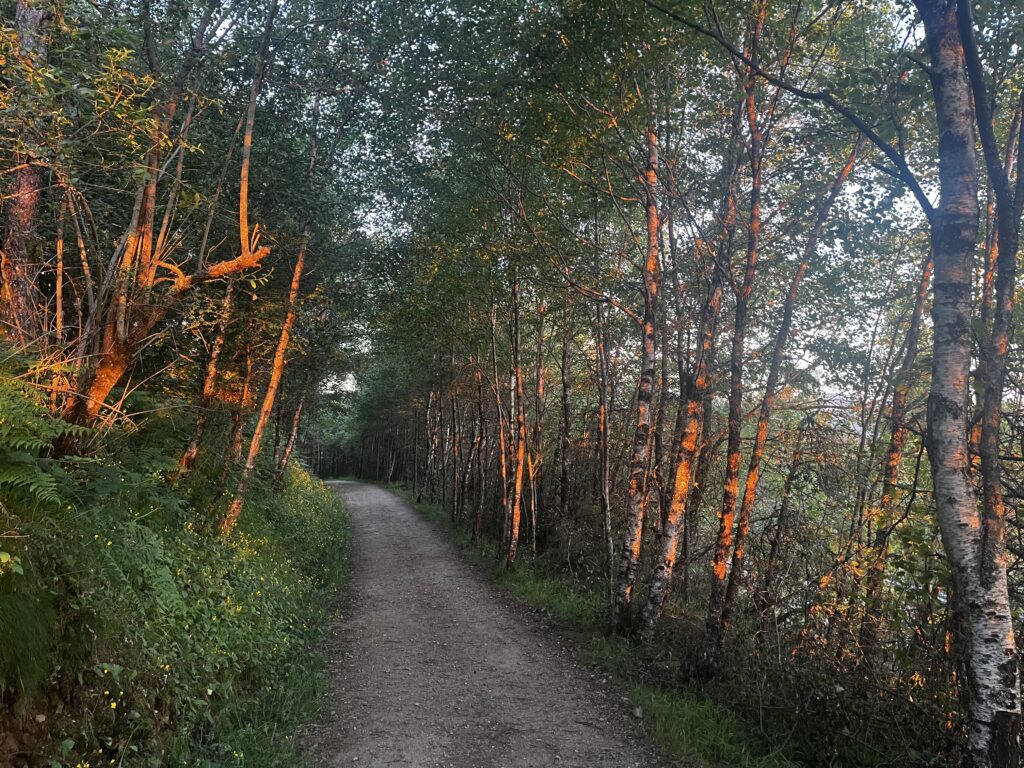
Through breaks in the trees, I could see the sun rising over the hills to the east. The golden light filtering through the trees was enchanting.
By about 7:05, the trees thinned out as I approached the hamlet of Liñares. I arrived a few moments later. The place smelled pretty strongly of cow this morning. Neither the café nor the church were open.
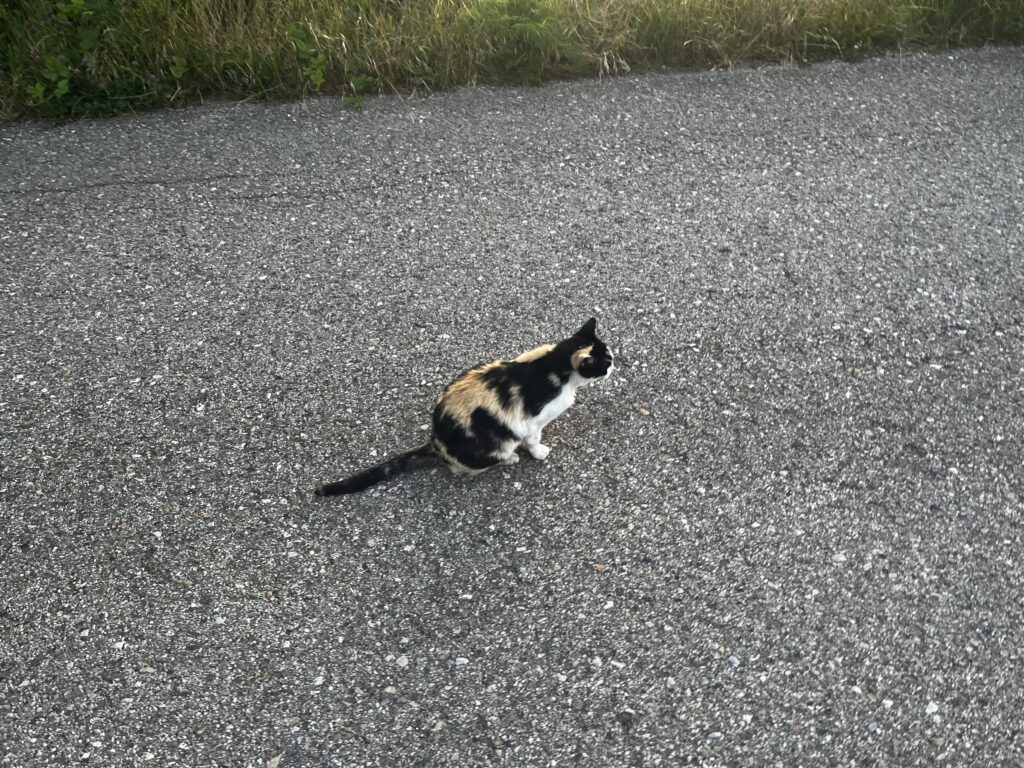
The Camino turned down a smooth asphalt access road guarded by a calico cat before turning sharply uphill on a dirt and gravel path. This took me up through a dark woods swarming with flies.
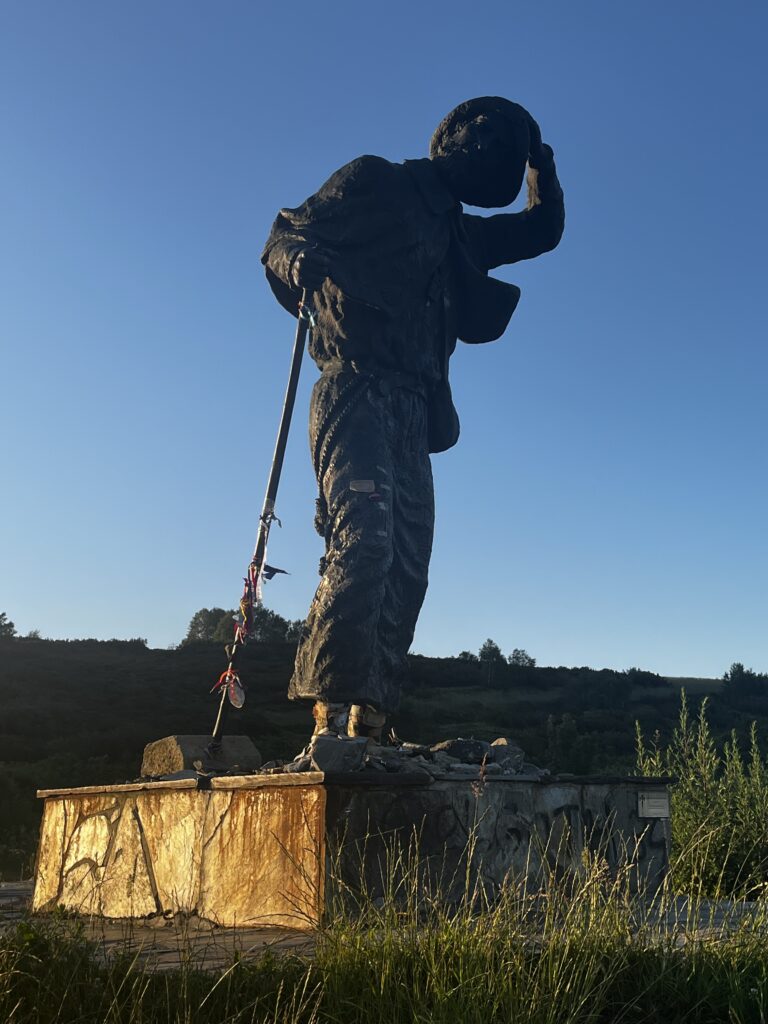
I arrived at the top of Alto de San Roque. At the top of this hill is a statue of a pilgrim fighting the wind. It’s an absolutely iconic piece of art on the Camino.
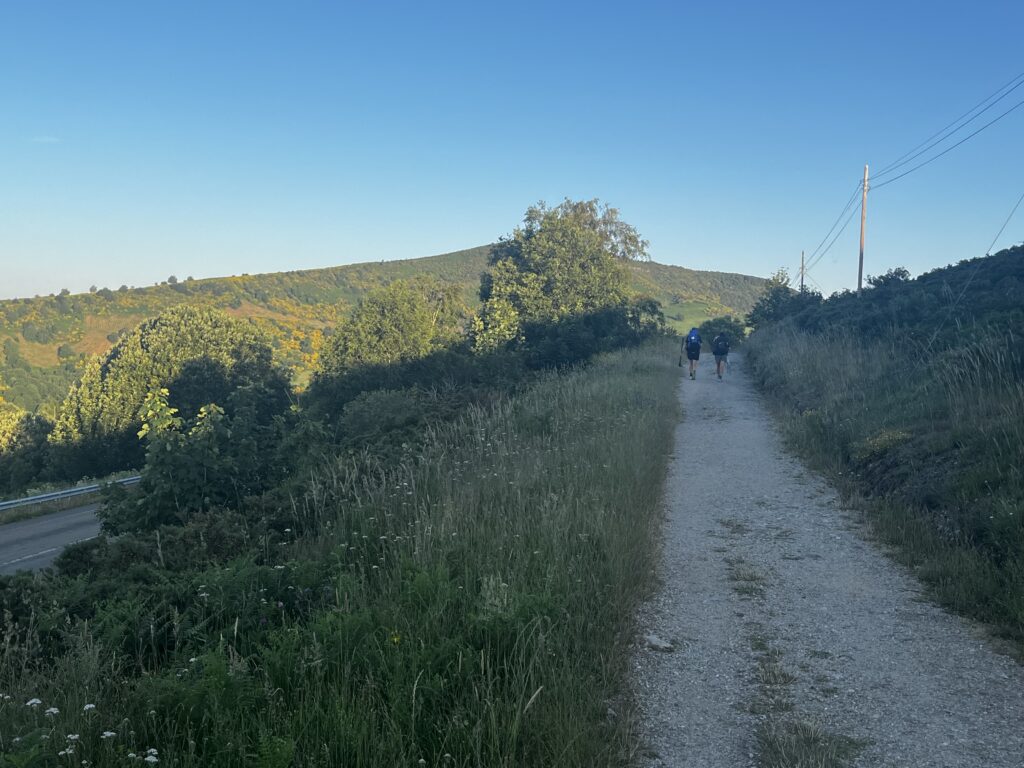
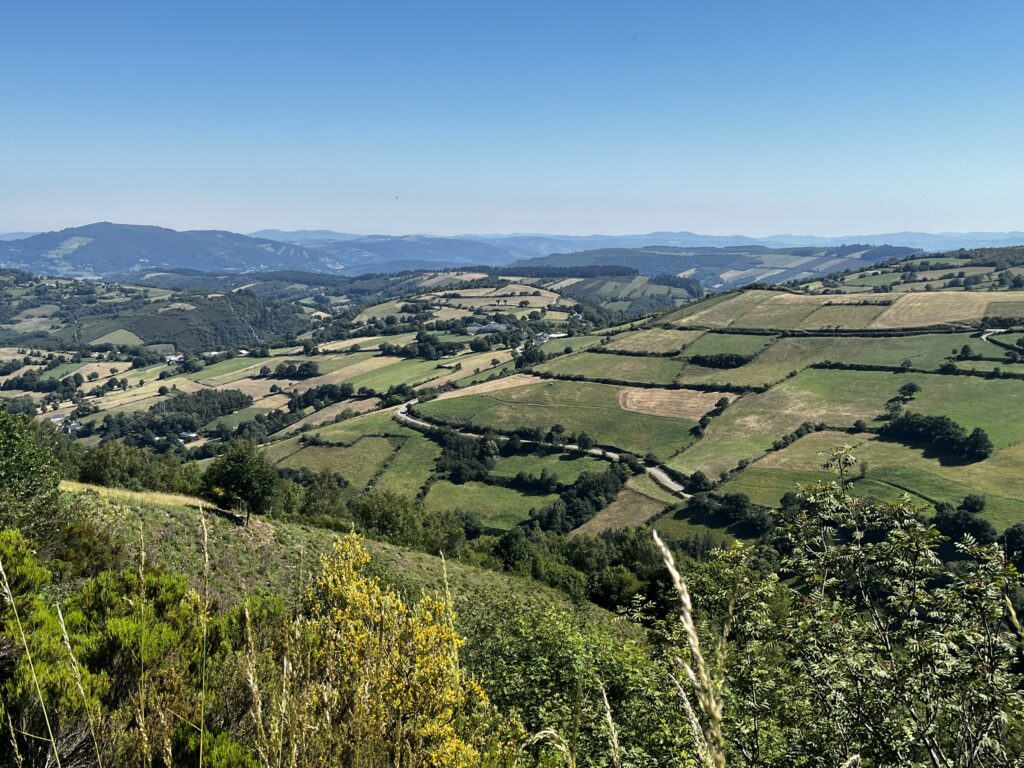
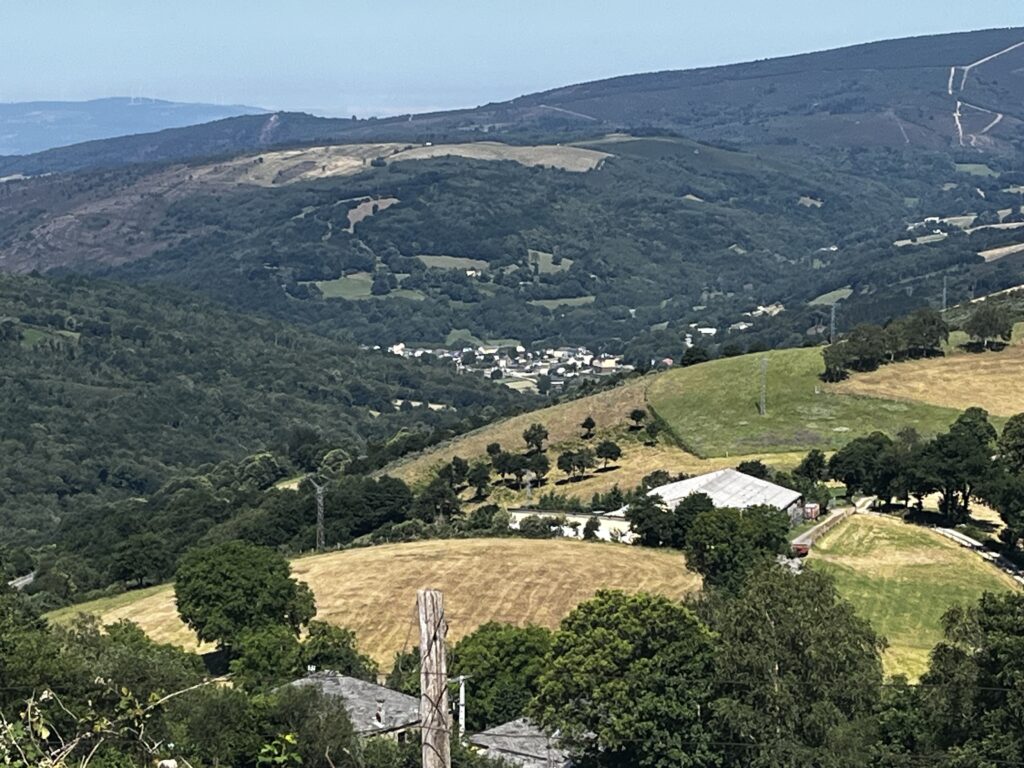
Camino continued on a gravel path just above the road. The views across the valley were tremendous. The flies continued swarming to distraction, and they didn’t seem in particularly bothered by my insect repellent wristband.
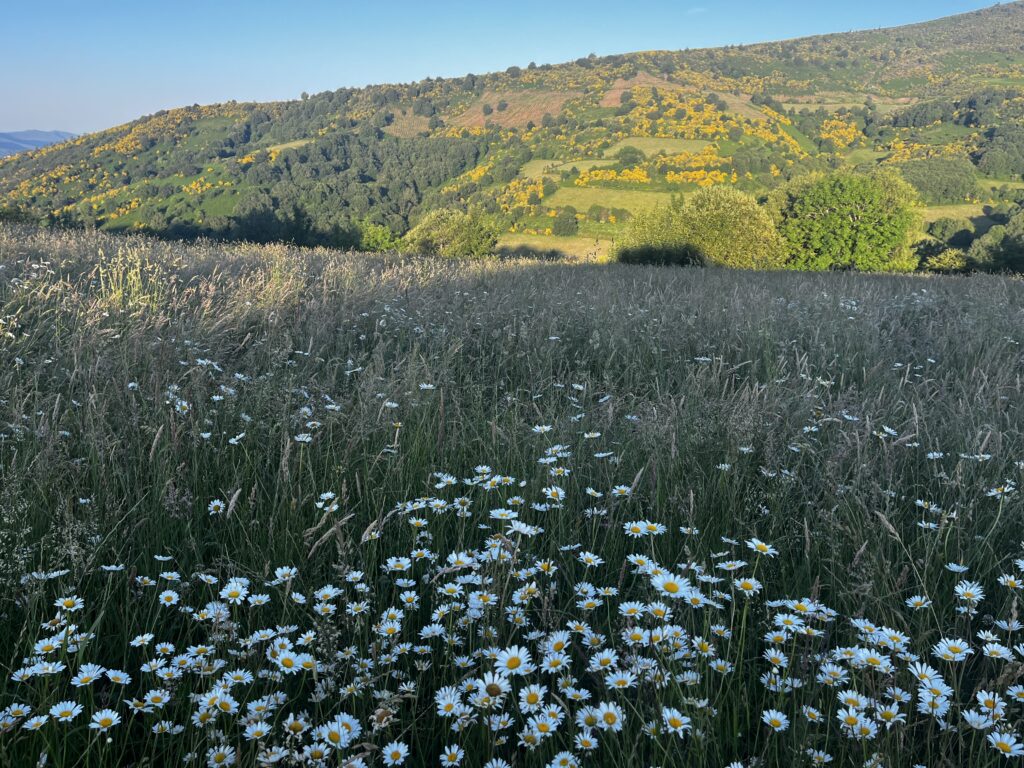
The path soon left the roadside and struck out through the hills. The path was bounded by by daisies and other wildflowers, by grasses and ferns and bushes, and the whole landscape was dotted with trees.
The path briefly became a rough concrete as it went steeply downhill and back towards the road. The uphill portion into the little hamlet of Hospital da Condesa was pure gravel, though. It was just about 7:50 as I passed through.
My pack was not sitting right this morning, despite an adjustment at Alto de San Roque. I wasn’t sure what the issue was exactly, though I suspect perhaps my weight has something to do with it. At least the flies had settled down.
By 8 AM, I was in line at the only café to be found. I was soon joined by a host of familiar faces. After a particularly large breakfast, I left around 8:45.
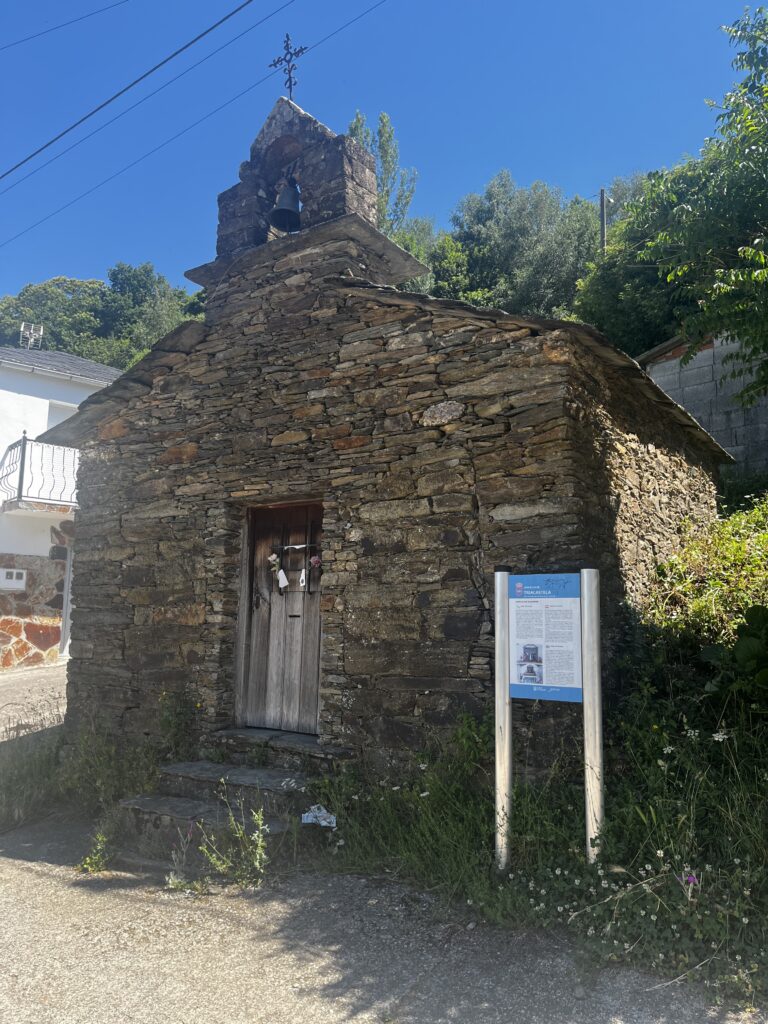
The little village church was locked.
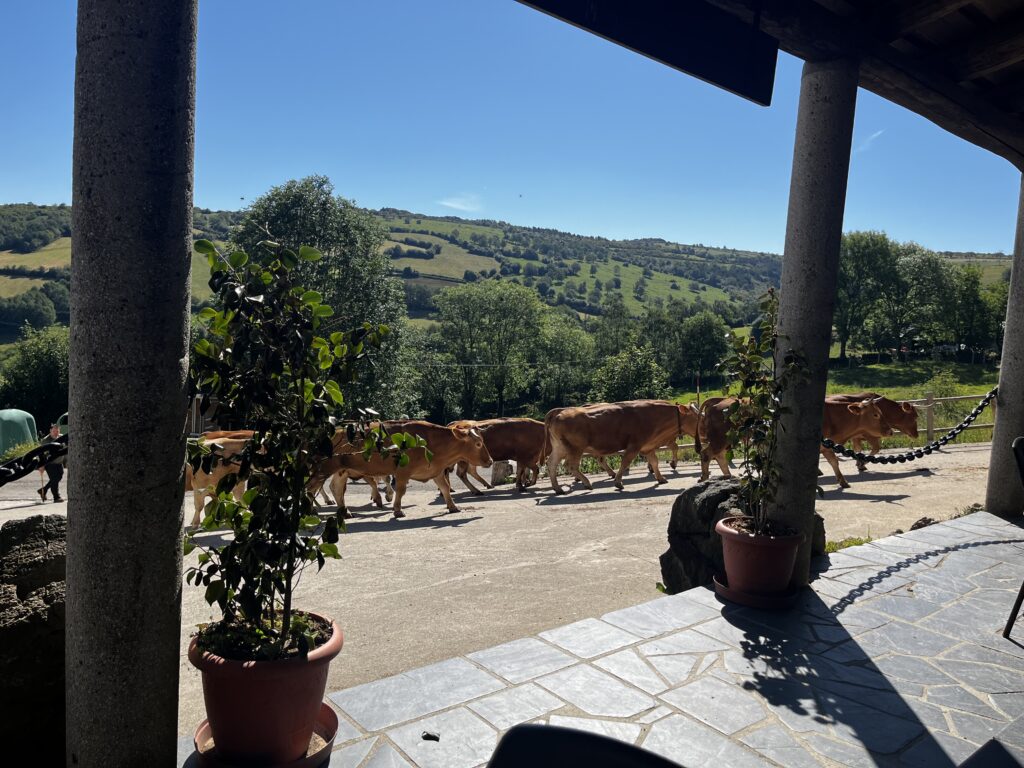
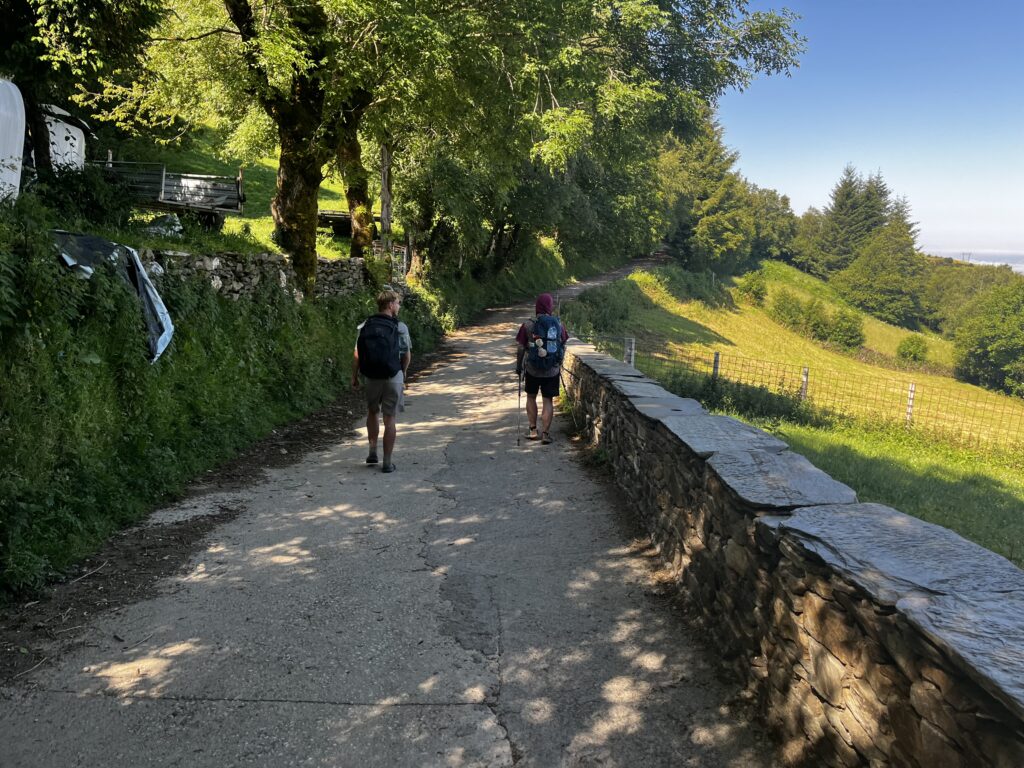
The gravel path out of the village ran right next to the road, mostly in the shaded of the trees. It is a path apparently shared by pilgrims and cattle.
For some reason today, Edgar Allan Poe’s poem “Eldorado” has been running through my mind.
Gaily bedight,
A gallant knight,
In sunshine and in shadow,
Had journeyed long,
Singing a song,
In search of Eldorado.But he grew old—
This knight so bold—
And o’er his heart a shadow—
Fell as he found
No spot of ground
That looked like Eldorado.And, as his strength
Failed him at length,
He met a pilgrim shadow—
‘Shadow,’ said he,
‘Where can it be—
This land of Eldorado?’‘Over the Mountains
Of the Moon,
Down the Valley of the Shadow,
Ride, boldly ride,’
The shade replied,—
‘If you seek for Eldorado!’
Donovan did a musical version of it, I think in the 1990s, and I have been singing this as I walked.
The Camino, meanwhile, had left the road and struck out through the open hills. It was already beastly hot whenever I was in the direct sunlight. Fortunately, there were plenty of trees.
At about 9:15, the Camino joined an asphalt road through the tiny hillside hamlet of Padornelo. The little church here was locked, though I had to go through a maze of open doors to get to the one locked door to the nave.
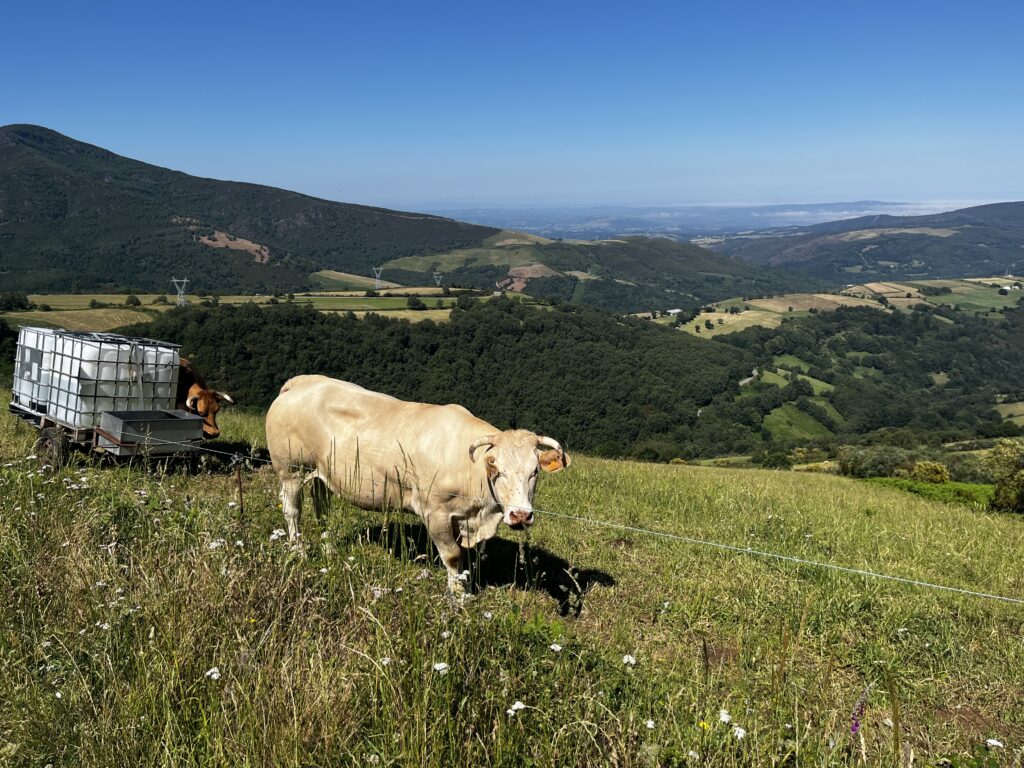
As the trail climbed steeply upwards, I passed a meadow with some grazing cows. This section, as steep as it is, used to be much worse. I remember in 2013, the final slope to Alto do Poio, covered in boulders, required you to go hand over hand in some sections. Francine reached the top, turned around, and may have made a very emphatic rude gesture. Then, as now, there’s a bar at the very top of the slope. Everyone on the terrace stood and applauded her. She bowed to them.
The slope is all smooth gravel now.
I grabbed a soda at the bar before continuing on. Then it was back to a shady gravel path beside the road.
The trees and the shade gradually grew sparser, and my body temperature rose. By 10:15 I had to put up my umbrella.
Five minutes later, I passed through the tint hamlet of Fonfria of happy memory. Francine and I stayed here in one of the best albergues on the whole of the Camino in 2013 with Anya, Iain, and Isabel (aka Bob). I stayed here most recently in 2023, but that was not the plan today.
In terms of kilometers, I was perhaps only a third of the way to my destination.
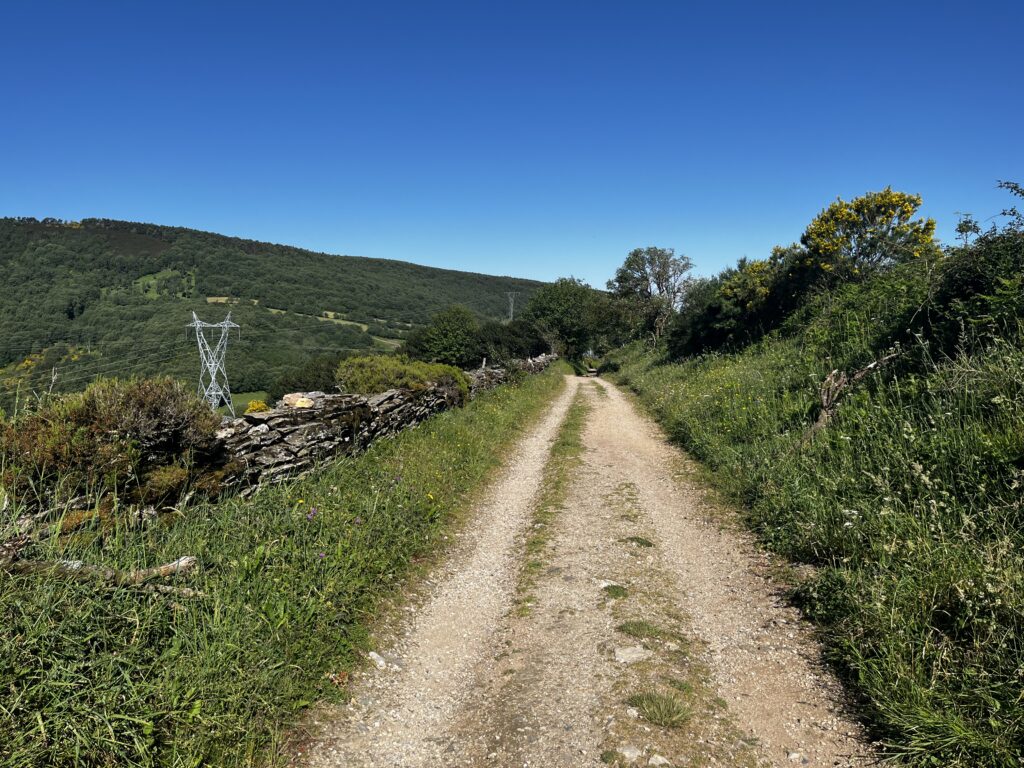
The Camino was now a gravel road, a climbing hillside on the right, and a low crumbling stone wall overgrown with bushes hiding the road below on the left.
By 10:40, the gravel road had briefly come down the hill to rejoin the main road before striking off again on its own. Now the valley was on the right, and the hillside on the left. In the distance, I could hear the clonking of cowbells.
Gravel became dirt, and the tree canopy closed over my head.
At about 10:50, I entered the little hamlet of O Biduedo and satisfied a sudden craving for Coca-Cola at the local bar. The little church – reportedly the smallest on the Camino – was locked tight.
Erik and Frederick caught up, so I walked with them for a while. It was back to the same gravel road on the hillside through the trees with stunning vistas and the occasional cow.
Erik became the second person this Camino (after Katie) to comment on the Mandalorian patch on my backpack. “This is the way.”
At about 11:40, the descent out of the Galician Mountains began in earnest.
It was down, down, down all the way until the little hamlet of Fillobal, clinging to the side of the hill and whose main street includes a switchback, which I reached at about noon. At some point, I had left Frederick and Erik behind.
Back in 2013, the bar here is where Eamon caught up with Francine and I after several days of separation.
I thought about stopping in for lunch for old time’s sake, but I settled for an ice cream instead. As I was enjoying my cornetto in the shade, Erik and Frederick passed on by.
After Fillobal, the Camino continued downhill, sometimes through steeply graded pasture land, sometimes through forest. The path itself grew rocky, uneven, and unpredictable in stretches. Other places, it was perfectly smooth dirt with only the occasional rock.
Sometime past 12:30, the path met up with the road again briefly before crossing over and then continuing the plunge into the valley.
Perhaps five minutes later, the Camino passed through the hillside farming village of As Pasantes. Everything here smelled of cow. It does seem a lot more prosperous than in previous years – there’s even a metal fabrication shop here, and judging by the sounds, they keep busy.
After the village, the Camino continued its descent on a concrete road that turned to dirt as it plunged into the forest.
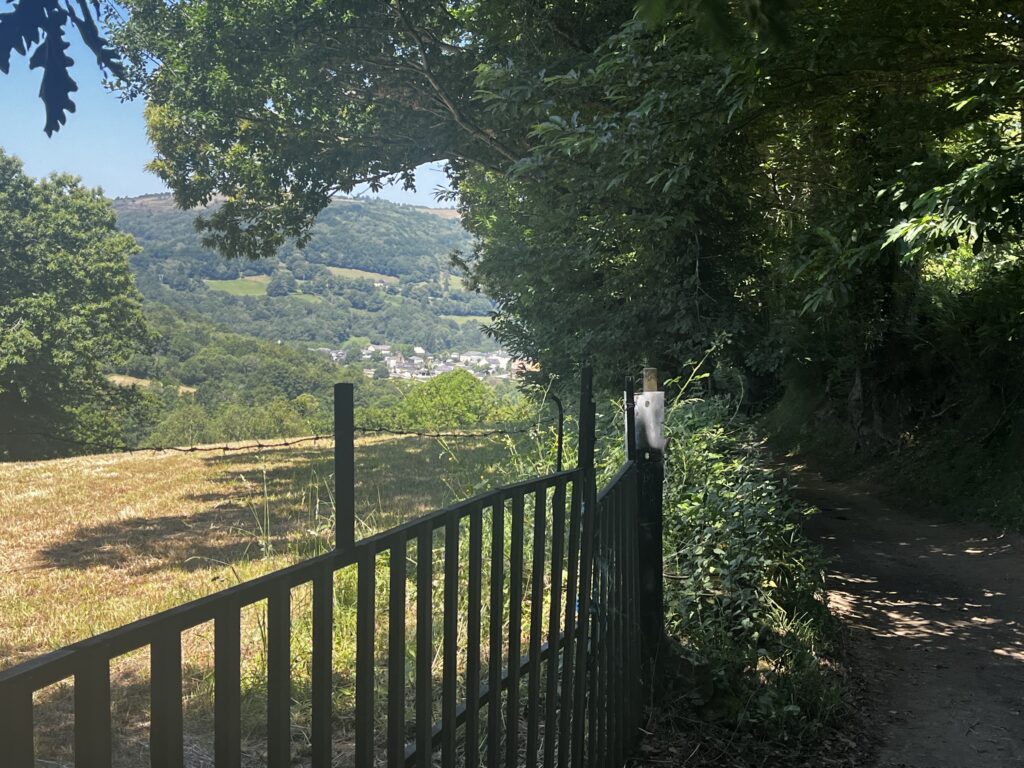
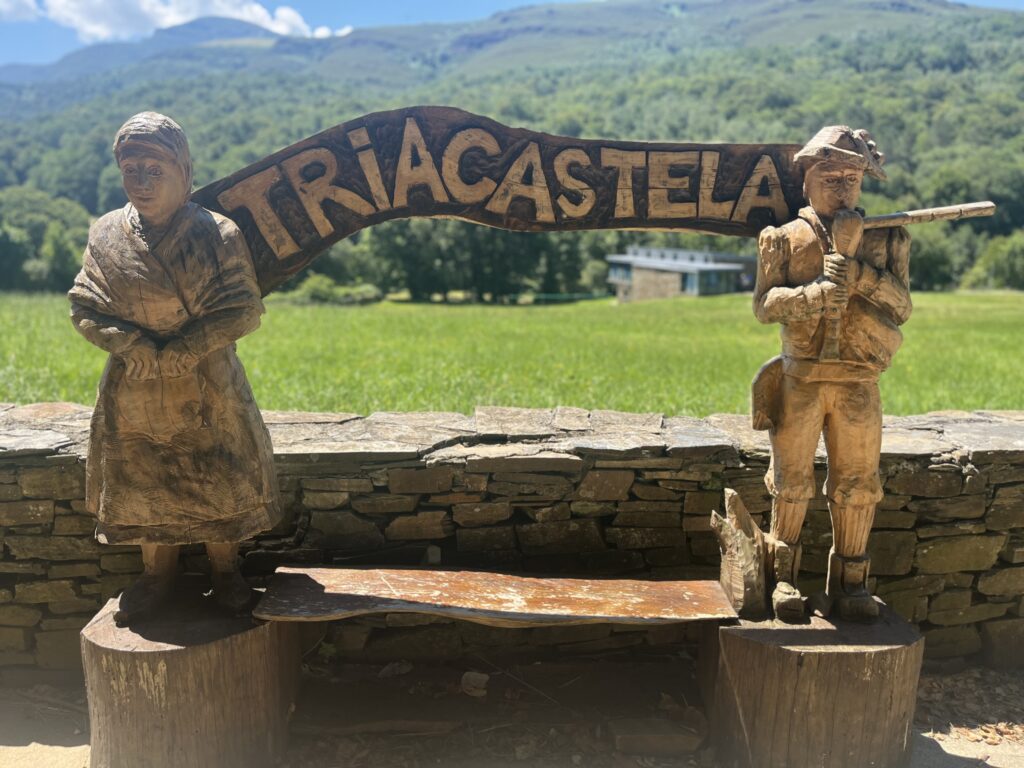
At about 12:45, through a break in the trees I caught sight of the town of Triacastela. This was my planned spot for lunch. Many of the pilgrims I’ve been walking with recently will be ending their day here.
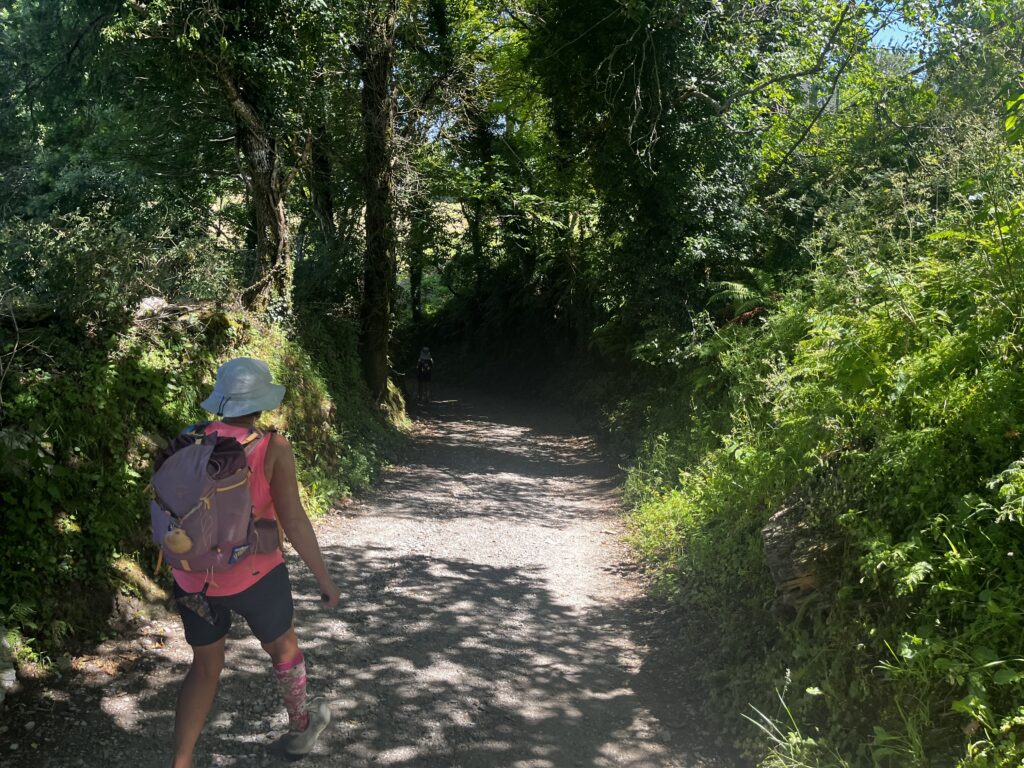
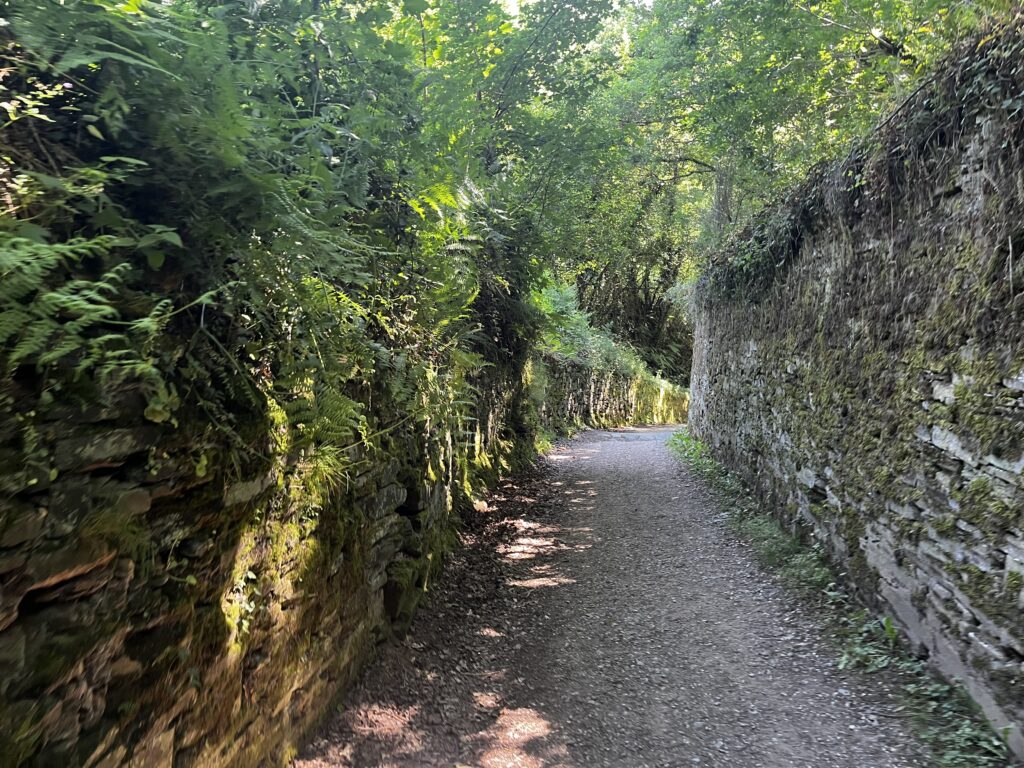
The forest road had all the appearance of a holloway, with steep embankments going up on both sides and the trees forming a kind of tunnel above.
Eventually, the embankment on the left was replaced by a low, crumbling mossy stone wall.
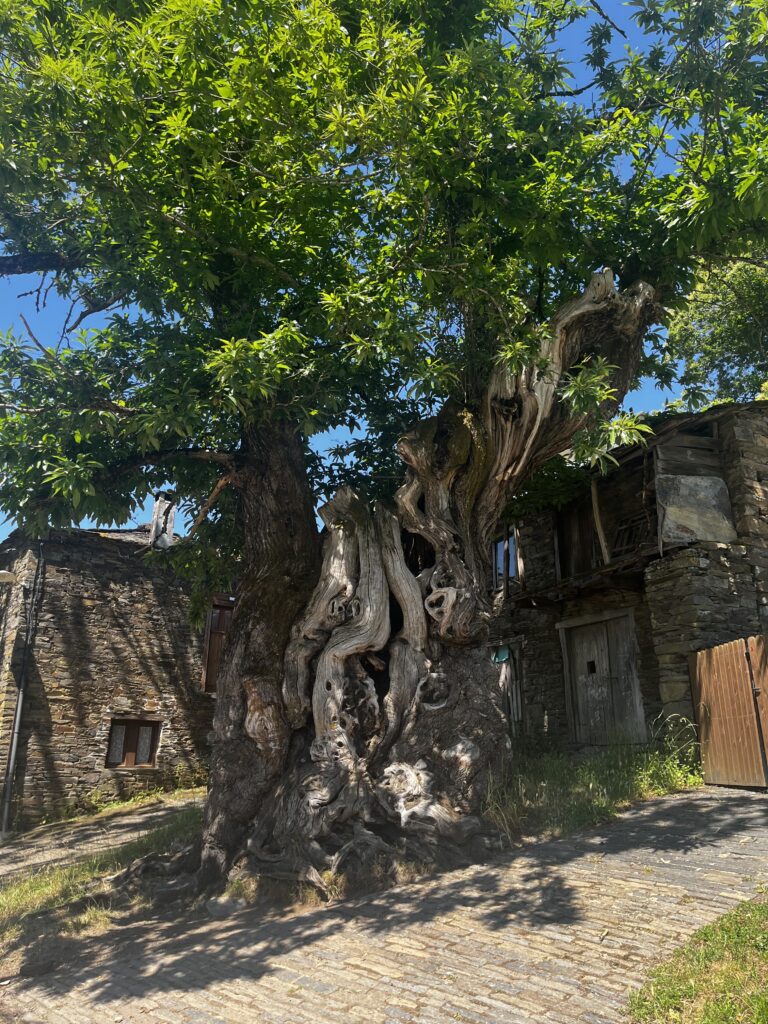
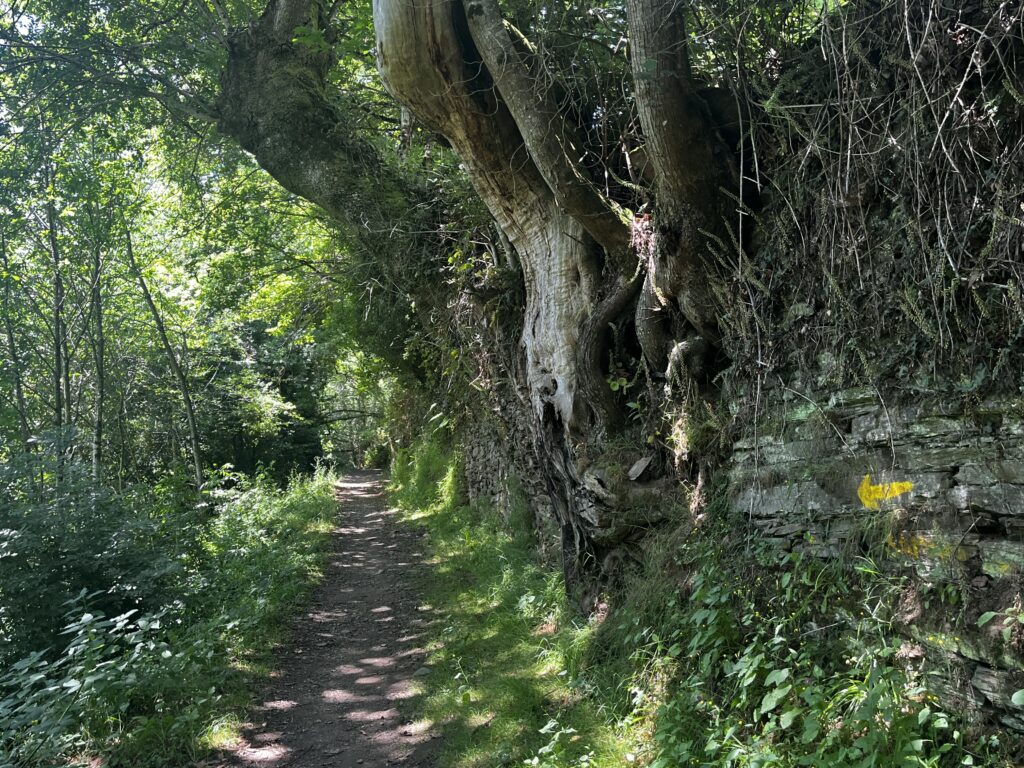
I passed through the farming hamlet of Ramil just before 1 PM. At the entrance to the little hamlet is a remarkable hundred-year-old chestnut tree, whose trunk has a circumference of more than 8 meters.
From here, it was just a few minutes to the village of Triacastela. The path now was broad, flat stones set in concrete, which was eventually replaced with just concrete slabs.
By 1:10 I was sitting at a table on the terrace with a beer waiting for my lunch. I was probably two-thirds of the way through my day. Life is good.
I was moving again at 2 PM, and feeling good. The air was warm, though not hot, and the umbrella took care of the direct sunlight.
Despite the name (and the coat of arms) Triacastela does not have three castles. It doesn’t even have one. But it does have is three long, longitudinal streets that run the length of the town, which is very much long and narrow.
And a locked church. It absolutely has a locked church.
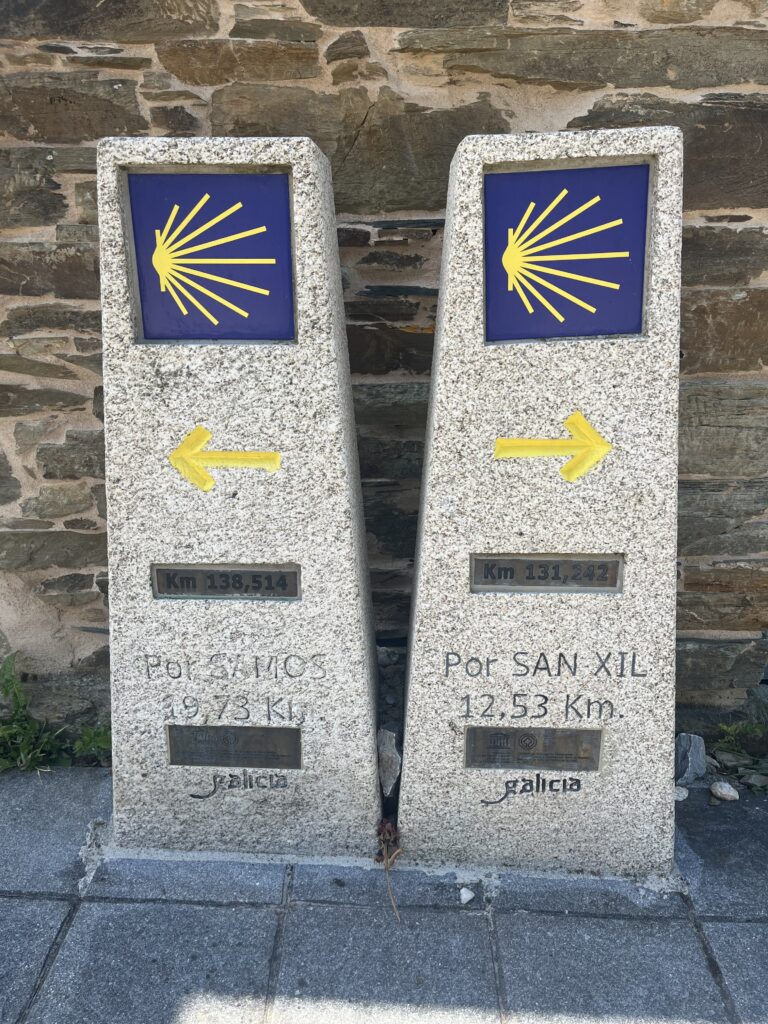
It’s also a place with a fork in the Camino. There is a slightly shorter route that goes through the town of San Xil, and a slightly longer route that goes to the monastery and town of Samos. I am taking the Samos option for a number of reasons.
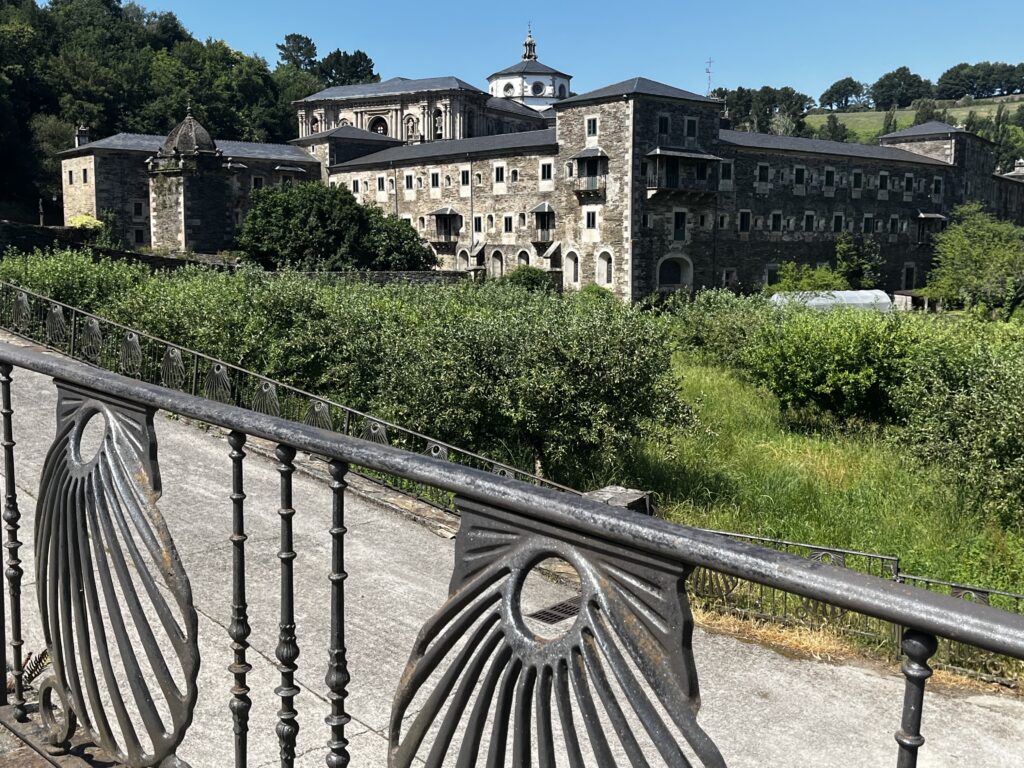
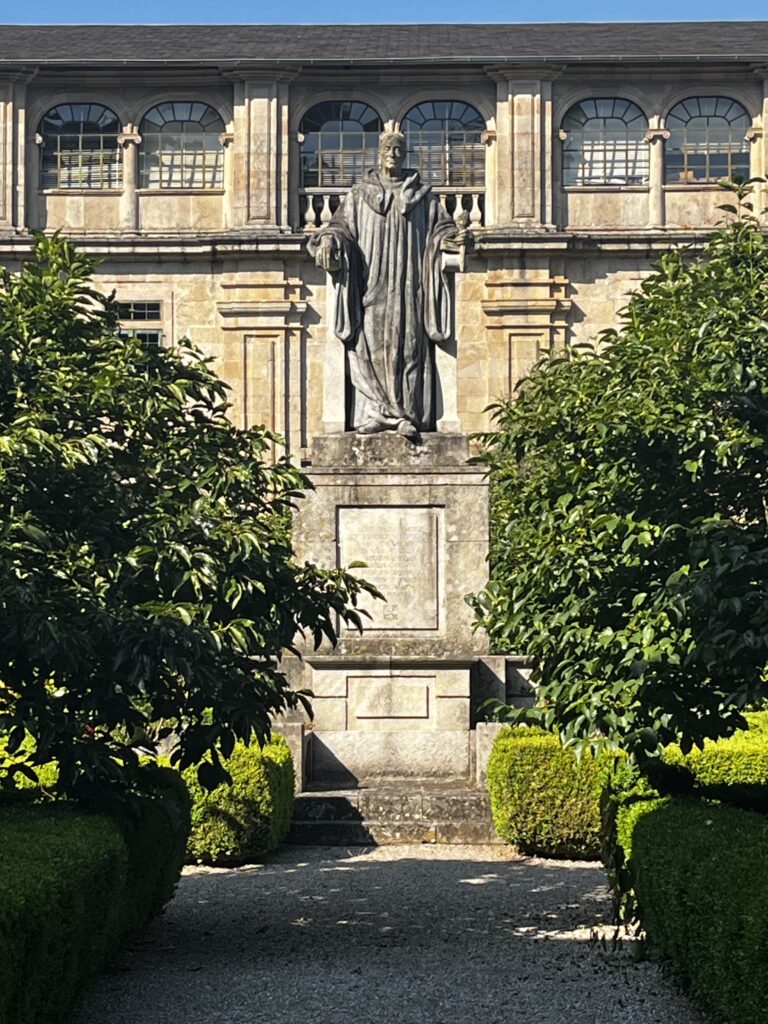
The monastery at Samos is absolutely beautiful, and it was once in charge of all of the Benedictine monasteries in Spain. Its library has something like 80,000 volumes.
If you sleep at Samos, your logical lunch spot is the city of Sarria. Something like 90% of the pilgrims who walk the Camino Francés begin walking in Sarria, because it is the town closest to the hundred kilometer minimum distance.
So if they are all starting there, and you were there at midday, you were not walking the same stages as all of those new pilgrims. This appeals to me quite a bit.
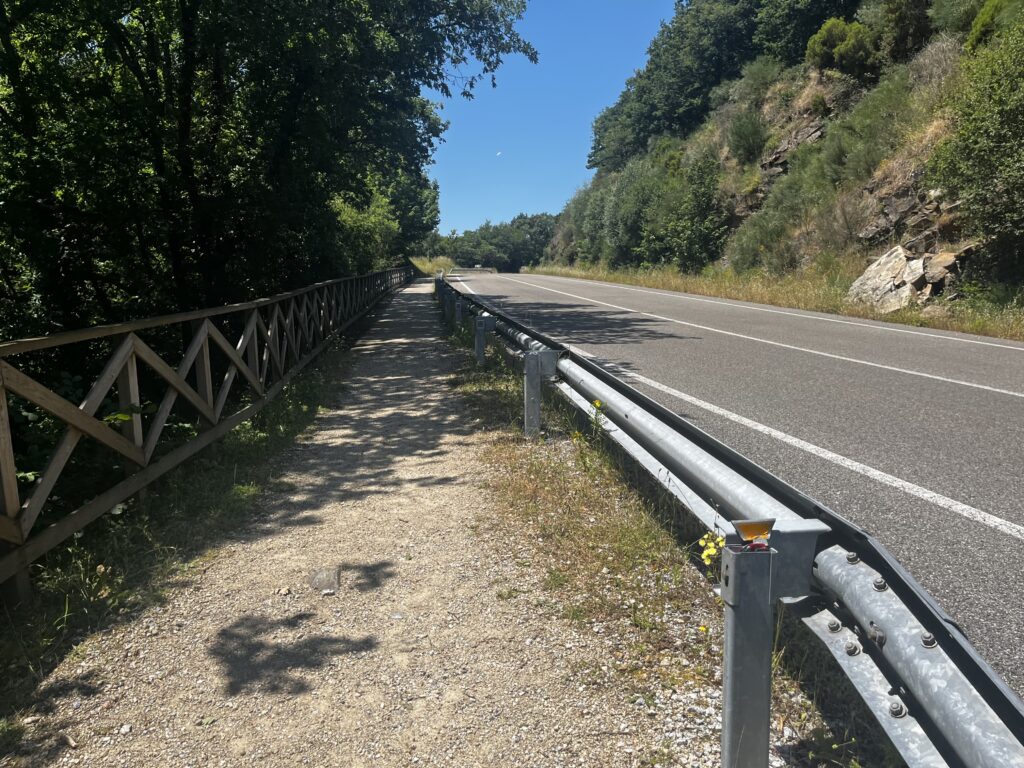
The Camino route followed a lovely gravel sidewalk beside the highway. Three years ago in the pouring rain, the sidewalks were flooded and I had to walk on the road. I am very happy not to be doing that this time.
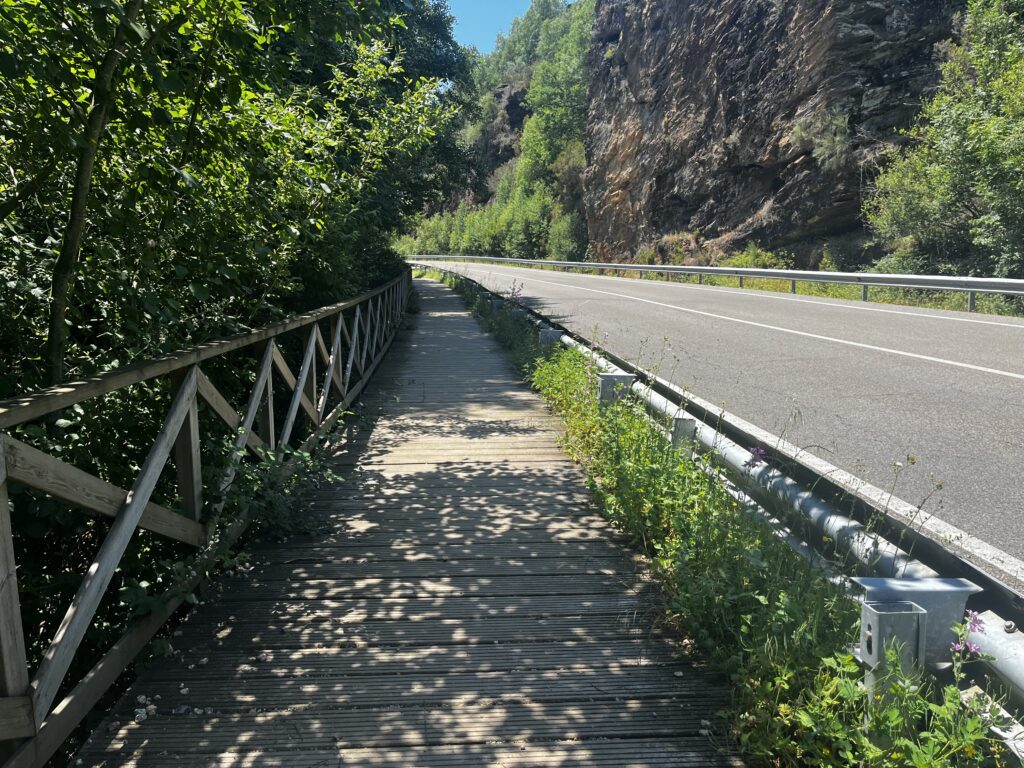
Further on, there were sections of the path like a boardwalk, hanging over the ravine into the river below. Super cruisey walking here.
At 2:45, I passed a sign welcoming me to the village of San Cristovo do Real, though I could see no evidence of an actual village. The Camino crossed the highway here onto another section of boardwalk before descending sharply on a narrow asphalt road into the woods. Here I passed through an actual hamlet, that I presumed to be San Cristovo do Real.
One of my favorite Camino photos of Francine and I was taken on a little bridge over the stream here.
After the village, the Camino became a narrow dirt path that passed the cemetery and took me into the woods again.
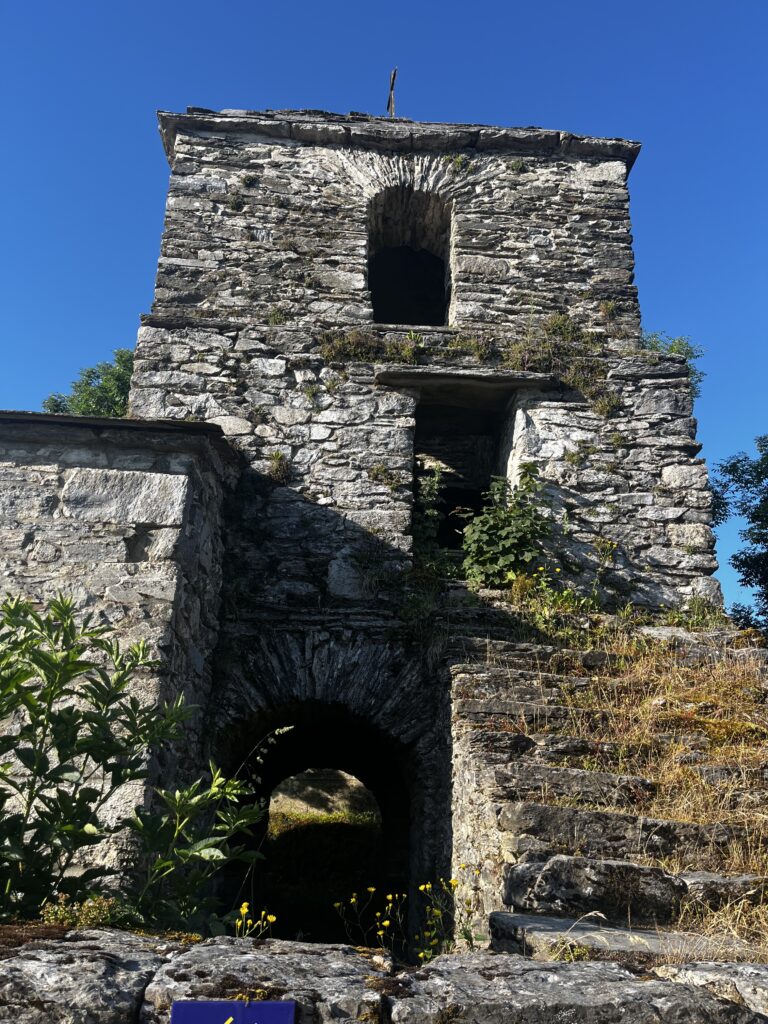
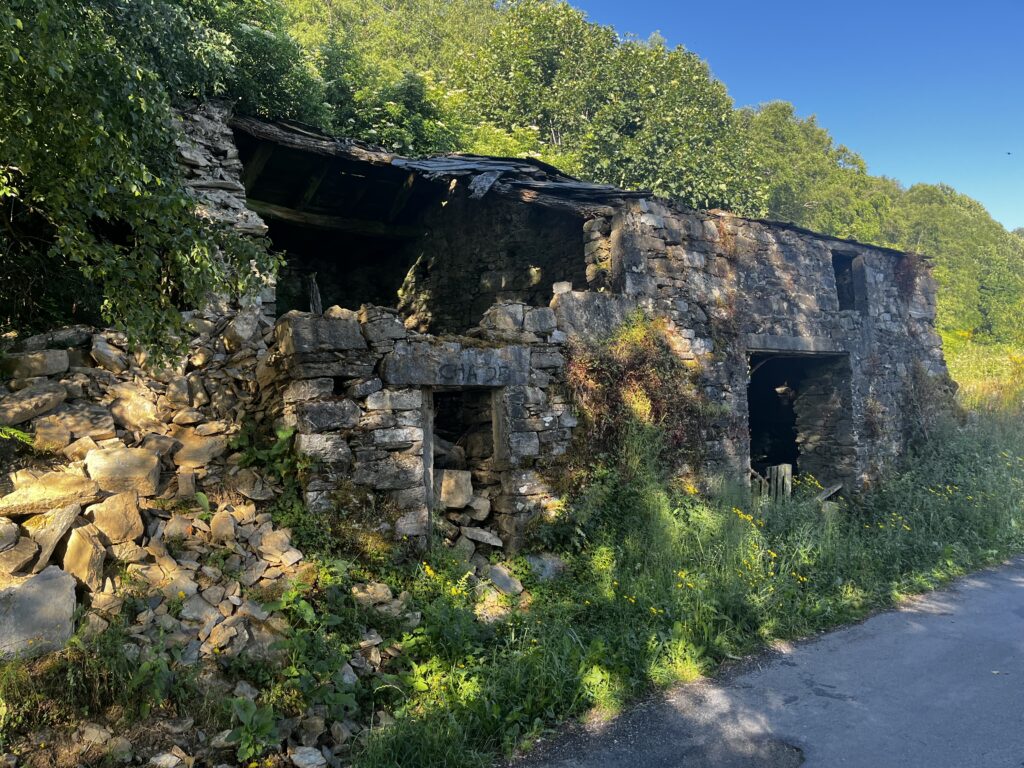
I very much get the impression that this land used to be much more developed than it is now. Periodically it would be great stone walls to the right of the path crumbling in places with trees growing through them.
Occasionally I would walk past openings in the trees, great sloping meadows to my left with the odd cow grazing.
At about 3 PM, I passed a group of four pilgrims just as the path widened out to the width of a road. A little stream that had been running to my left probably now qualified as a river.
Perhaps five or ten minutes later, the Camino crossed over the river and became a proper asphalt road into the village of Renche.
I took down my umbrella and somehow managed to lose one of the bungee connection points. It’s OK, I have a spare somewhere in my pack.
I got a message from Katie telling me that the monastery albergue is closed. I popped into the café in the little hamlet, grabbed the cold drink, and booked a room at the monastery instead.
Then it was back to walking. The asphalt road took me through the three-house hamlet of Lastres, and then it was back to the dirt path through the woods, walls to my right, river in the valley to my left.
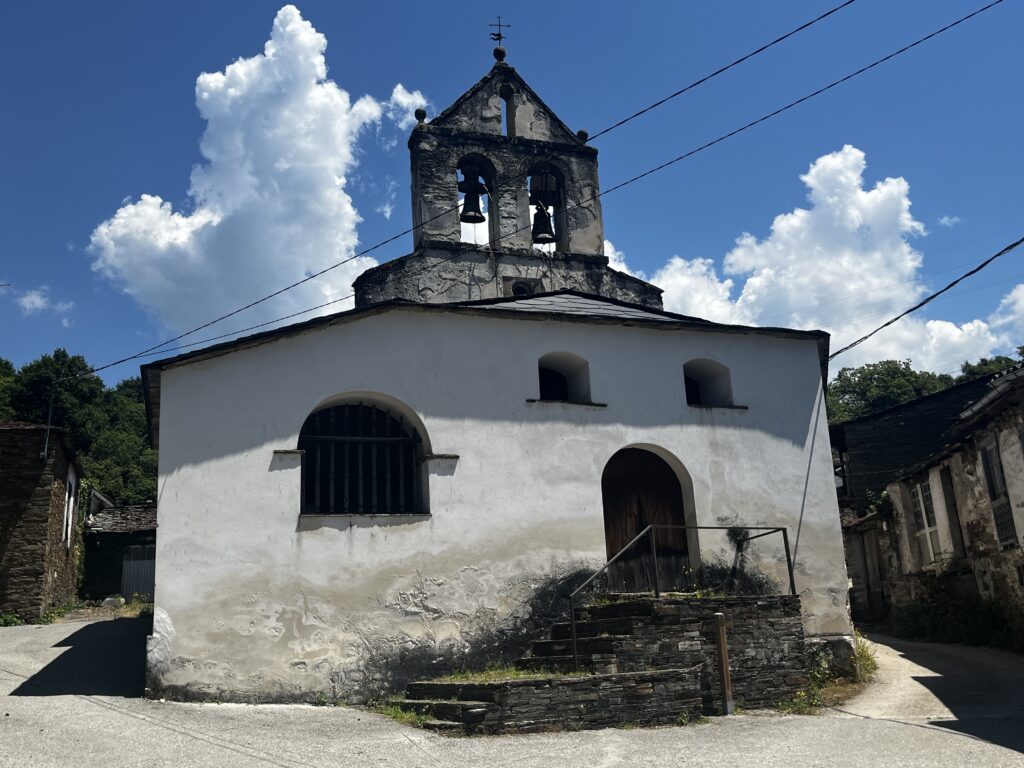
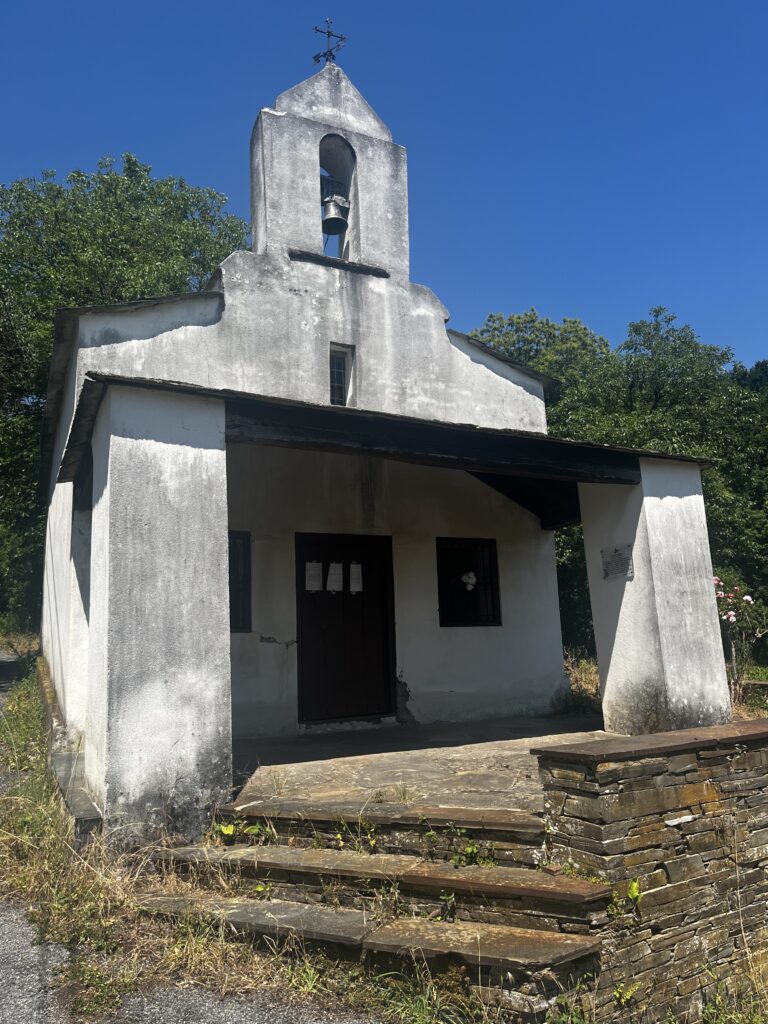
About 4:05, I passed through the delightfully quaint and charming hillside hamlet of Freituxe. Despite its small size, it even has a quaint little (locked) church, painted white.
Then it was back to the forest path, which at some point simply became a dirt road carved into the wooded hillside.
At about 4:15, the Camino turned onto a rough, rocky downward path. At least some of those rocks had tumble out of walls on either side of what I’m guessing used to be a road.
This eventually brought me to a bridge over the river, and then up a gravel road on the other side to the hamlet of San Martiño do Real.
The road from here was asphalt, and it was absolutely brutal without shade. Fortunately, it soon turned into the forest, where at least it was cool, shaded asphalt.
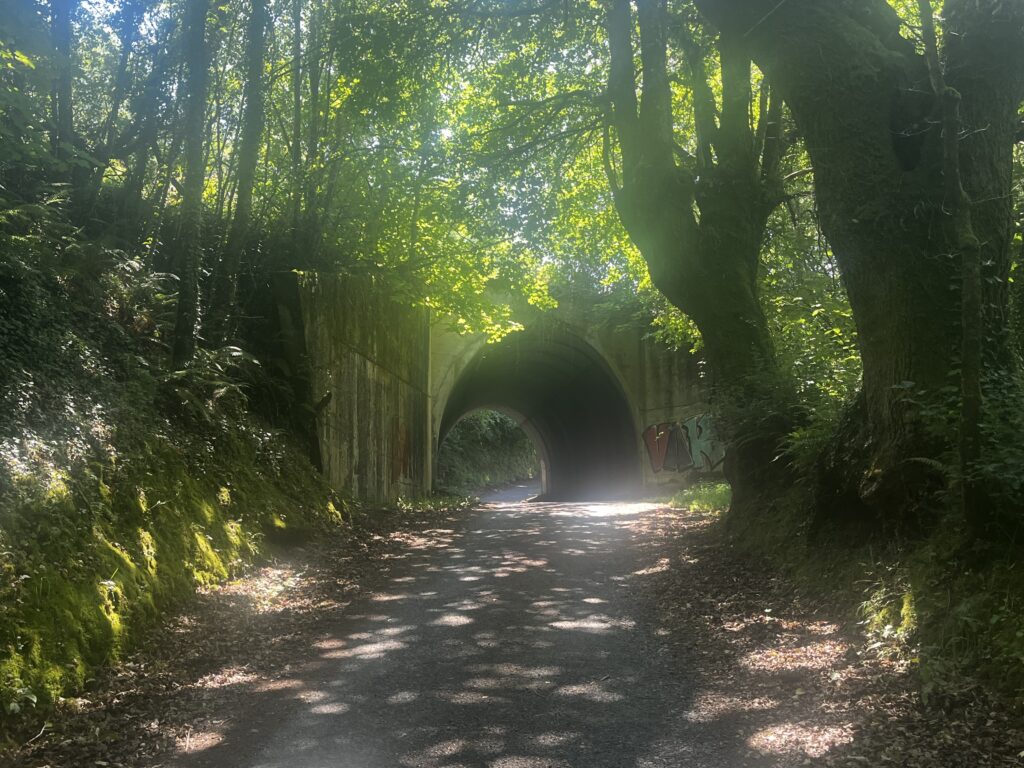
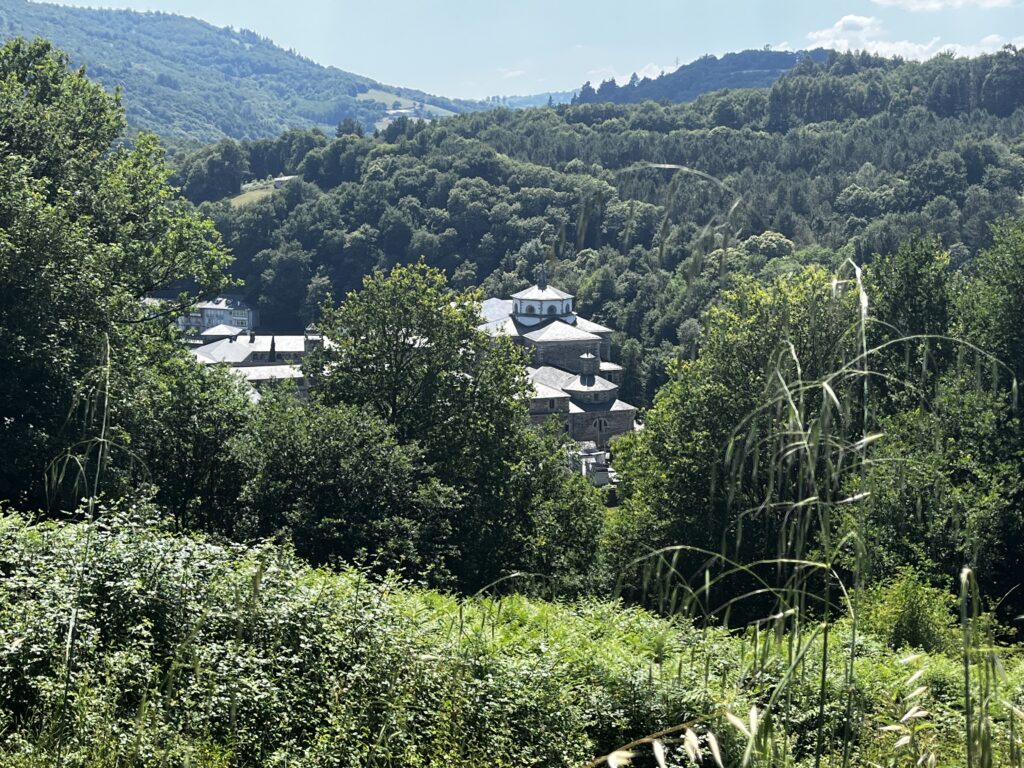
About 4:30, I passed under a highway tunnel which brought me up to a dirt and gravel road through meadow and forest. It was here that I caught that first iconic glimpse of the great monastery in the valley below, somewhat obscured by foliage. Not surprising, I suppose, given the season.
And now I was on a smooth dirt road with tumbling walls on either side. Soon the walls resolved themselves into actual buildings, and the road beneath my feet was concrete. The road wound its way down the hillside into the town of Samos.
I arrived at the monastery at 4:45, and set out to find my accommodation. It turned out to be directly across the street from the monastery albergue.
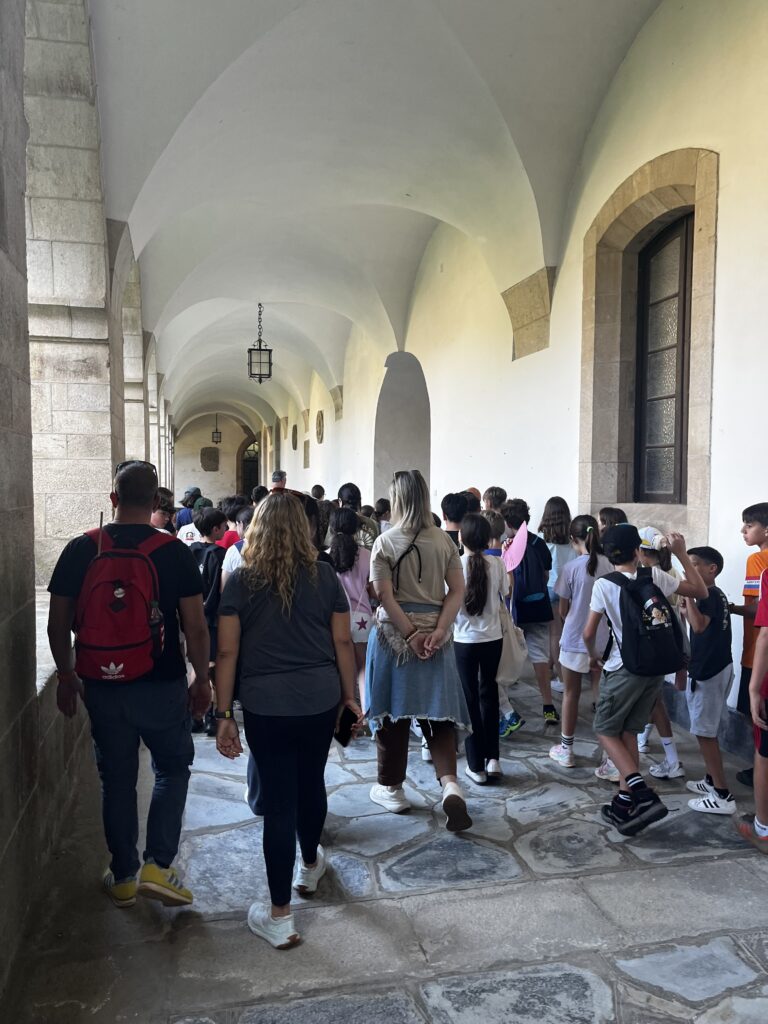
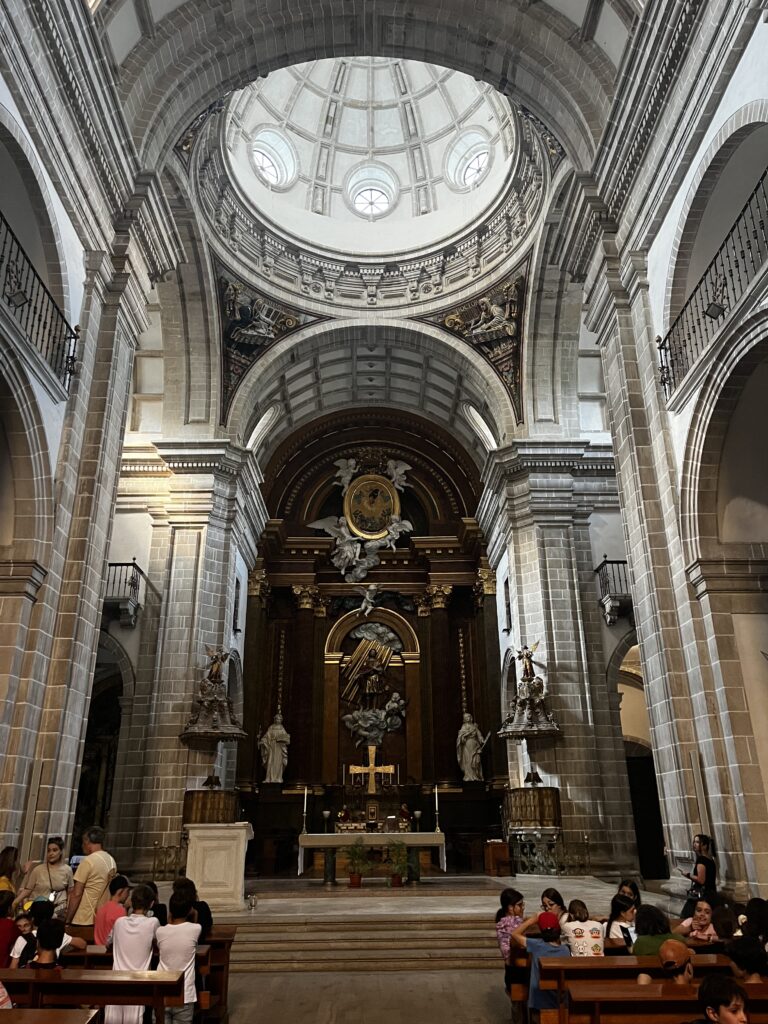
After the usual pilgrim chores, I signed up for monastery tour. I wasn’t quite anticipating that I would be joined by an entire group of middle schoolers. The guide did her best, and she was very good, but it was chaos.
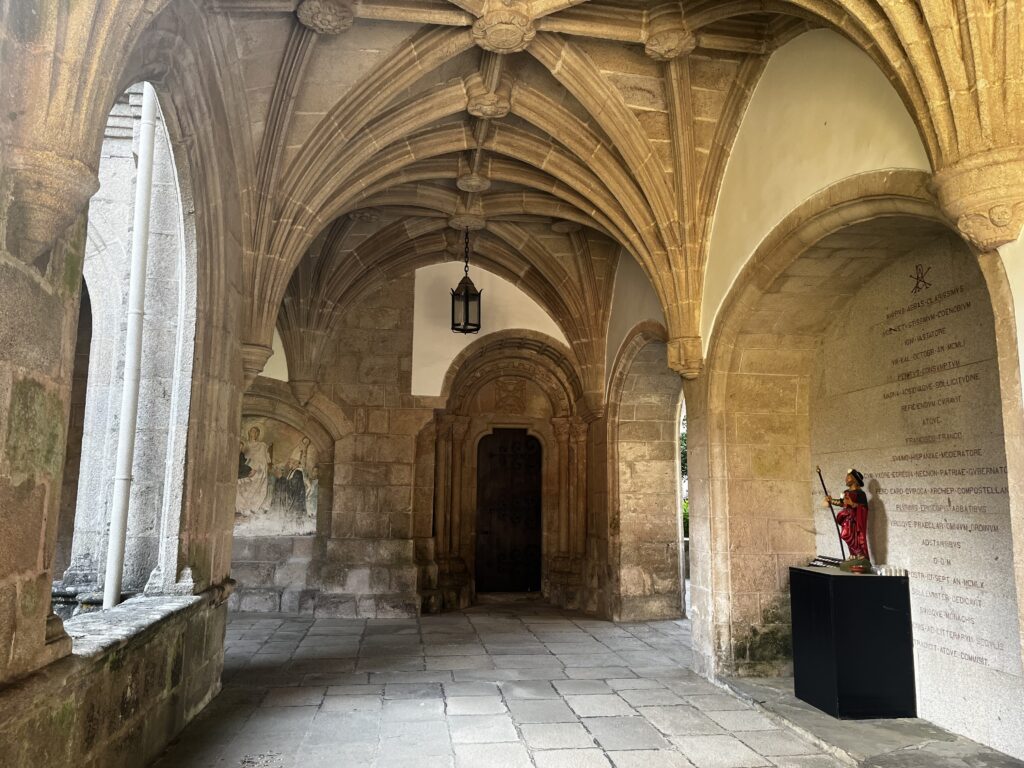
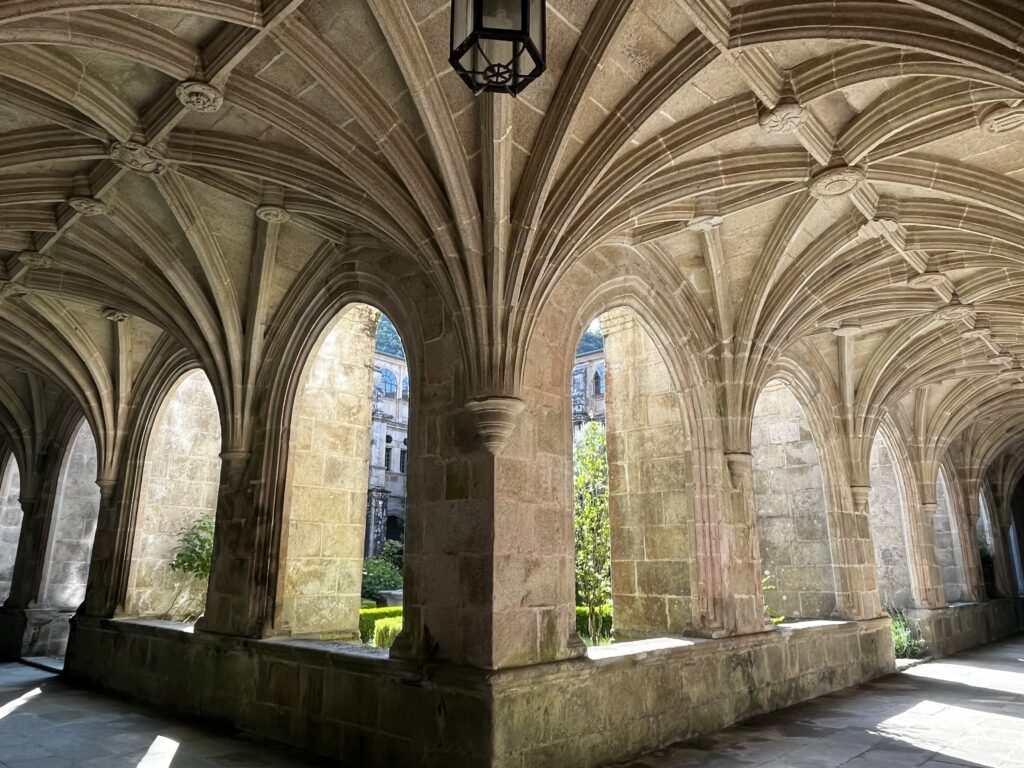
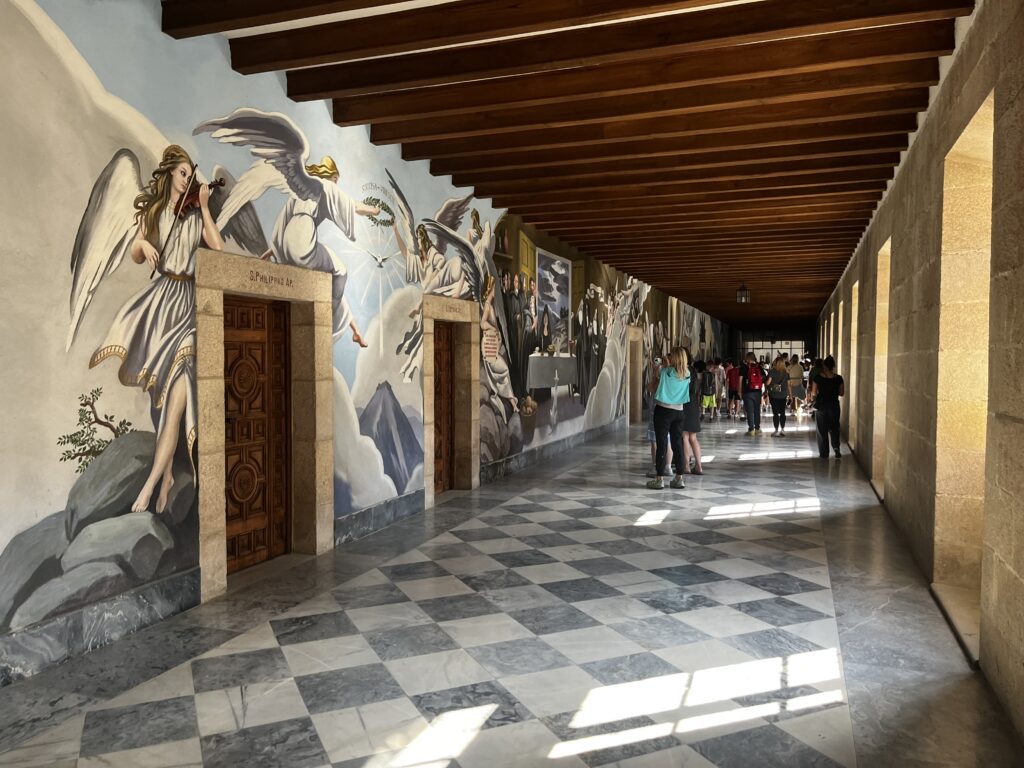
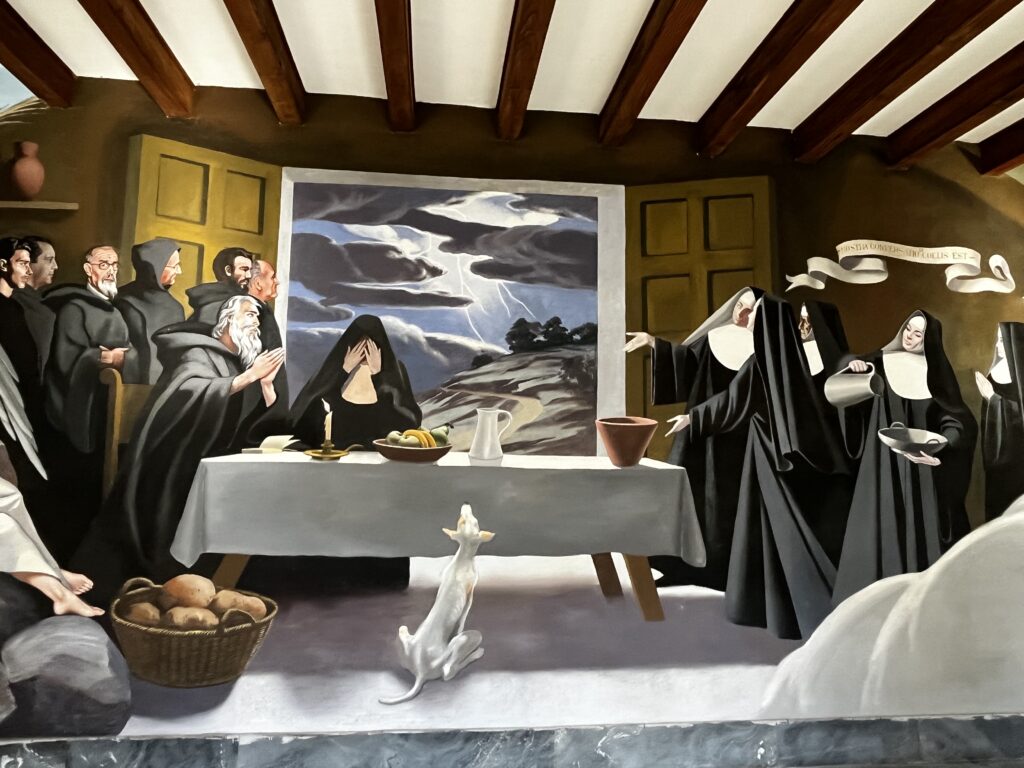
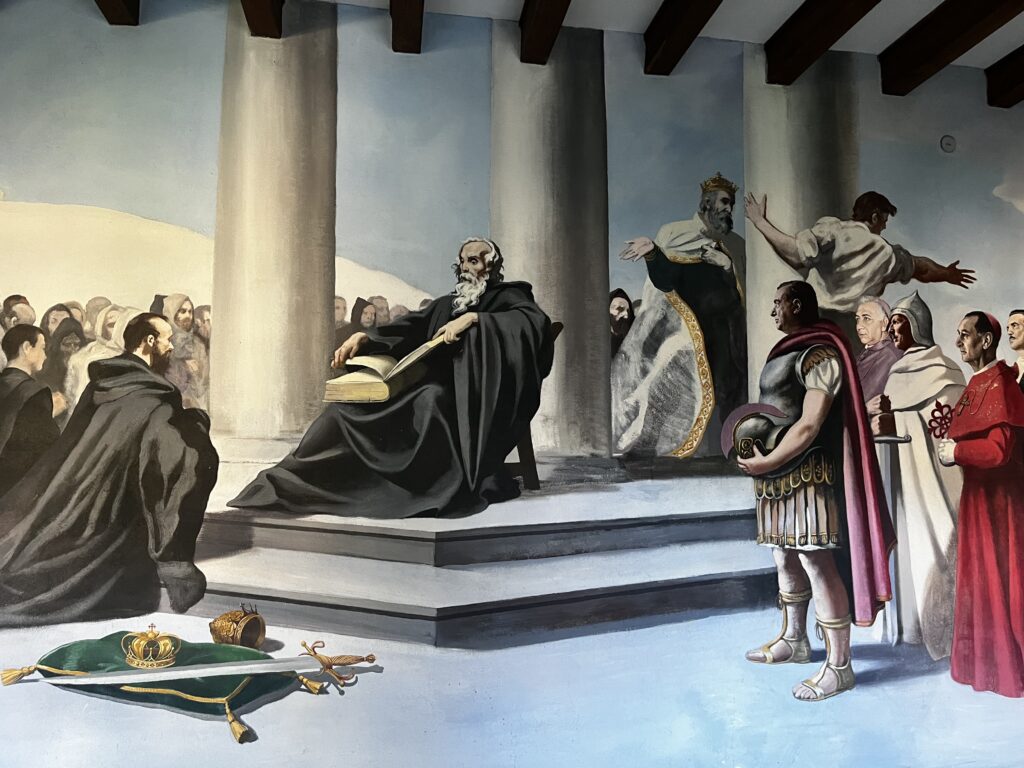
Although I’ve seen them several times now, the murals on the second floor of the Romanesque cloister continue to just amaze me. They are done by several different artists, and they depict events from the life of Saint Benedict and of the Benedictine order.
The faces of many of the figures are patrons of the monastery, especially those who help rebuild it after a devastating fire in 1951.
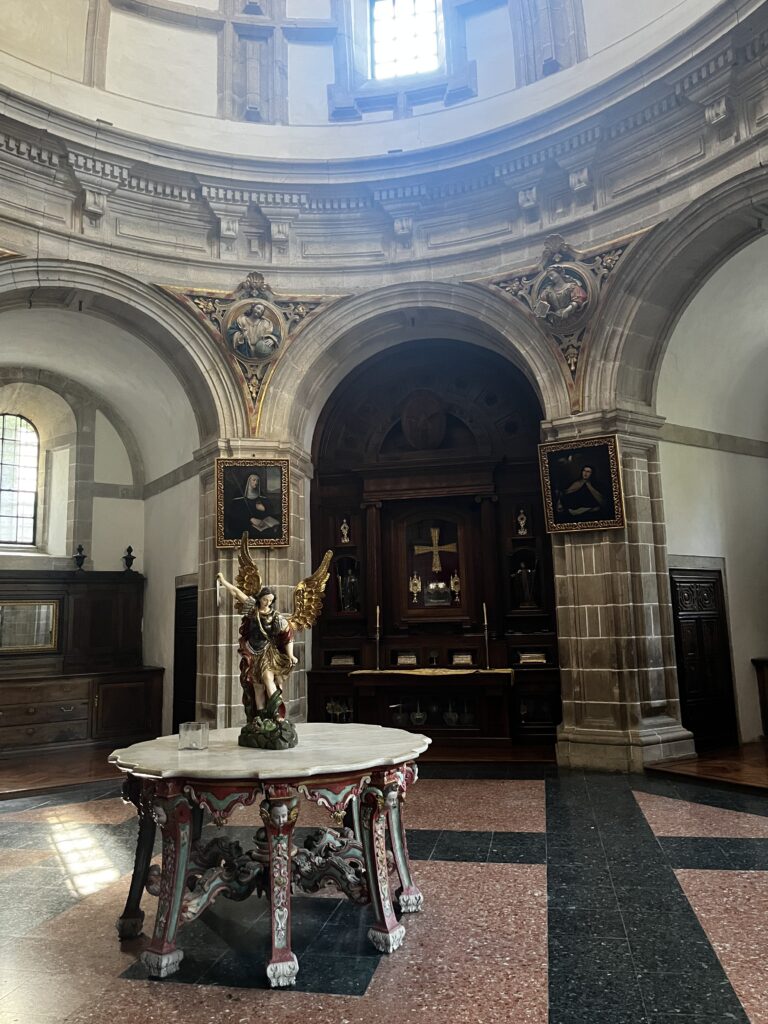
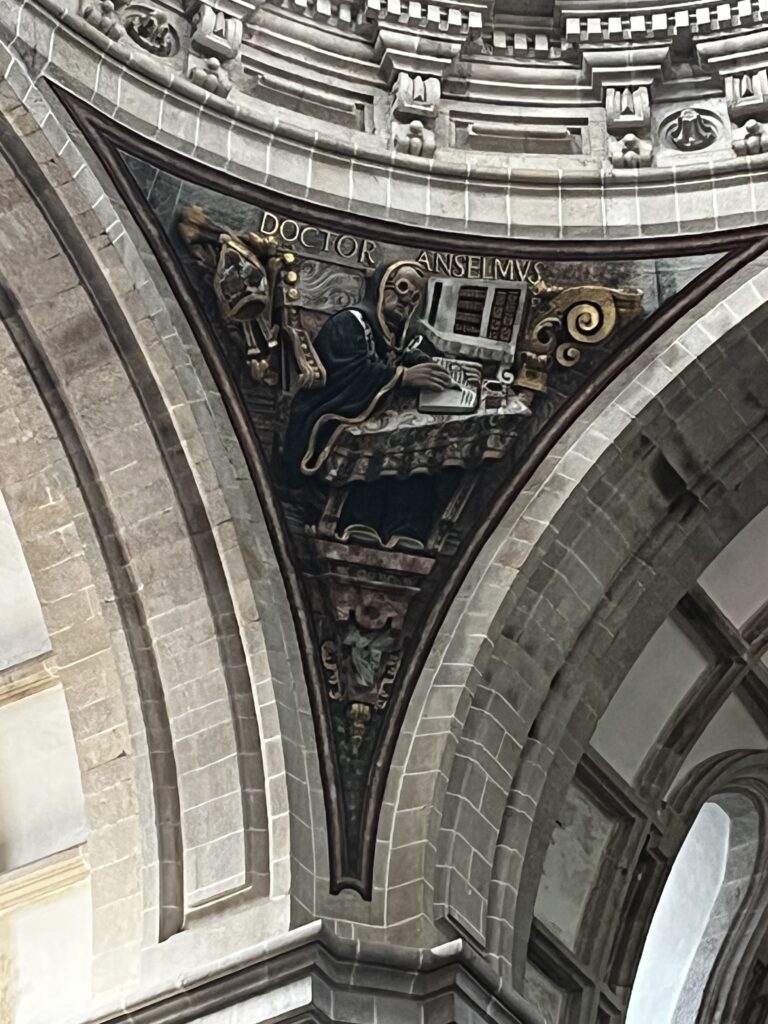
The octagonal Baroque sacristy also holds the relics of the monastery. The medallions around the dome depict Christ and the seven virtues. It’s very clear that the room is still in use.
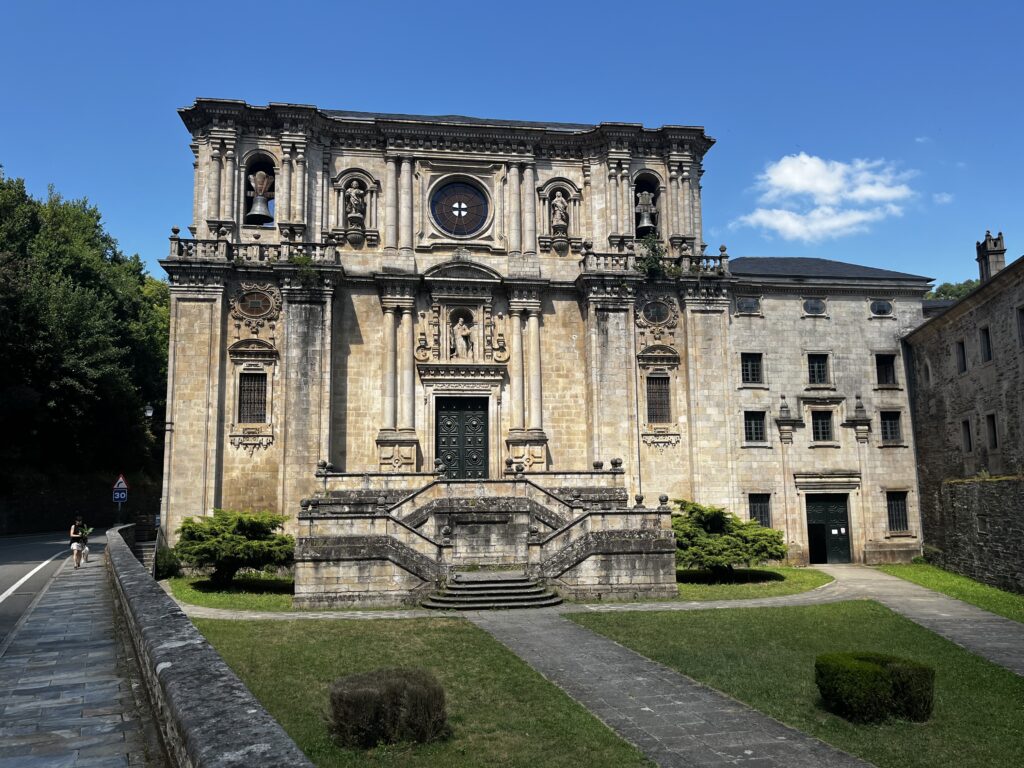
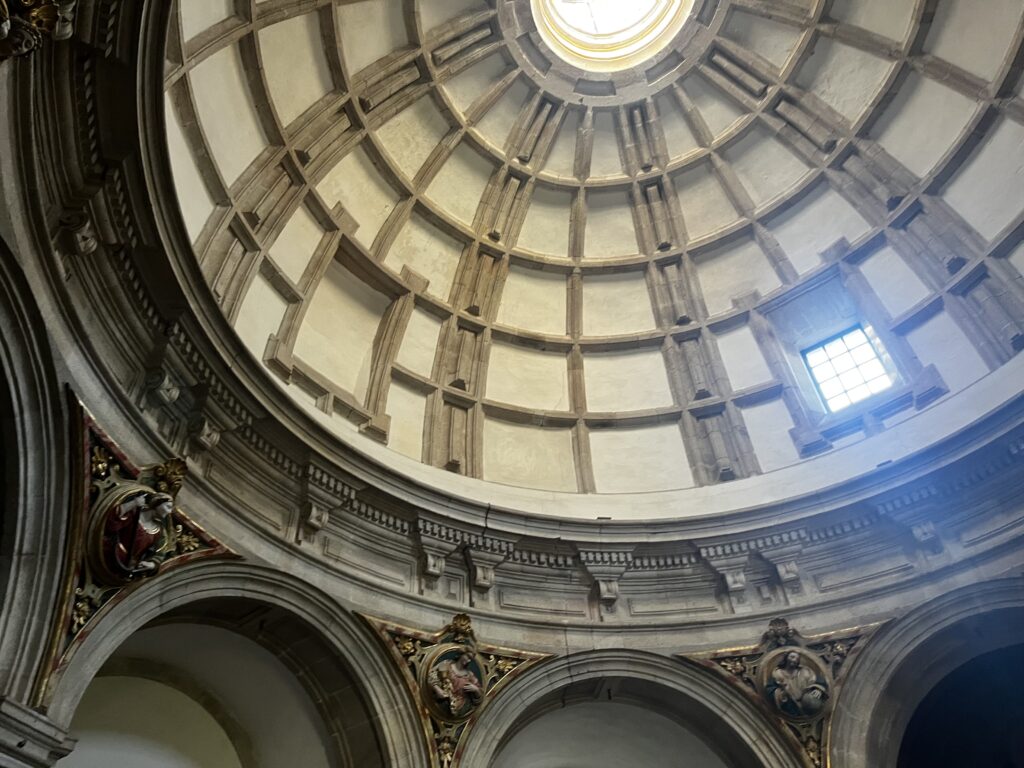
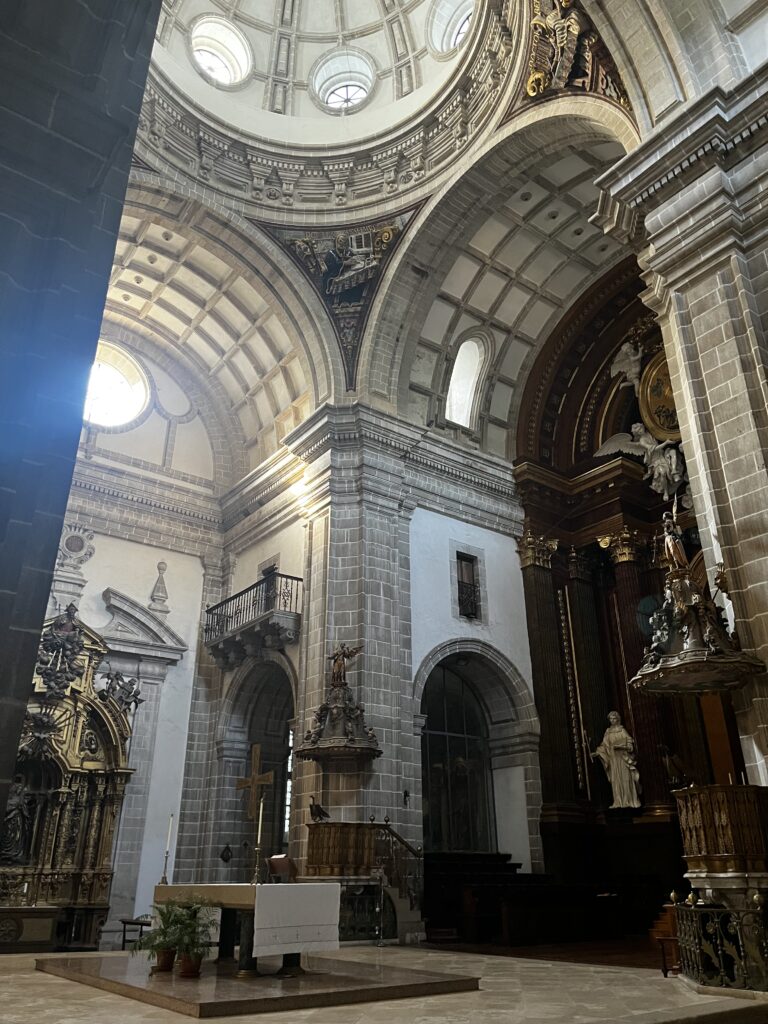
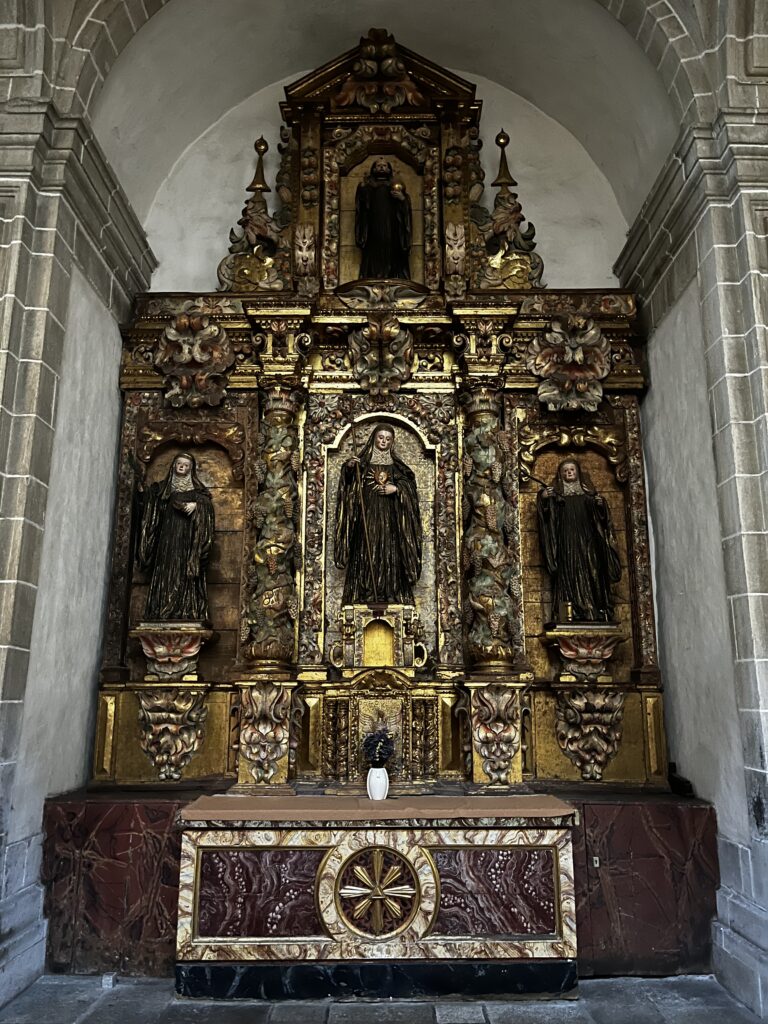
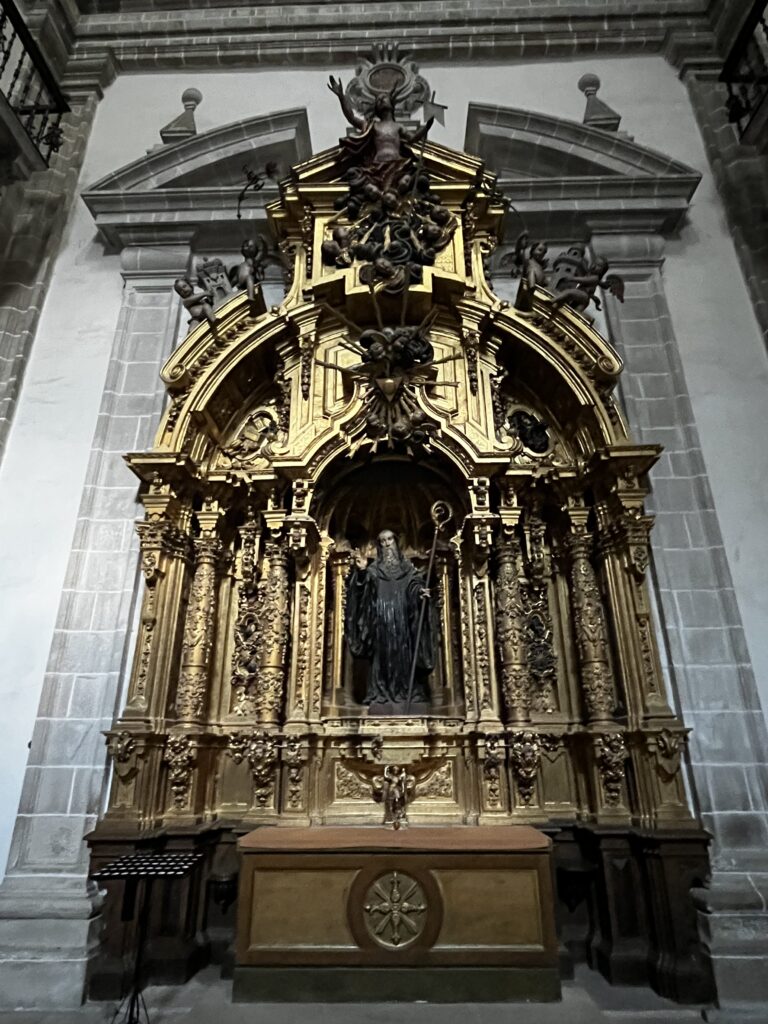
And the church! An amazing Renaissance structure with more baroque side altars than I can count. The retablo of the high altar is unbelievable. I am quite sure that the photos don’t do it justice.
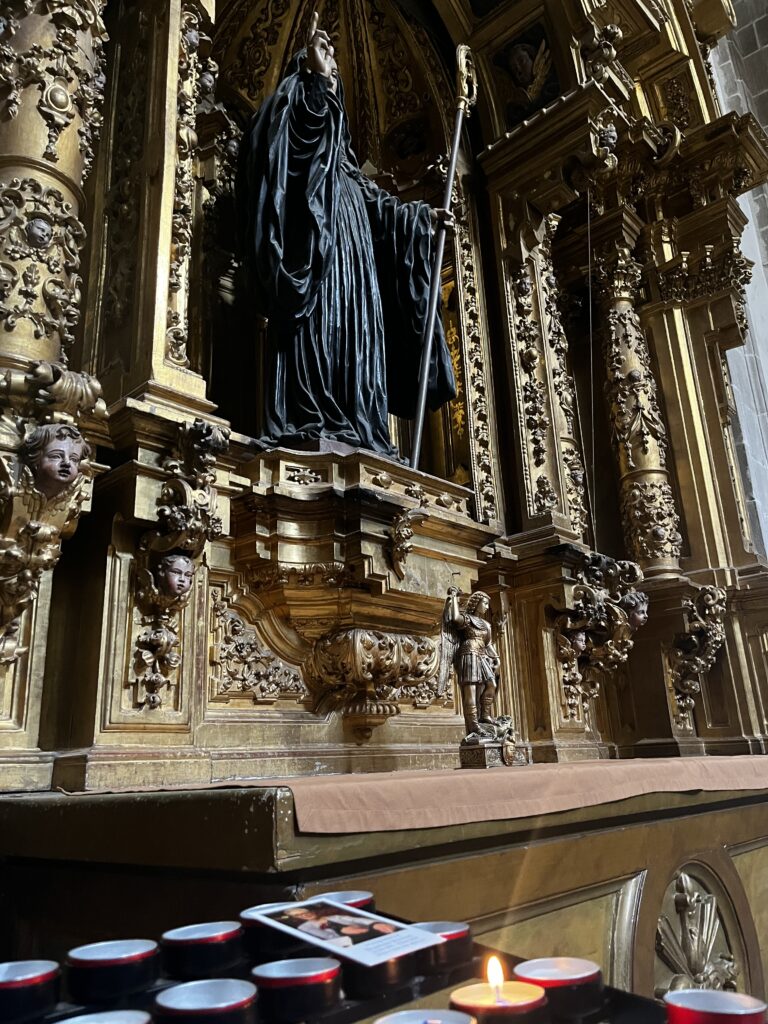
Despite the chaos of the tour, I managed to carve out a small time of quiet to pray, and I lit a candle for Francine at the altar of Saint Benedict.
Vespers and Mass followed the tour. Weirdly, the middle schoolers all seem to have vanished by then.
Date: 16 June 2026
Place: Samos
Today started: O Cebreiro
Today’s Photos!
Thom! I’ve been following your post and your journey, allbeit a bit inconsistently. It’s a source of inspiration to me each time I read one! I look forward to catching up when you’re back here. Safe and great travels!!!
Looking forward to catching up!
The beauty of the monastery is very inspirational
It has certainly inspired me, in all sorts of ways!