
Via Lemovicensis: the Longest Day
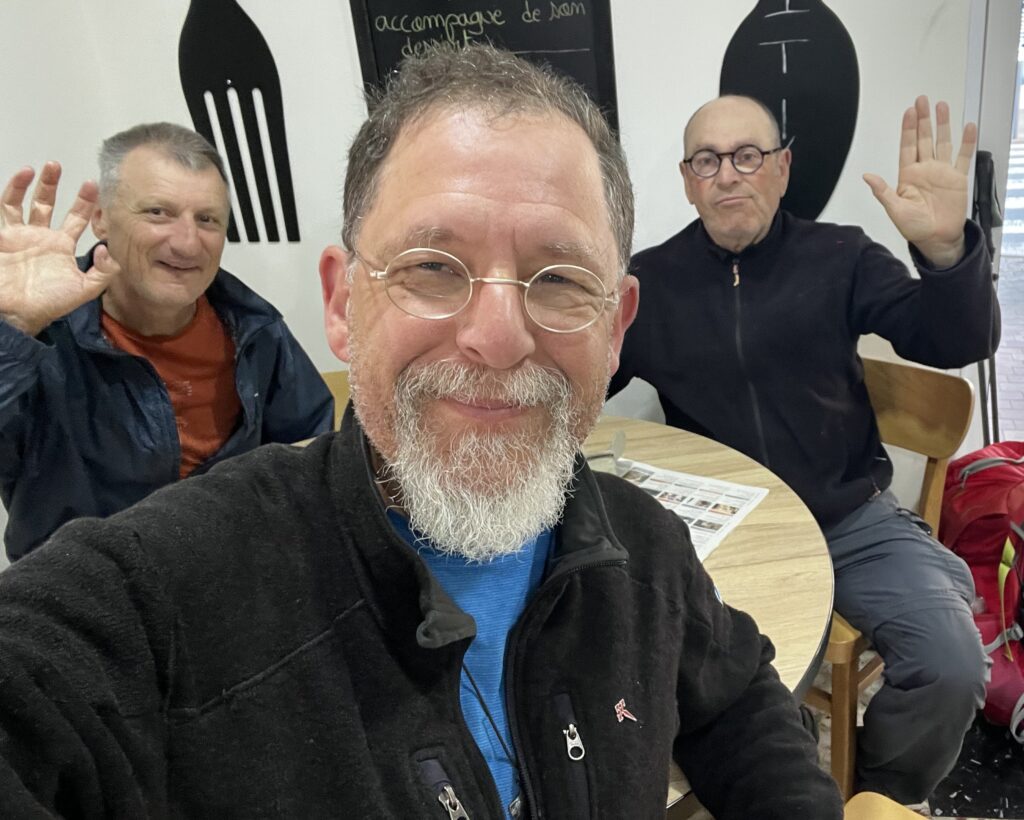
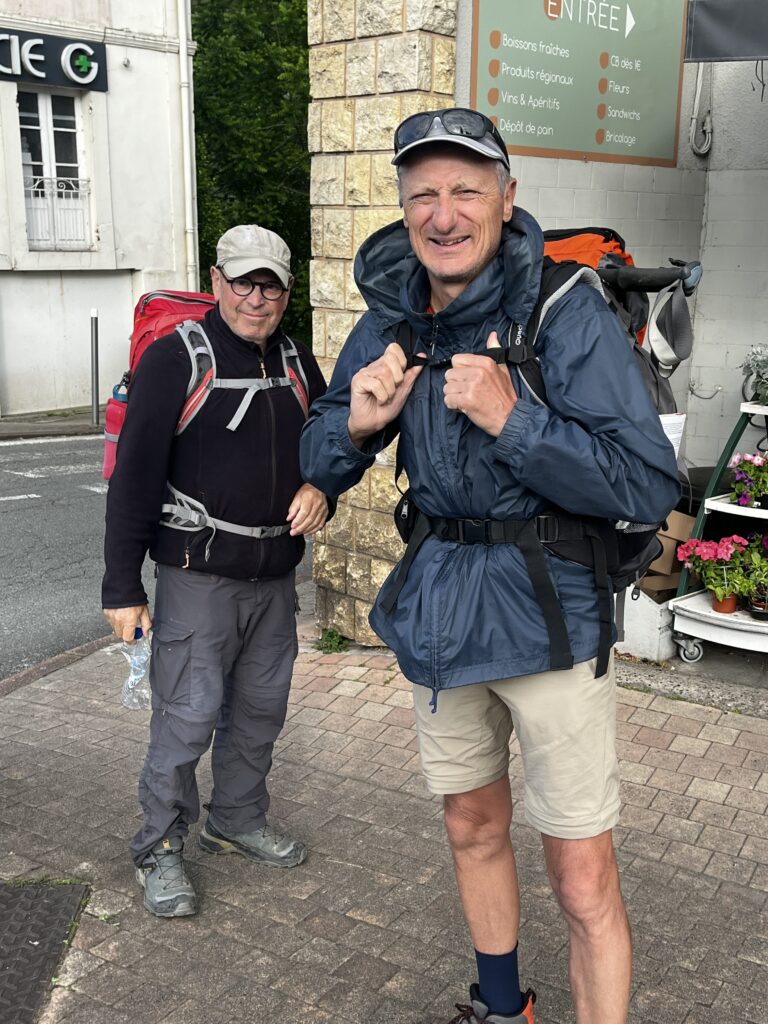
Breakfast in Captieux with Louis-Marie and Luc was bittersweet. I’m walking much farther than them today – 14 km farther – so unless we meet up at Saint-Jean on my rest day, I’m not likely to see them again.
Anyway, we dawdled even more than usual. We probably didn’t leave town until almost 9 AM. The air was crisp this morning, and about half the sky was covered in dark clouds, while the other half was completely cloudless.
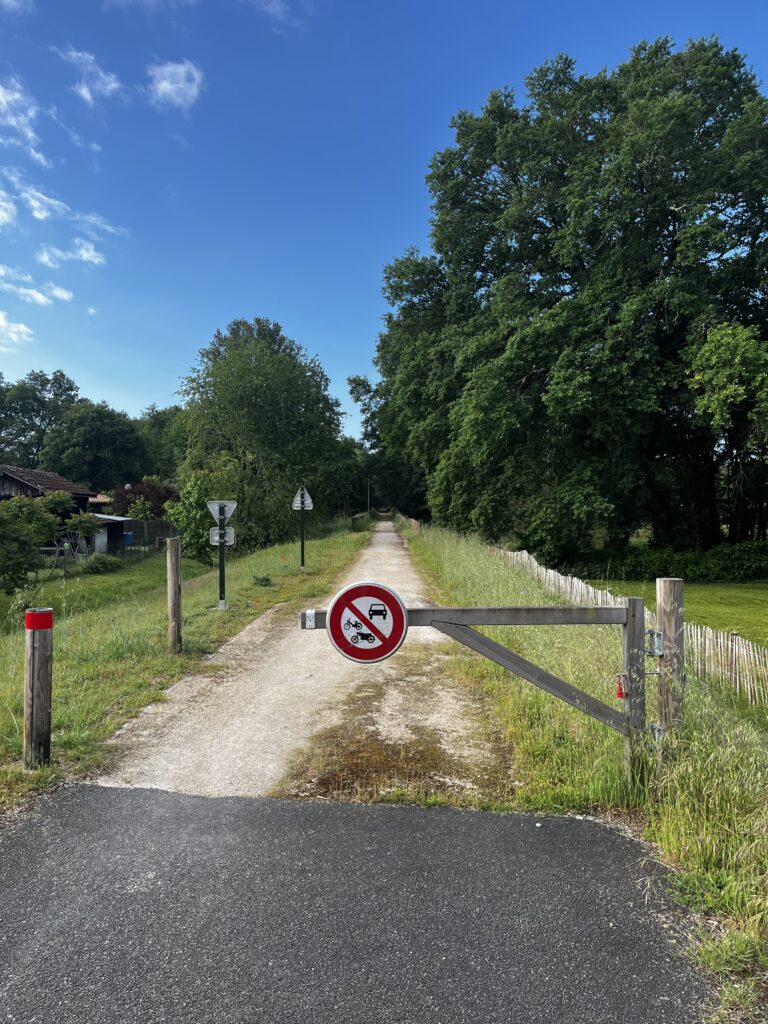
Finding the Camino meant finding the same path on the old railroad bed that we walked most of yesterday. The route took us through the sort of residential neighbourhood where just looking at the styles of the houses you could see that it began life as a rural hamlet, transitioned to a suburb, and was now part of the village.
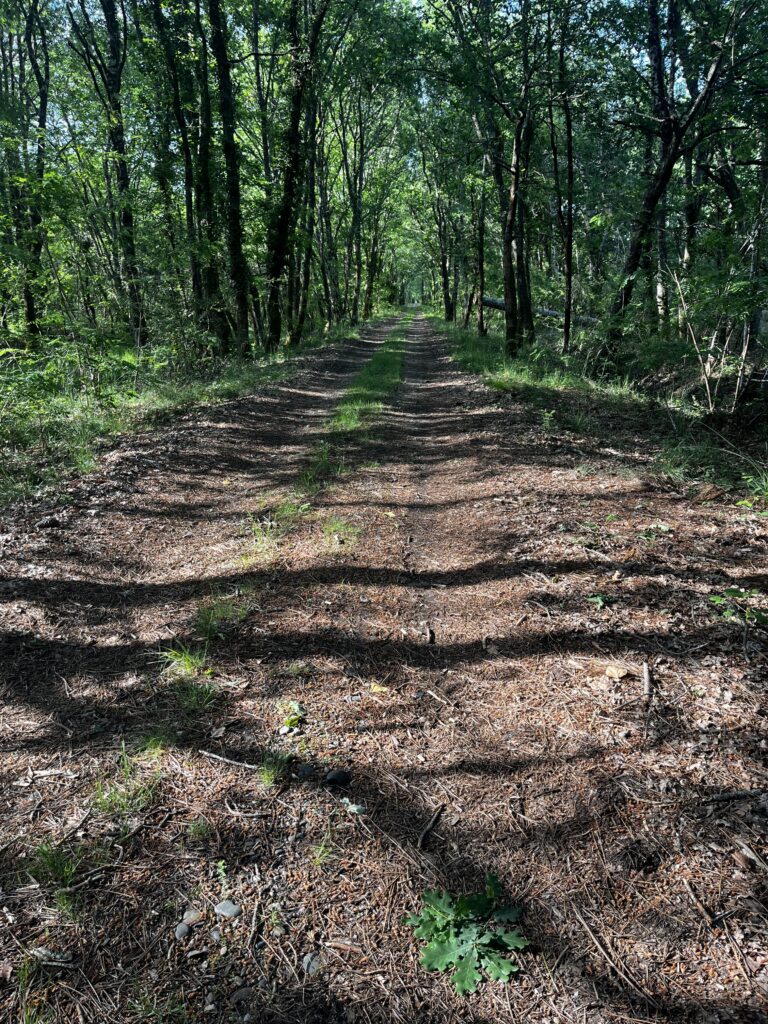
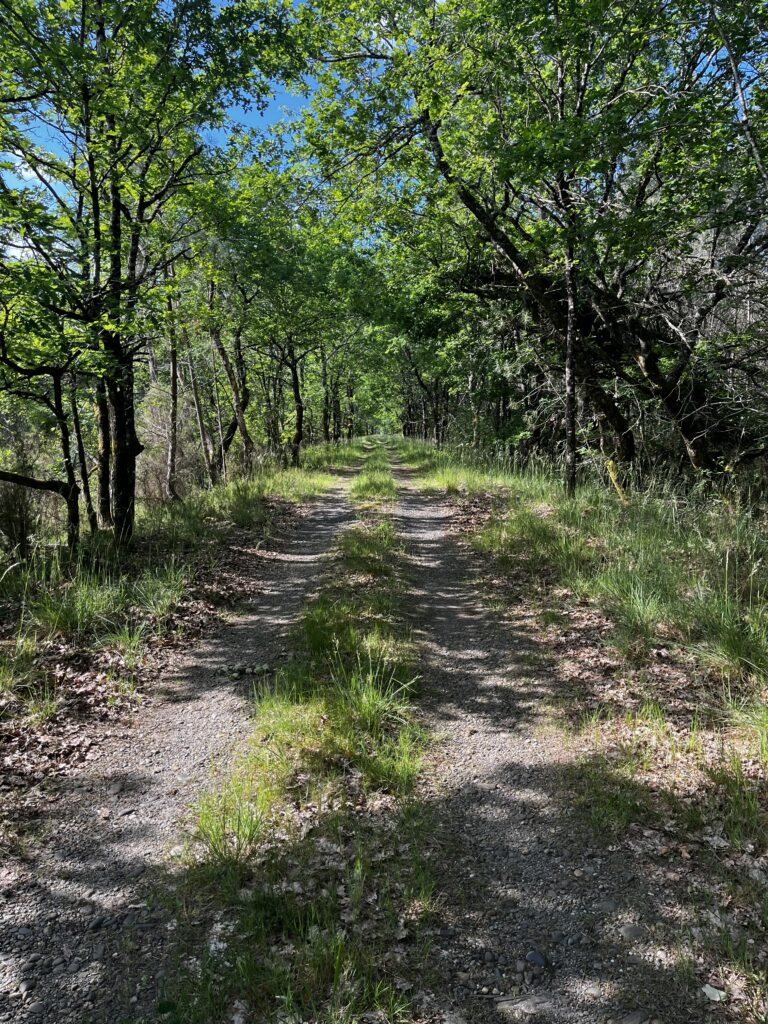
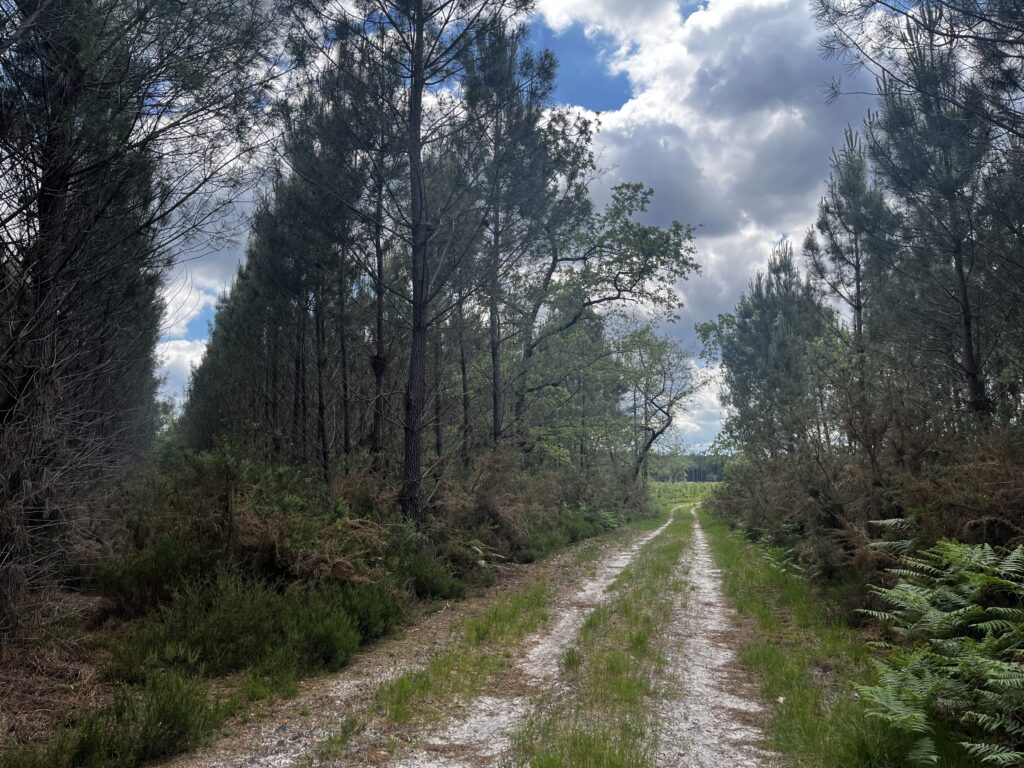
And then, it was back to the green tunnel.
The surface of the path right out of Captieux was a lot more naked asphalt than we’d had yesterday, with a lot more potholes.
We passed a meadow with cows grazing. Slowly, my friends fell further and further behind.
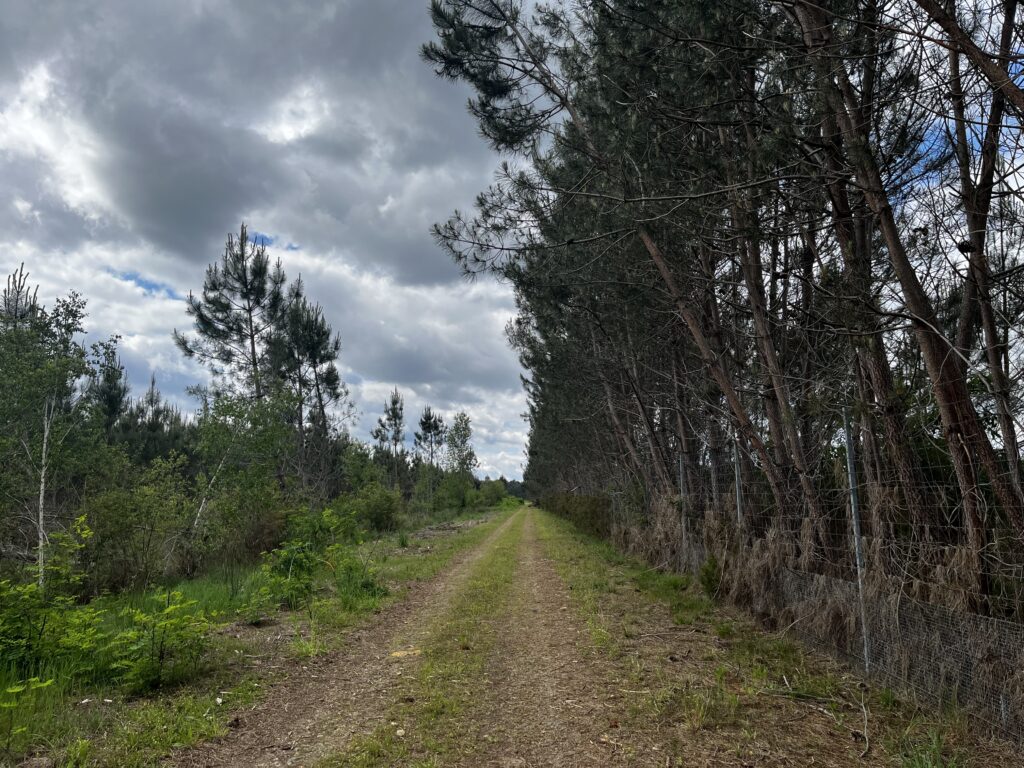
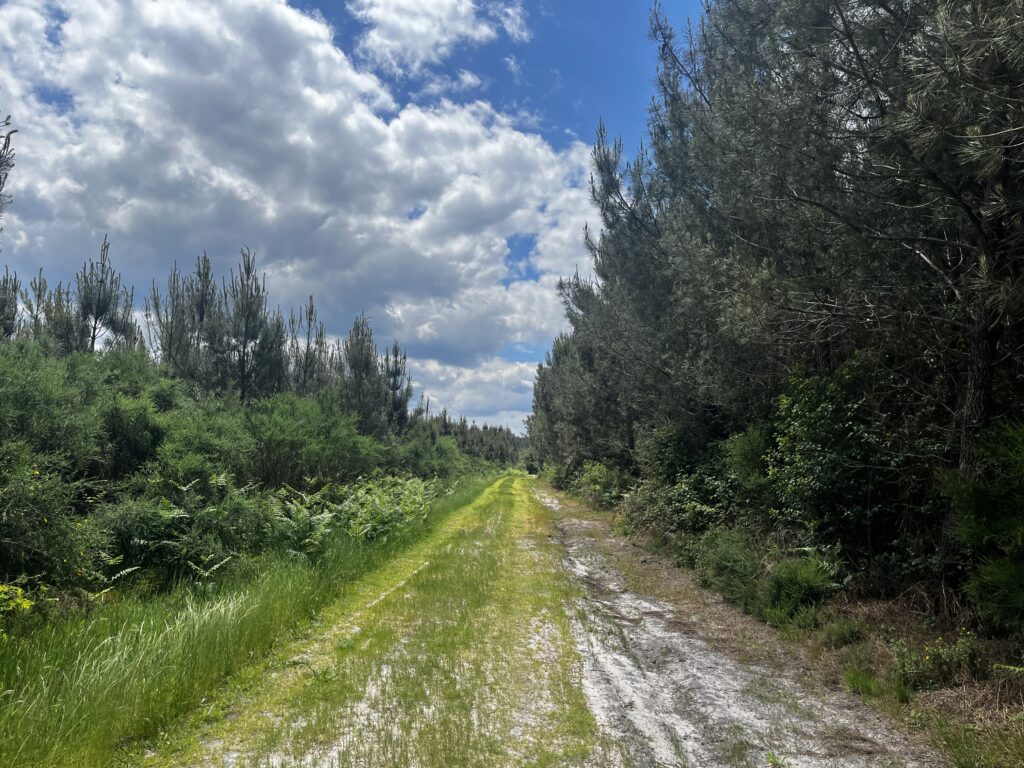
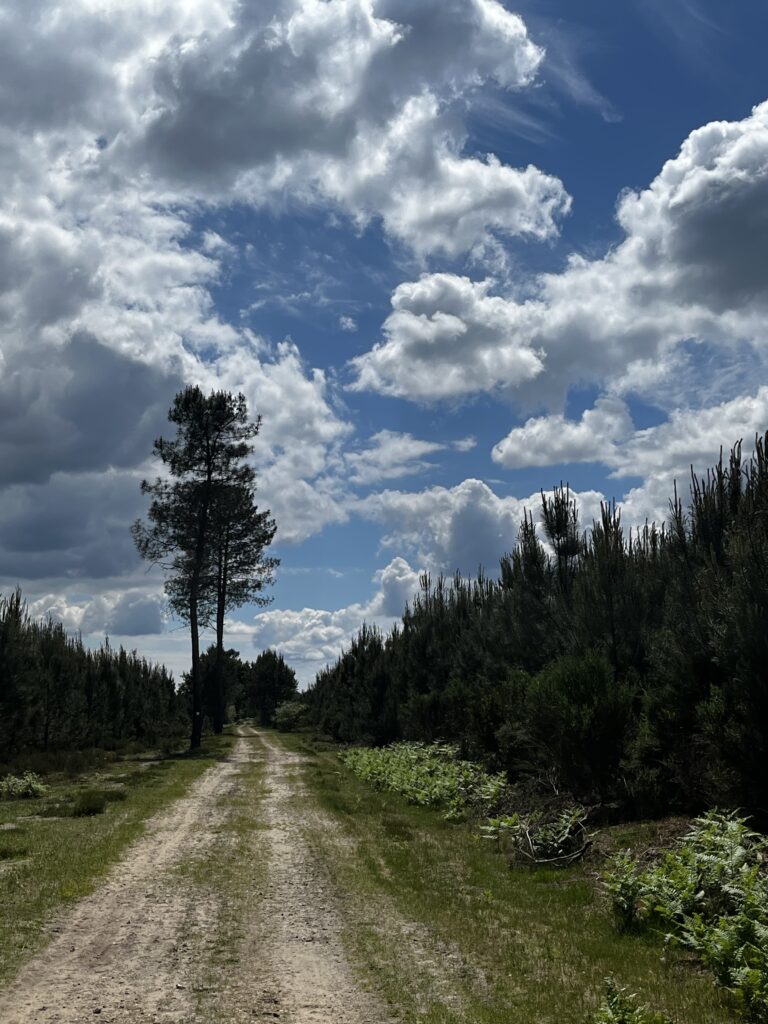
After a couple of kilometers, the path more or less smoothed out, but it also acquired a green hump of grass in the middle. It looked far more like a forestry road than it did a bike path at this point.
I was seeing more and more pine trees, while at the same time the trees nearest to the road got sparser. Some sections of the path were less of a tunnel and more of a corridor.
Sometime before 9:30, the fleece came off.
By now, I was starting to encounter stretches of the path completely covered in dried pine needles, oak leaves, and even small branches. It’s clear that this section of the trail is not maintained to the same standard as yesterday’s.
The trail continued to deteriorate with every passing kilometer. The grassy island in the middle grew larger and more unkempt. There was so much to detritus that it was impossible to tell what the actual road surface was, though I suspected by this point it was dirt backfilled with stones.
It was much more a hiking trail than a bike trail now.
The tik-tik-tik of my sticks was constantly startling the little lizards near the trail, sending them scrambling away in a scattering of leaves.
I will say this about the green tunnel: it’s pretty difficult to get lost, even for me.
For whatever reason, Facebook refused to show me last year’s memories this morning. I kind of rely on those for details, because my personal memory of that time is a hazy blur. Indeed, that’s why I journal. That’s why I write things down. It’s difficult sometimes to keep things in proper sequence otherwise.
Somewhere around 10:15, the path crossed a dirt road. There was a house at the intersection identical in design to the one I saw yesterday, the one that I thought might have been to do with the old railroad. I am now more convinced of this.
After this, though, the path gave up all pretense of being suitable for bicycles, except perhaps dirt bikes. It was still pretty cruisey for hiking, though.
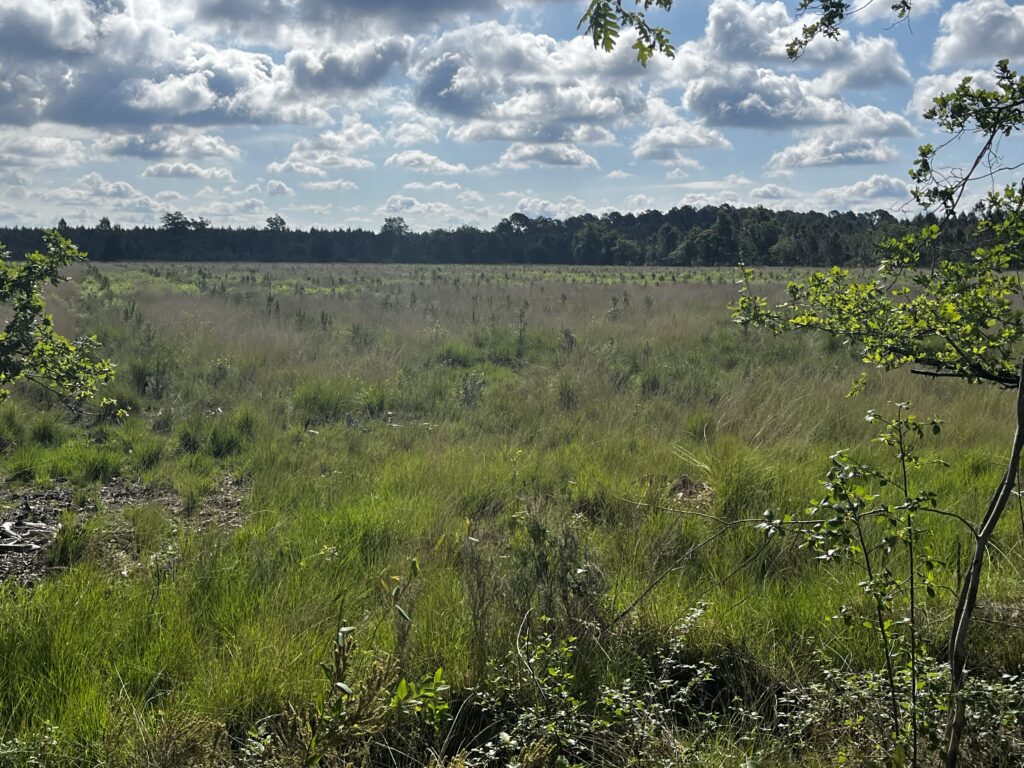
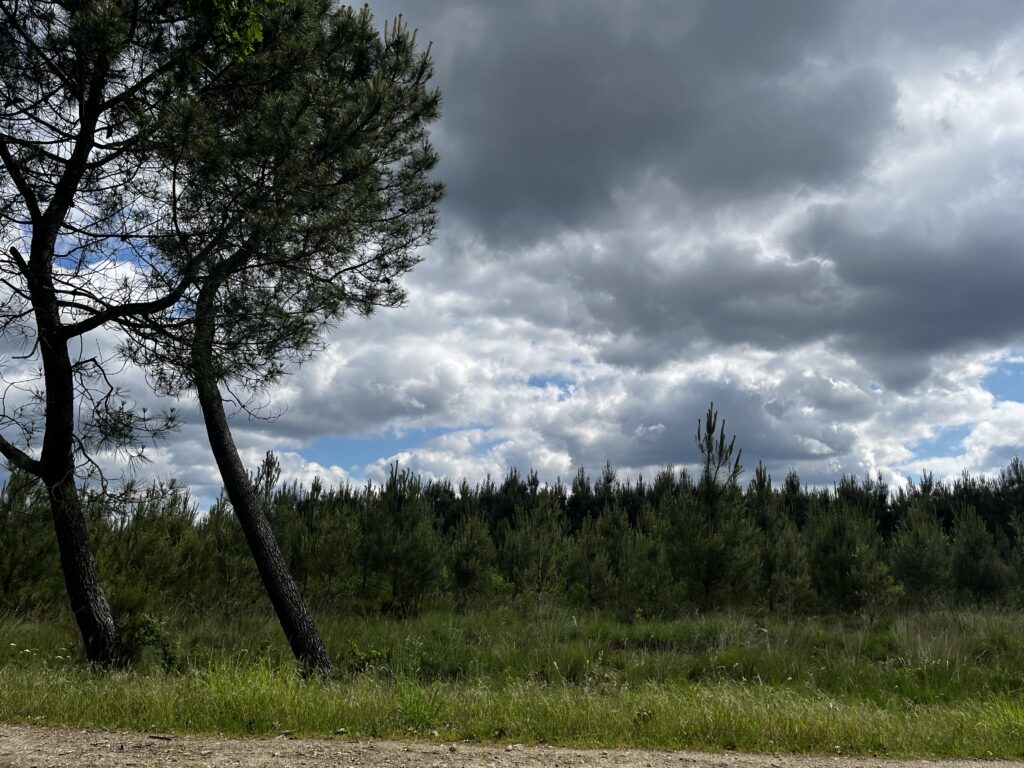
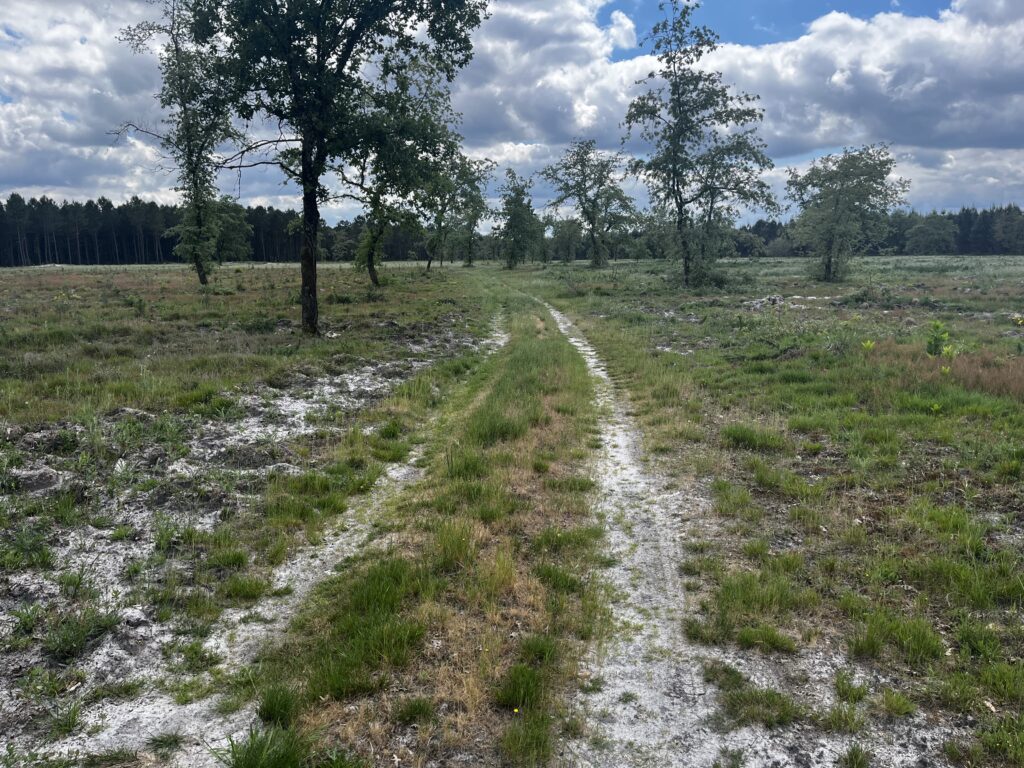
At about 10:20, massive open spaces, almost a prairie, appeared on both sides of the green tunnel. Through the long grasses I could see the tops of sapling pine trees just poking out.
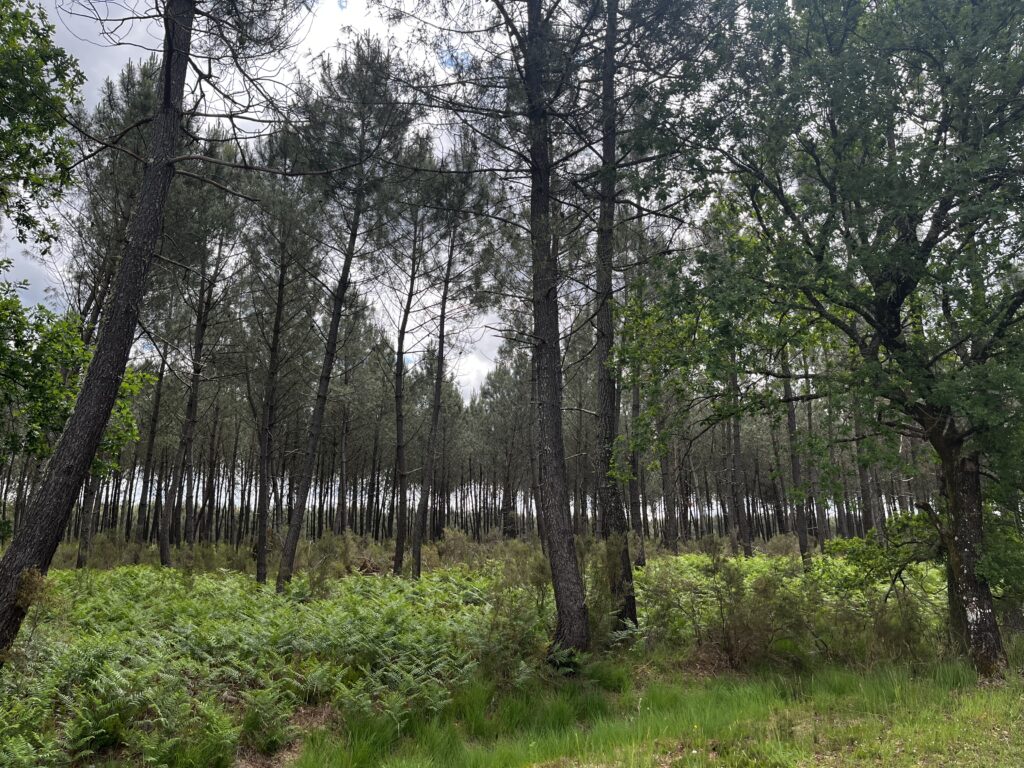
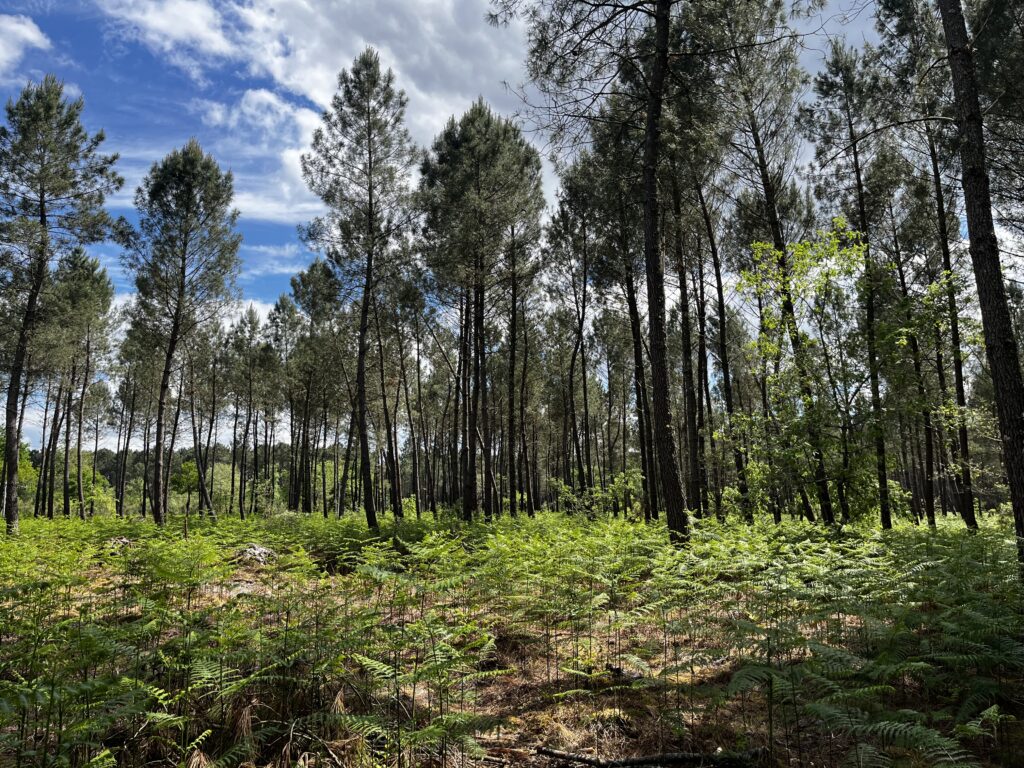
As I walked on, it became clear that this was indeed tree farming. I would pass large sections of forest where the trees were all the same size, however tall or short that was.
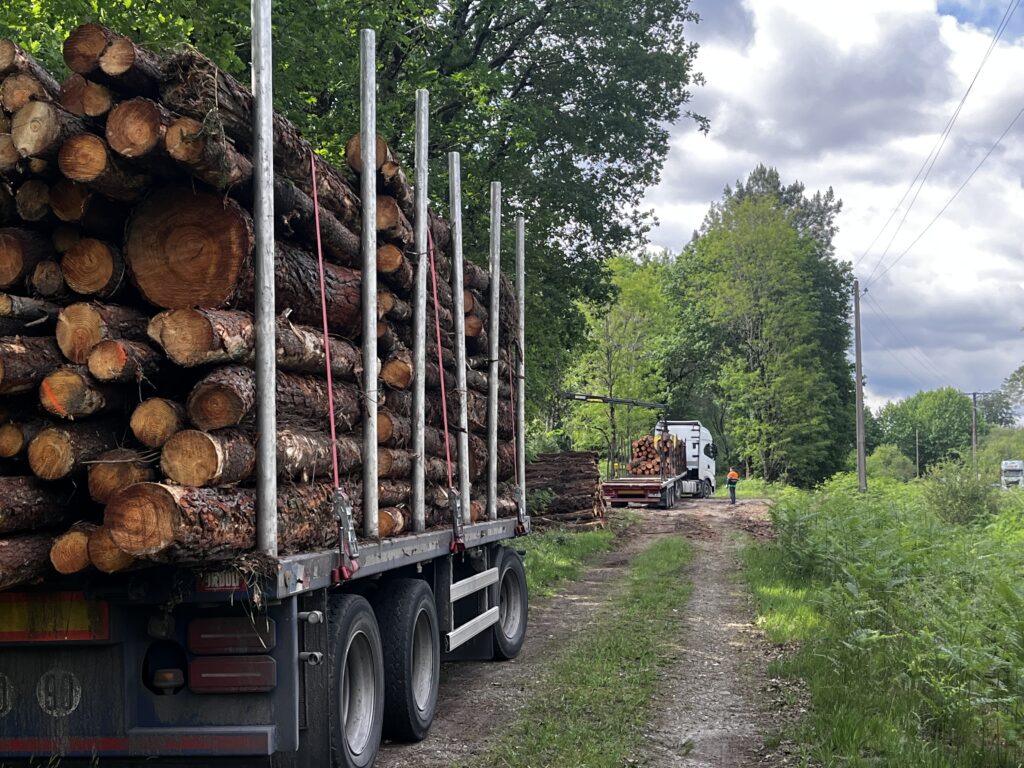
I saw my first logging trucks at about 10:45. They were in fact loading timber up on one of the trucks, and they were completely blocking the road that I now had to turn down.
If Francine had been here, she could’ve charmed the loggers with her French and her laugh. I was reduced to gesturing at my map and then down the road.
It took a little bit of negotiation before they would let me squeeze through between the heavy equipment and a pile of logs.
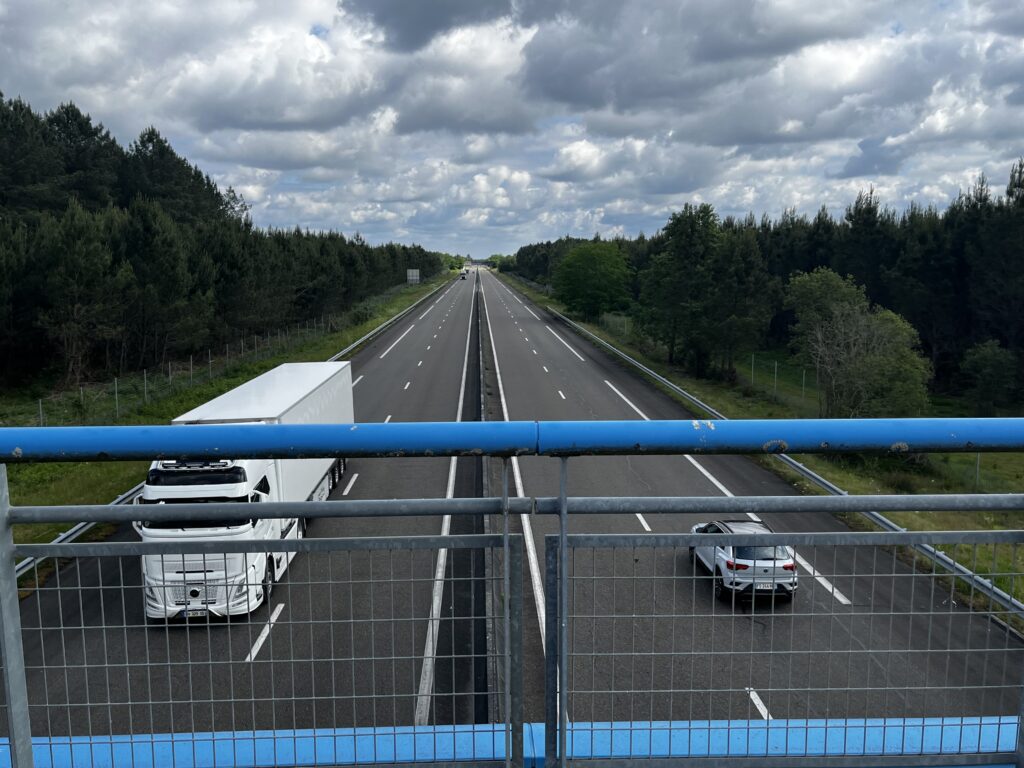
The Camino turned down an asphalt road for the purposes of crossing the A 65 highway. I crossed over it in the other direction yesterday, and now it was time to cross back. spoiler alert: I will cross it at least one more time before I leave France.
This was not a cozy, sheltered bridge like the one yesterday. It was simply an overpass. I crossed over at 11 AM. From here, the Camino followed a disintegrating asphalt frontage road that eventually became two ruts of dirt and gravel.
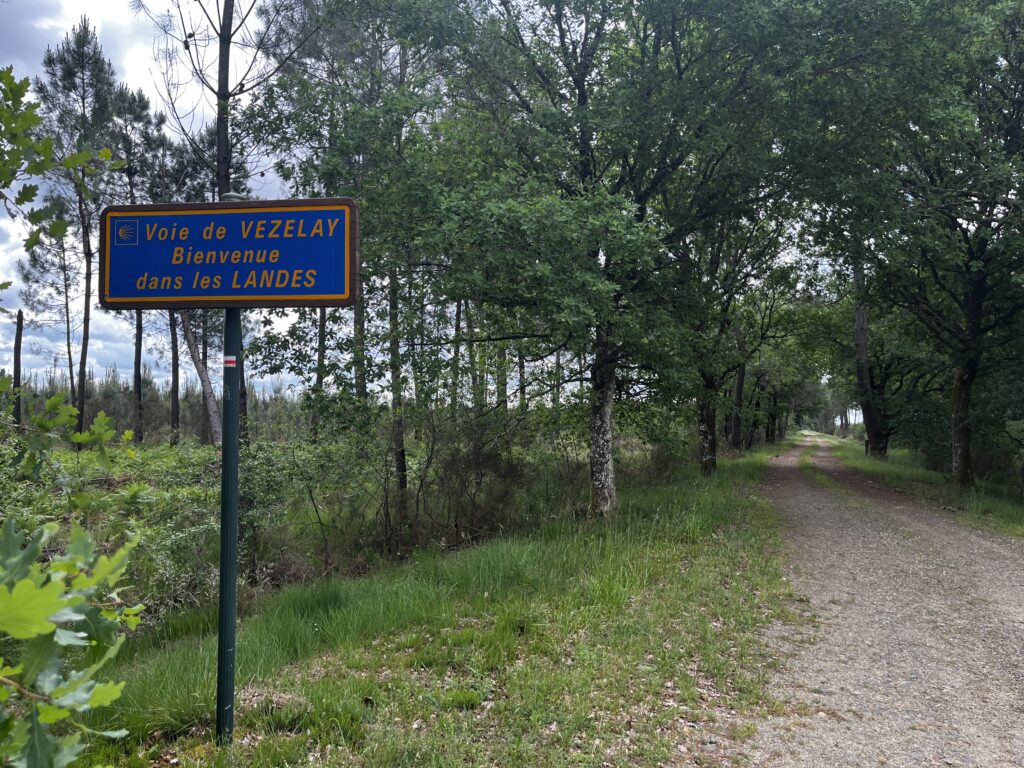
I walked next to the highway for about 2 km, before the road verged off deeper into the woods. It was here that I entered the Landes Forest, la forêt des Landes.
This is the largest managed forest in western Europe, but it wasn’t always so. Once, it was the largest swamp in Western Europe.
It was so boggy here in the medieval era that the local shepherds typically wore stilts to get around. That sounds like something out of a Terry Gillian movie, but I assure you it’s the truth.
In the 19th century, the area was forested, and millions of trees were planted. I suspect this might have something to do with French naval ambitions, but who knows?
Since the 1970s, some areas of the forest have been turned over to agribusiness and are now effectively factory farms.
No green tunnel now, just acres of pine trees, each lot in a different stage of growth. The road surface was asphalt covered in gravel and small stones.
At about 11:30 AM, I came upon the first bench I had seen since I left the village this morning. I decided to take a little rest and have a snack here. I was probably close to halfway through my day, so the snack rapidly turned into lunch.
The skies were definitely overcast now, and a chill wind blew. Somewhere in the distance a cuckoo pronounced its judgment on my life choices.
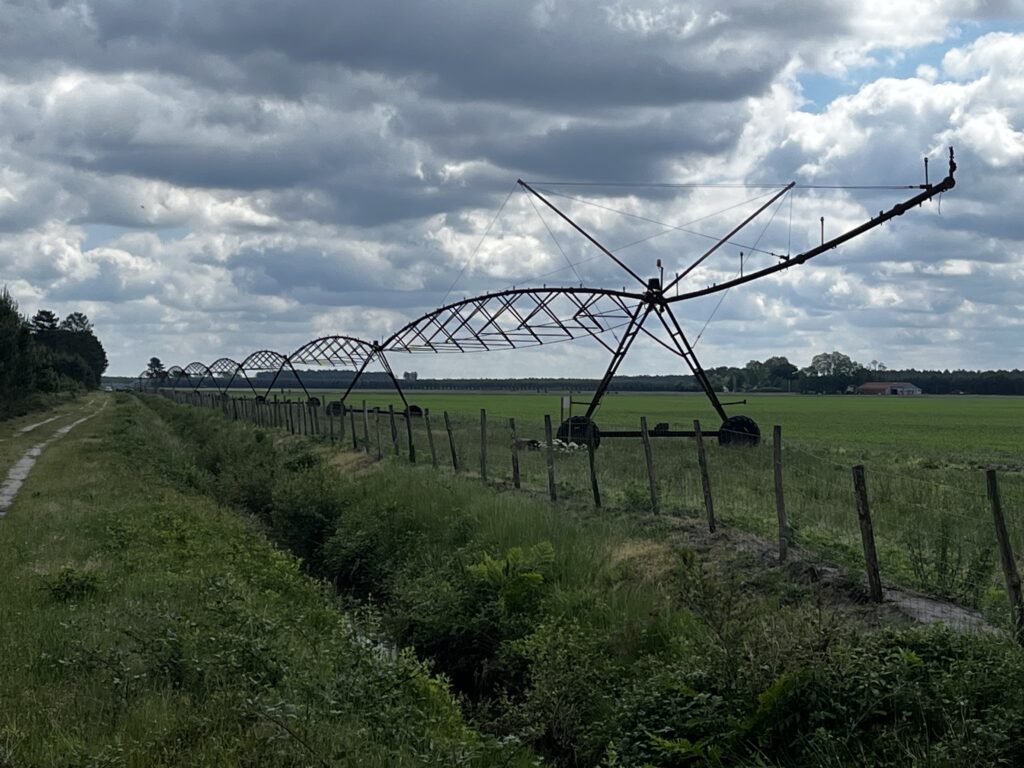
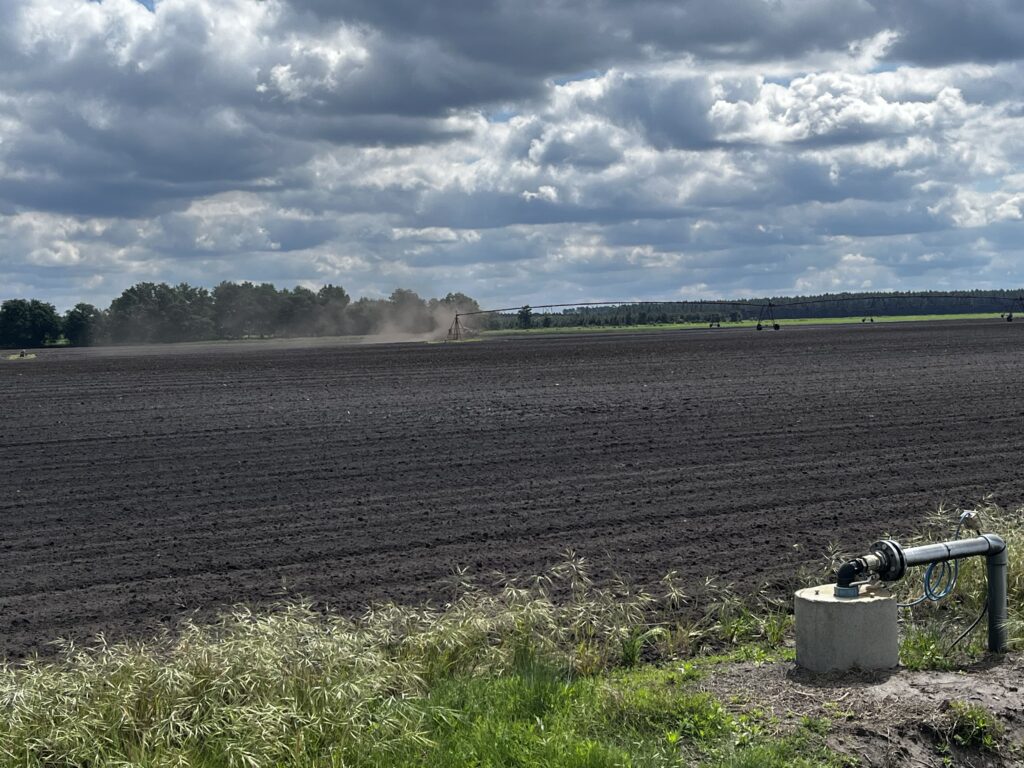
Twenty minutes later, I was back to walking. Just a little past the bench, the tree farms gave away to a couple of massive agricultural fields with insanely wide mobile watering systems.
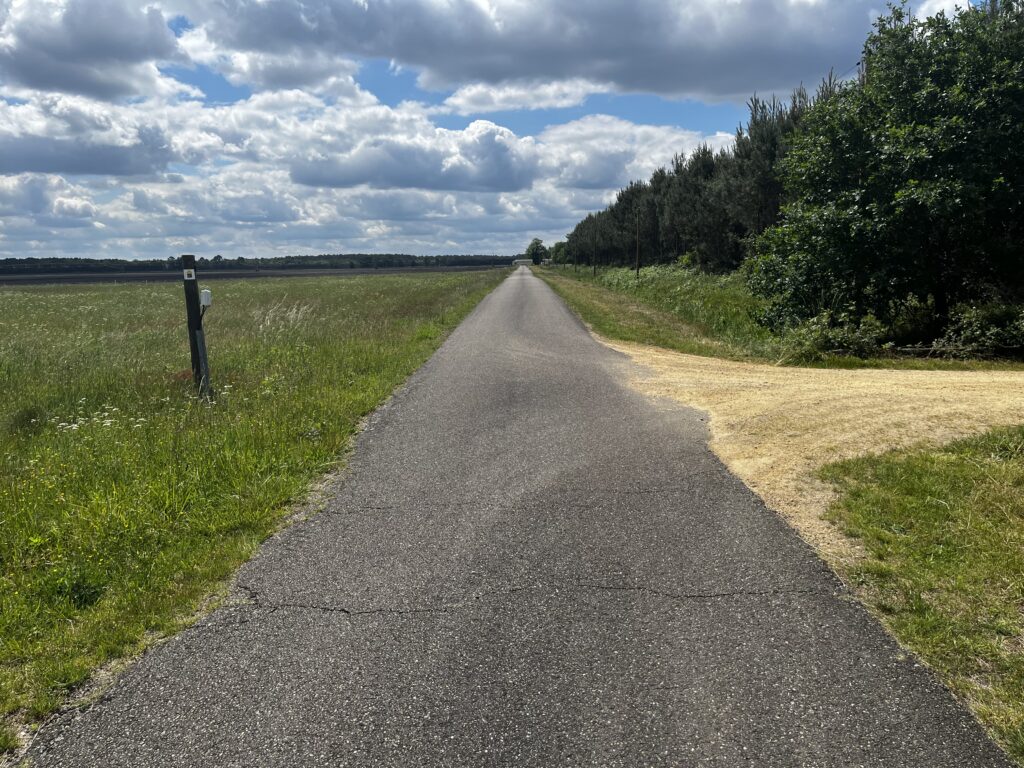
Just about noon, the Camino turned, and I found myself road walking on asphalt through the vast agricultural fields.
Occasionally, there were neat rows of farmed pine forest to my right, while there was still agricultural land to my left. There was a great deal of evidence of logging in the forest, indeed a full logging truck passed me along this stretch.
And so it continued.
Very occasionally, I would pass farm buildings.
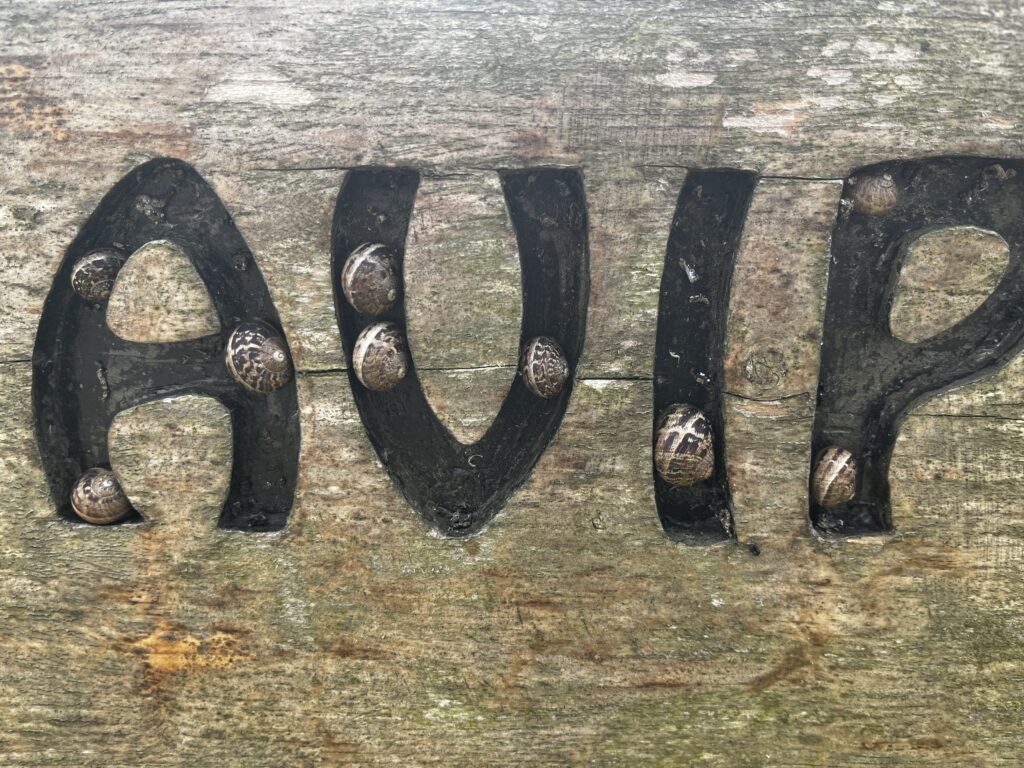
About 12:35, I passed a cluster of buildings labeled Aviphoenix. It wasn’t an official sign – it was carved in wood, and there were snails hiding in the shadows of the carving.
After this, I started passing smaller family farms. One of them even had ducks and hens running around in the yard.
Finally, at 12:45, the Camino turned down a soft, sandy dirt road through the forest.
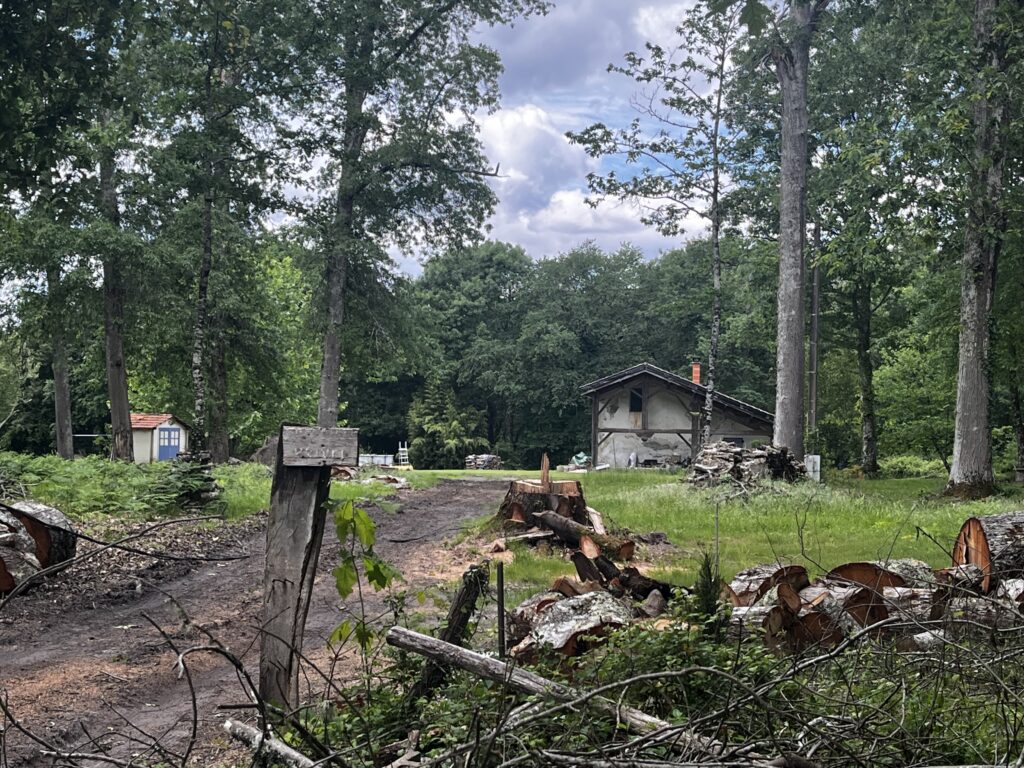
A few minutes later I passed the house in the middle of the forest with a sign that said Le Petit Betera. Again, carved not official.
In some places, the road was just straight up sand. it reminded me of walking in the Indiana dunes when I was a kid. there’s a particular way of walking on sand that immediately came back to me across five decades.
Memory is a funny thing.
There was no agriculture here now. It was simply farmed forest, small sections of wild forest, and huge clearings awaiting the next crop of trees.
At about 1:15, the path emerged into a quaint rural neighborhood on the outskirts of the village of Bourriot-Bergonce. From here, I roadwalked through increasingly suburban neighborhoods into the village.
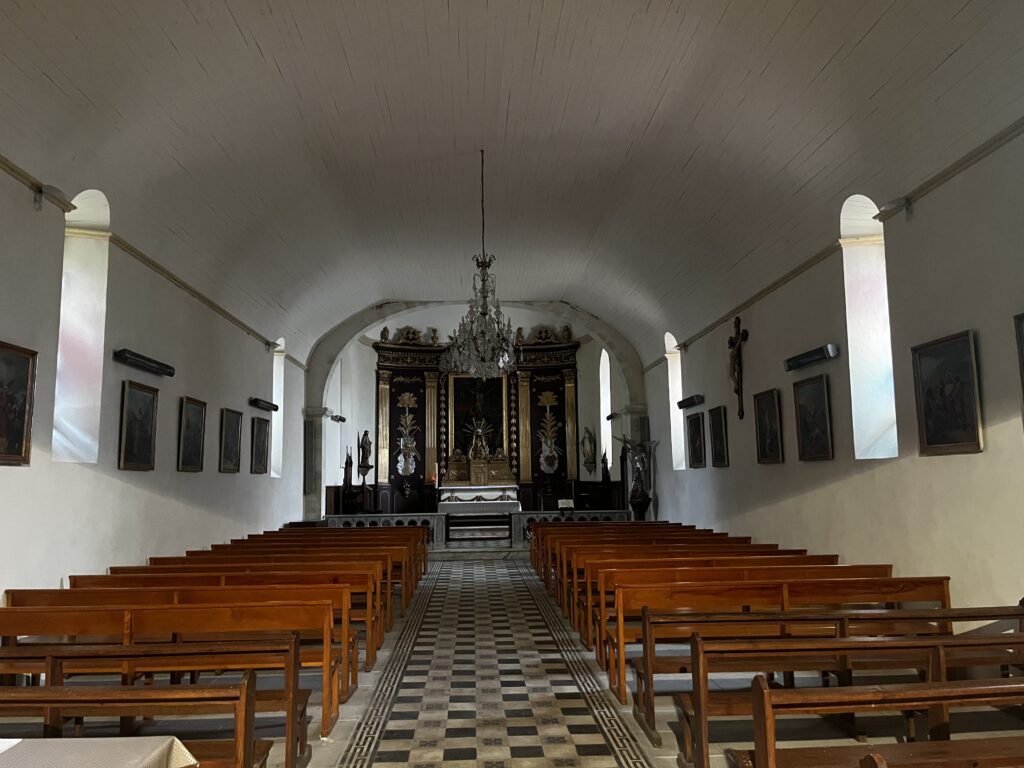
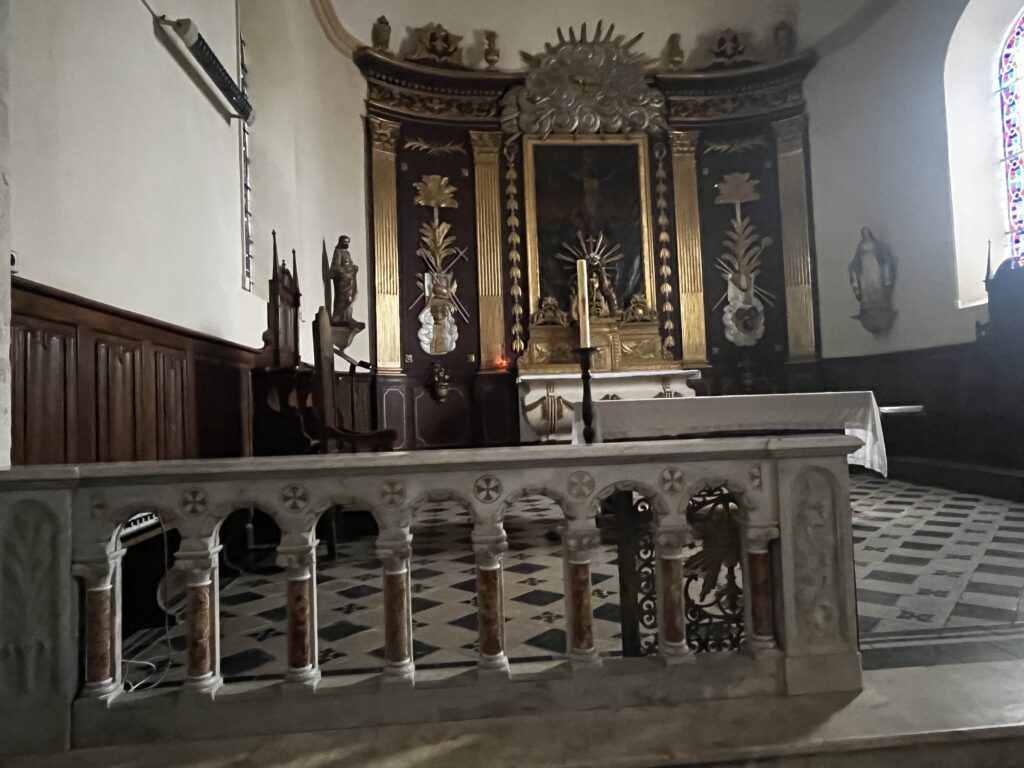
I arrived at the tiny little church here at about 1:20. The altarpiece is a surprising piece of 18th century overstatement that somehow manages to not overwhelm the place.
I offered a quick prayer and then had to be on my way.
This is a weirdly dispersed village – more of a collection of hamlets. I was surprised there was a church, but not surprised to find no café or bar.
By 1:40, I had left the village. If my MMD was accurate, it was a little over 14 km to my final destination. The Camino soon turned back into the forest on a sandy, grassy access road.
After a couple of twists and turns, I was back to the green tunnel.
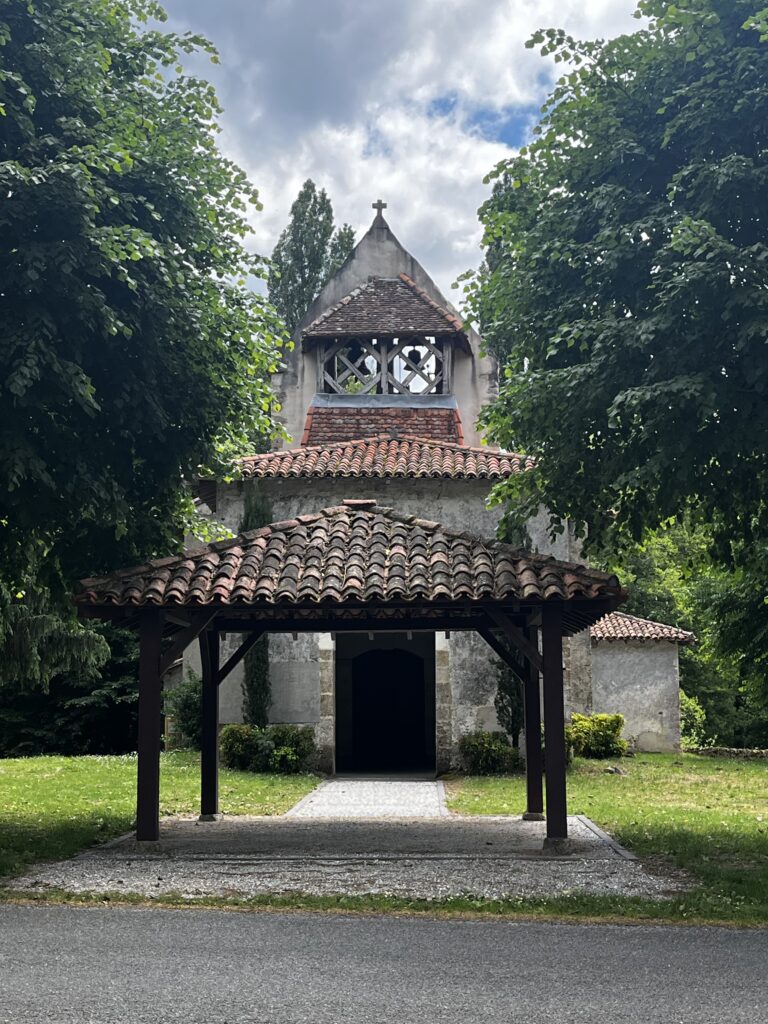
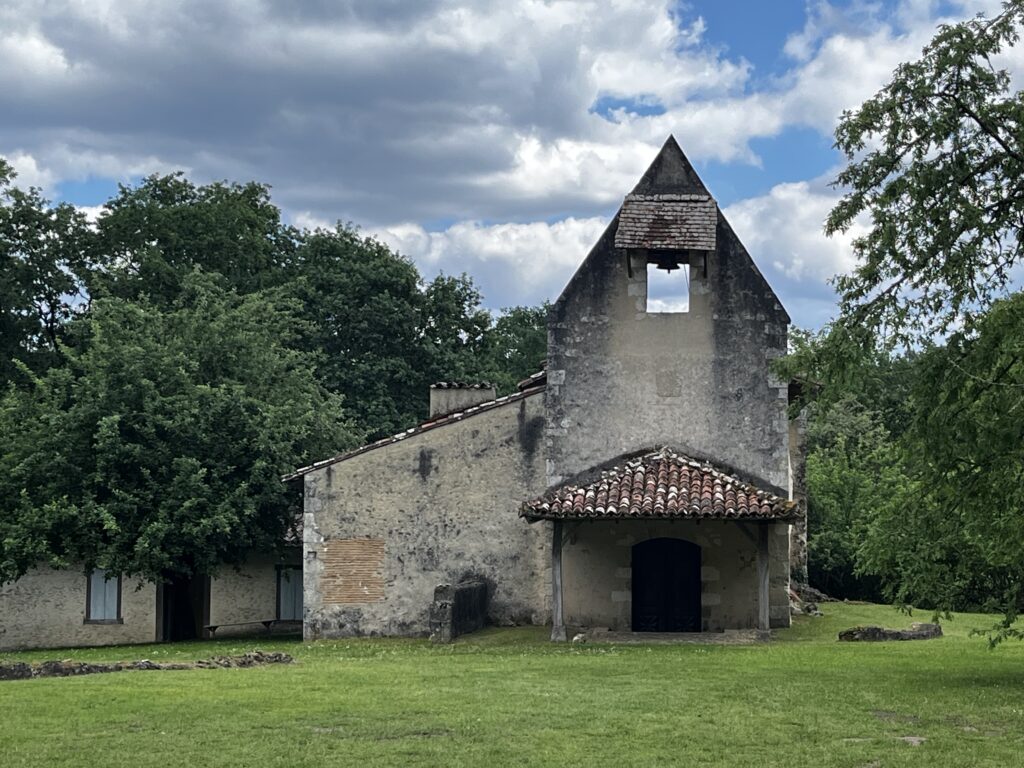
At 2:25, I took a 600 m detour to visit the 11th-century Chapelle de Lugaut.
it’s not much to look at on the outside, but I had heard about the inside. The chapel’s distinctive feature is its interior frescoes, dating from the late 12th and early 13th centuries, a treasure of medieval art. They depict scenes from the Gospels, scenes from everyday life, symbolic scenes, and finally a historical scene, where the church and its tithes are given to the Order of Saint John of Jerusalem.
The building was burned by the Huguenots in 1569, and the walls were whitewashed during the 18th and 19th centuries. Gradually abandoned, the church was finally deconsecrated in 1896. It was used as a stable and henhouse. The murals were rediscovered in the early 1960s by a schoolteacher, leading to the restoration of the building.
I was very excited to see it. It was, of course, locked.
What wasn’t locked, though, were the public restrooms, complete with working sinks. If nothing else, I was able to refill my water, which by this point was dangerously low. My guess is the water is piped from the nearby village of Retjons, which is one of the places I had considered staying tonight.
It was 2:40 by the time I was back on the Camino, and according to the sign at the intersection I had almost 9 km to go. At the speed I was going, I figured I would be in town at 5 PM.
I grabbed a quick snack, and off I went.
About 2:50, a young lady on a bicycle passed me heading the other direction. She had the dress and demeanor of somebody biking to the library. She looked so out of place that it kind of threw me for a loop.
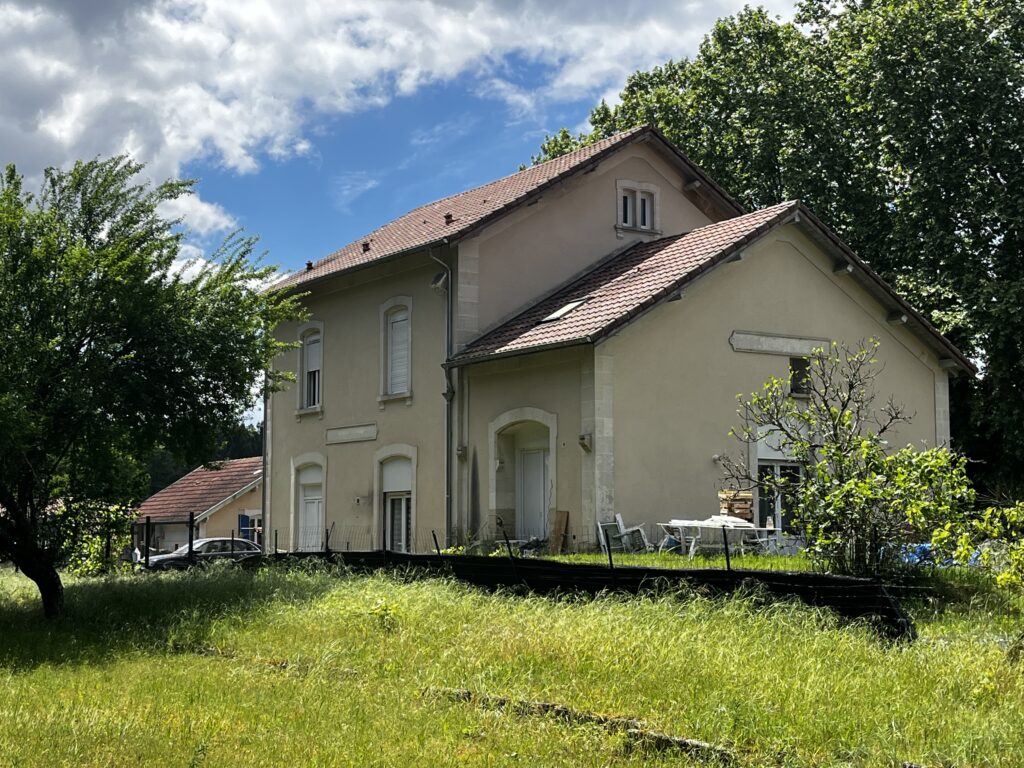
At 2:55, I passed an enormous house that looked as though it might’ve been a train station once. There were several other buildings on the property that looked like cottages.
Meanwhile: the green tunnel.
At 3:30, I passed a park bench. I took that as a hopeful sign.
Just after this, I crossed a road, and there was a tangle of different trails and roads leading from it. The one that Camino followed was a broad relatively smooth dirt road.
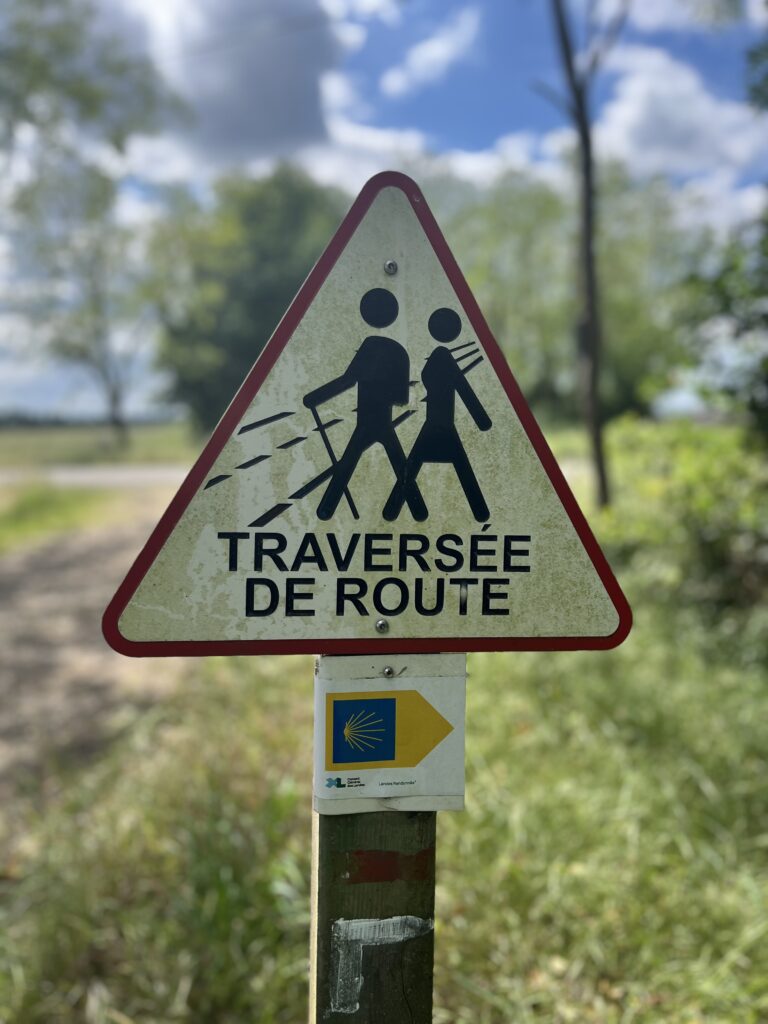
I noticed here in Landes, they are using the newer Camino blazes, whereas Gironde (where I’ve been the past few days) uses the older style.
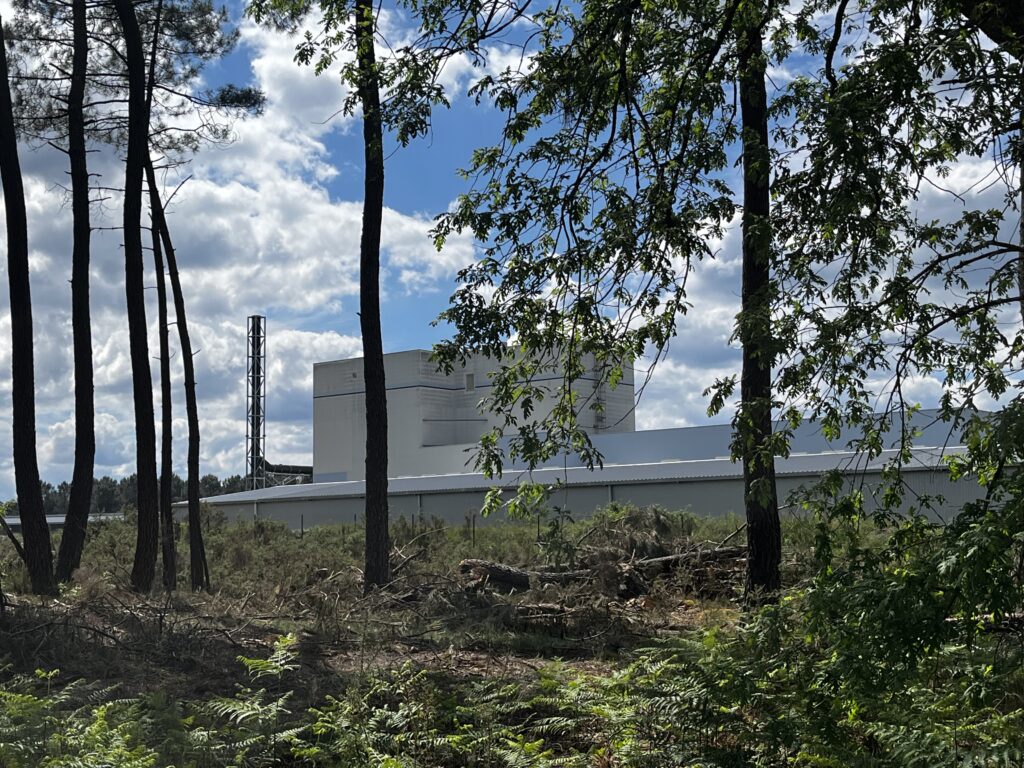
At 3:55, through a break in the trees I suddenly saw a large modern industrial building. Could I be approaching the city? Or did this have something to do with the lumber operations?
The road became stone and gravel, and it zigzagged back and forth across the forests and the thickets.
Having run out of mysteries, I started singing “It’s the 3K that never ends”. I may have been going slightly daffy at this point.
The road transitioned to asphalt covered with forest detritus.
Finally, at about 4:25, I came out of the woods into a suburban residential neighborhood. This was followed by a rundown light industrial district, and then down an alley behind some gardens back into the trees. The alley became a dirt road.
I briefly thought I’d missed the entire town.
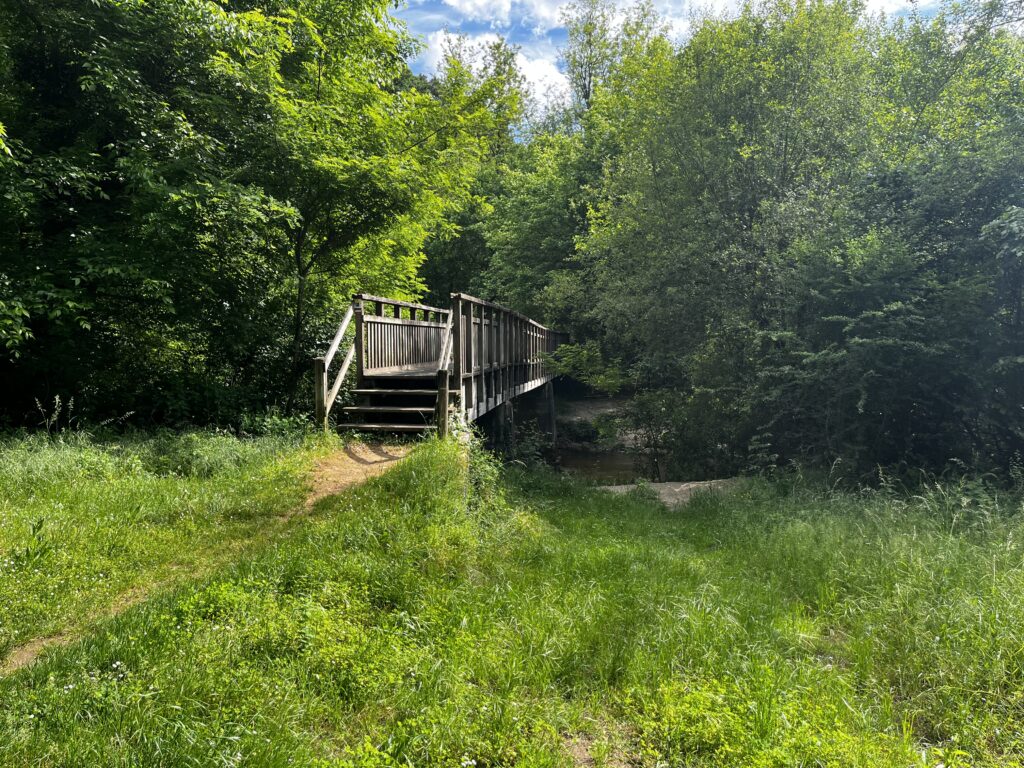
A wooden footbridge took me over a swiftly moving brown river. I had to sit down at the steps on the opposite side. My feet were screaming at me, and I noticed I was starting to walk with a bit of a wobble.
My tracker was showing almost 38 km on the day so far.
After four or five minutes rest, I started the final push. The dirt road took me right around a corner, out of the trees, and into a high density residential area.
And suddenly I was in the city of Roquefort. You know the city famous for its cheese? Yeah, not that one. This is an entirely different Roquefort.
I immediately made for my hotel, the St. Vincent. I was there by 5 PM. I knew that today was going to be a ridiculously long day, and I was going to need some serious R&R afterwards, so I booked a room at a hotel.
Francine and I used to have a custom on Camino of getting a private room once every week or ten days or so. I have sort of indifferently kept this custom, but the St. Vincent was recommended to me by several people. I absolutely made the correct choice.
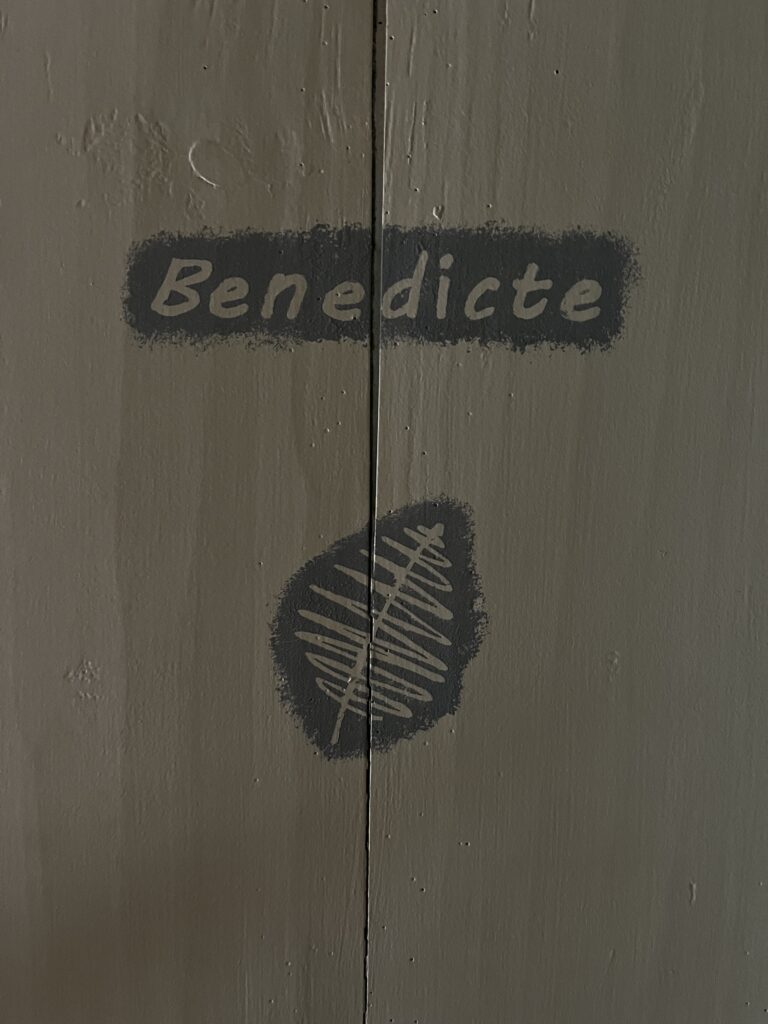
My room, which by happy circumstance is called Benedicte, is absolutely luxurious and faces onto the garden. Even before my shower, my first priority was to take off my shoes, go to the garden, and have a tasty beverage to celebrate the victory of just getting here today.
This is my longest Camino day ever, and a virtual tie for my longest day ever, on the Three Hearts pilgrimage last year.
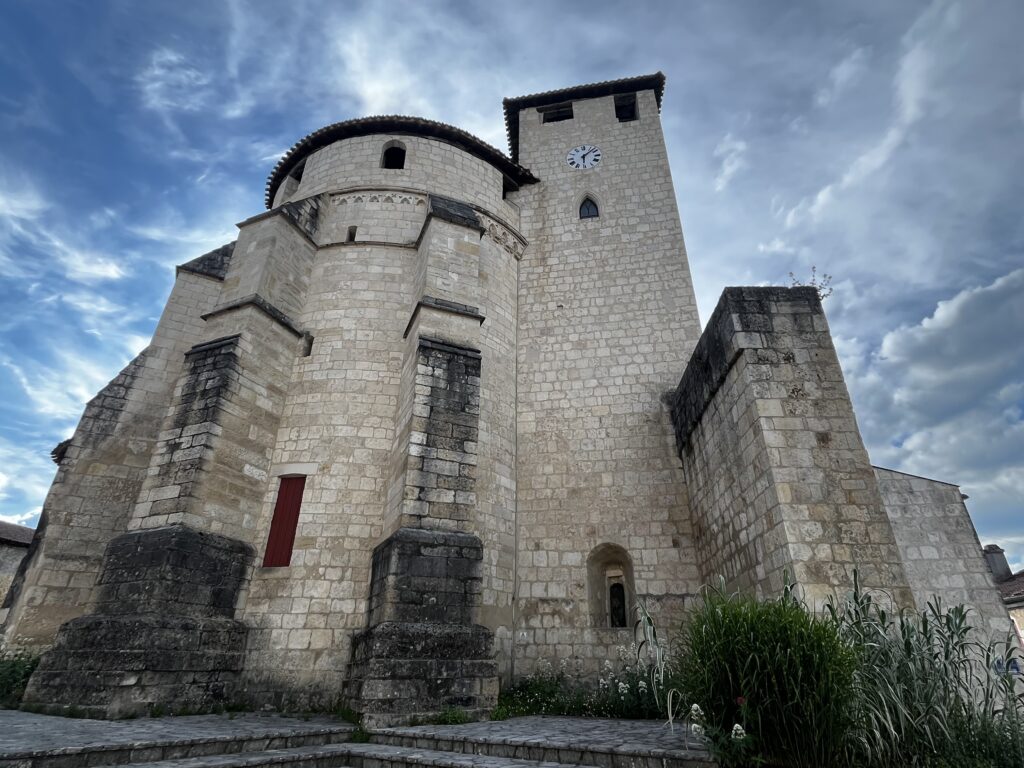
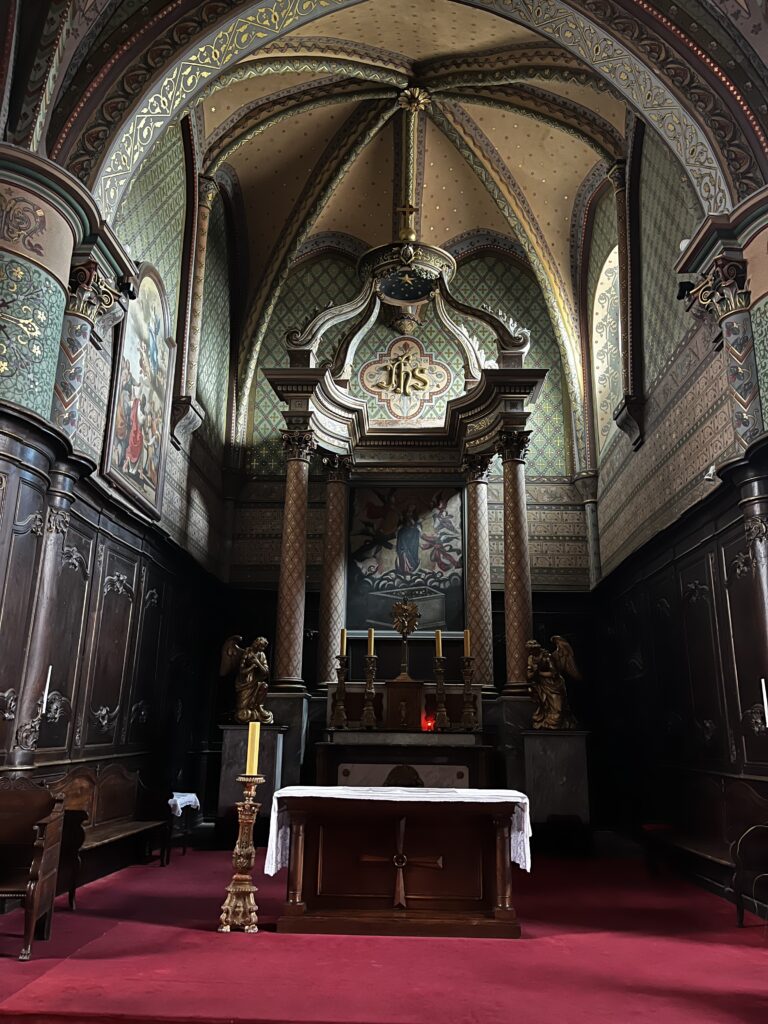
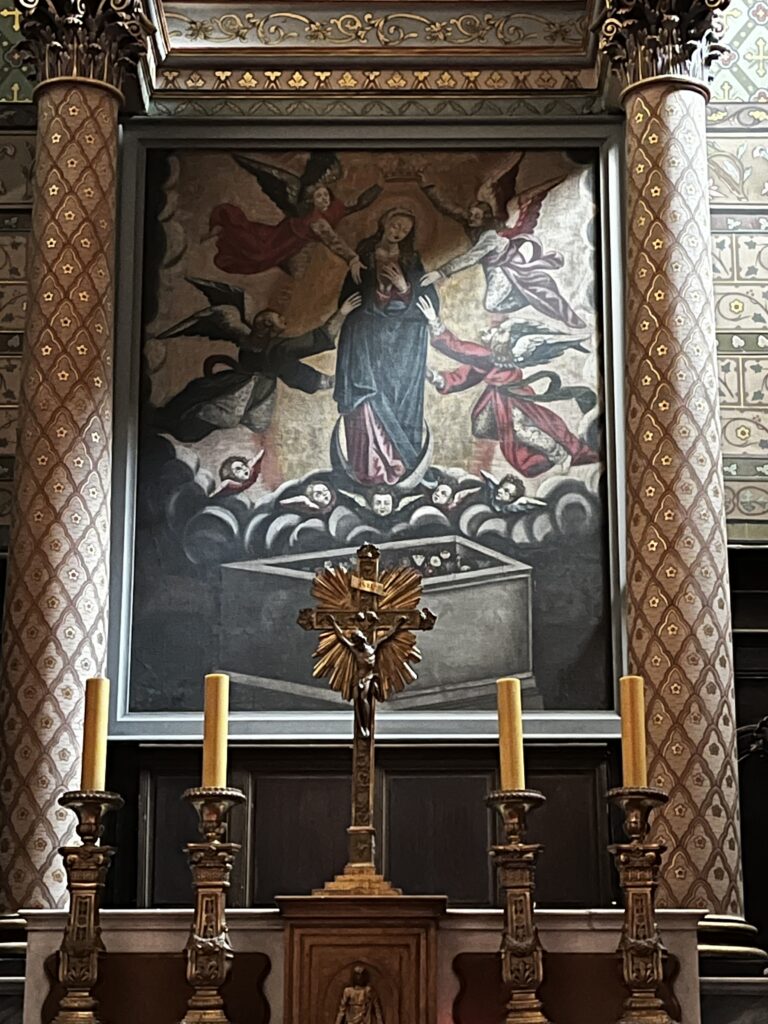
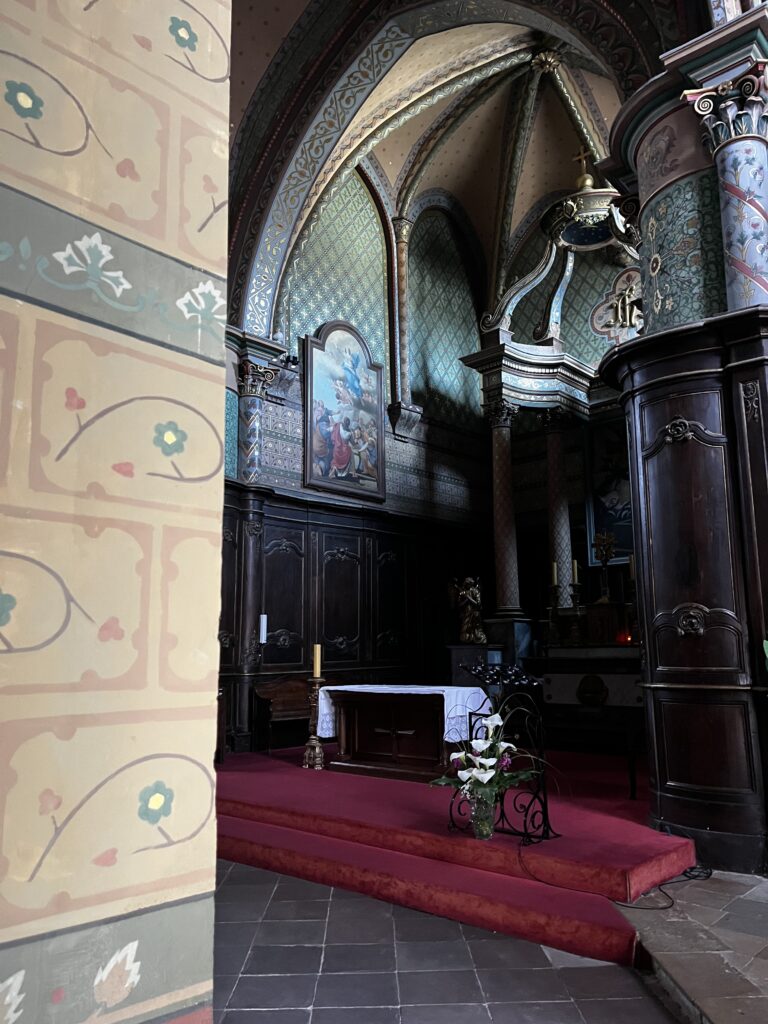
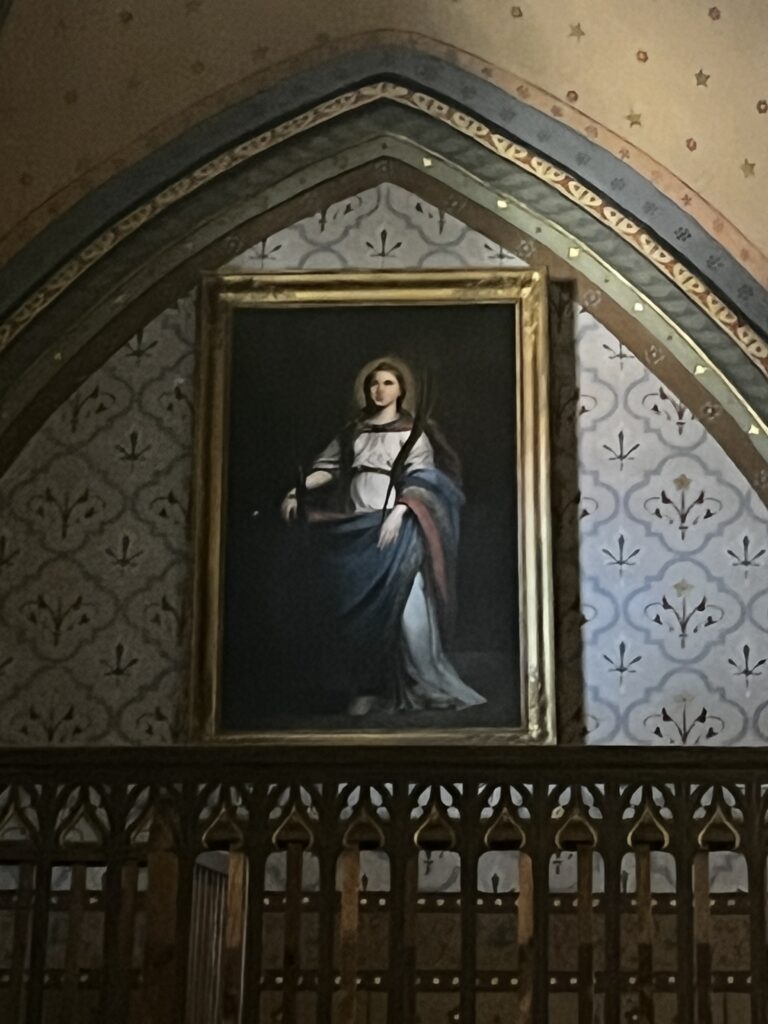
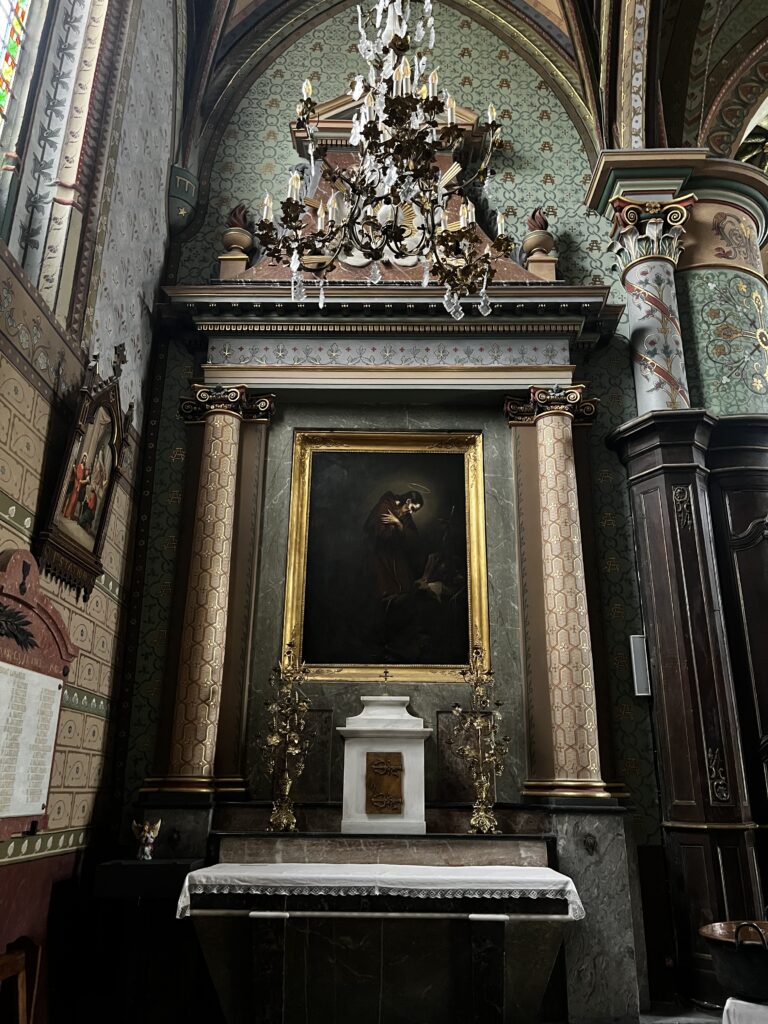
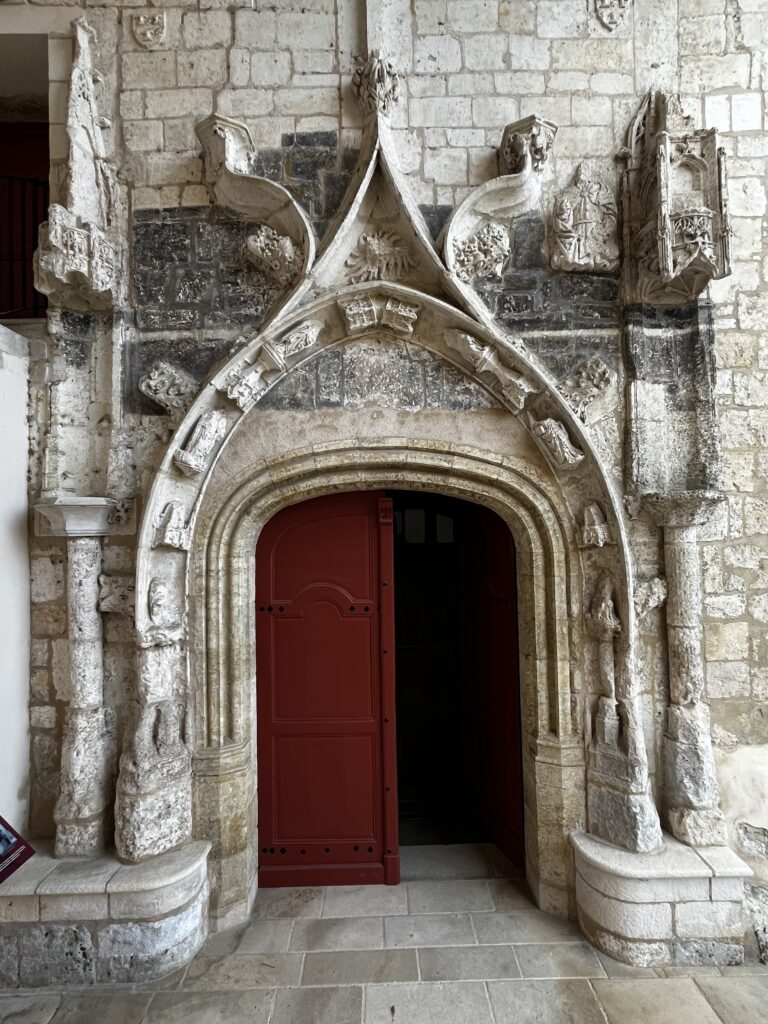
After my shower, my first stop was the church of Sainte-Marie Notre-Dame de l’Assomption. Originally built in the 12th century, most of what actually currently exists is from a 16th century renovation and rebuild.
It’s small, but absolutely magnificent. Every detail is well thought out and what should be an explosion of busyness instead becomes a beautiful harmony. It is a place whose sheer beauty moves you to pray.
And I did.
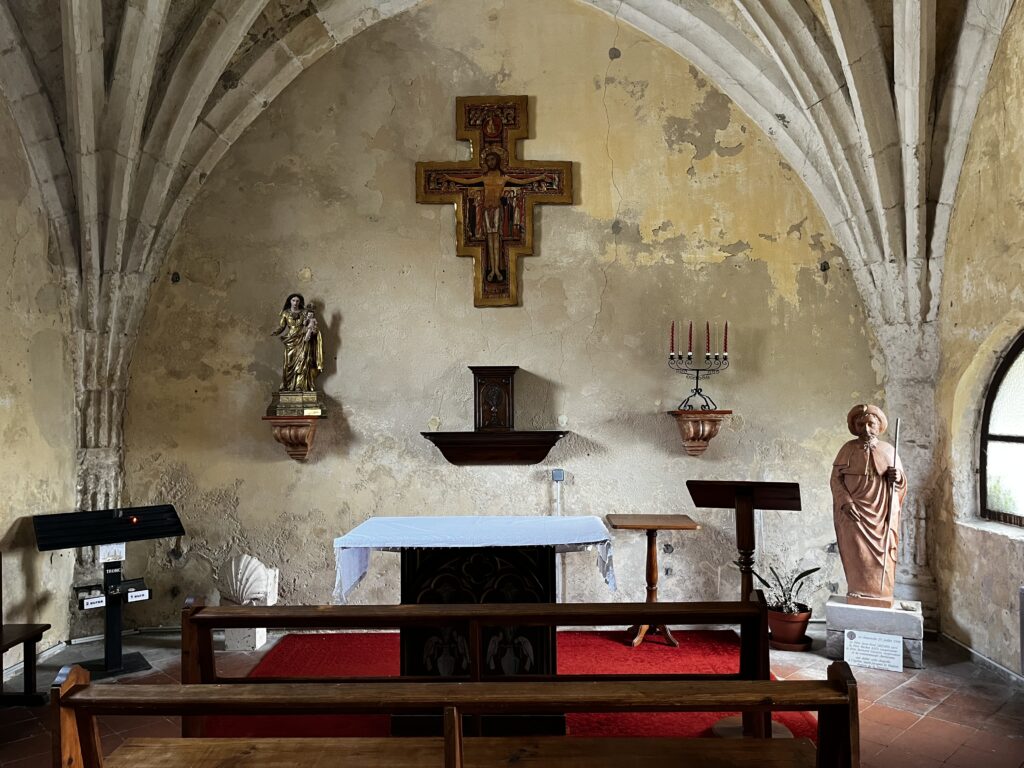
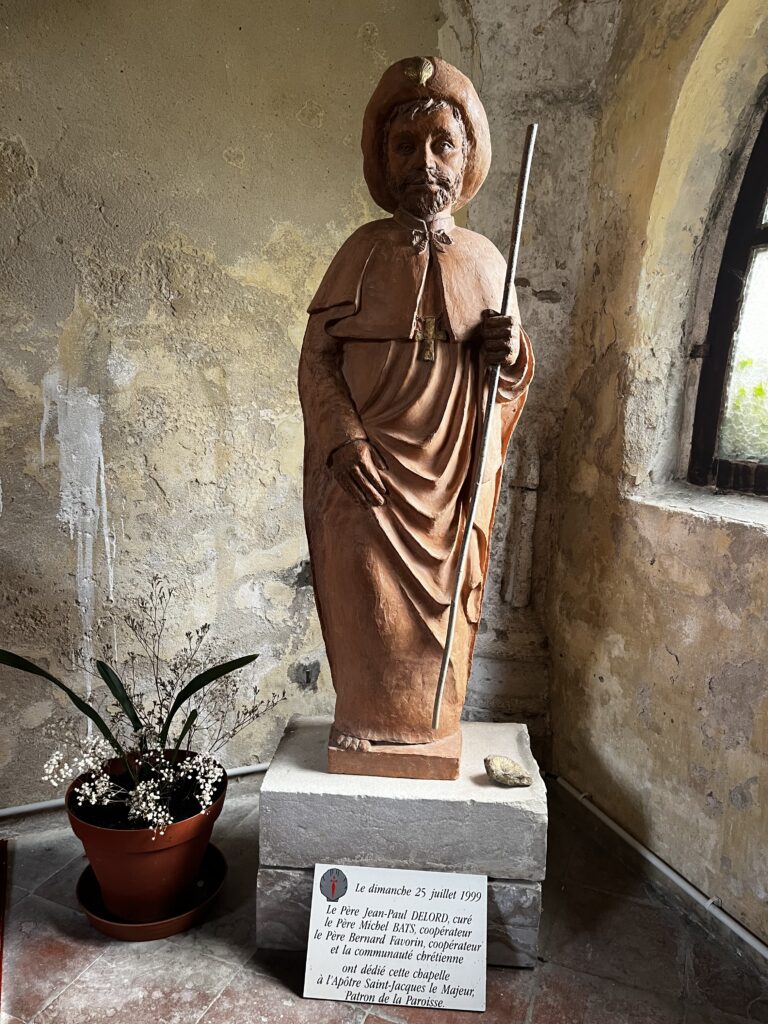
Across the courtyard, the even tinier chapel of Saint Joseph features a reproduction of the San Damiano Cross and a small shrine to Saint James, patron of the parish.
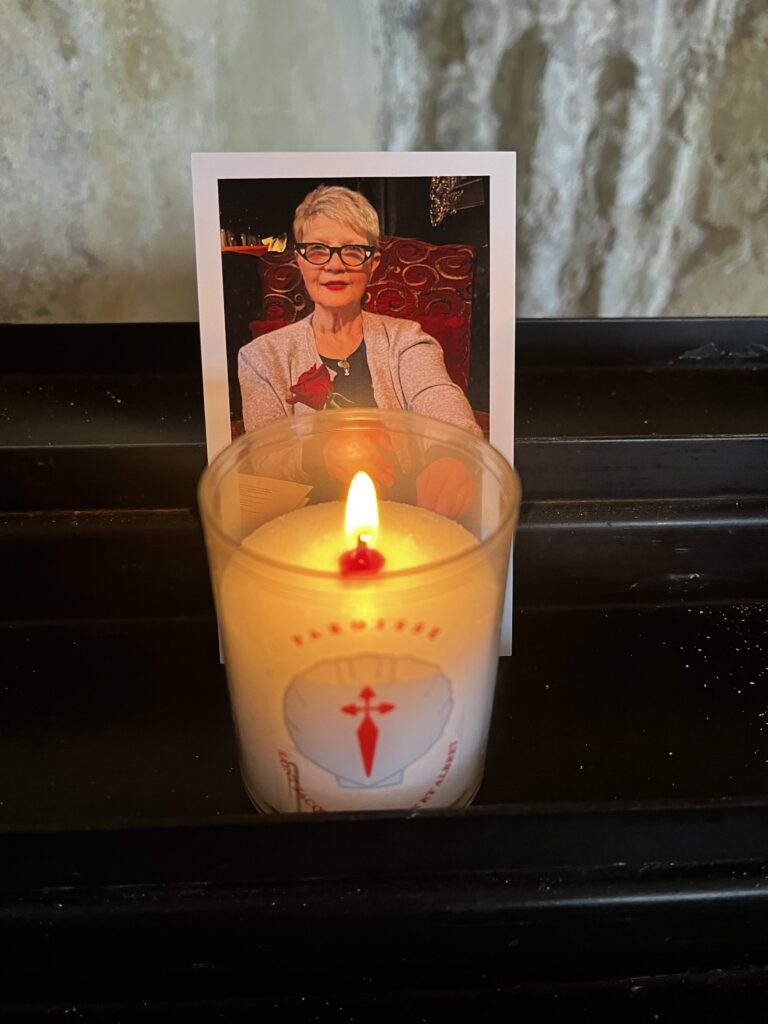
Strangely, this was the place where I was moved to light a candle for Francine, and not to the beautiful church I had just left.
As I was leaving the chapel, who would I run into but Yves! He had done a longer day yesterday, and a shorter day today – basically the opposite of what I did.
We had a great conversation before I had to get back to my hotel for dinner.
Date: 12 May 2026
Place: Roquefort (Landes)
Today started: Captieux
Today’s Photos!
This was a marathon day for you and seemed like a a lot of fun.