
Via Lemovicensis: to Saint-Jean-Pied-de-Port
The day dawned cold and clear in the mountains. Breakfast with 28 pilgrims was a bit of a madhouse. I had a great conversation with a Swiss-American woman named Julie who had walked from Moissac on the Via Podiensis. She, like most of the folks I talked to, is ending her pilgrimage in Saint-Jean today.
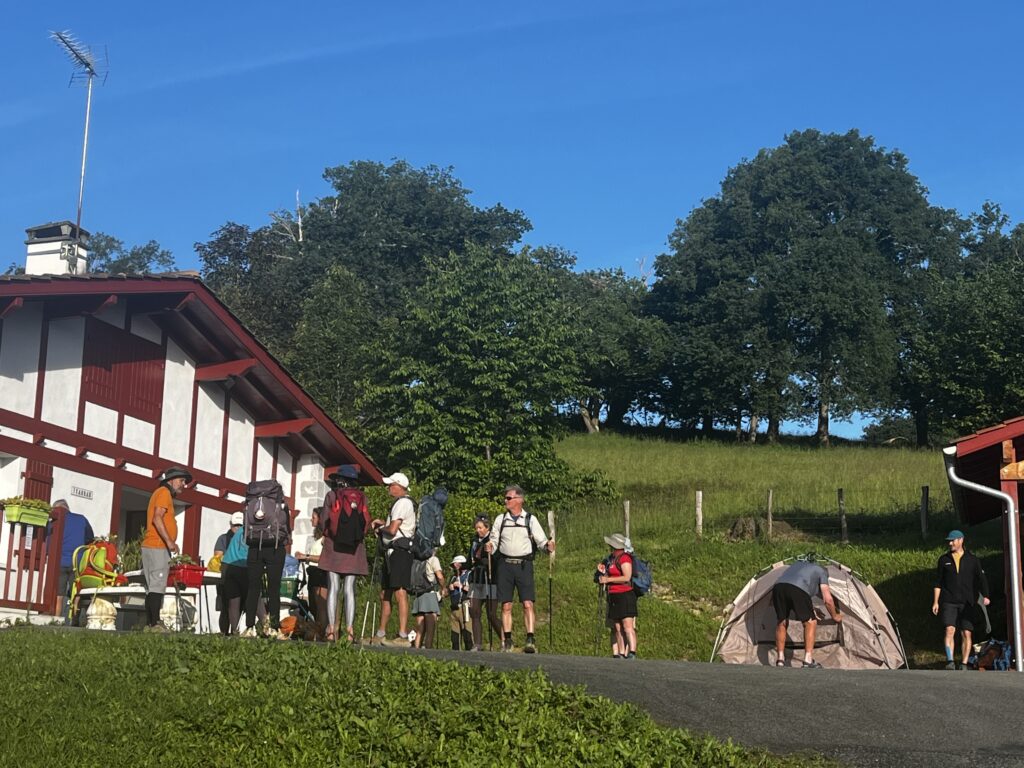
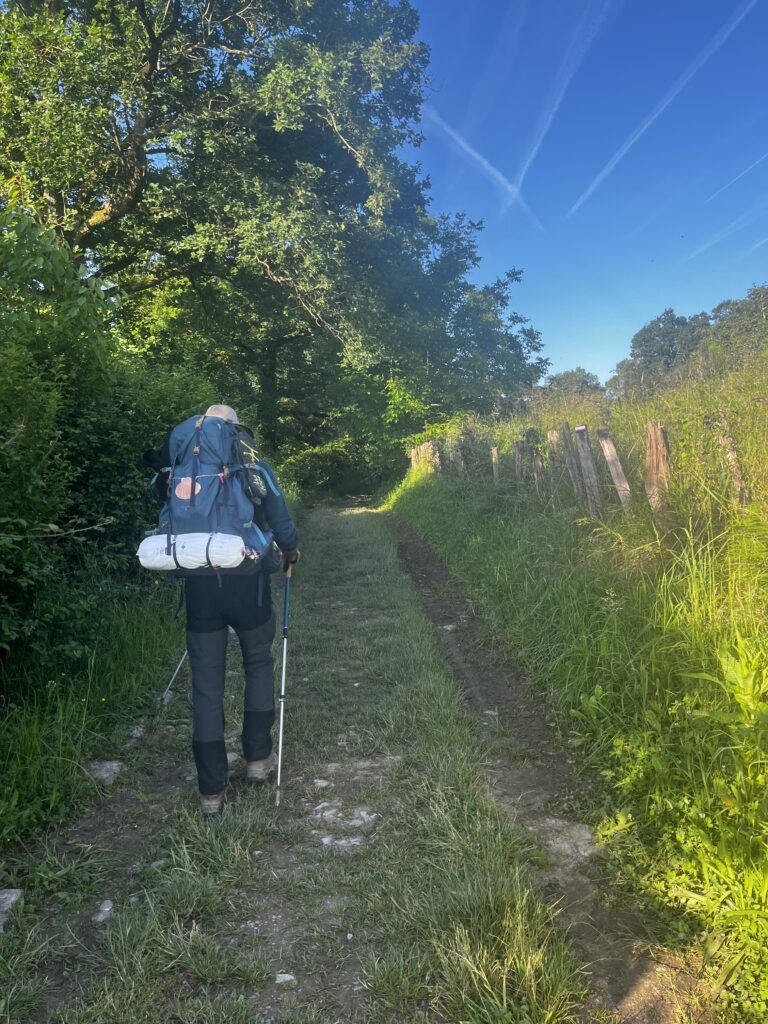
Herve and I finally left the gîte at about 8:15, about midway through the pack, I think. The Camino began down a muddy green tunnel through the woods.
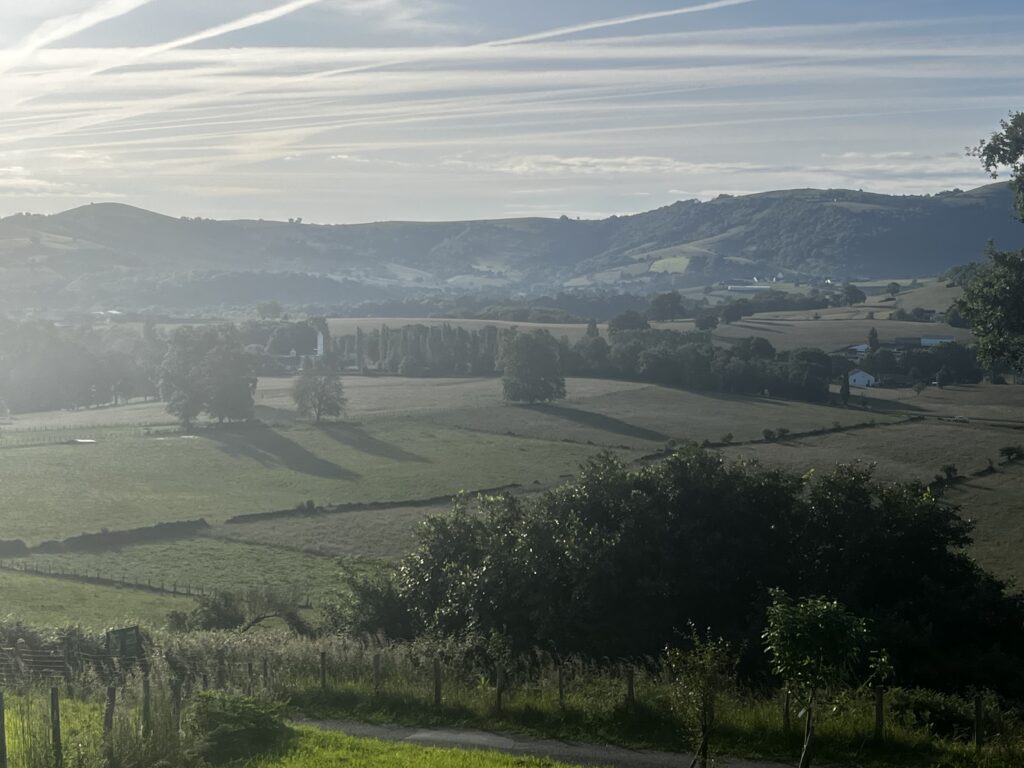
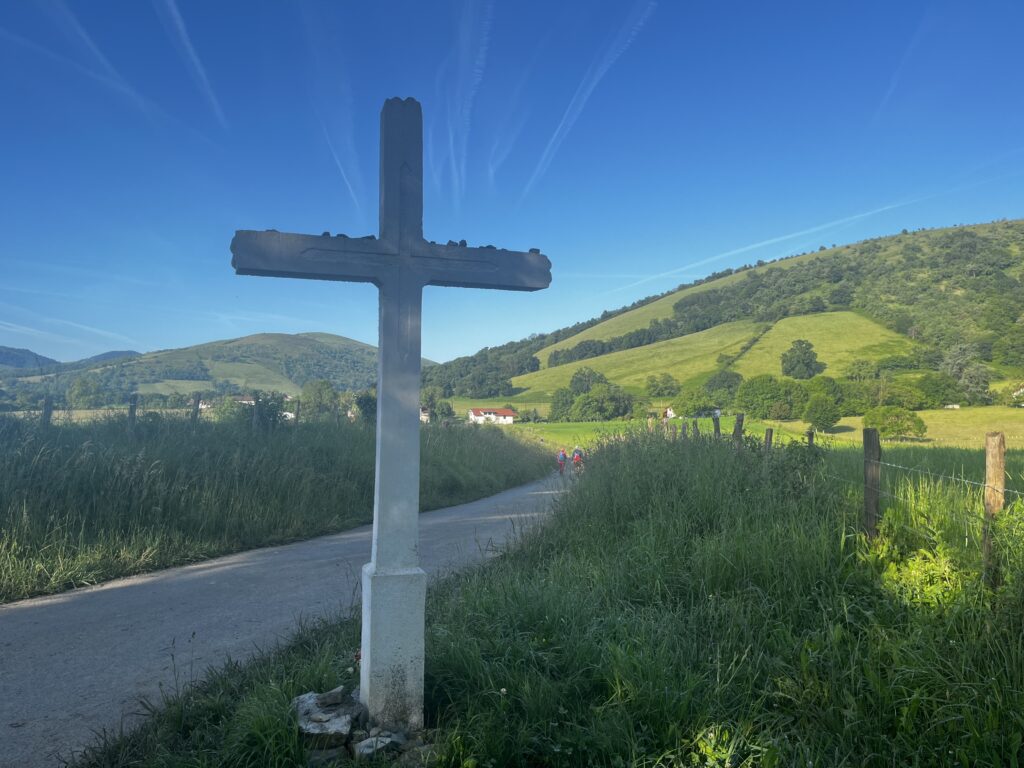
About fifteen minutes later at a roadside cross, the Camino turned onto the narrow asphalt road with fields on either side. We were ringed in wooded hills.
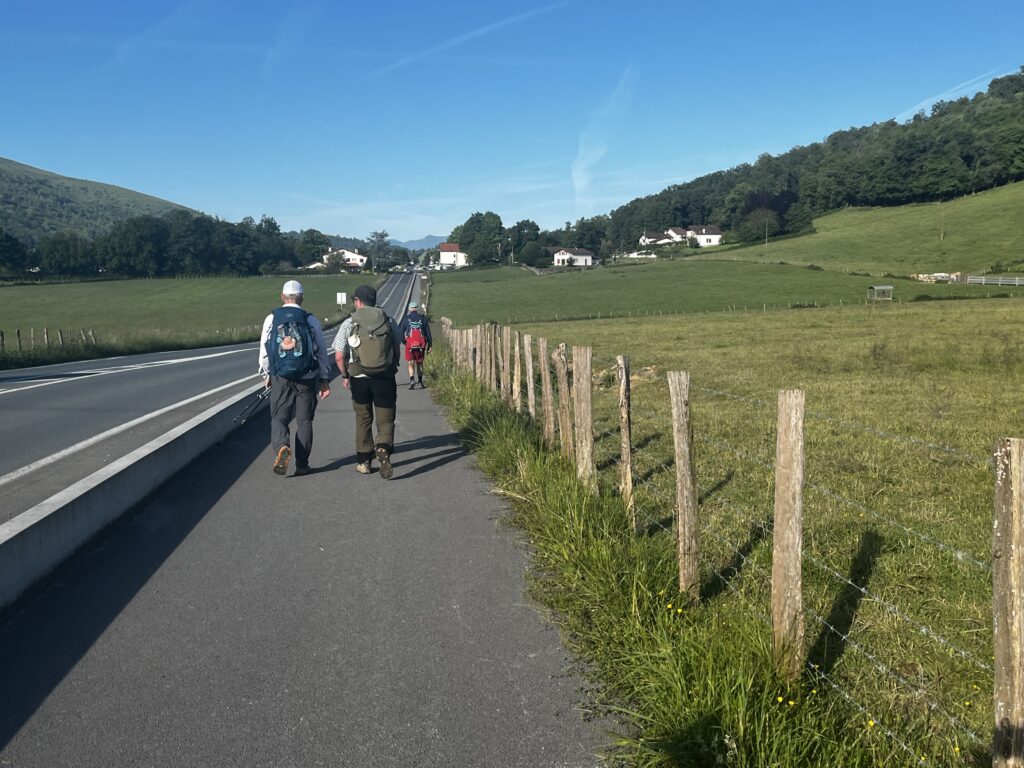
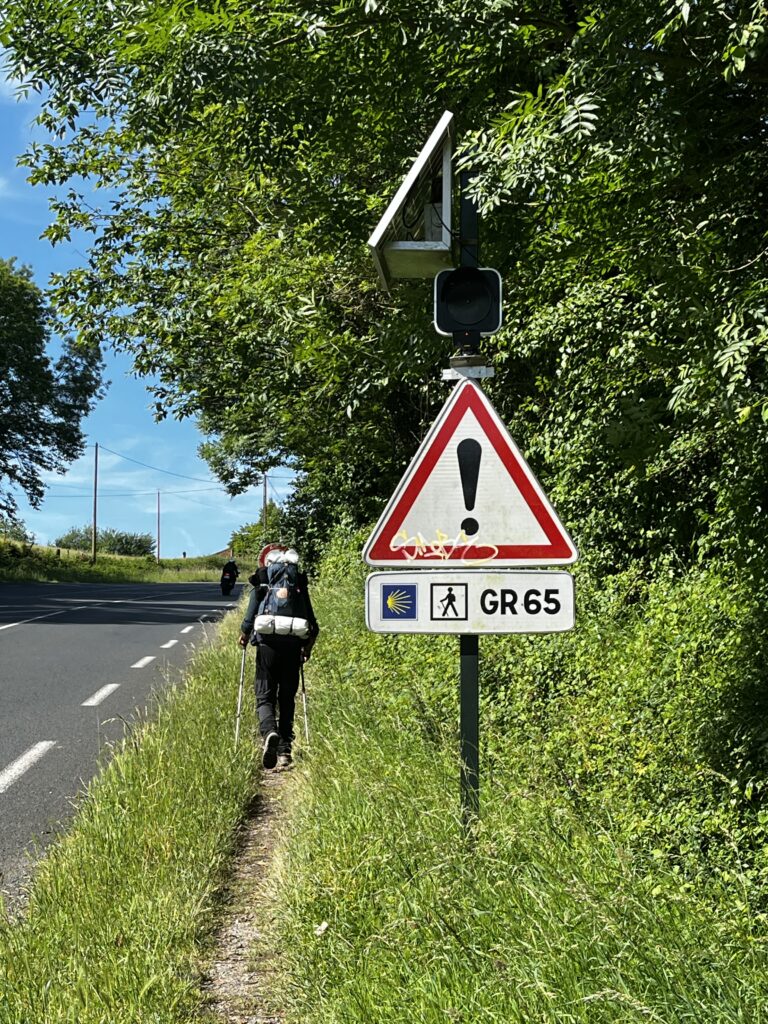
At about 8:40 we passed through our first little hamlet with a very long name, Déchèterie de Ostabat. Here, we began walking on a pedestrian walkway beside a busy highway. Pilgrims passed us in pairs or small groups. Quite a different experience from the weeks past!
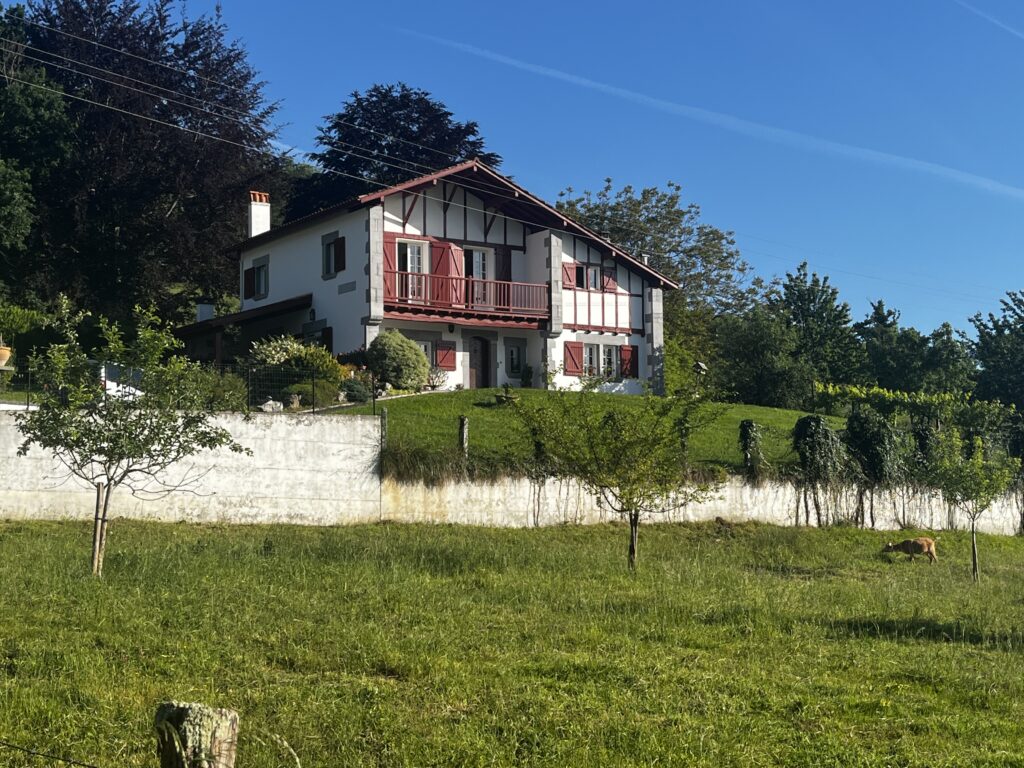
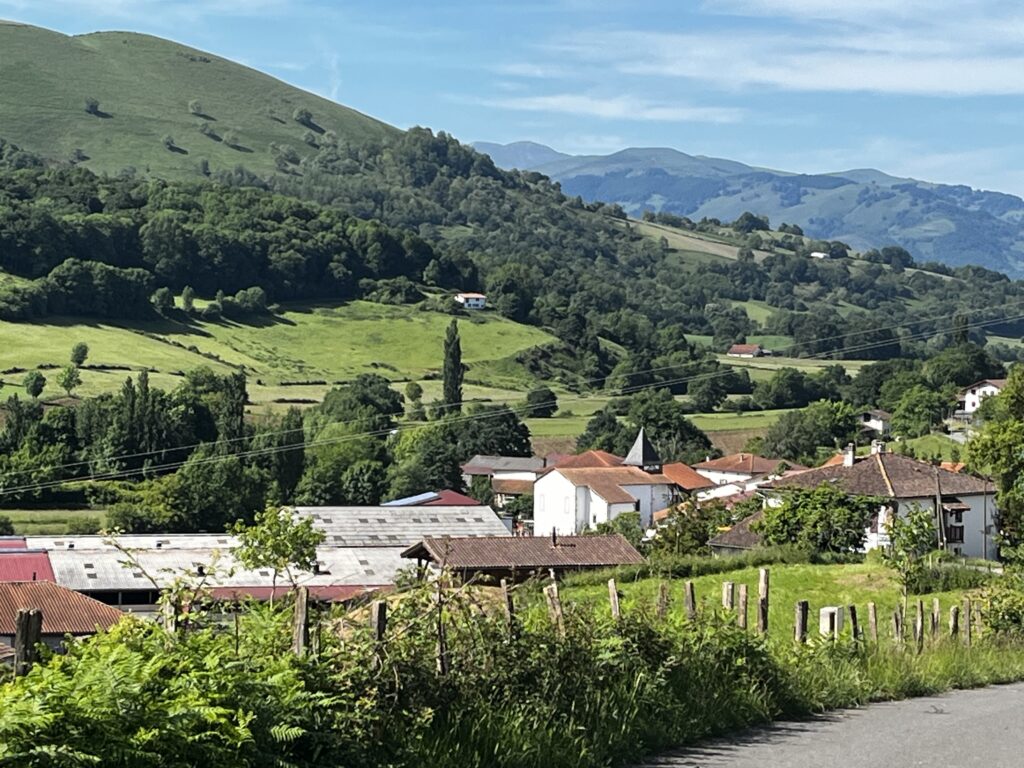
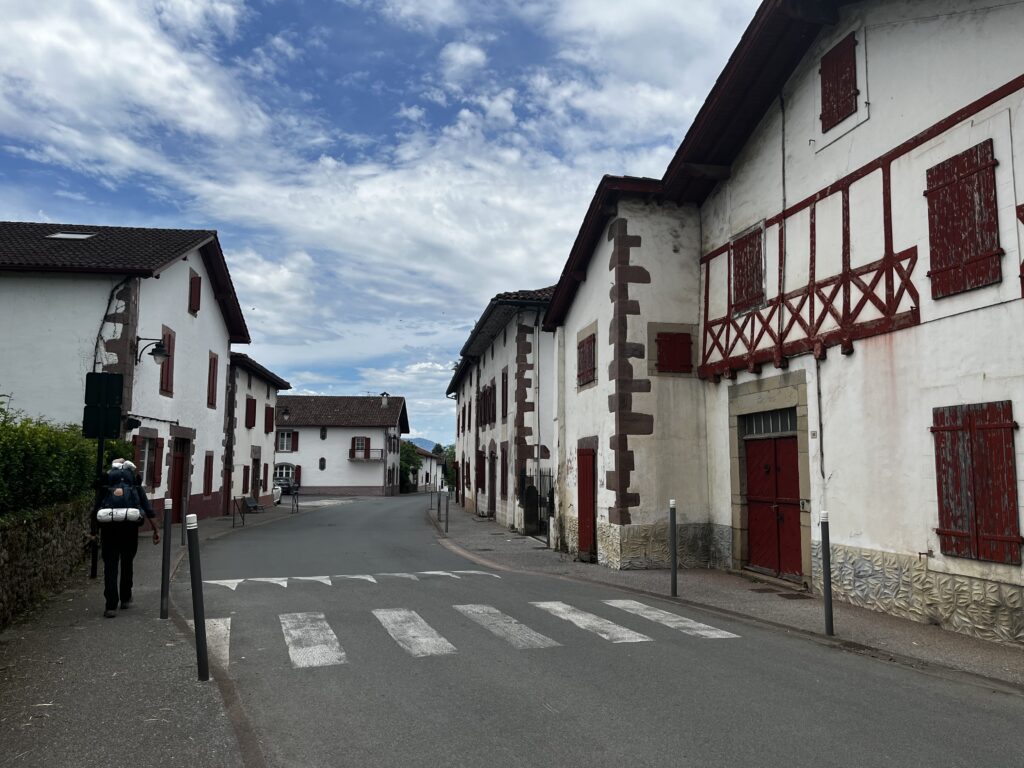
As we approached the village of Larceveau (Lartzabale), the Camino diverted onto a smaller road through the village and into the countryside. Houses are planted thick here, even in the meadows and on the hills.
I just after 9 AM, we turned once more onto gravel past houses and barns, and finally onto two a dirt and grass road.
At about 9:15, we were back on asphalt roads. We stopped for a coffee at a roadside stop that might have been in the hamlet of Mendiondoua. There we met up with Michael, who had stopped for a cup of tea.
Pilgrims came and went while we waited for our host to make us some sandwiches to go for our lunch later.
We dallied entirely too long, only leaving at 9:55. It was worth it.
Today, as the Camino leaves in and out of these little Basque hamlets, we often find ourselves walking down somebody’s driveway or between their barn and their home.
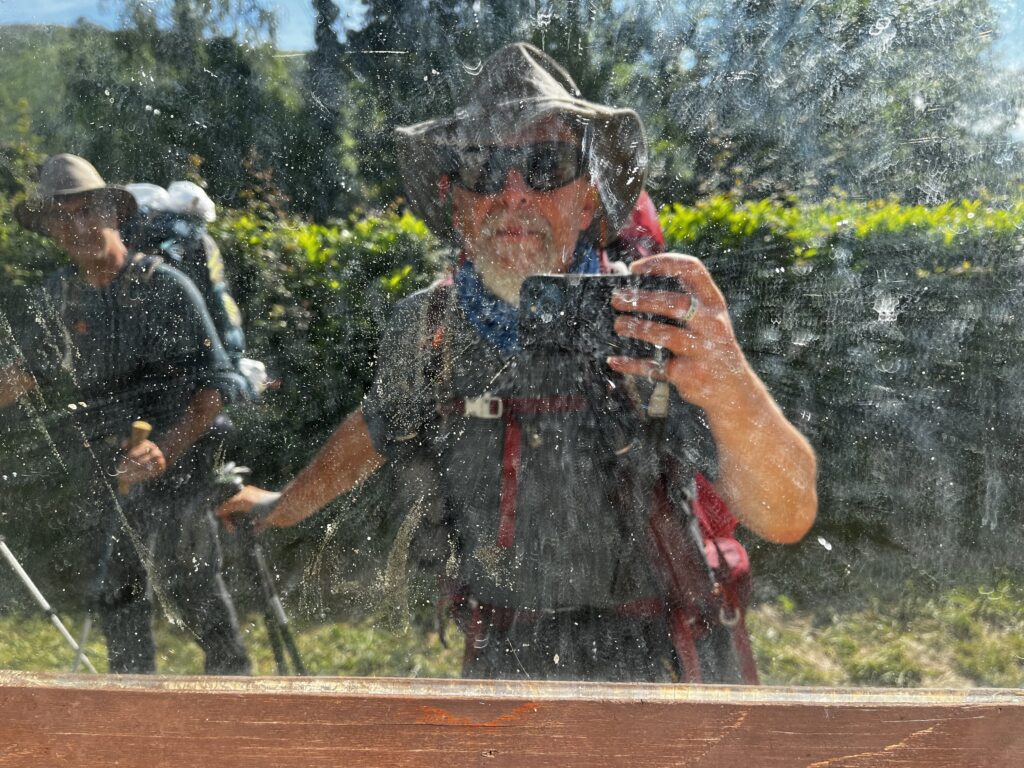
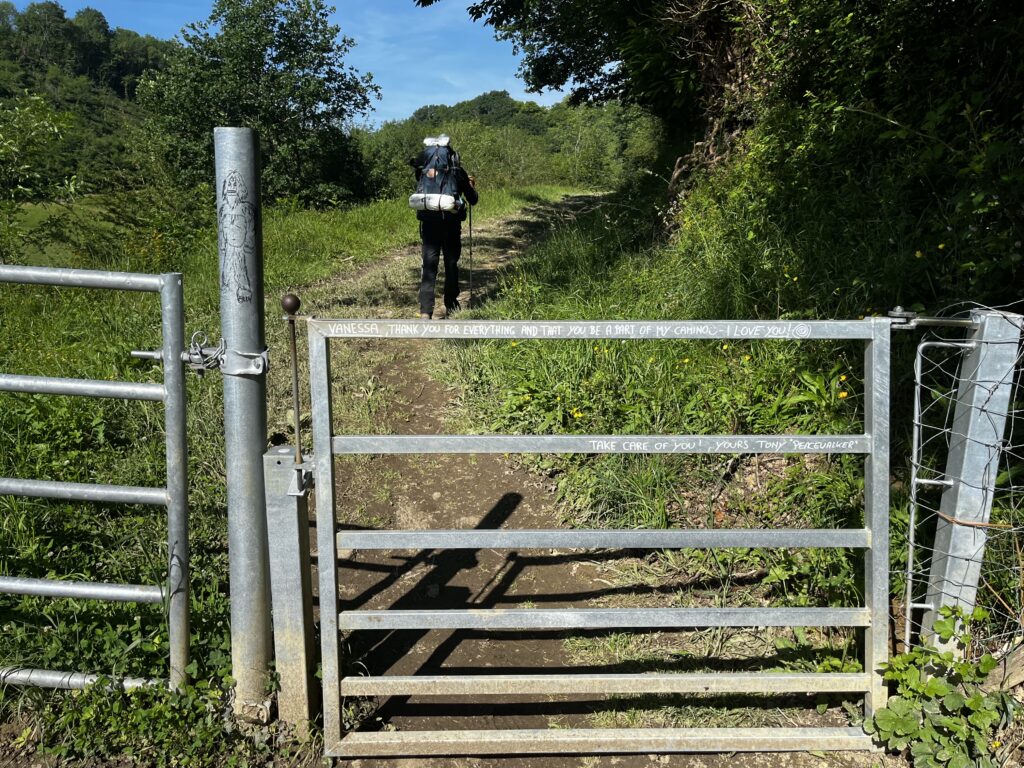
At 10 AM, we turned down the road of mud and grass , through a cattle gate, and under the trees. This pretty quickly let us to a walking trail just above a major highway to our left. We paralleled the highway as we passed through the tiny hamlet of Ulziate. This place is about five buildings, only a few which appear inhabited. there is, however, an ancient pilgrim fountain here, as well as a mirror, just so you can remember what it is you look like.
After this, the path parallelling the highway became an asphalt frontage road. Is the road turned away from the highway a few minutes later, the Camino once again moved to a dirt path. We continued to follow the highway.
A year ago, I noted that Francine’s comprehension far exceeded her ability to speak. This was often a source of frustration for her.
She was also still singing the Kyrie and the Pater Noster. These remind me of a very powerful moment on our first Camino. We attended mass in a little monastic chapel in Rabanal. Most everything was in Spanish, of course, but we sang the Latin mass parts – the Greek Kyrie, the Sanctus, the Agnus Dei – and suddenly, all these people from different nations, many of whom did not share a common language, were able to unite their voices and singing in praise to the Lord as one.
It was like a sudden undoing of the tower of Babel. It was an experience that stuck with both of us. It’s the reason that Francine and I were tireless champions of the Latin Mass parts. Even if the rest of the Mass is in English or Spanish or Vietnamese or whatever, for those brief moments we can all of us be united in song.
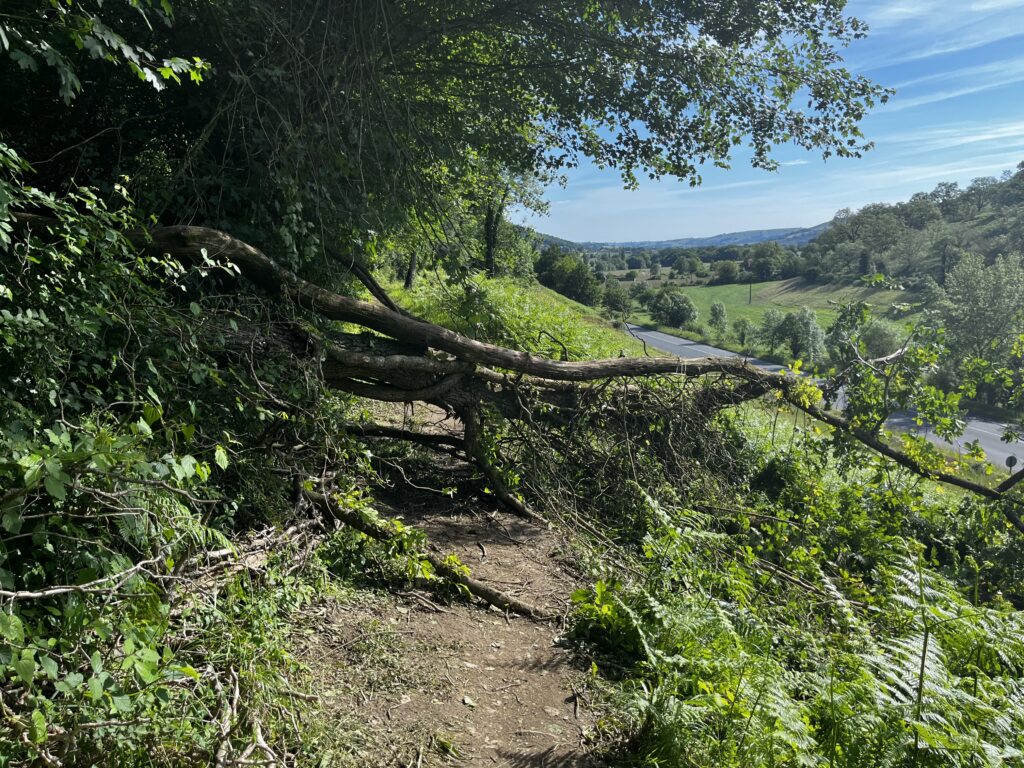
At about 10:20, Herve and I came across a tree that had fallen, completely blocking the path. There was no way to go over, and we could only go underneath by taking off our backpacks. He went through first, and I handed him the packs, and then I followed.
The dirt trail wound up and down through the woods, though we could still hear the highway clearly off to our left. Another cattle gate, and we were back to open terrain above the highway.
By 10:30, it was already beastly hot in the sun.
We kept this pattern for a while, cattle gate, shade, cattle gate, sun, up and down hills. Sometimes we were right next to the highway, and sometimes we were ten meters on a bluff above it.
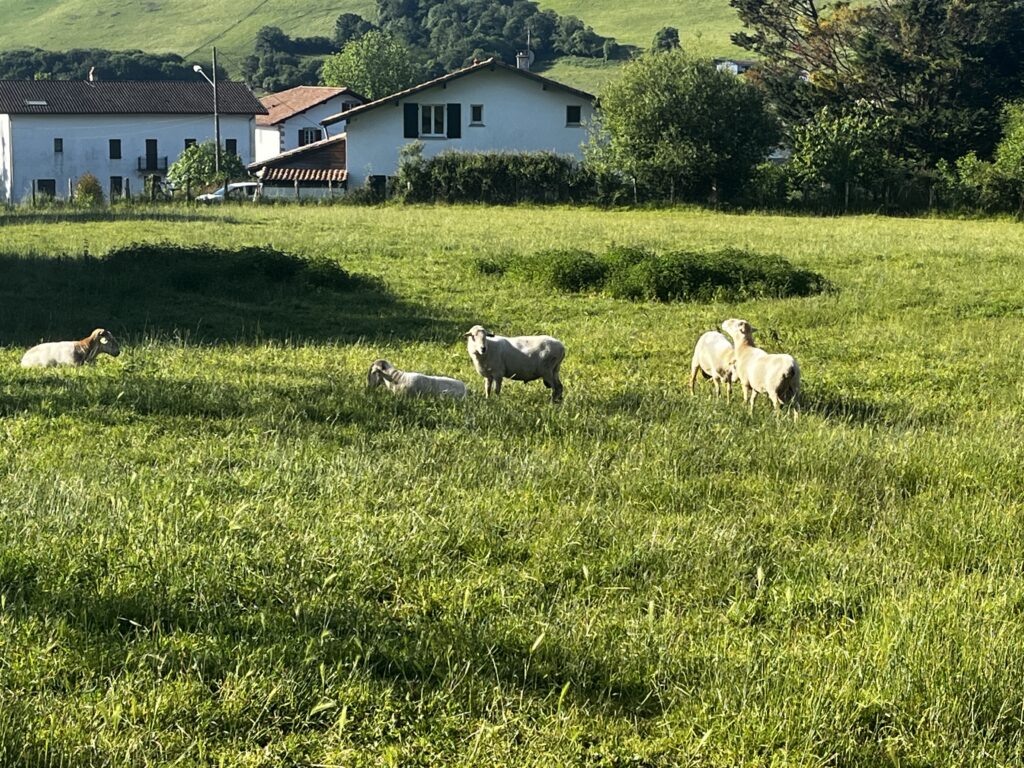
At about 10:40, as the road passed the exit to the village of Gamarthe, we found ourselves walking directly on the shoulder. We actually had to cross over the highway, where are the Camino now went down are more sedate asphalt road through meadows of grazing cows and sheep.
Just at about 10:50, just as we were about to enter the village of Gamarthe, we were stopped by a traffic jam. Not cars, cows.
After the village, the Camino eventually rejoined a busy two-lane road. Again, we were walking on a path just off to one side.
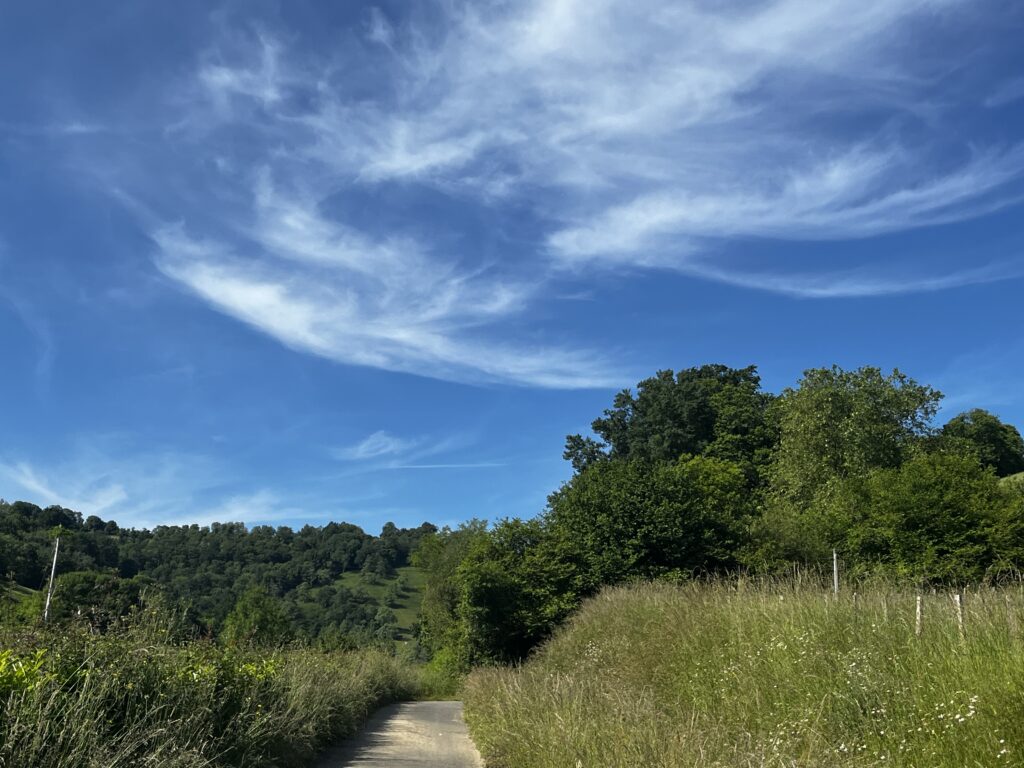
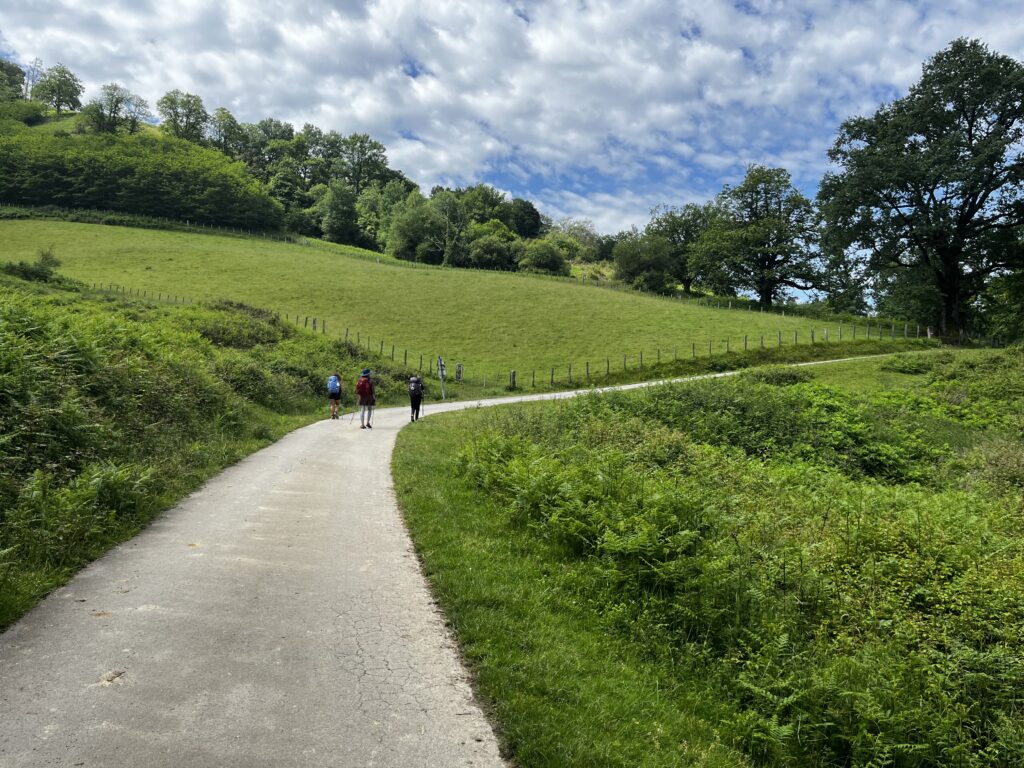
This didn’t last long, and soon we were again walking down a narrow asphalt country road through meadows as the hills towered around us.
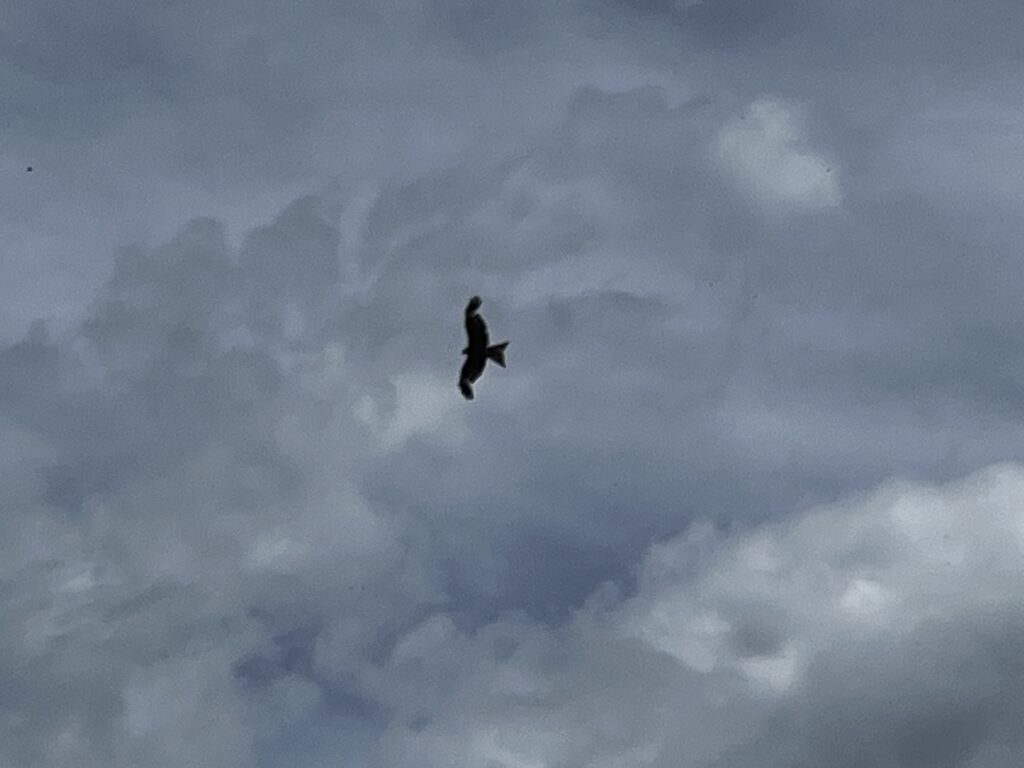
A hawk circled overhead, riding the thermals.
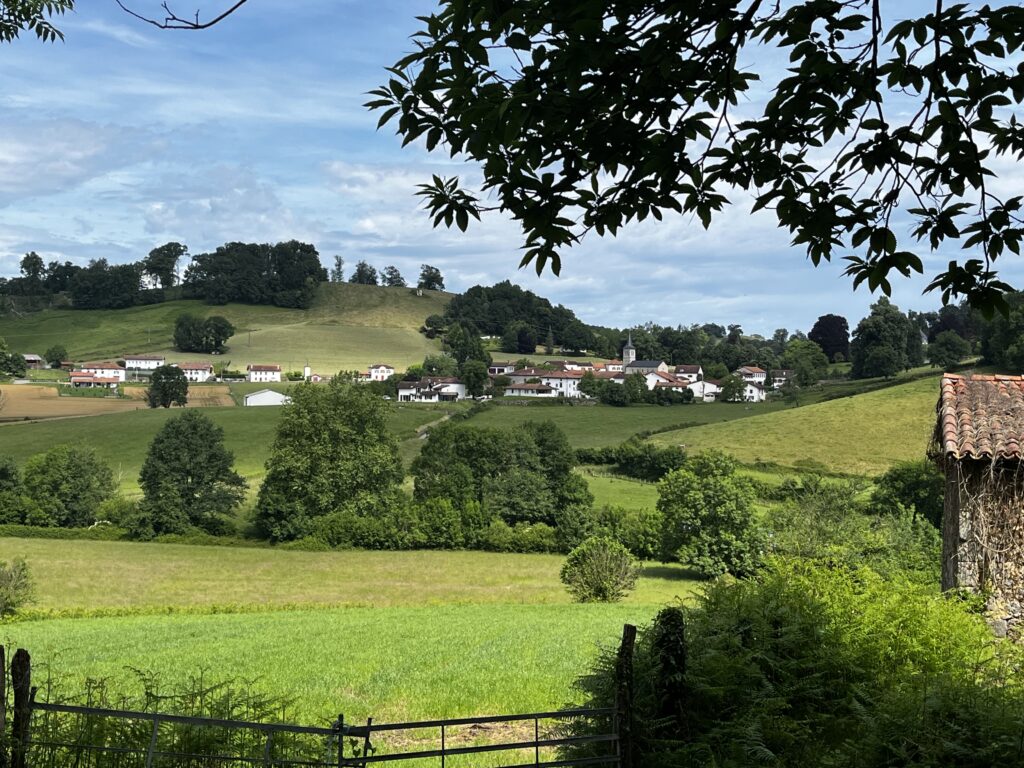
The road took us past distant hamlets, through farms and meadows with grazing cows, and even through short stretches of woods as it wound around and through the hills.
But always up and up and up.
Just before noon, we passed the turnoff to Lourdes. Just 128 km!
About ten minutes later, we passed through the large hamlet of Bussunarits (Duzunaritze). We had hoped to find a cold drink here. No such luck. We resolved to stop at the nearest shady resting place for some lunch.
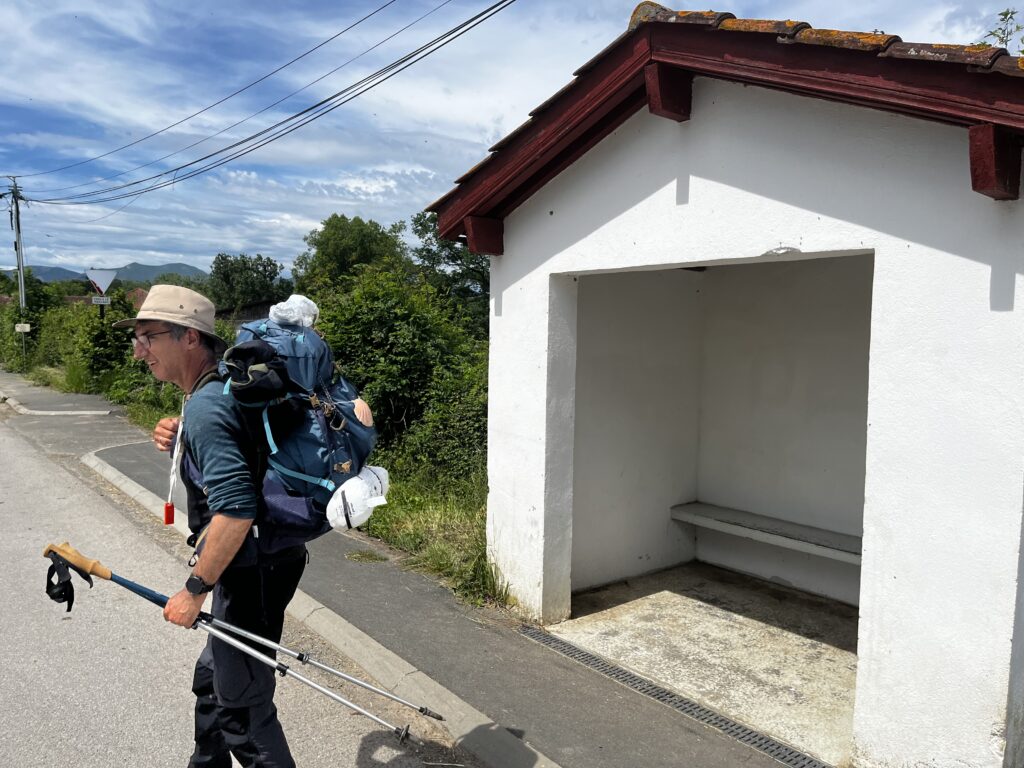
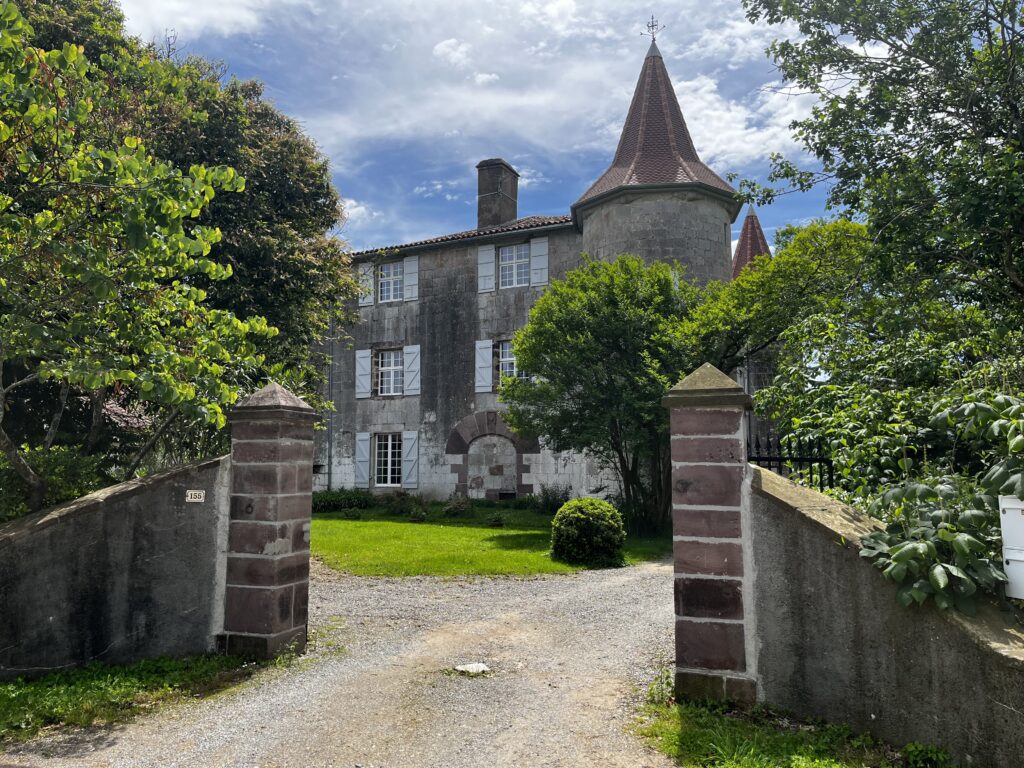
We found the spot in the form of a sheltered bench near to Château d’Aphat, a stately old home with a turret at every corner.
We resumed our walk at about 12:45.
From here, there was actually a little sidewalk by the side of the road. This took us to the hamlet of Larraldea at 1 PM. While this was once its own place, it is now very much a suburb of the town we were approaching.
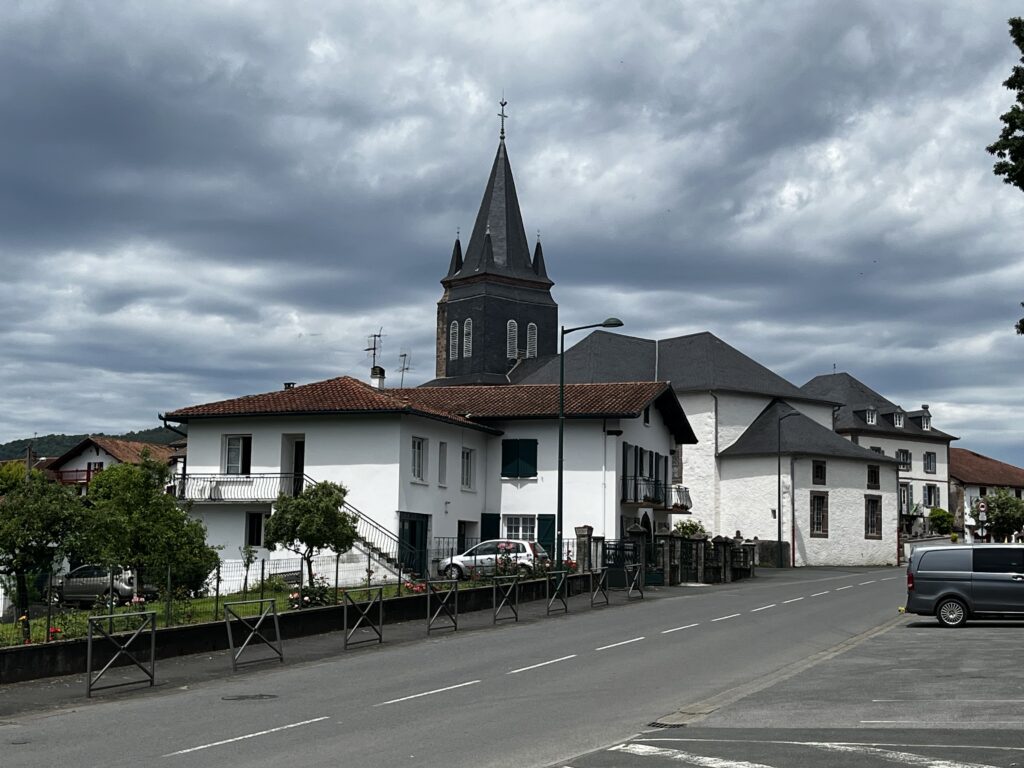
In fact, it merged neatly into the town of Saint-Jean-le-Vieux (Donazaharre), making it impossible to tell when we actually entered the town. Regardless, we were standing in front of the church at 1:10.
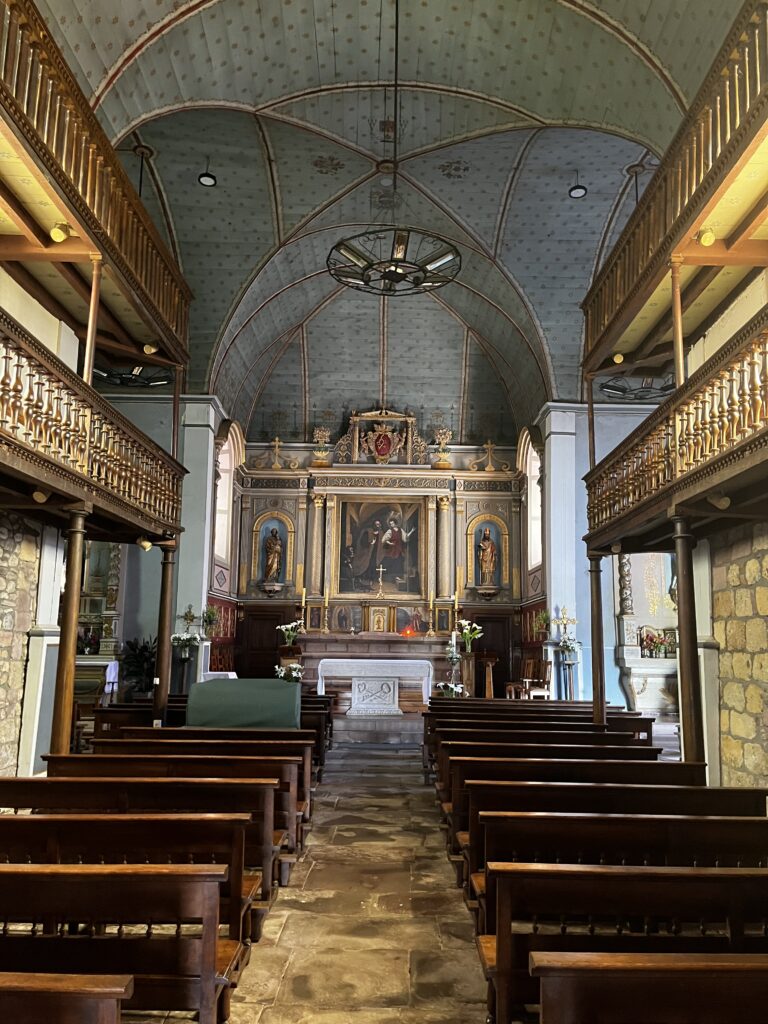
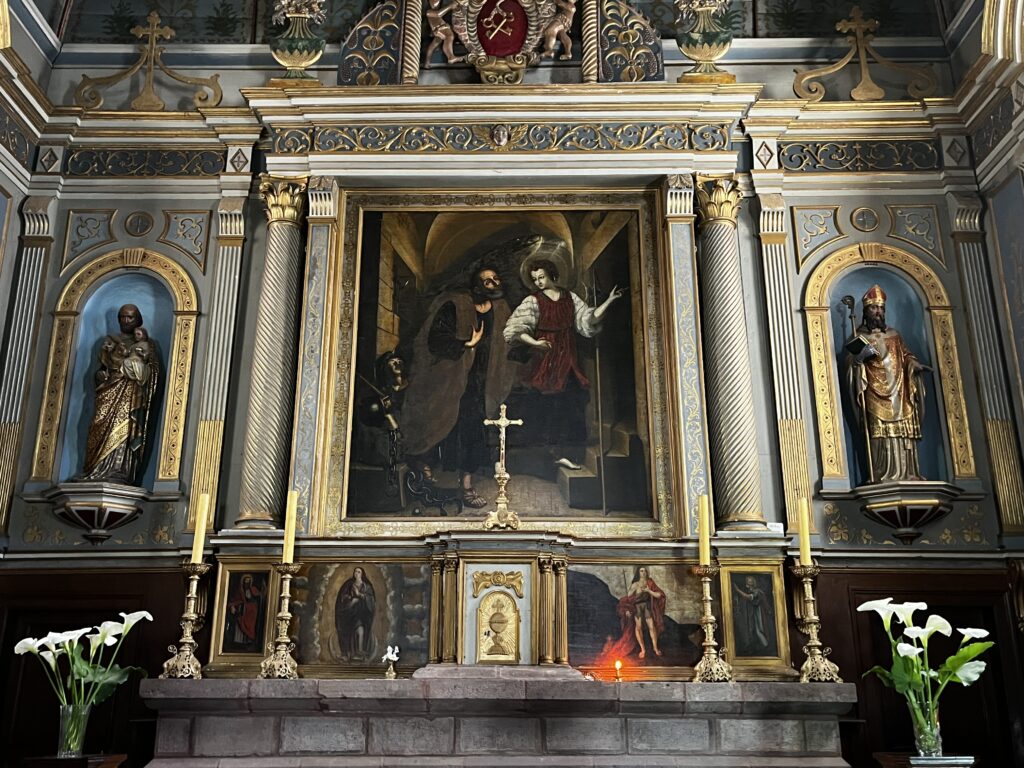
The church of Saint-Pierre de Saint-Jean-le-Vieux has Baroque altars, but a very similar style of painting on the ceiling as I’ve seen in the 19th-century churches throughout the region. It was originally built in the 12th century, but it lay abandoned for a long time before being restored in the 16th century and effectively rebuilt a hundred years later.
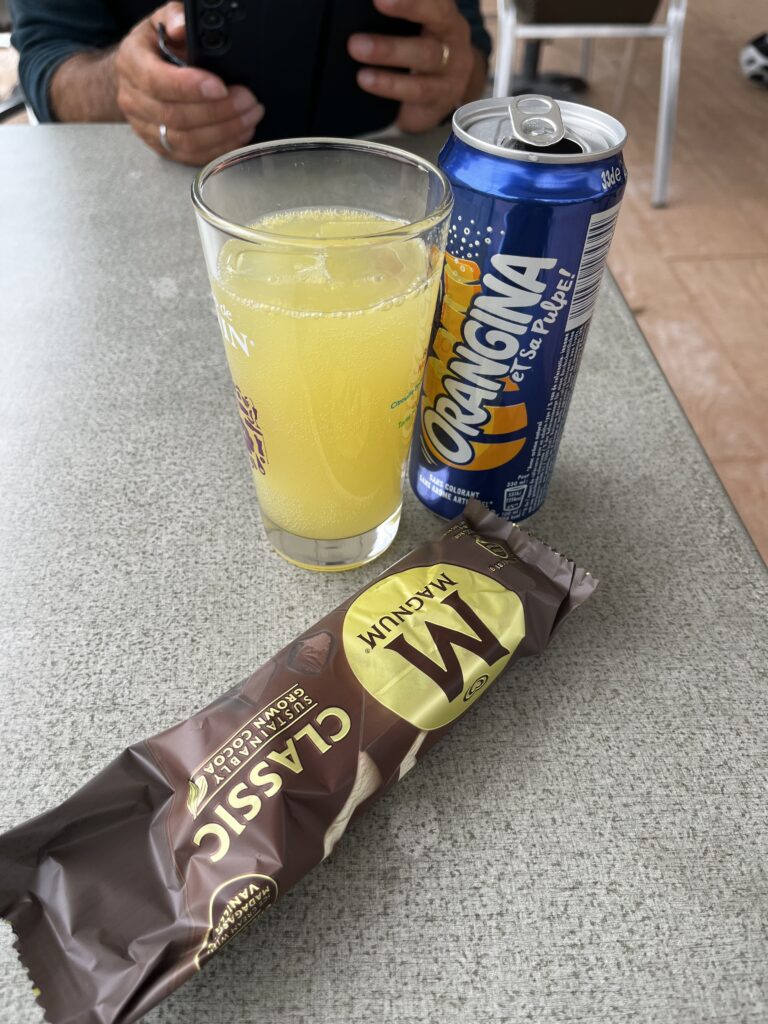
It was a cool, quiet, meditative place that smelled strongly of lilies. I prayed here before joining Herve for a cold Orangina and an ice cream at the bar across the street.
We were definitely moving slowly today, not leaving town until after 1:50, but with only 4 km to go, it didn’t seem like an issue.
Just a few minutes later, we started feeling drops of rain. The skies were partly overcast, but somehow the sun was still shining through with all its heat. As soon as we felt the first few drops of rain, we put on our pack covers, and the rain immediately stopped. Of course.
We were roadwalking through farm country, with a string of homes and farm houses to our left. Soon enough, the houses settled back down into occasional farmsteads and unnamed hamlets.
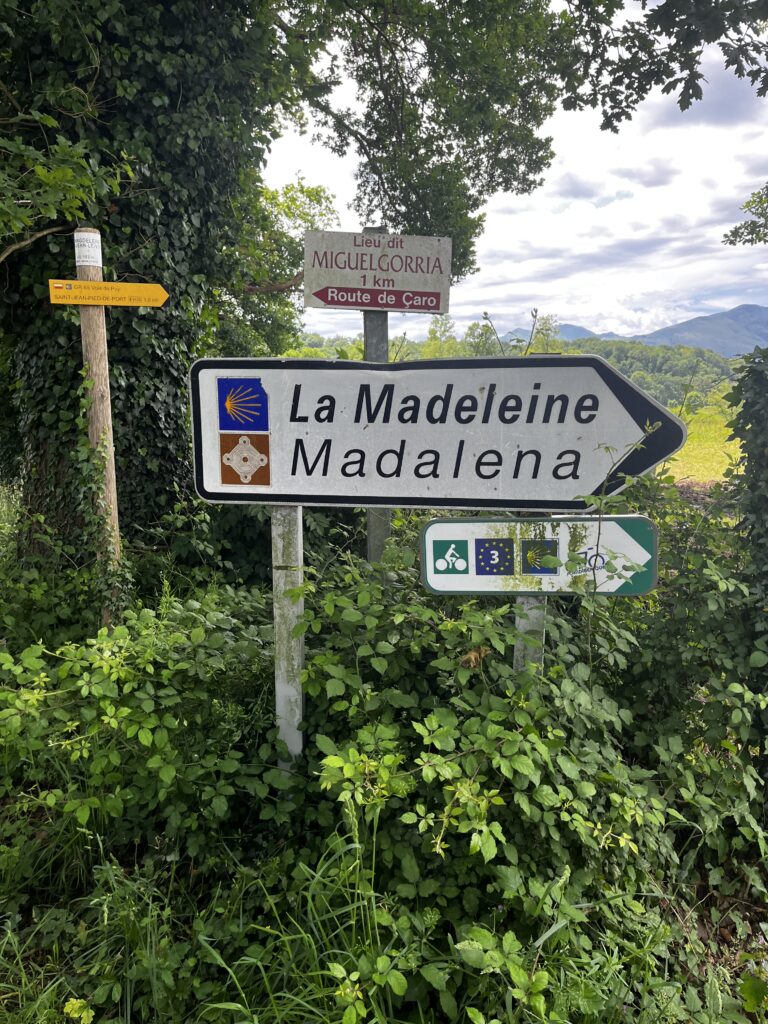
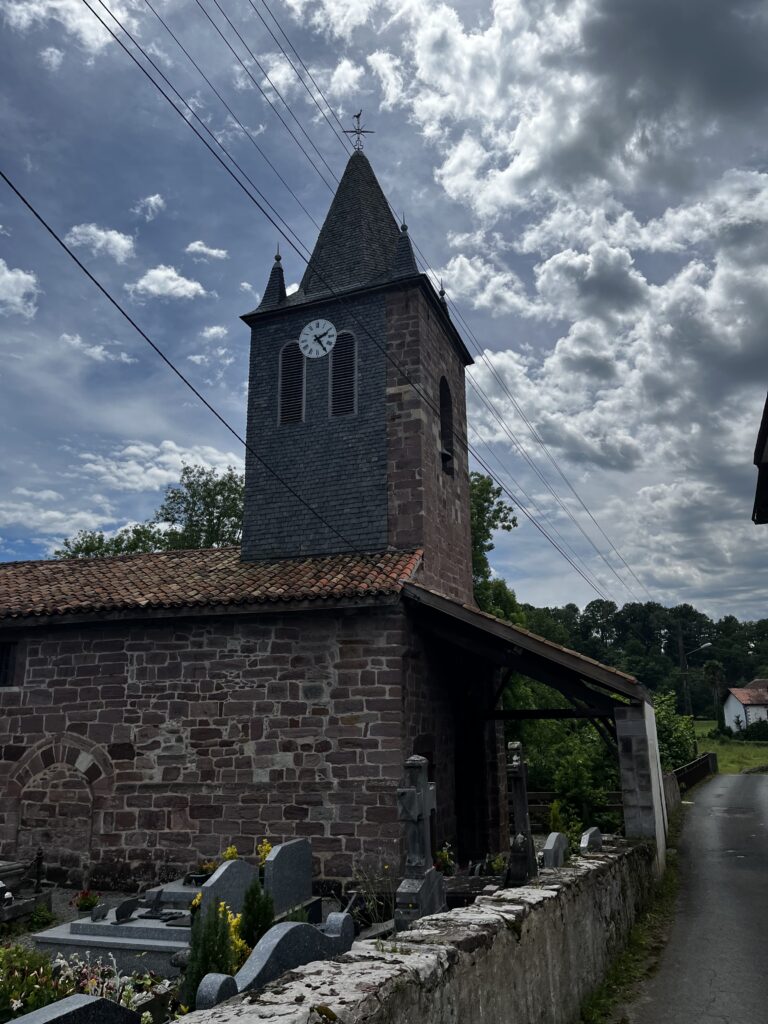
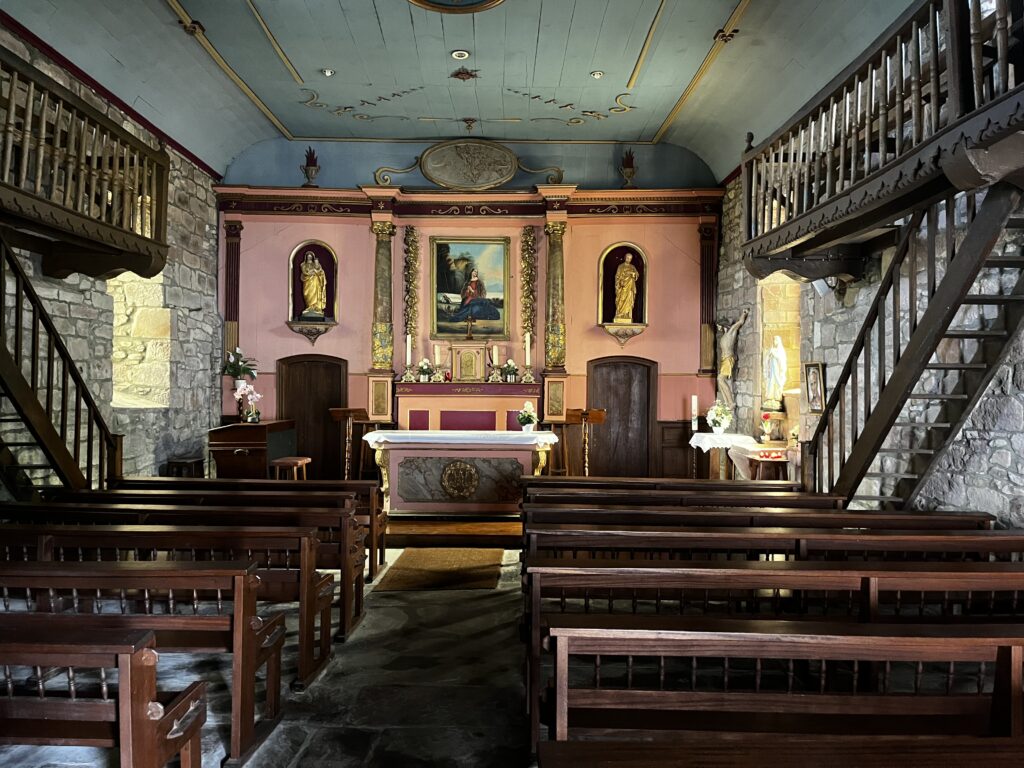
We took a few twists and turns on the way, including passing under a highway twice. After this, we passed through the little suburb/hamlet of Maddlen. At about 2:25, we came upon the hamlet’s namesake, the little Chapelle de la Madeleine.
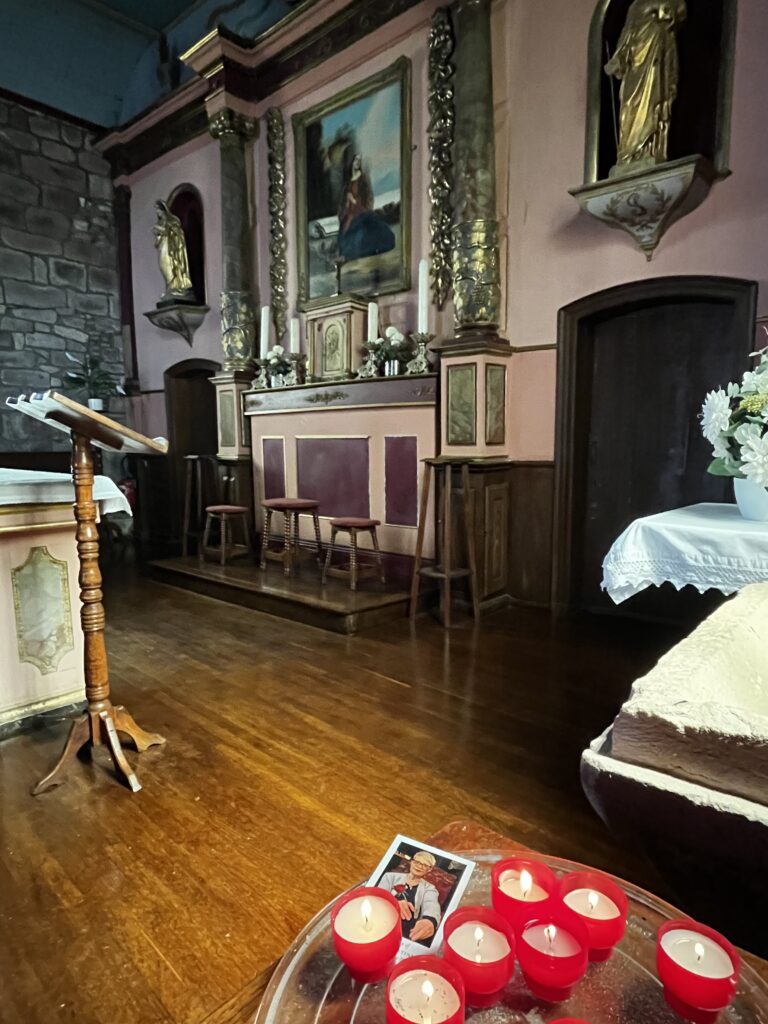
The interior looks like a little home, its altarpiece resembling nothing so much as a fireplace mantle. In a sense, this little homely chapel is the culmination of a walk that began with the great Basilica of Saint Mary Magdeline at Vézelay.
I prayed here, and I lit a candle for Francine.
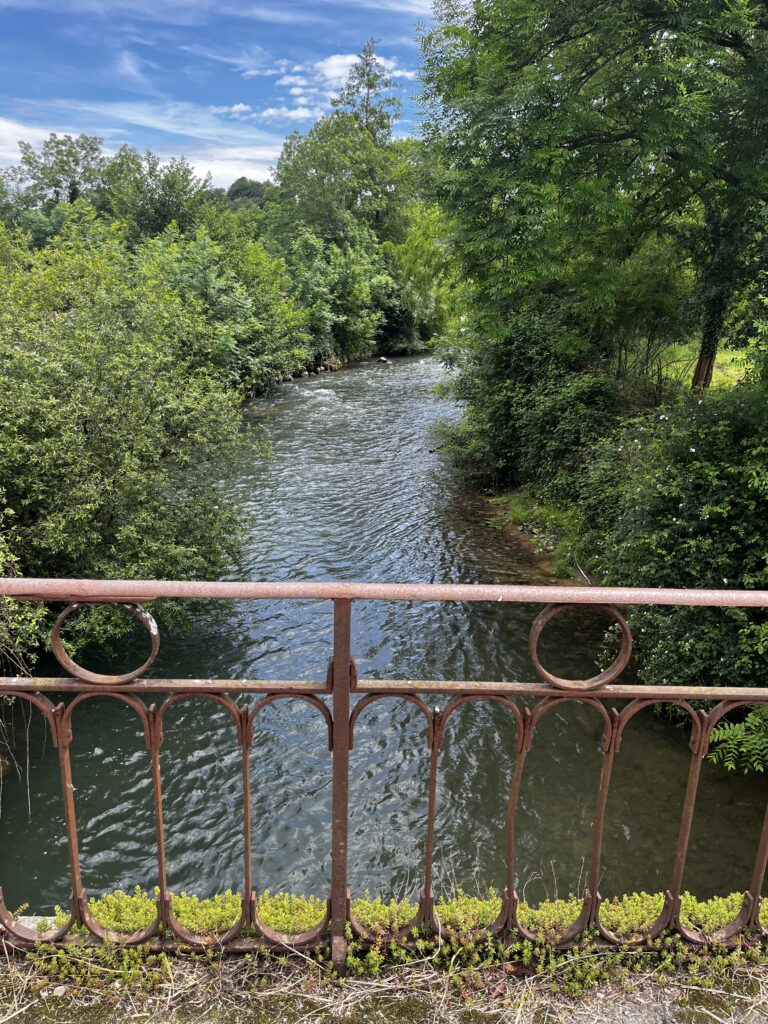
Then we crossed a bridge over a little stream called Lauribat and continued on up the hill into the town.
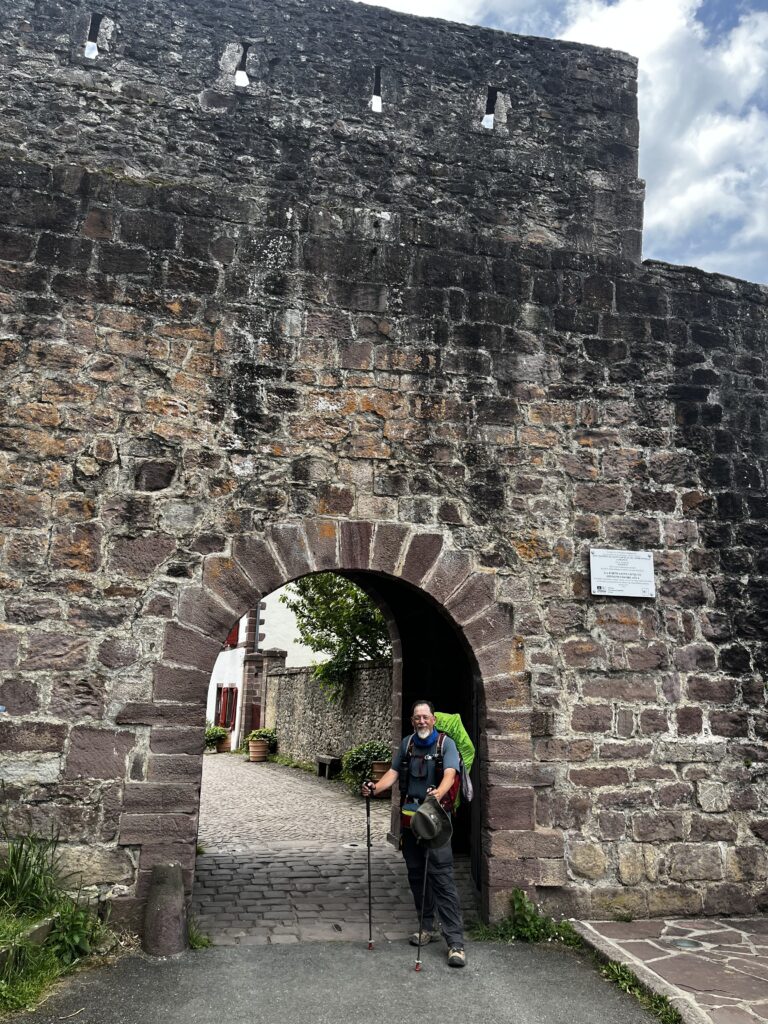
We arrived at the Porte de Saint-Jacques, the pilgrim entrance to the town, at just about 3 PM.
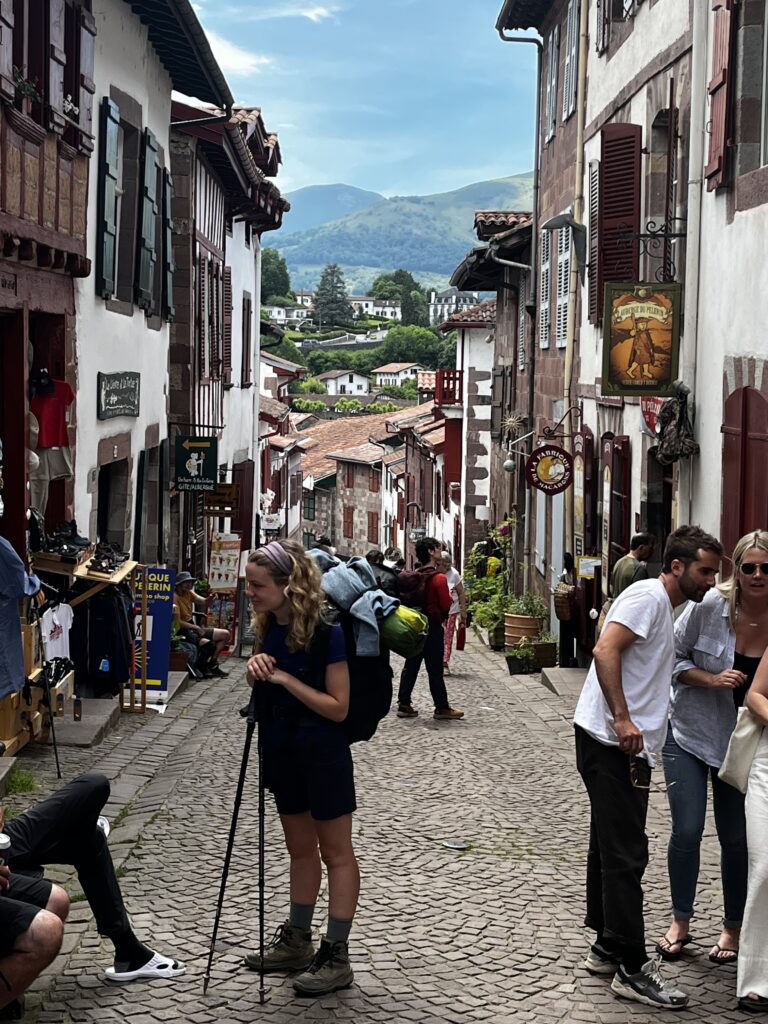
Walking the Rue de la Citadelle, the main street of Saint-Jean-Pied-de-Port, is an experience like no other. I sometimes only half-jokingly call it “Peregrino Disneyland”. The streets are lined with gîtes and bars and cafés and shops that all cater to Pilgrims, either those who are starting from here, or those for whom this is a major waypoint. The street is full of pilgrims with backpacks. Some are new to town, with their shiny shoes and clean clothes, and some of them, like us, are already weatherbeaten and footsore.
Herve and I walked most of the length of the main part of the street before he took leave of me to go to his gîte, and I turned back up the hill to go to mine.
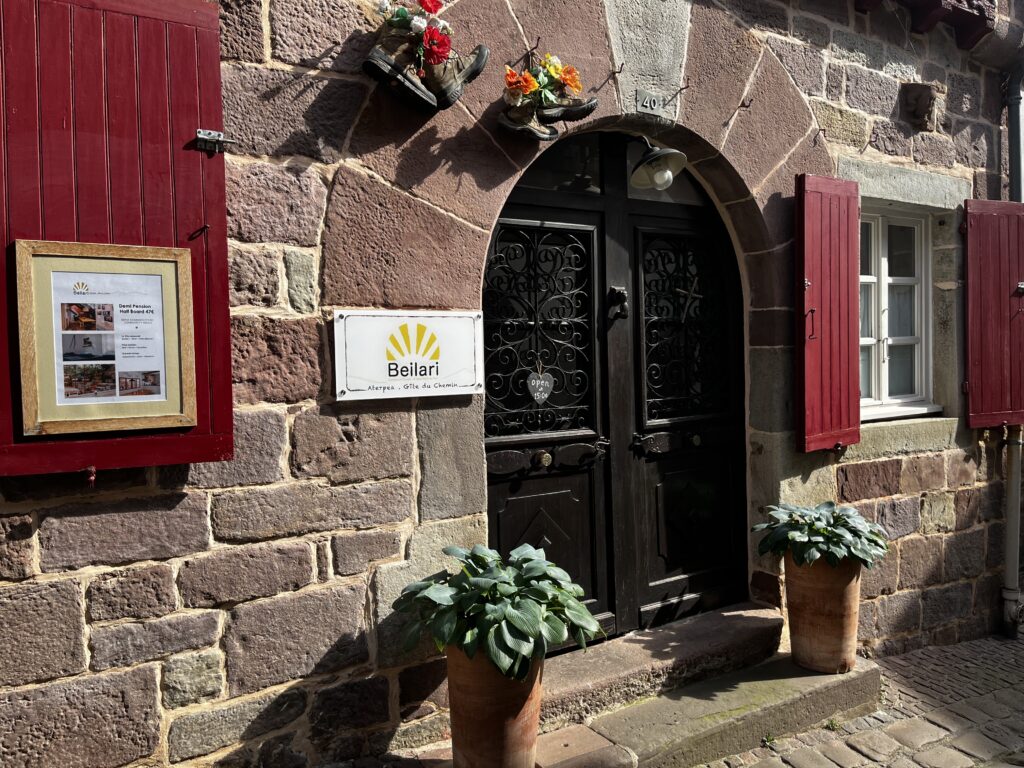
I’ll be staying at Gîte Beilari for two nights. This is the place ten years ago where Francine and I stayed as we embarked upon our longest Camino together. The place holds special memories for me, and it is truly a house of rest and respite.
Date: 19 May 2026
Place: Saint-Jean-Pied-de-Port
Today started: Izarrak
Today’s Photos!
Hi Thom !
Glad to see that you’re pursuing your Camino according to plan.
I wish you a good stay in St Jean and “Bon courage” for the crossing of the Pyrénées !
Buen Camino !
Philippe
Thank you, my friend! Saint-Jean really is a fantastic place to take an extra day.
Enjoy your day of rest! You really deserve it!
Thank you! I figure if the Lord can rest after six days, I can rest after 41.