
Via Lemovicensis: Estella la Bella
By 5 AM the pilgrims were everywhere stirring in the albergue, and within half an hour, many of them were already packed and getting ready to go. by 5:45 AM, many had already hit the road.
The sun wouldn’t rise for another half hour. The heat had made early morning converts of us all.
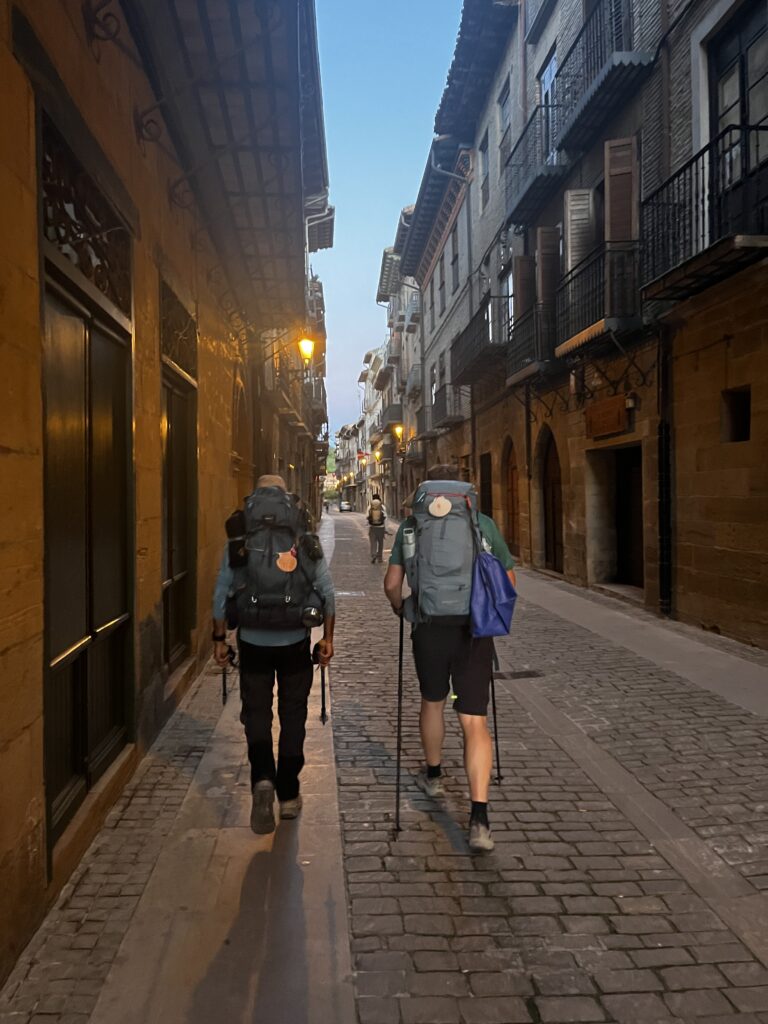
While I had no intention of leaving until there was light in the sky, I was packed and ready to go by 5:45. By 6, Herve, Tom, and I were out the door.
We made it as far as the only open café in town. First breakfast! Fueled with coffee and napolitanos, we left left at 6:25 AM.
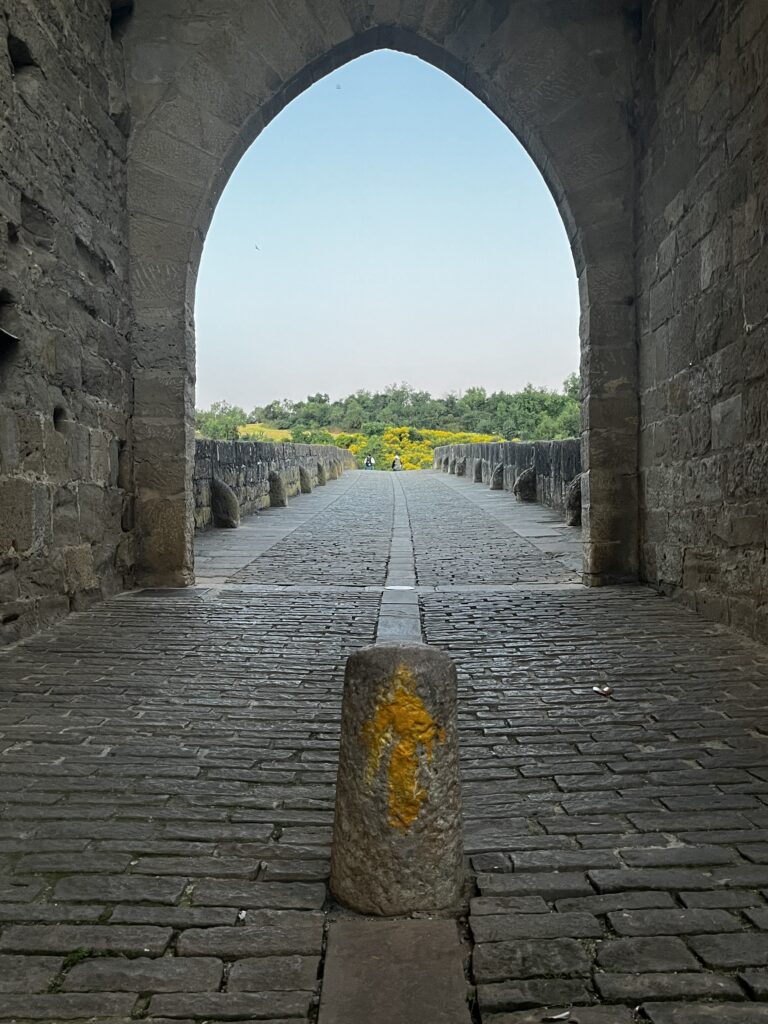
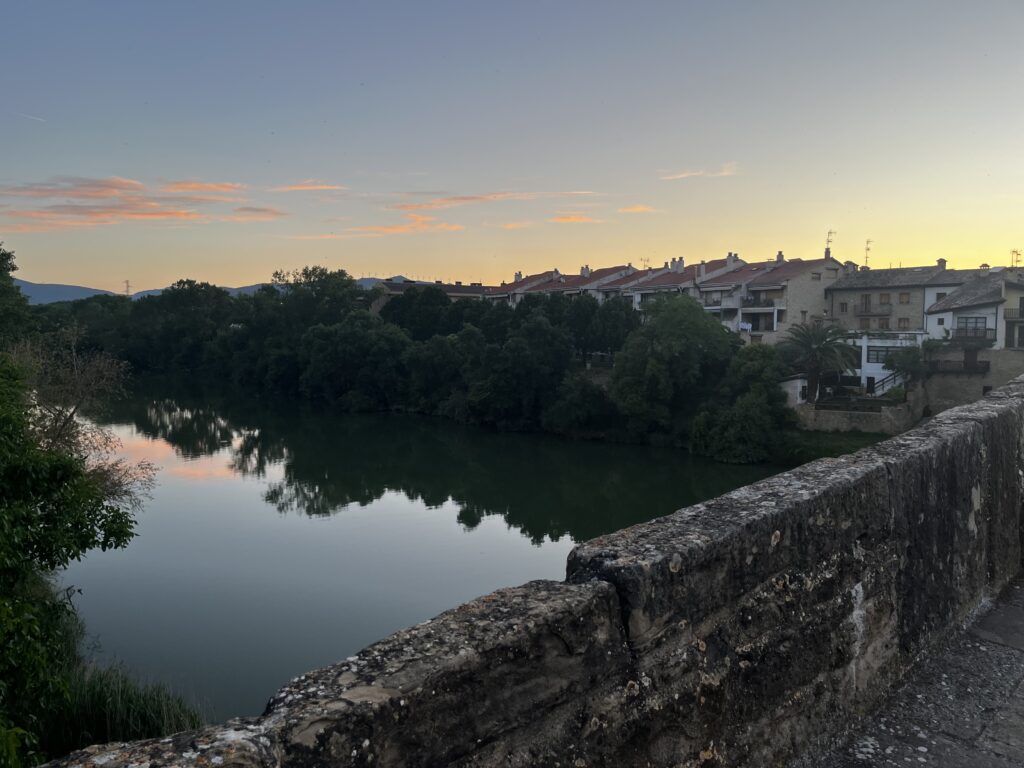
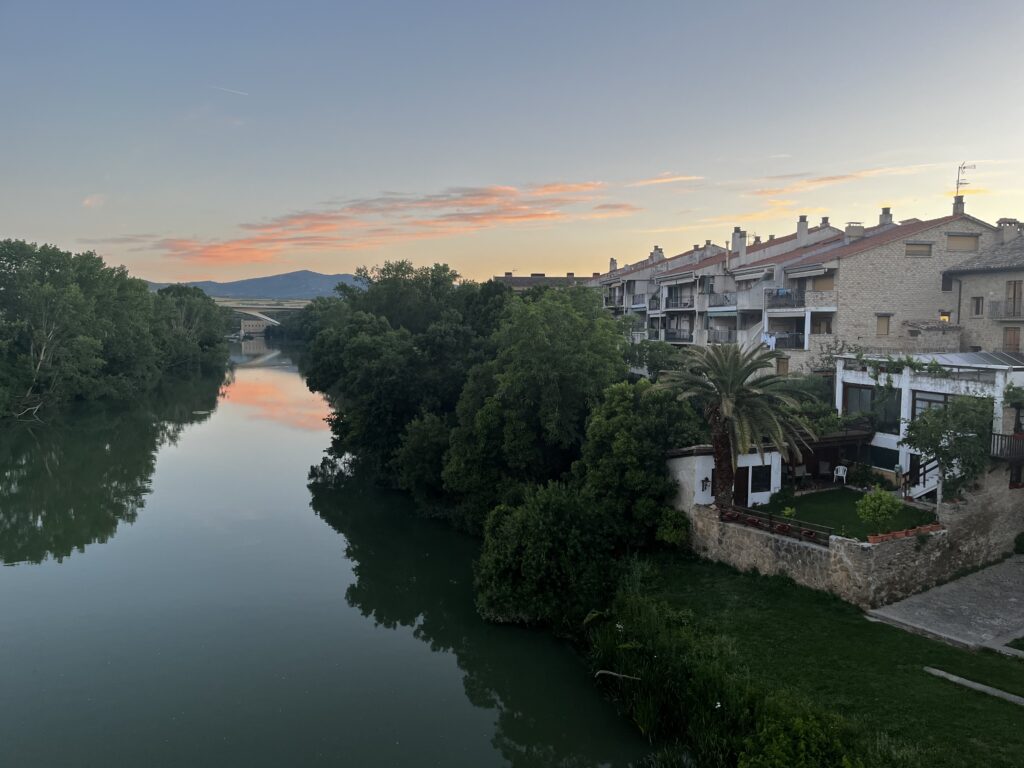
We crossed the River Arga on Puente la Reina’s titular 11th-century bridge just about 6:30 AM.
There’s some debate amongst historians as to just which queen the bridge is named after – there are two involved in its construction or reconstruction over the years – but since originally there was a statue of the Blessed Virgin in the now vanished tower in the middle, I think we can safely say who the queen was!
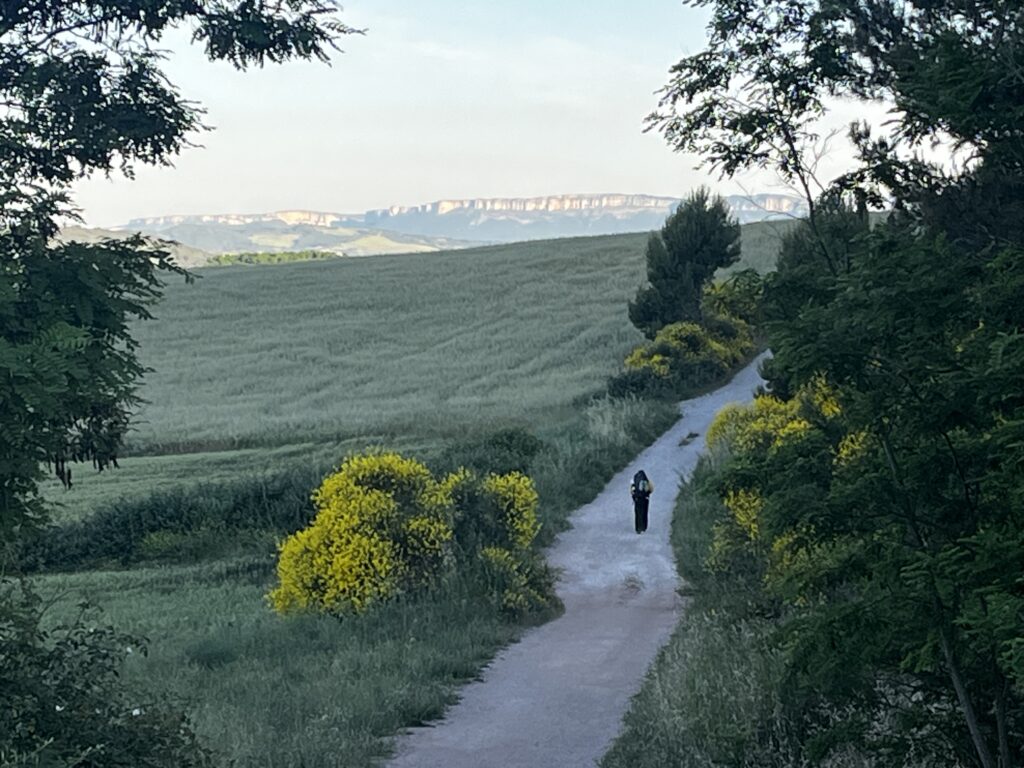
Once we were out of the central part of the town, the Camino continued on a broad road of crushed gravel past back gardens, small stands of trees, and occasionally open fields.
The air was cool, but the sky was cloudless. It was going to be another scorcher today.
I’ve lost enough weight now that I need to tie my fleece around my waist for my backpack hip belt to sit properly.
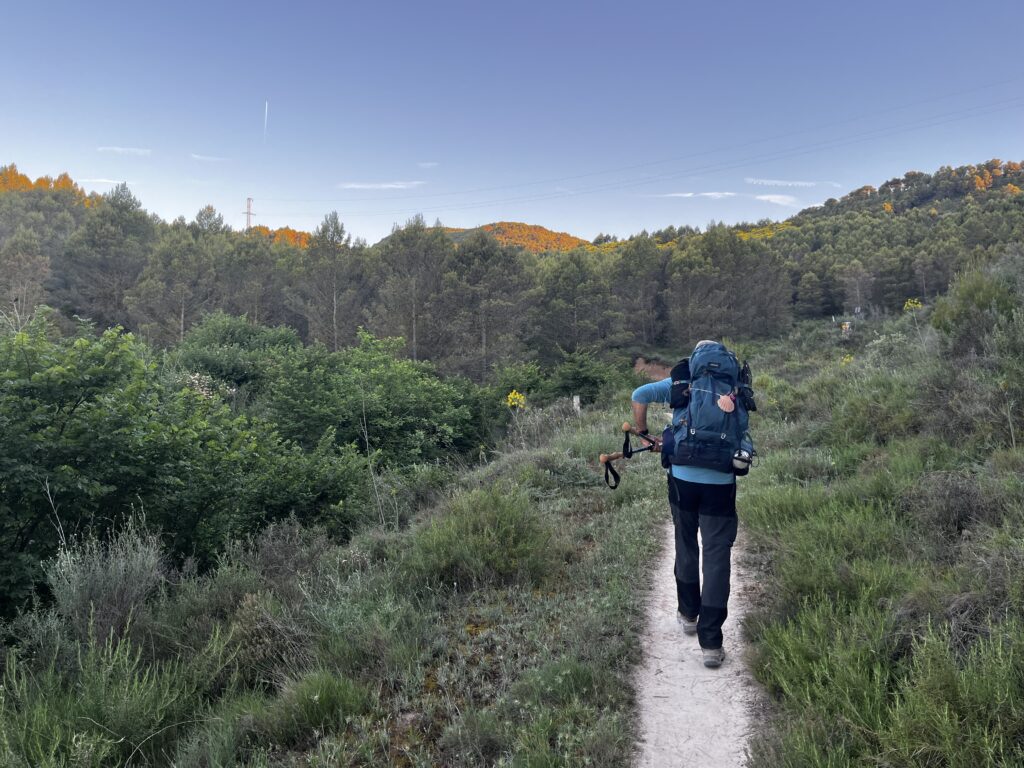
At about 7 AM, Herve and I left the main Camino trail for a narrow path of cracked earth. This variant would take us past a monastery and was even shorter than the main route somehow. Tom elected to continue on the main route.
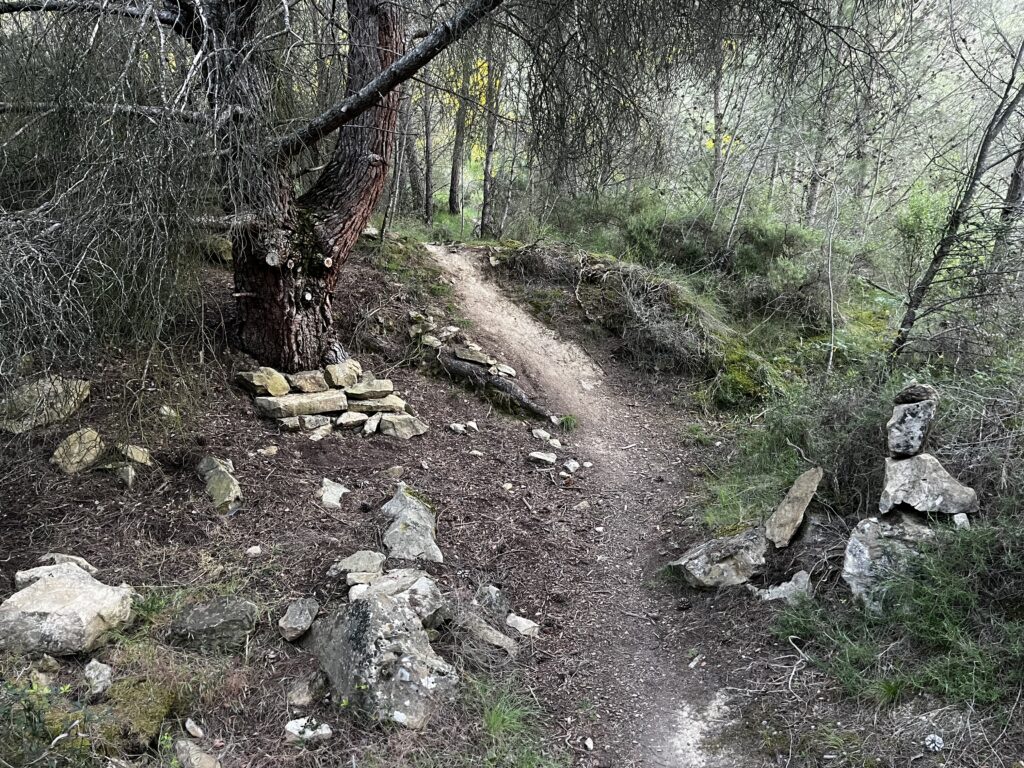
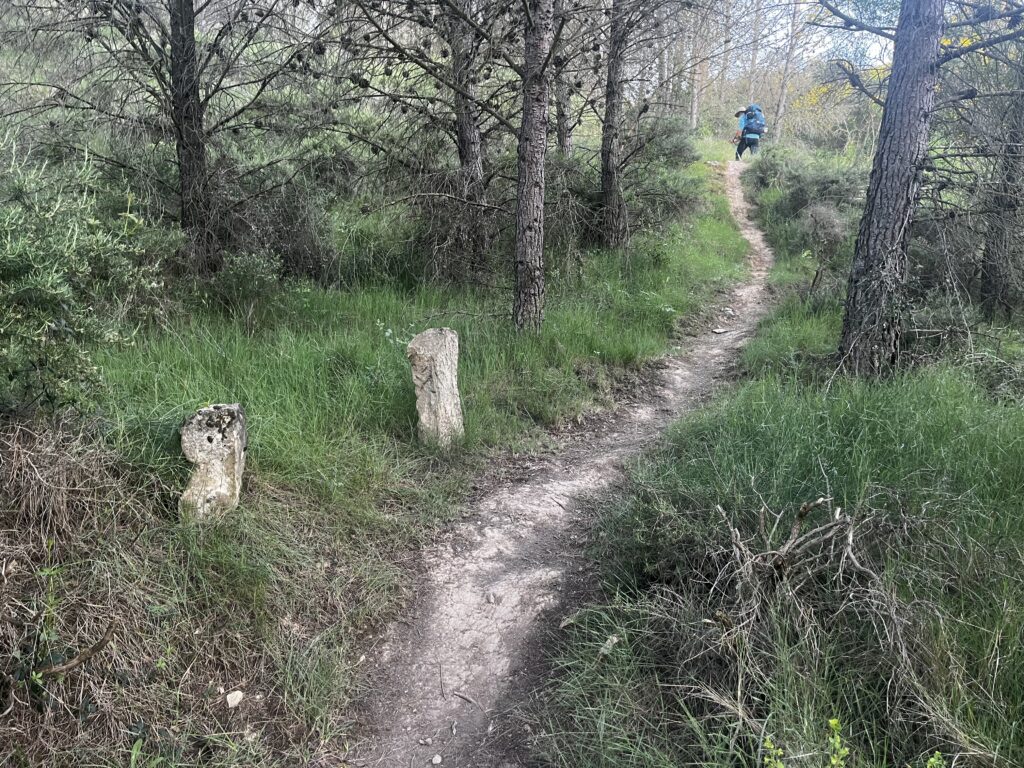
The path took us down over muddy streams and then up through a tangled pine forest. We passed through places perfume with blossoms, past strange standing stones, a dried out canal lined with cyclopian blocks, and a tree Herve thought might be a sleeping ent.
We arrived at the ruins of Bogota at about 7:15. There’s not much left here – foundations, a partially reconstructed wall, the outlines of a little Romanesque chapel. I paid my respects to the forgotten monks, and we continued on.
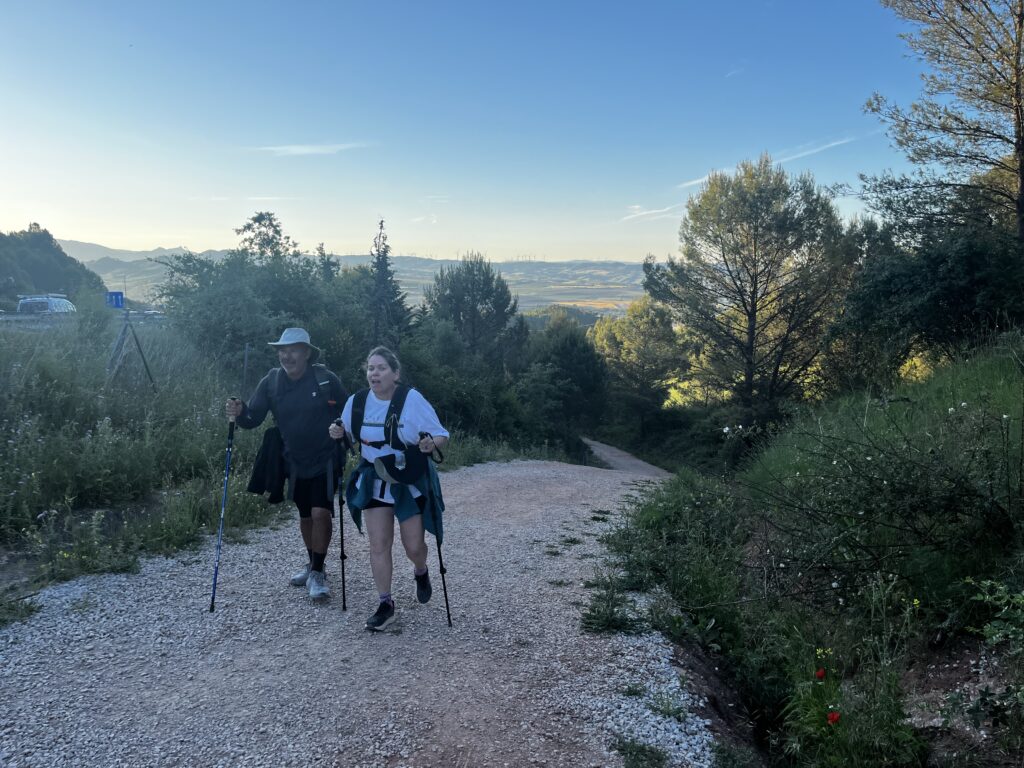
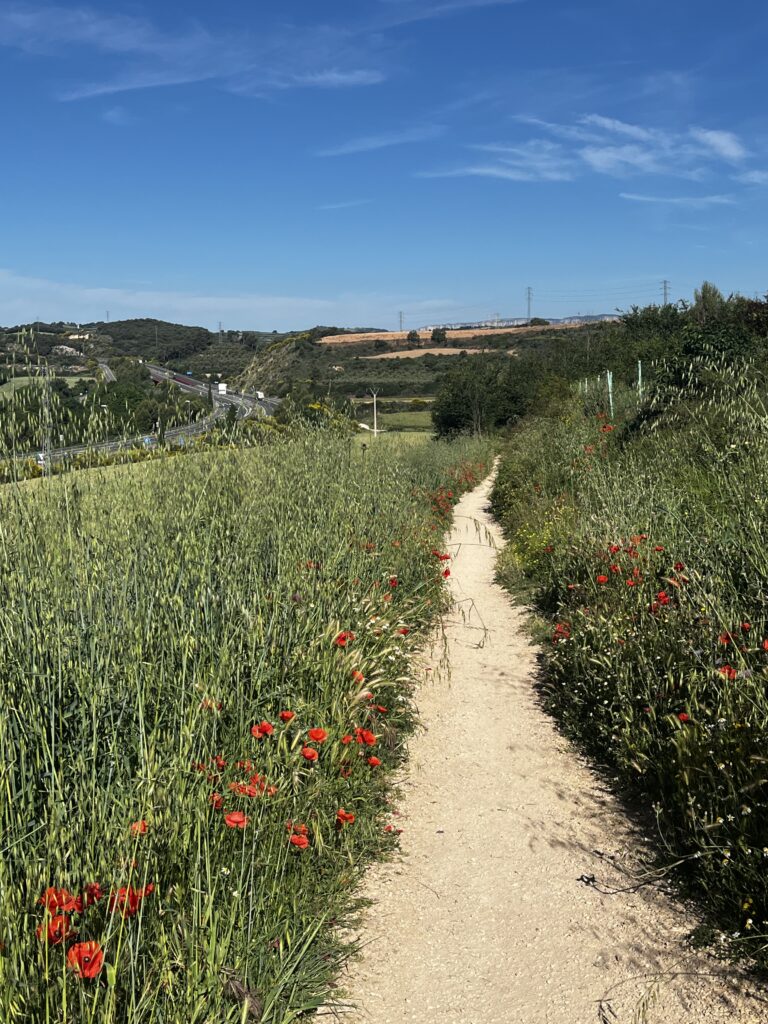
From here, we followed a dirt path almost wide enough to be a road. he joined up with the main Camino route mid climb up a brutal hill. From here, the Camino was a wide gravel path – really a road – which briefly fronted on a large freeway.
At about 7:30, the road left the freeway towards the village of Mañeru. In the distance ahead of us, we could see great cliffs lit by the early morning sun.
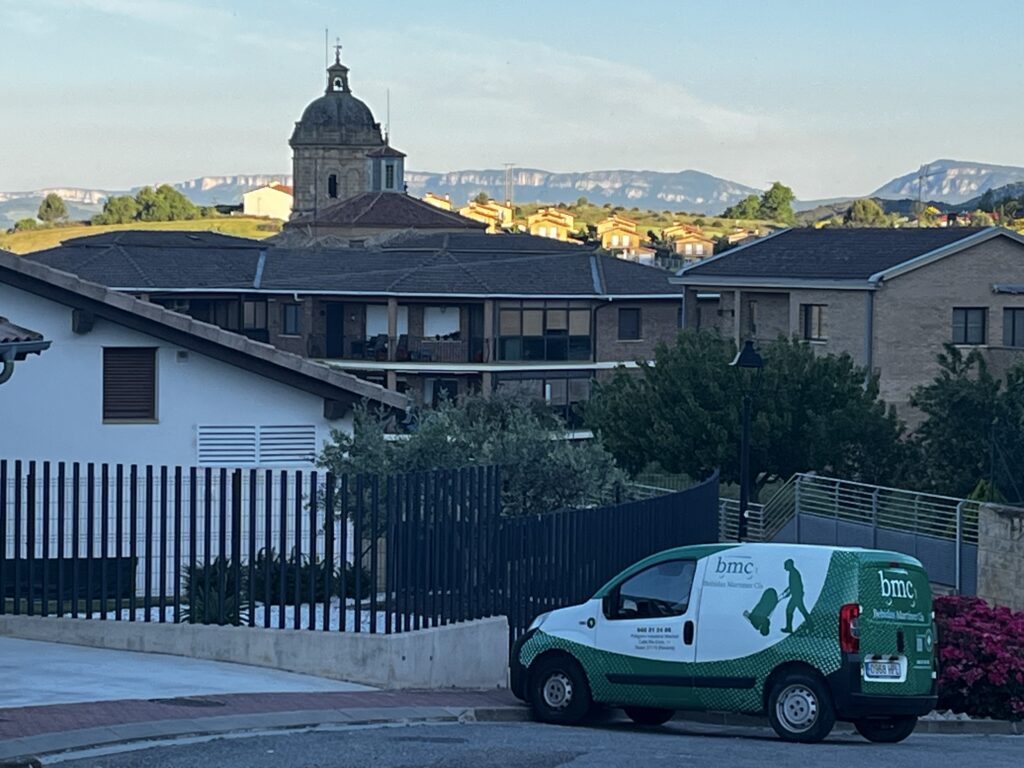
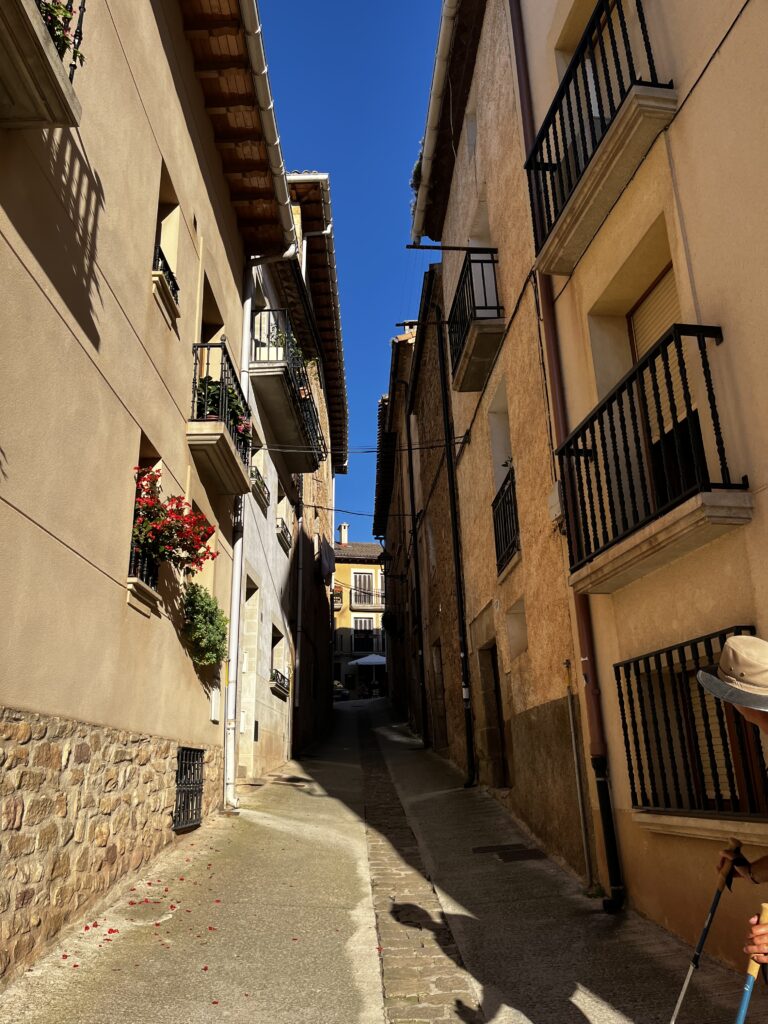
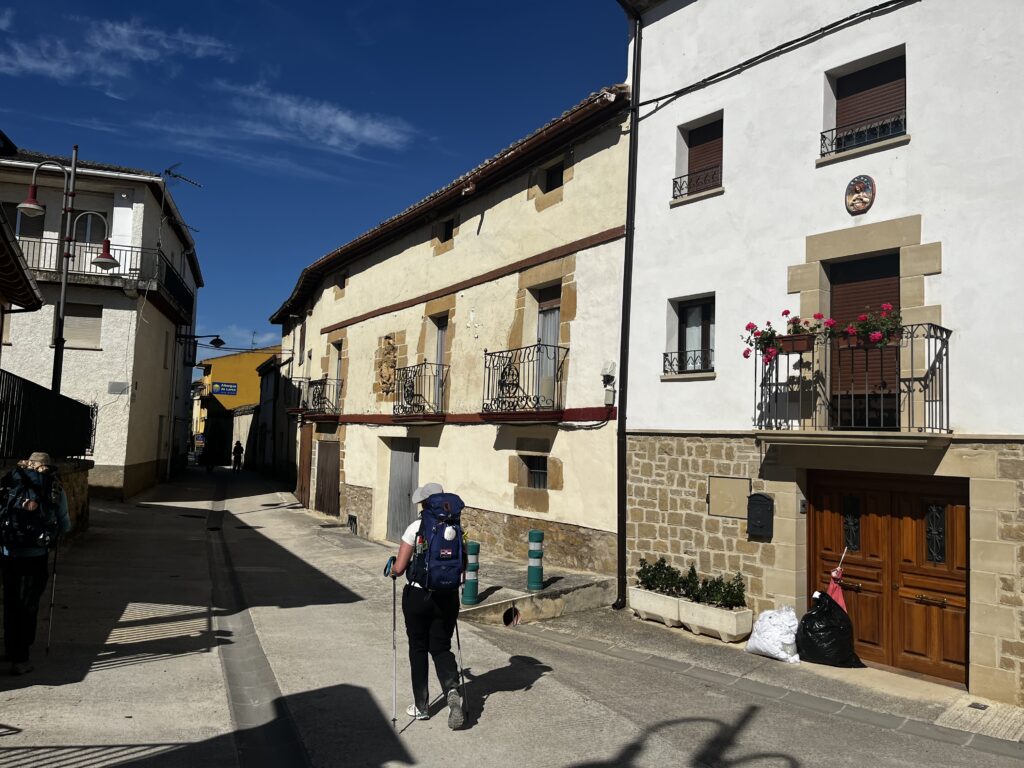
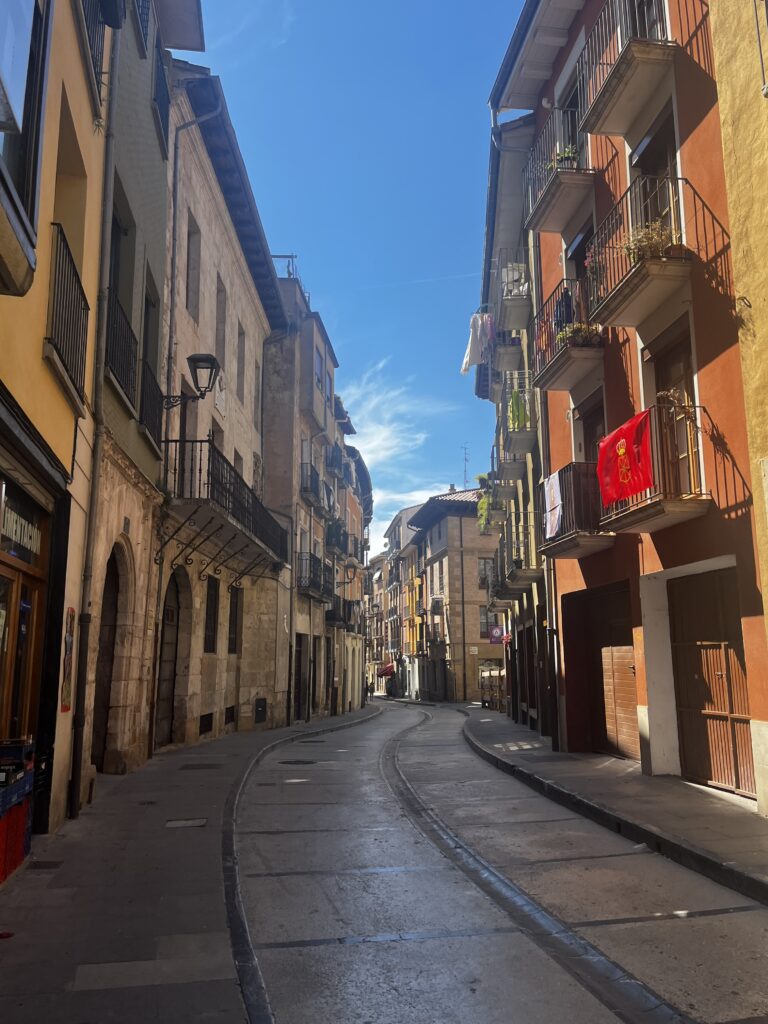
Most of the housing in the village is modern, and there’s plenty of evidence of brand new construction here as well. The core of the village, remains the typical old stone architecture of the region.
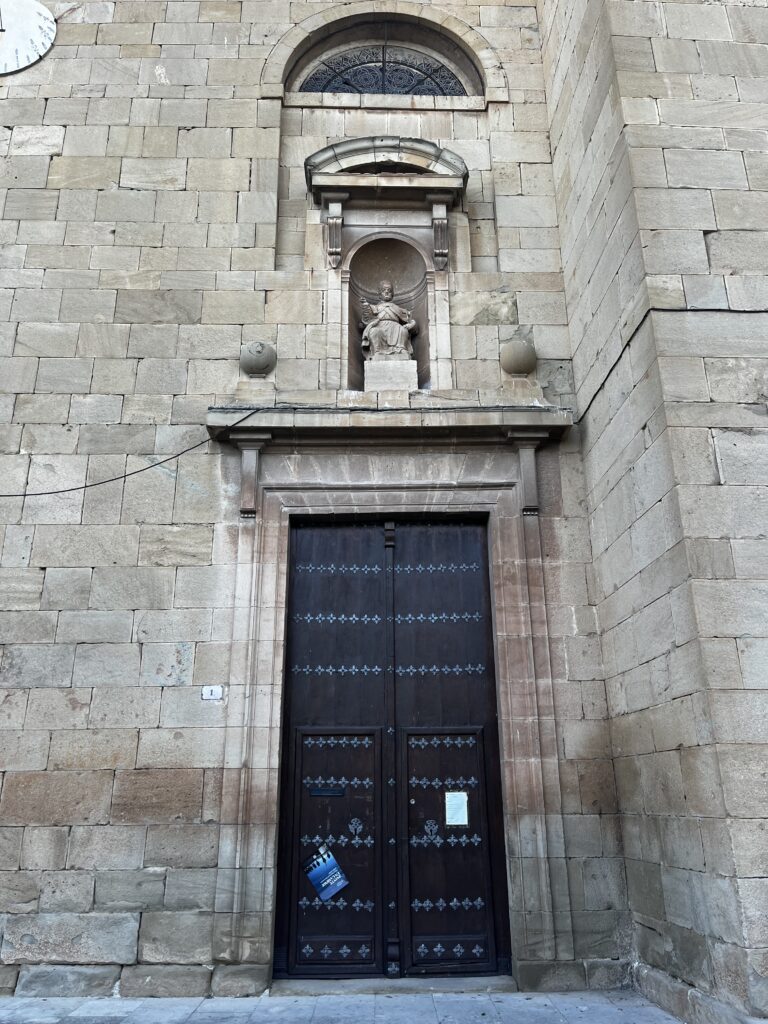
And the church of San Pedro, with its dome visible through most of the town, is a wonder. It’s a little off the Camino route, and of course it was locked. Still worth the visit.
Of course, the medieval center of the town is an absolute maze, and I got completely lost trying to get back to the Camino.
The route out of town was an asphalt road that gradually transitioned through gravel to dirt through wide open fields and past a little walled cemetery.
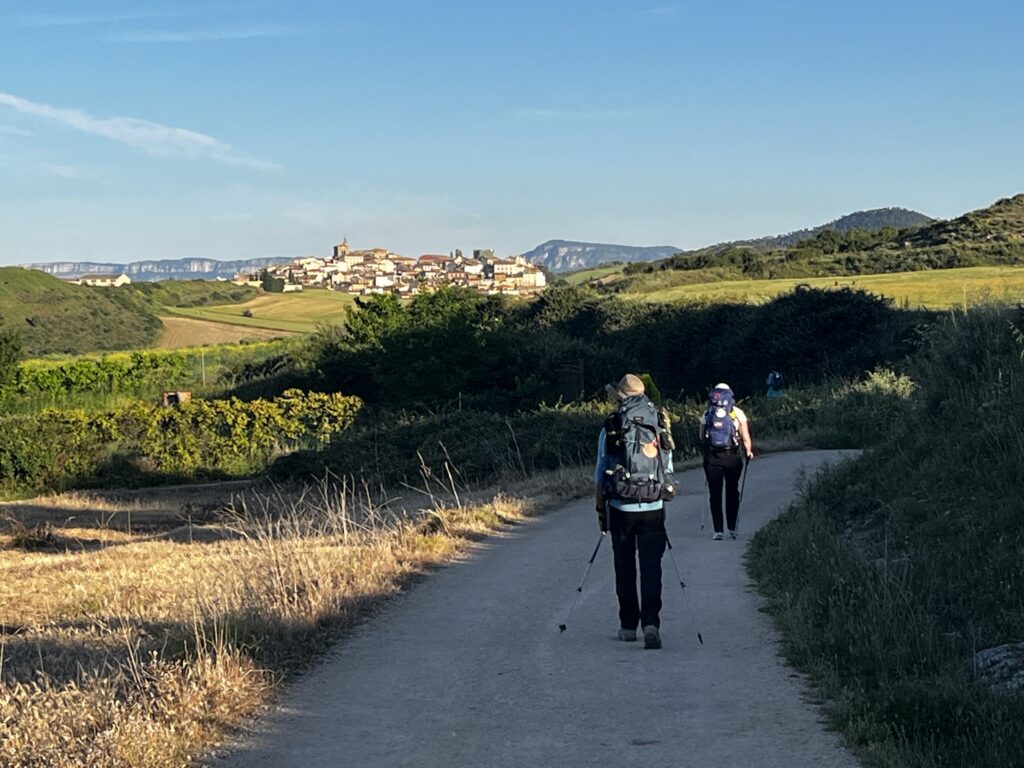
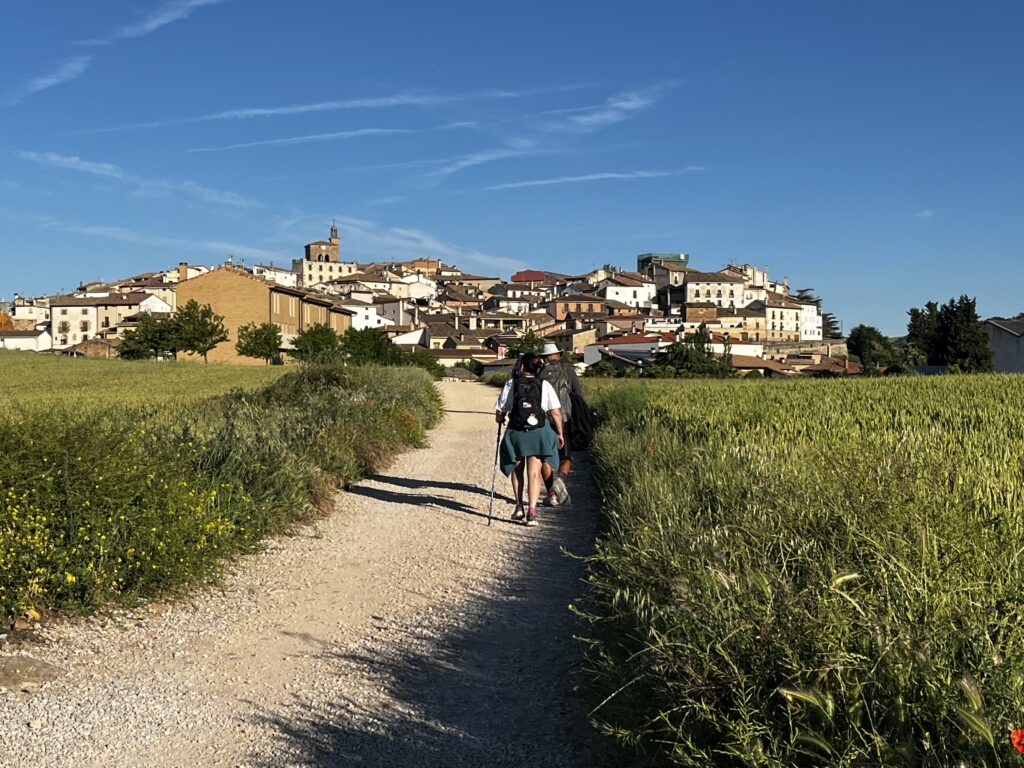
The hilltop village of Cirauqui can be seen from a long way away. It’s an absolutely striking vision, particularly in the early morning light.
The Camino left the road and followed a narrow path of stone and concrete, which eventually became a dirt path.
At about 8:10, the Camino rejoined a dirt road for the final approach to the village. We had rows upon rows of grapevines to our right, and farmland to our left.
The thing about hill towns is that to get up into them, you have to climb a hill. We stopped for a second breakfast on a little terrace table near the top. Kas Naranja and a banana.
The Camino actually goes through a building in the town, which is only one of two places that I can think of where that’s true.
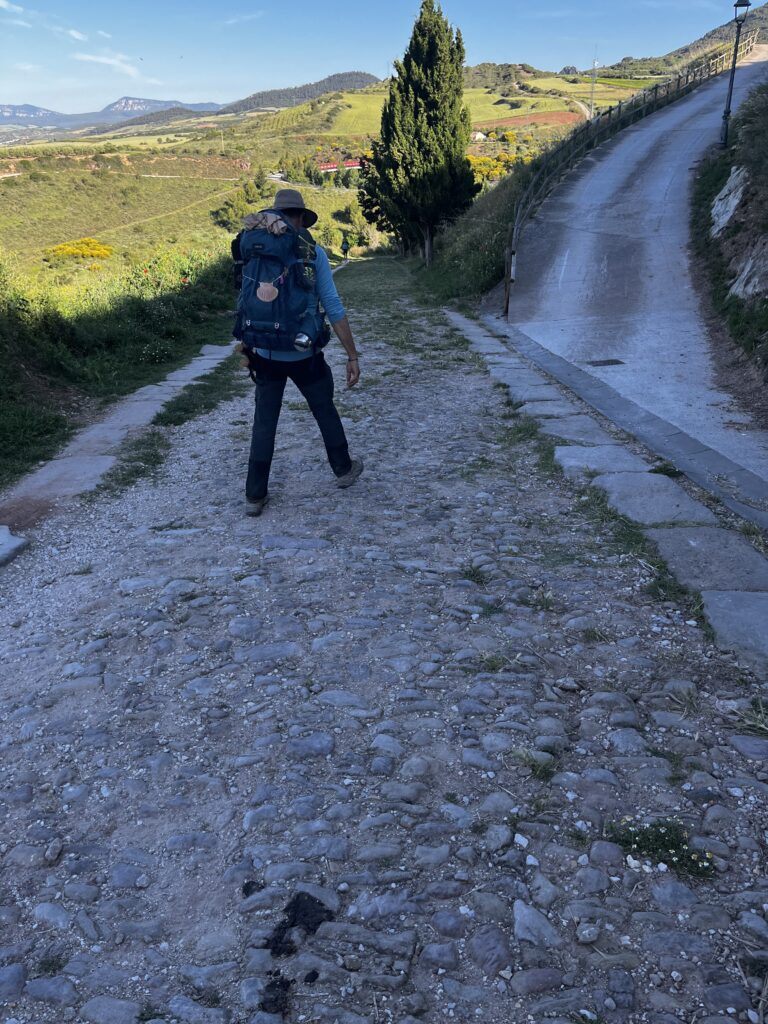
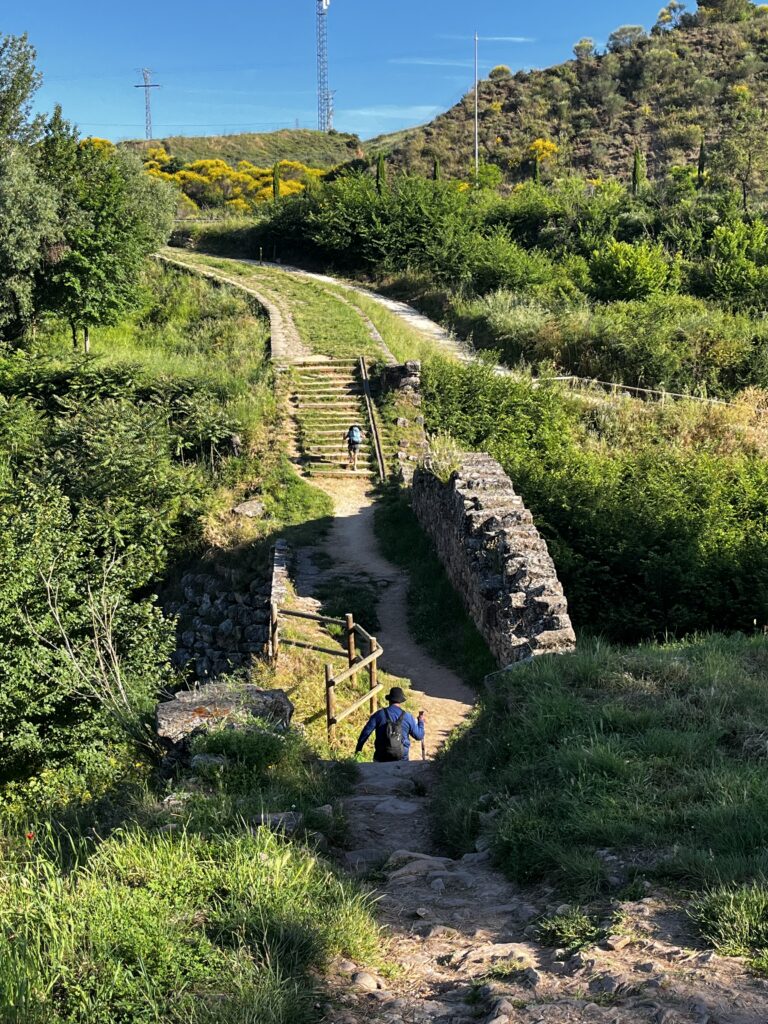
We climbed down out of the village and onto the remains of a Roman road through some truly spectacular hill country. There’s a bit of a gap in the road where a bridge used to be, and pilgrims have to climb down and then back up the other side.
The old Roman road took us to a thoroughly modern gravel road with a stunning view of the valley below. We crossed a bridge over the highway. By now, the umbrella was out.
The road was mostly dirt as it wound its way through the hill country.
At about 9:25, we crossed over the Puente de Dorrondoa. This is supposedly a reconstruction or restoration of an old Roman bridge.
After this, the Camino became narrow, stony, and sharply uphill until it met up with a different dirt road. We continued on through the hill country, surrounded by fields and scrub.
I’m finding the Camino in Spain to be quite different from that in France. Of course, it’s a different country, and the Spanish infrastructure is much more developed on the Camino, but it’s more than that.
I’ve been walking with Herve for a couple of weeks now, and we’ve slowly started to accumulate other pilgrim friends out of the crowd walking now. There’s a socialization aspect which is more and more crowding out my pondering and reading time. I think that’s for the best.
I think a part of this process is social reintegration – learning how to be with people again – and this part of my pilgrimage is giving me that opportunity.
It does mean, though, that I have to more consciously and deliberately carve out time for solitude.
The Camino followed another little stretch of Roman road, though it was so overgrown you would be forgiven for missing it.
Then there was a steep descent on a dirt and gravel trail, and then somehow we were paralleling the highway again.
At about 9:50, the path merged into a broad gravel road, taking us under the highway and then onto a gravel path next to a two-lane road.
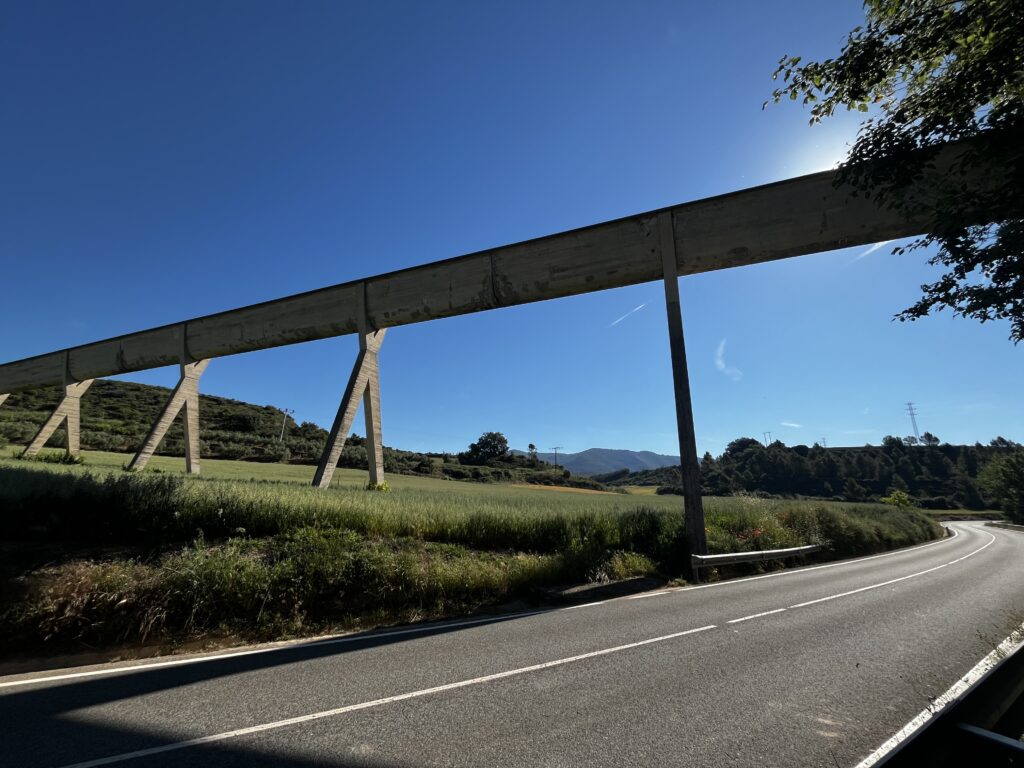
Somewhere around 10 AM, we passed under an aqueduct, the Canal de Alloz. It is a striking piece of public works that I can’t really imagine seeing anywhere but Spain.
Shortly after this, the Camino left the road and passed over the Rio Saládo on a medieval stone bridge. It was restored in 2007, and it already has the look of something that’s been there forever.
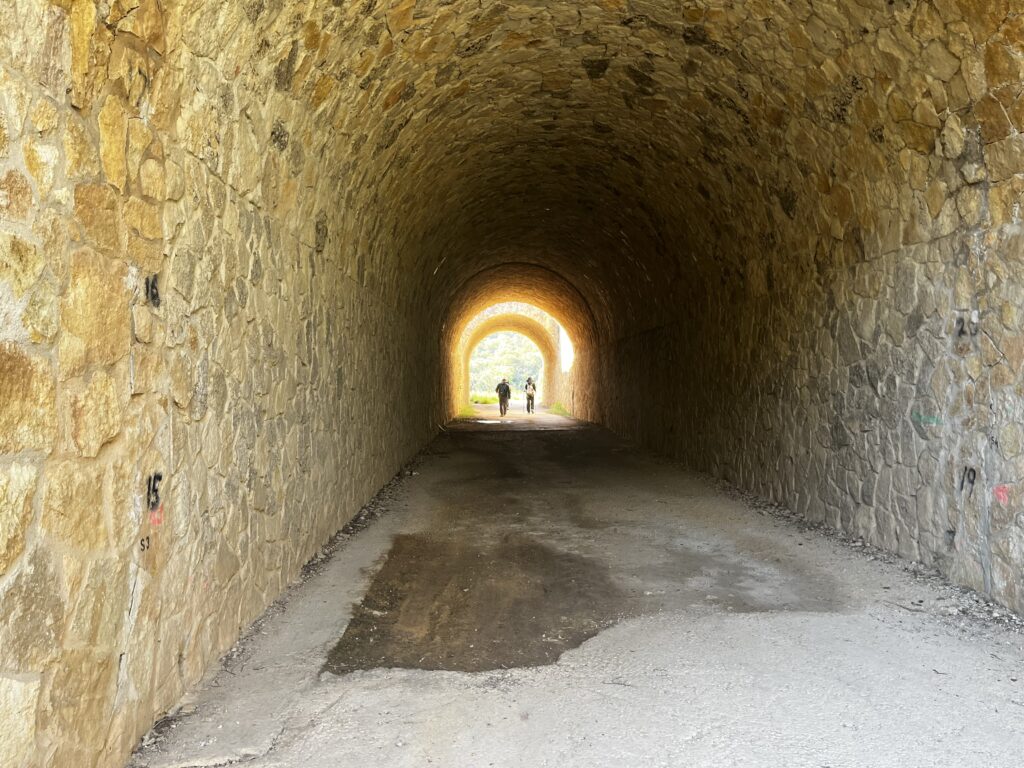
The Camino followed a concrete road through a narrow valley, with its orchard and small plot of farmland. This climbed to a stone tunnel underneath another highway.
I found out last night that in Pamplona, Tom from Germany had stayed in Albergue Betania. He loved the place. This was the last place that Francine had served as an hospitalera, in 2024.
This was, in fact, the last time that she walked any part of the Camino, as before her two weeks in Pamplona began, she and our friend Becky walked a few days from Pamplona just to see what the route was like so that they could better inform the pilgrims they served.
After the tunnel, the Camino turned down abroad gravel road surrounded by hills and bushes. Then it began to climb. The climb into the village of Lorca was relentless in the heat. We arrived about 10:25.
The church was, of course, locked. But, the town’s bars were open. We picked one for a snack of orange juice and tortilla Español. Herve had the gazpacho that he’d been craving for days.
We left at 10:55. After the village, the Camino continued on a wide gravel path paralleling a two-lane highway. there were trees, but not enough to provide more than a scattering of shade.
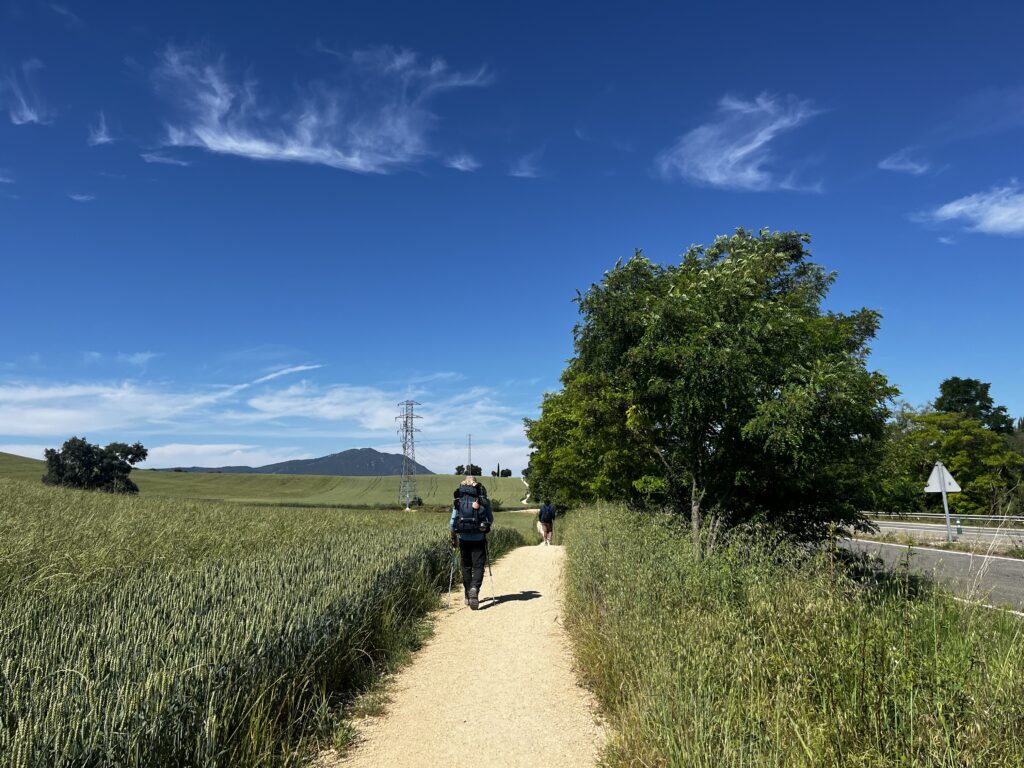
At about 11:15, the road pulled away from the highway and into the rolling hills of grain. Here we fell in with Patrick, a retired police officer from New Jersey on his first Camino.
We chatted as we walked, and about 11:35 the Camino took us through another under-the-highway tunnel that looked for brand new.
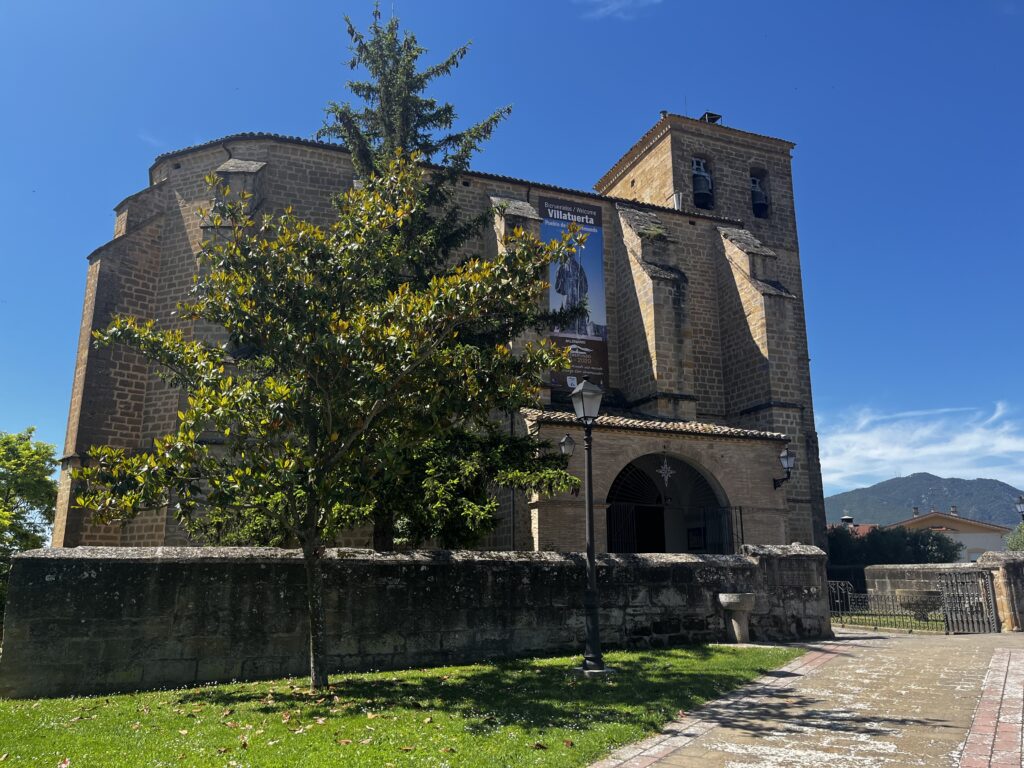
About ten minutes later, this brought us to the town of Villatuerta. Again , a lot of modern construction.
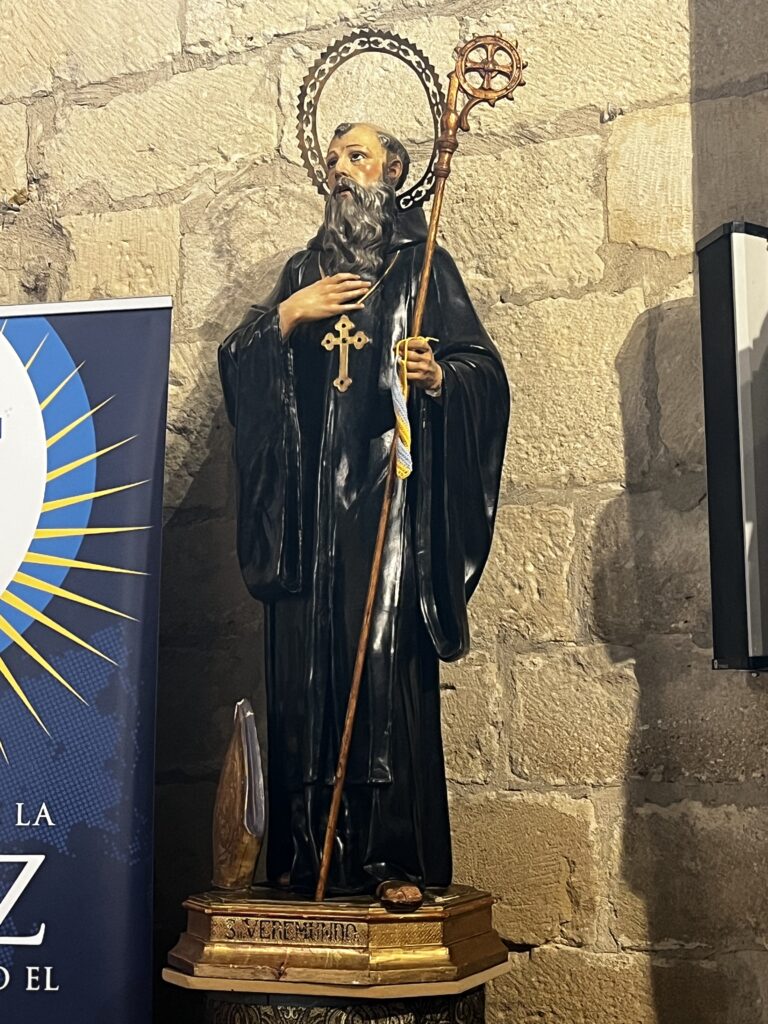
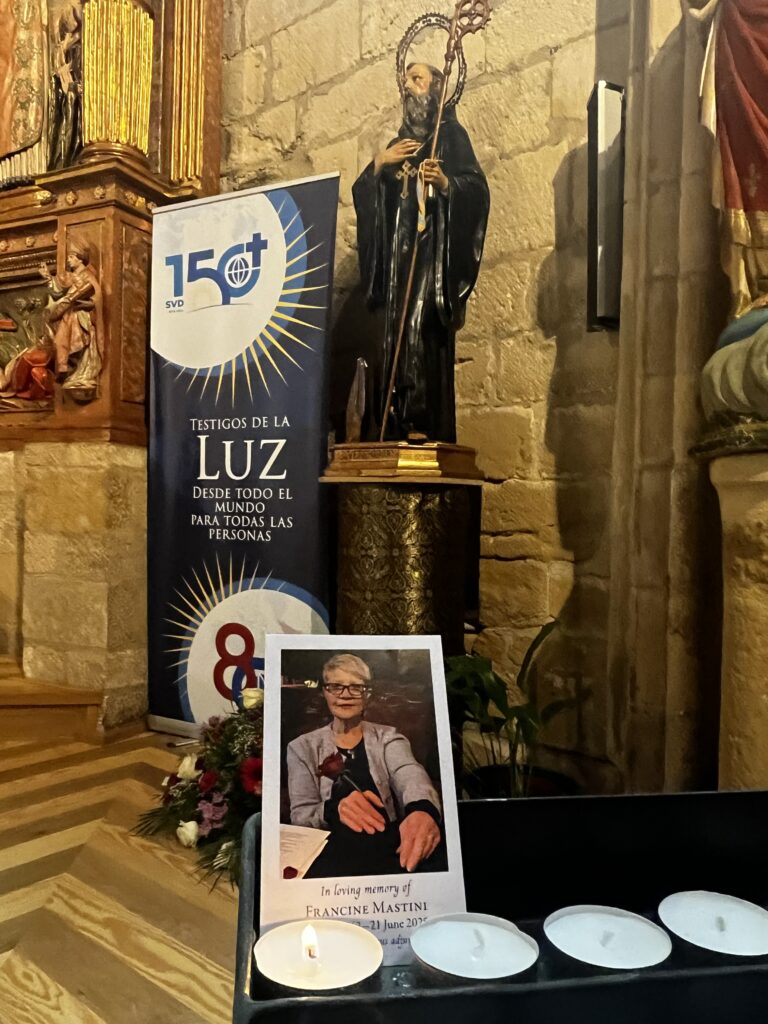
The town just kept going on and on. By the time we arrived at the church of Saint Veramundo it was already noon. This Saint is the patron of pilgrims in Navarra, and despite the large number of pilgrims crowding in there, I prayed for Francine and lit a candle for her here. It just seemed right.
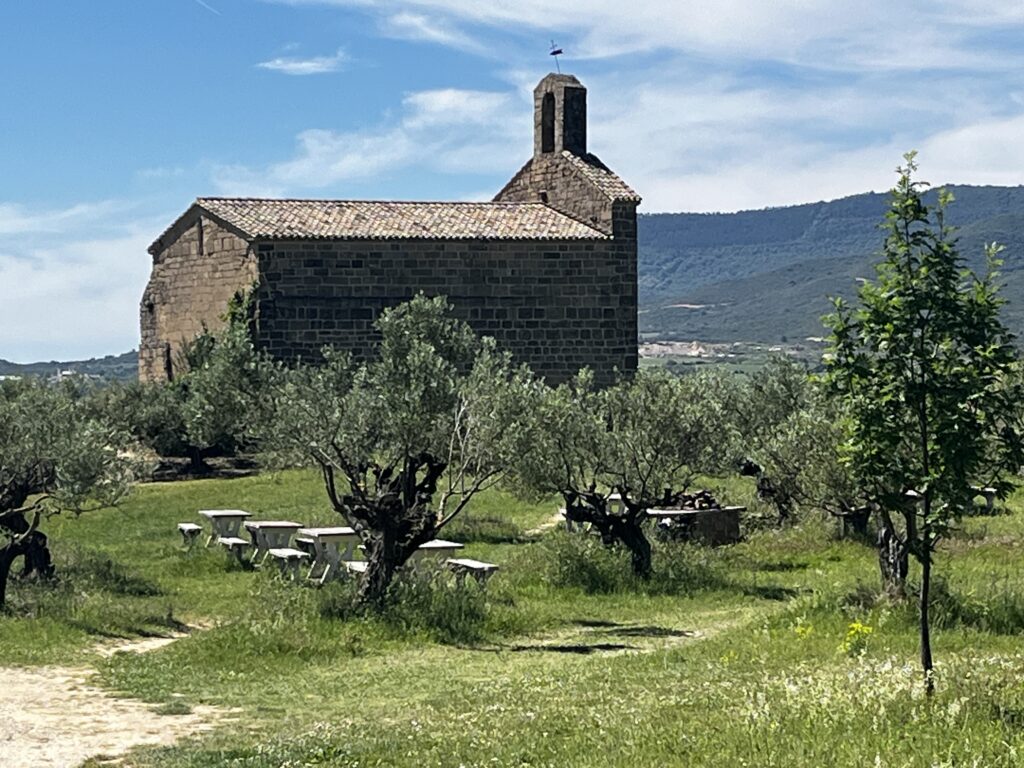
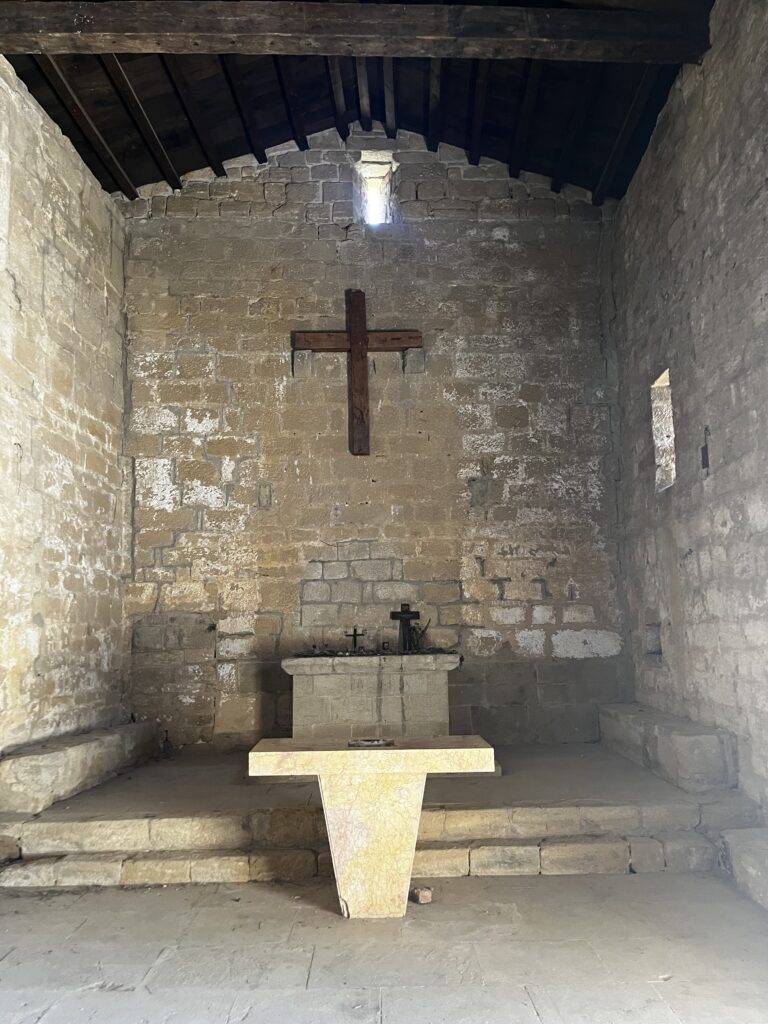
Out into the countryside, we stopped in the 10th century Hermitage of San Miguel. The interior furnishings how long since been stripped out, but I still find a strangely moving place.
We left about 12:40, and the Camino took us down hill had a rough stone and gravel path. Took us to another under the freeway tunnel, and then the Camino resumed as a dirt and stone path, still going downhill.
At about 12:50 we crossed the River Ega on a relatively new bridge. My memory may be paying tricks on me, but I remember a rickety wooden bridge at the spot.
After this the Camino returned to a broad gravel road.
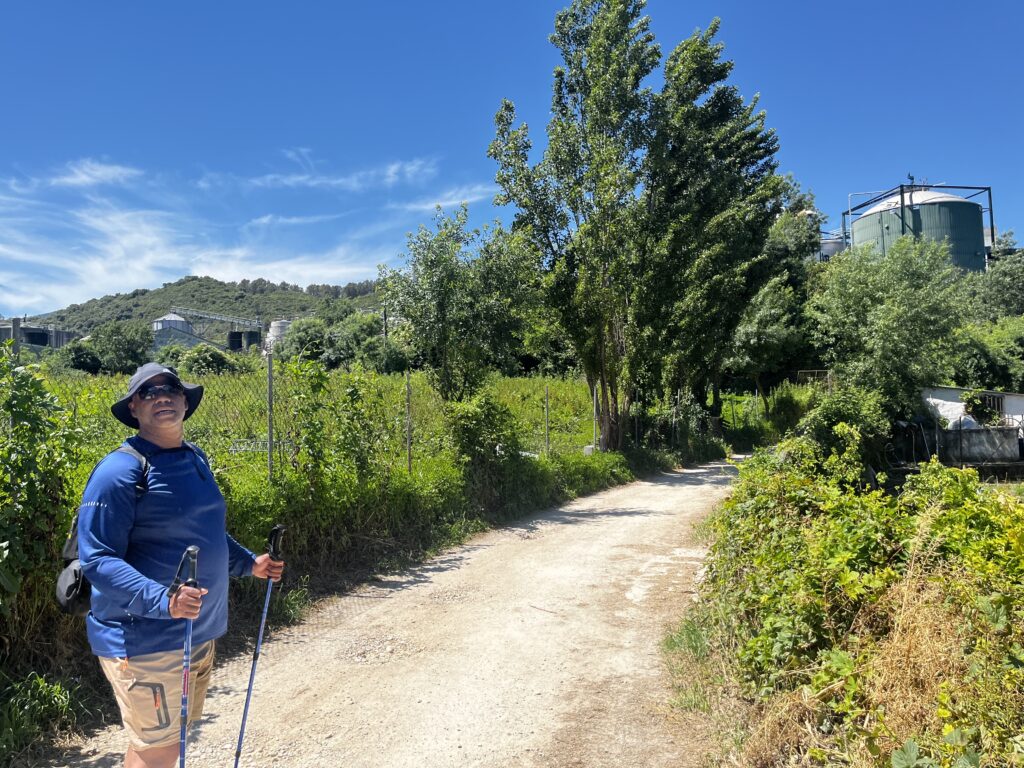
Just a bit past 1 PM we started walking past some industrial buildings that seemed very out of place in the wooded hills. After this, the Camino merged onto an concrete road. Road walking!
Even with the umbrella, the heat seemed unbearable.
We were starting to catch sight of a bunch of larger buildings through intermittent breaks in the trees.
At about 1:15, we arrived at fountain marking the entrance to the town of Estella. The fountain was dry, and we pushed on. We could now see buildings
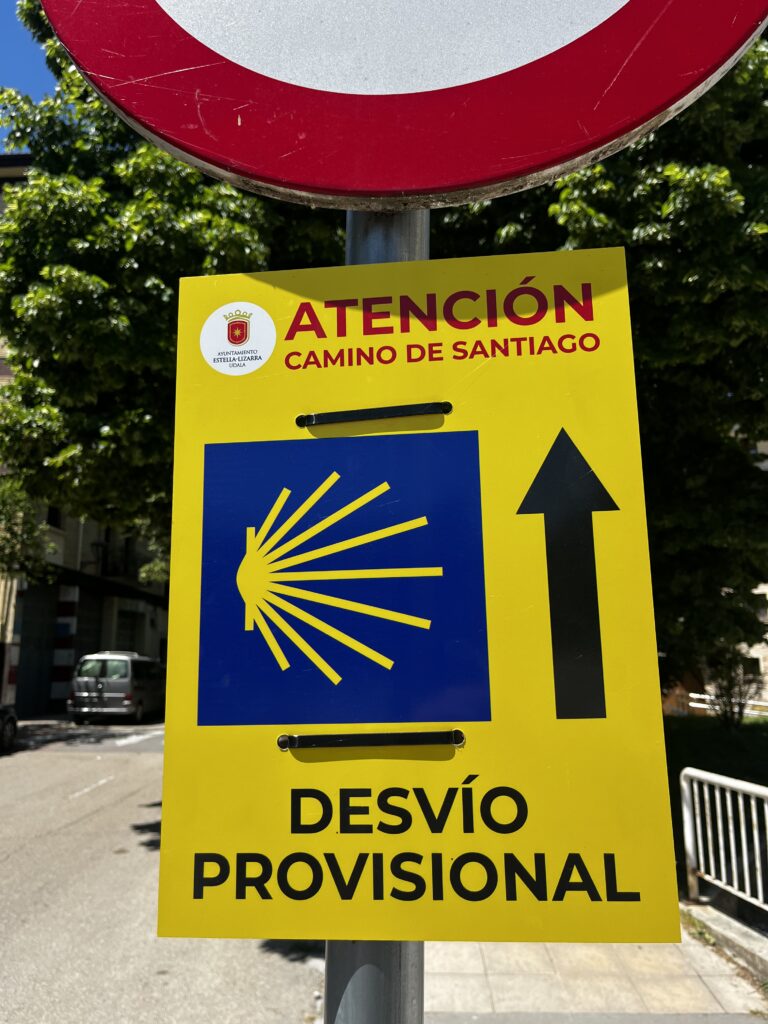
The way into the town of Estella is a temporary reroute – there’s a large amount of construction and restoration work going on right now.
Herve, Patrick, and I repaired so the first likely looking outdoor café for a radler and a think about albergues.
Patrick had his already booked, so we bid him adieu, and Herve and I checked into the municipal. The room we were assigned was refurbished with the aid of a grant from American Pilgrims On The Camino.
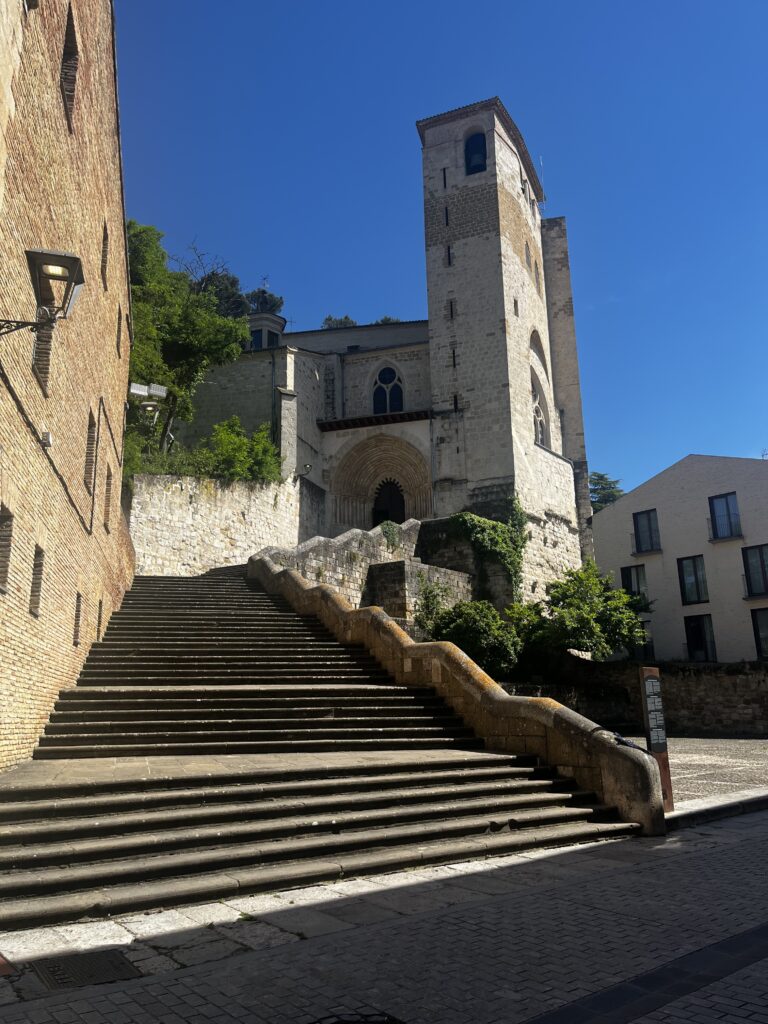
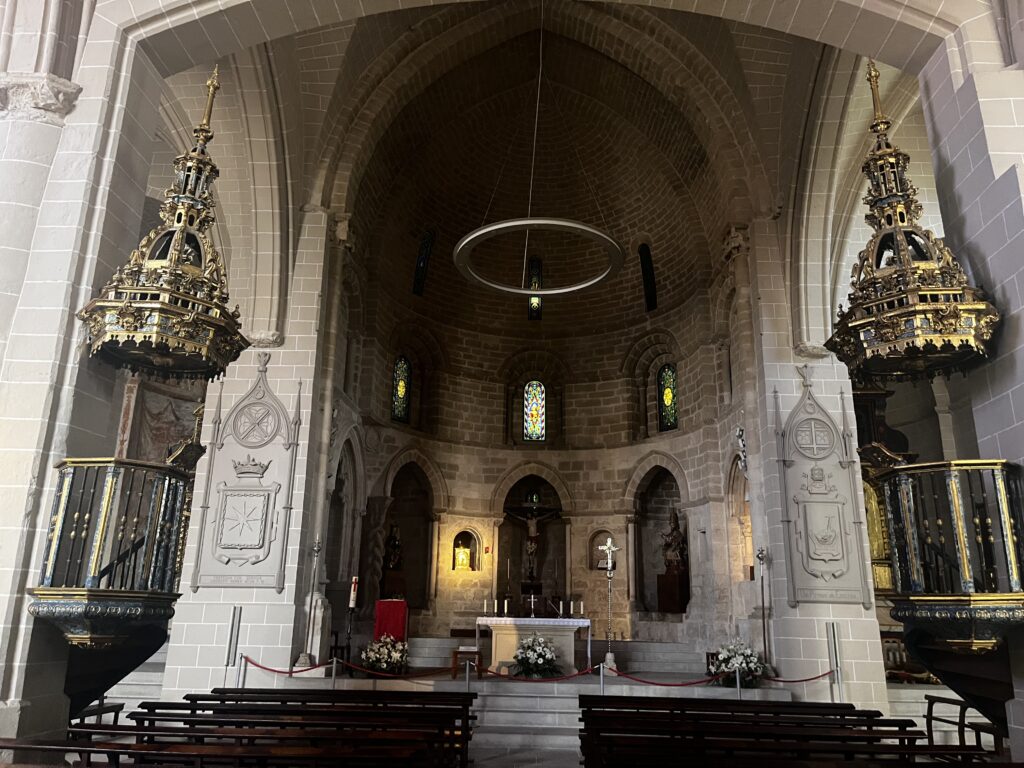
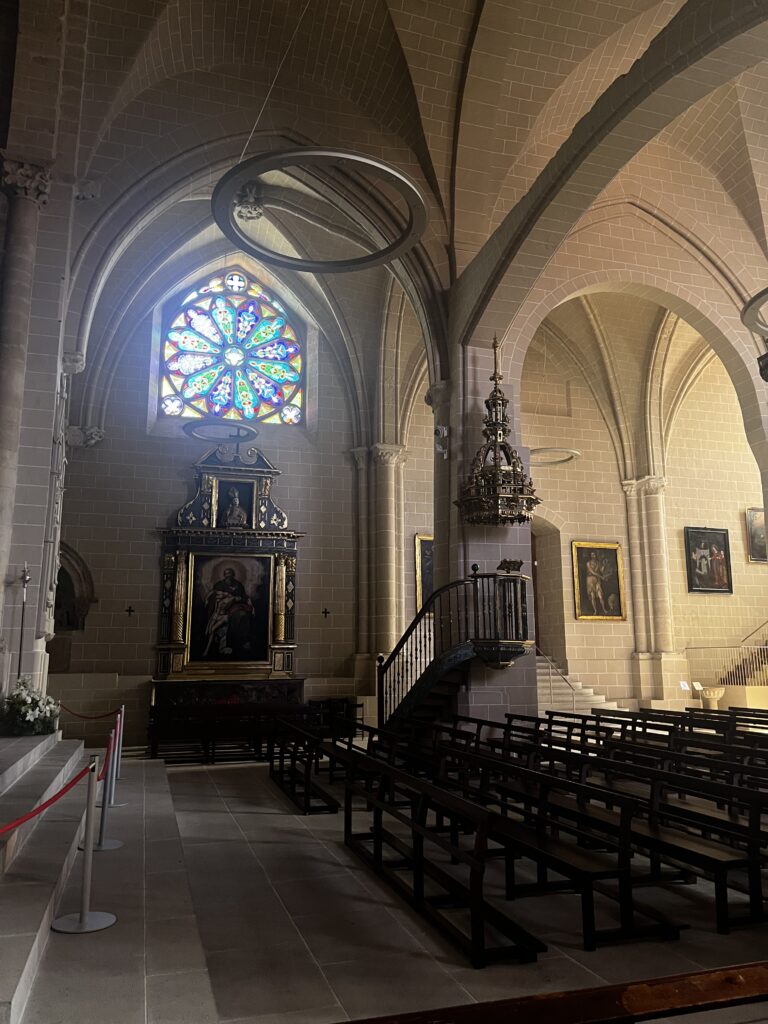
After taking care of the usual building chores – including a nap – we visited the church of San Pedro.
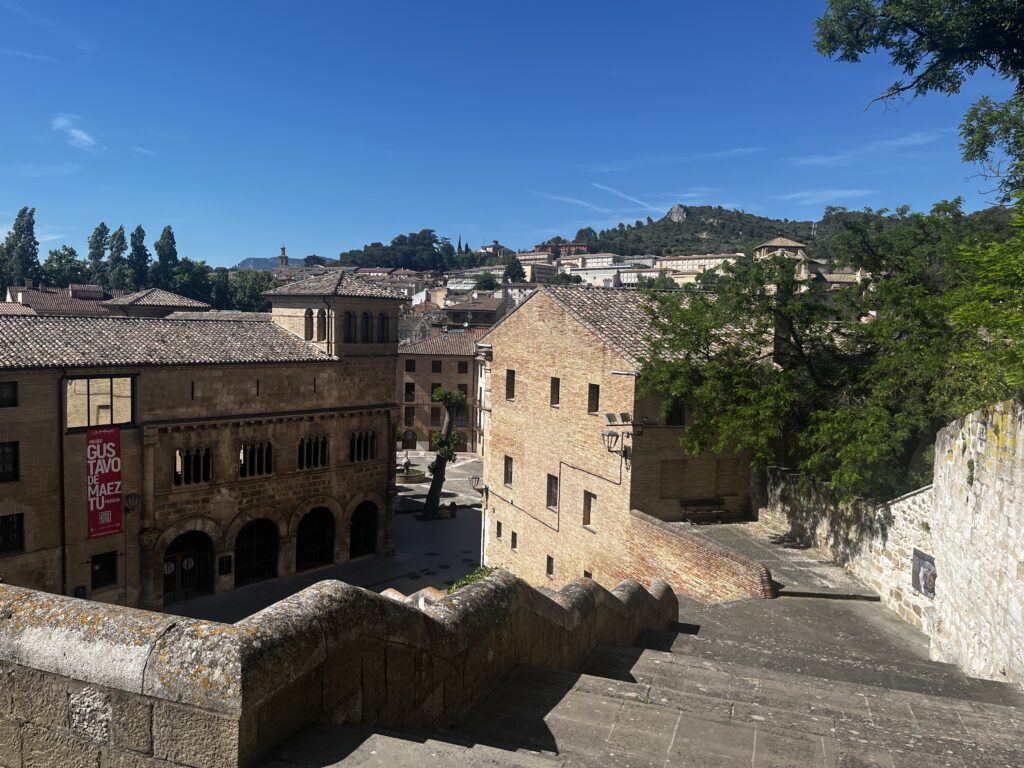
It’s built into the side of the hill, and there are a long set of steps up to the main entrance.
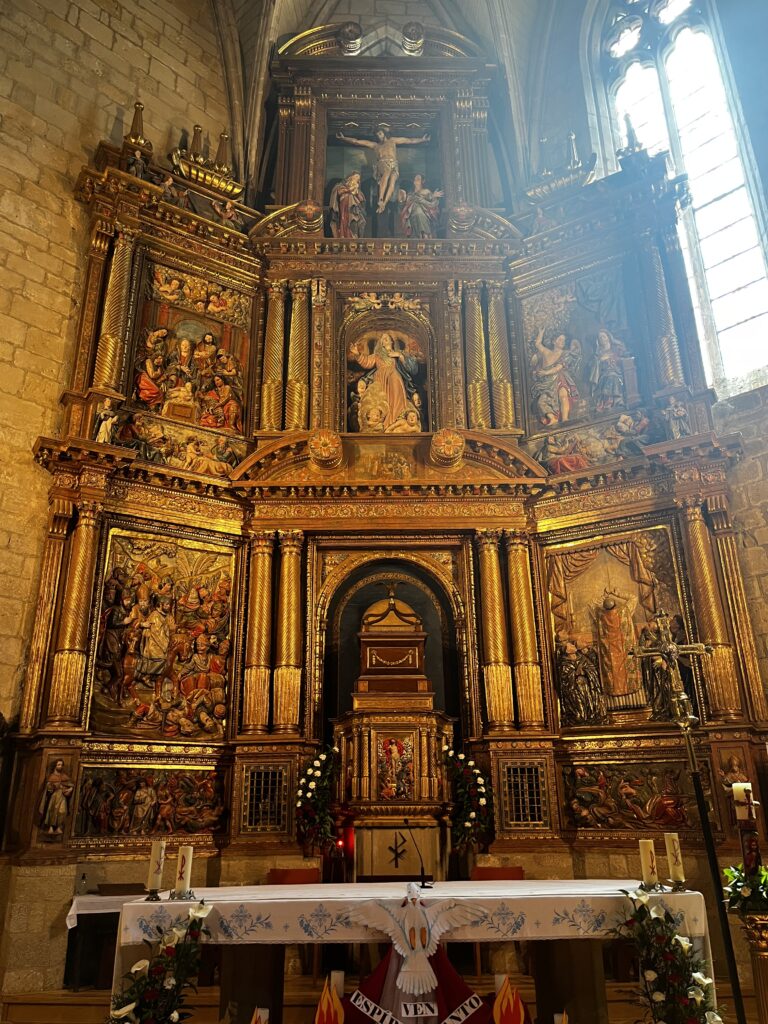
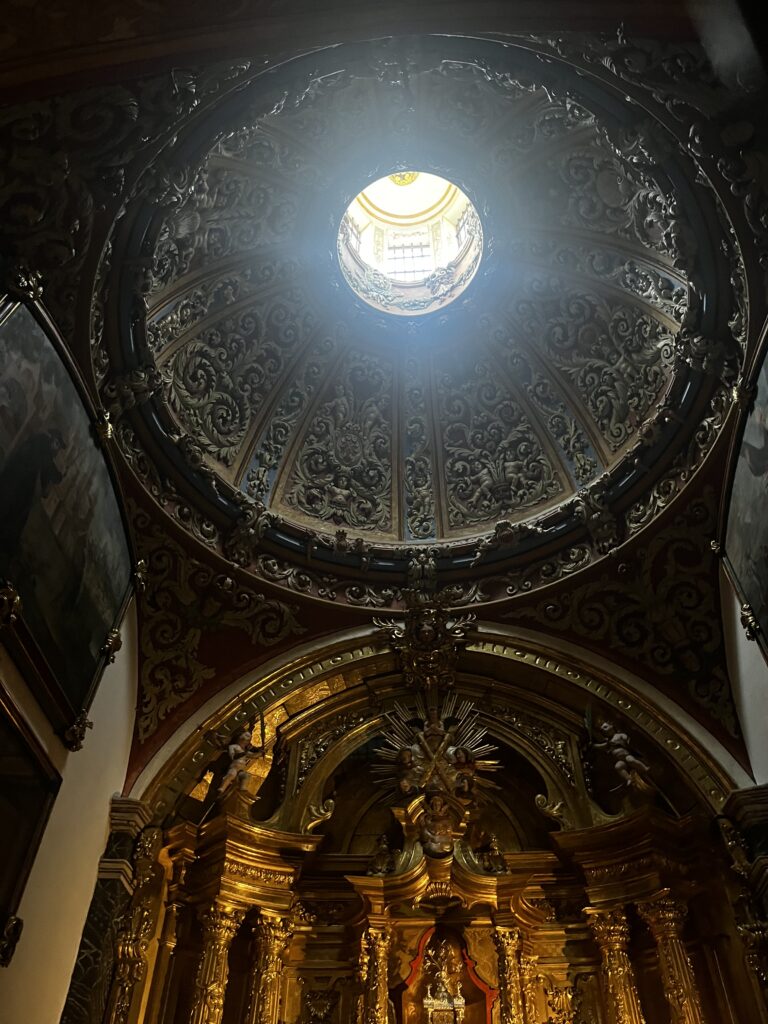
The church is a simmering stew of Romanesque, Gothic, Baroque, and Rococo that somehow manages to form a tasty whole. The building was clearly designed to fit the space for it available on the side of the hill, so various aside chapels are at odd angles in places.
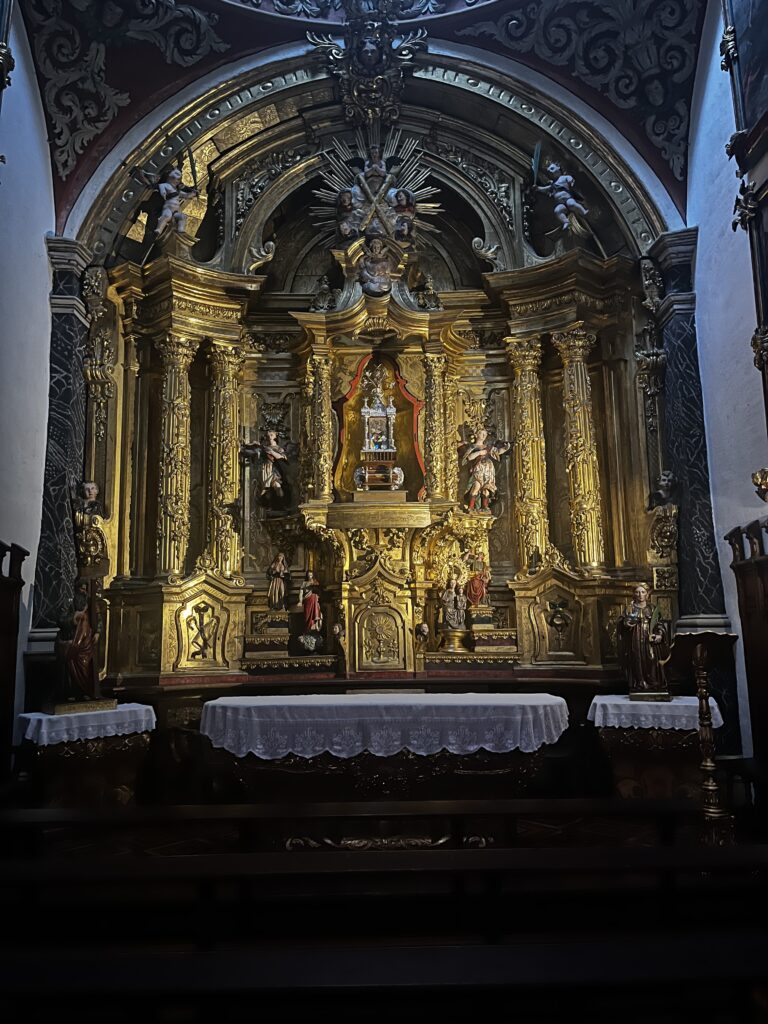
The Baroque right-angle side chapel contains a relic of Saint Andrew, a chip of bone from his shoulder. The story goes that a 13th-century pilgrim died near here, and when his belongings were examined it was discovered that he was an incognito Greek bishop on pilgrimage to Santiago. He was carrying the relic of Saint Andrew.
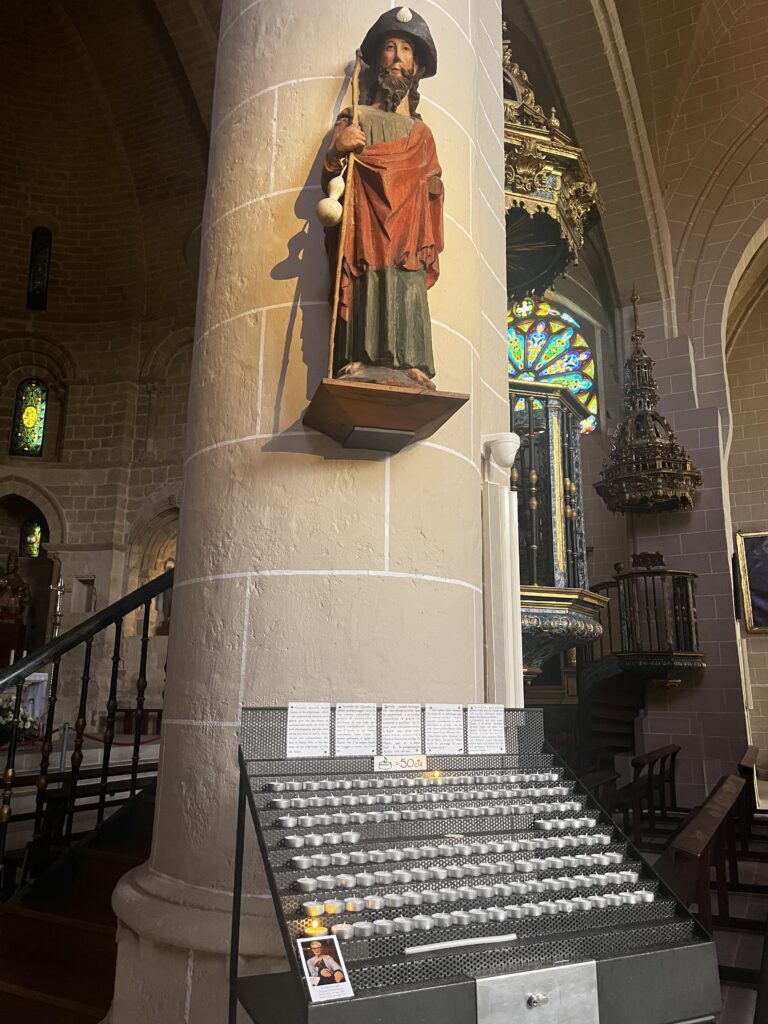
I have always found this place conducive to prayer, and it just happens to contain my favorite statue of Saint James on the whole of the Camino Francés.
Date: 25 May 2026
Place: Estella
Today started: Puente la Reina
Today’s Photos!
Brilliant sunshine for you today, however thanks to your excellent descriptions of events one could almost feel the heat.
Some really striking vistas! Thank you for sharing them.