
Via Lemovicensis: Follow the Children
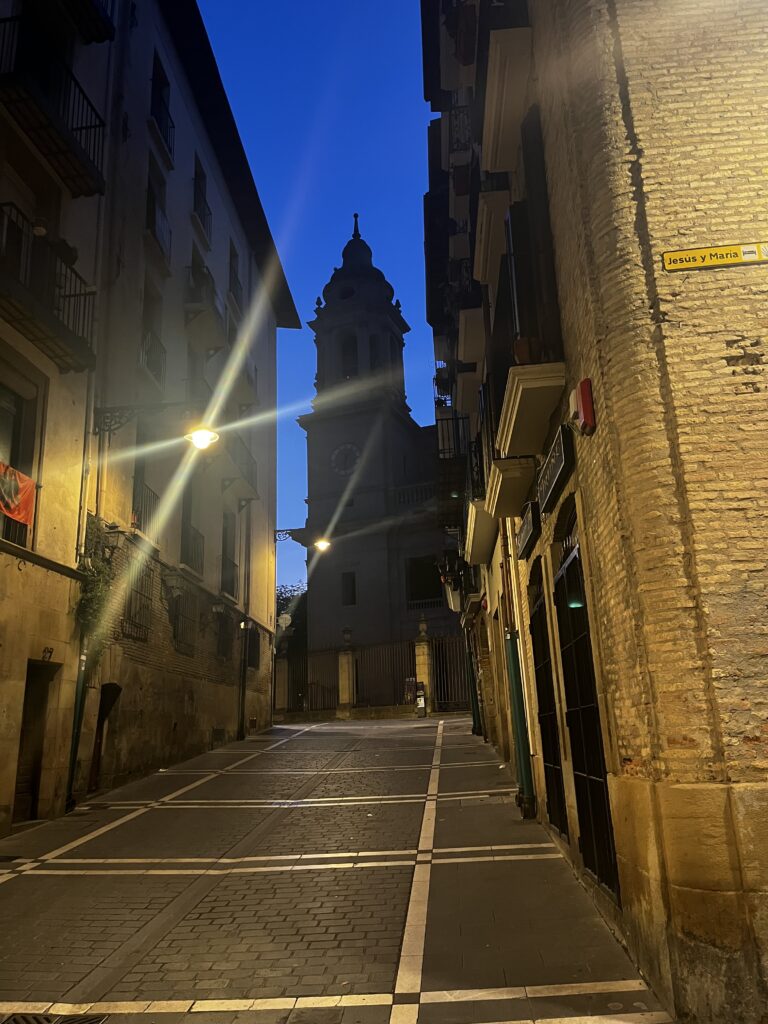
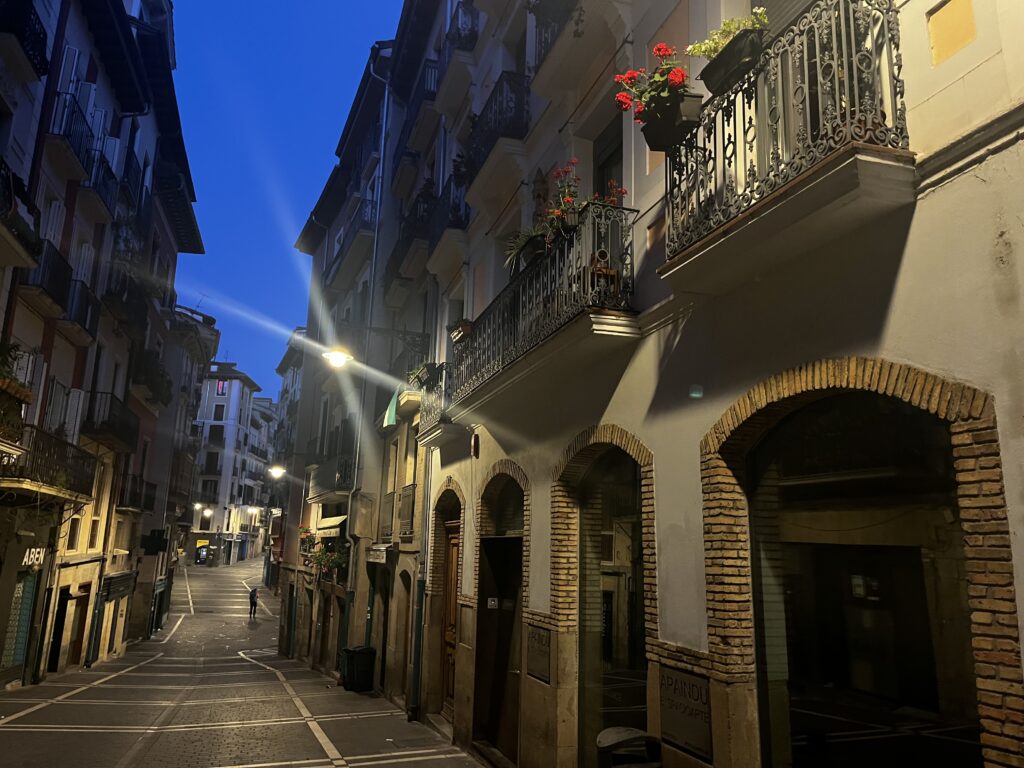
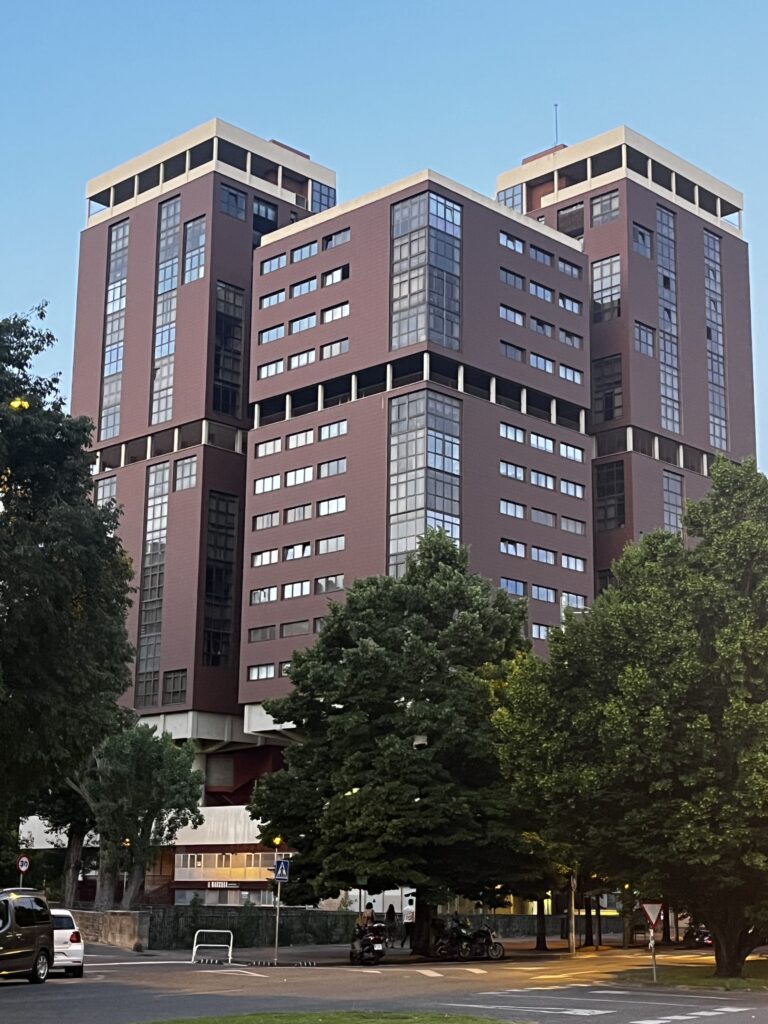
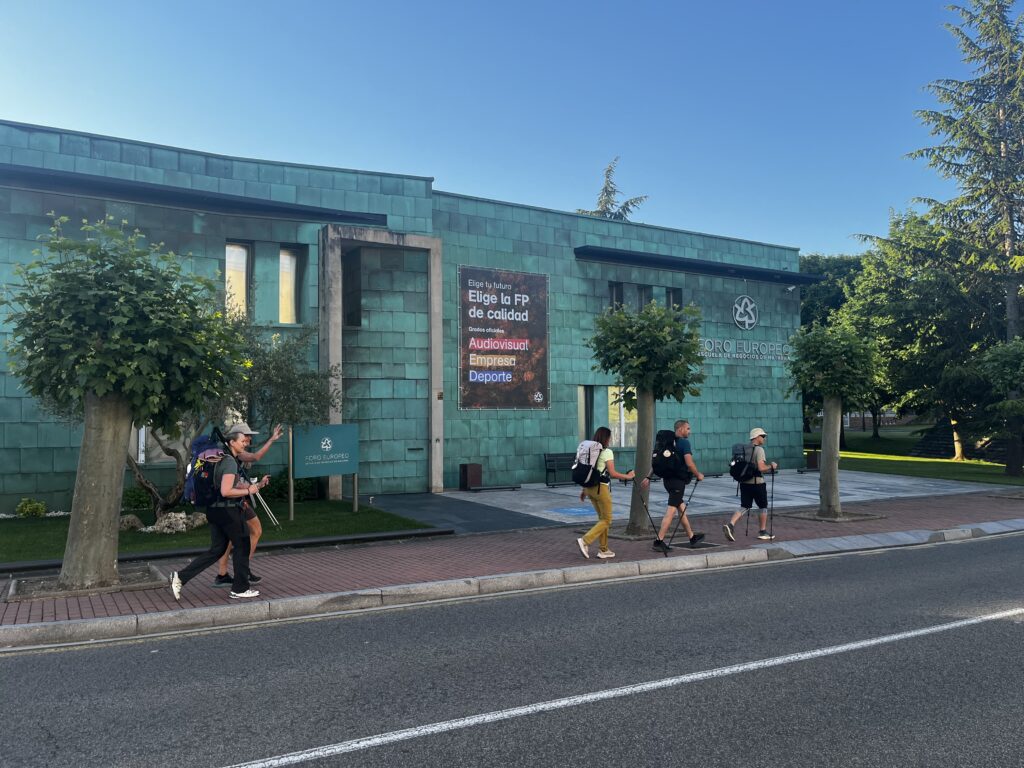
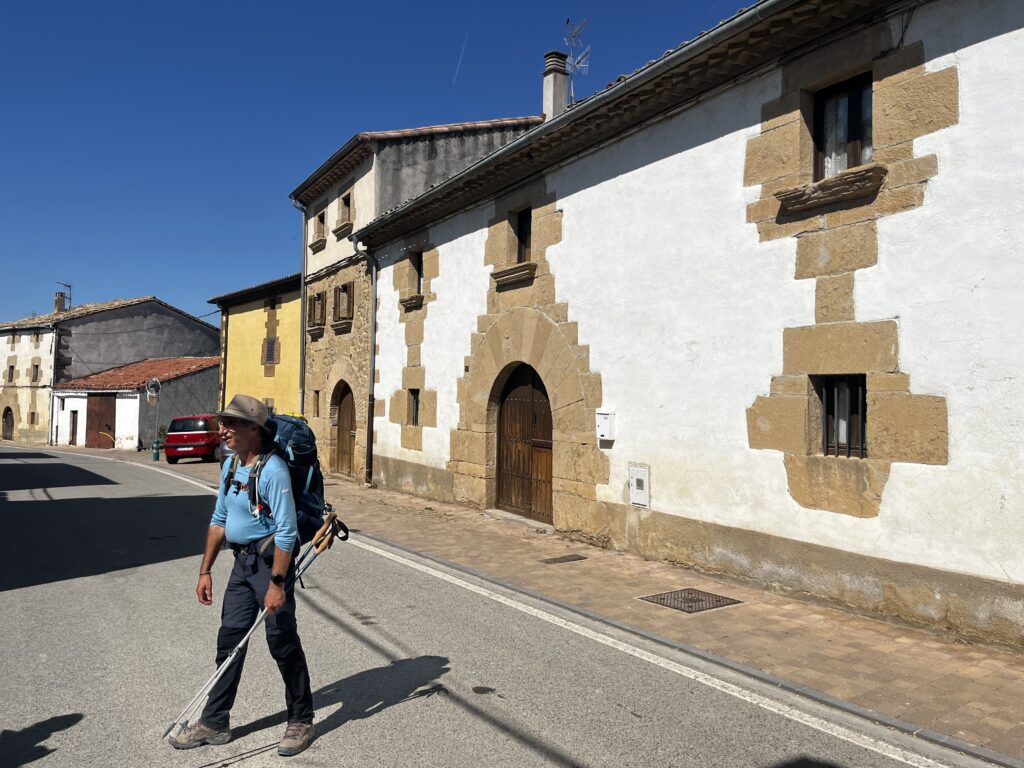
Somehow Herve and I were actually up and out 6:05. We walked out of the old town and into the more modern sections of Pamplona. Even where there were towering modern apartment blocks, in the distance I could hear a rooster crow.
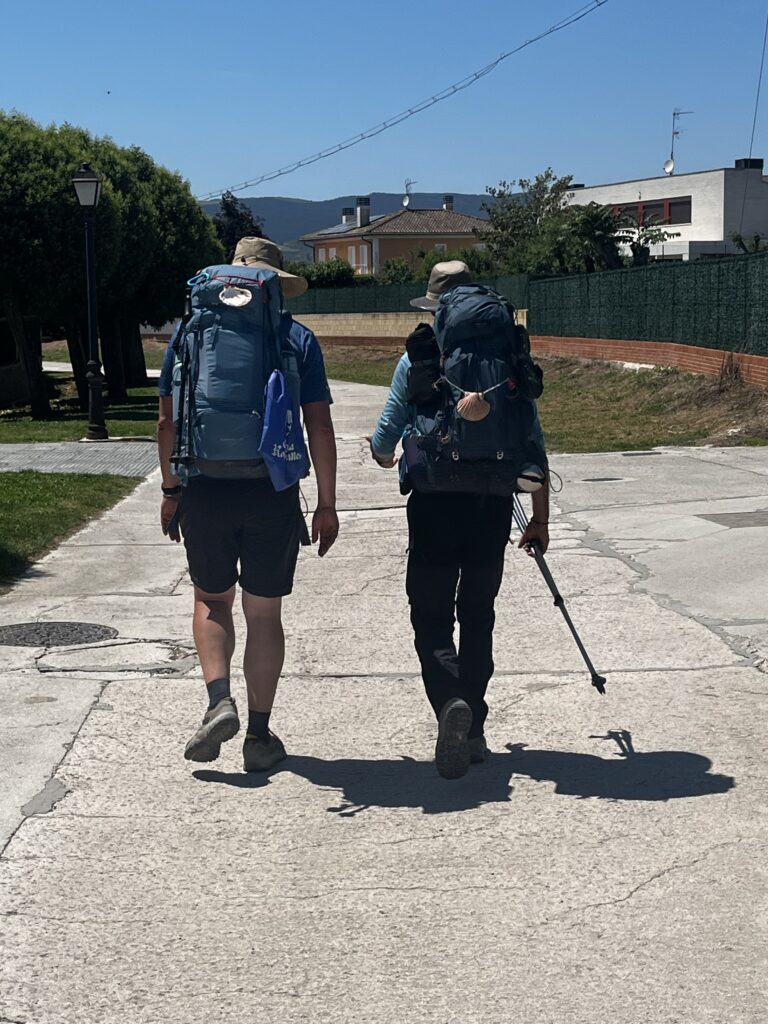
Four times I’ve walked out of Pamplona. I have never failed to get lost at least briefly. At one point a helpful local shouted at us, “follow the children!” as he pointed to two young pilgrims down the street.
It was already warm and humid.
We were hoping to find an open café somewhere, but no luck this early.
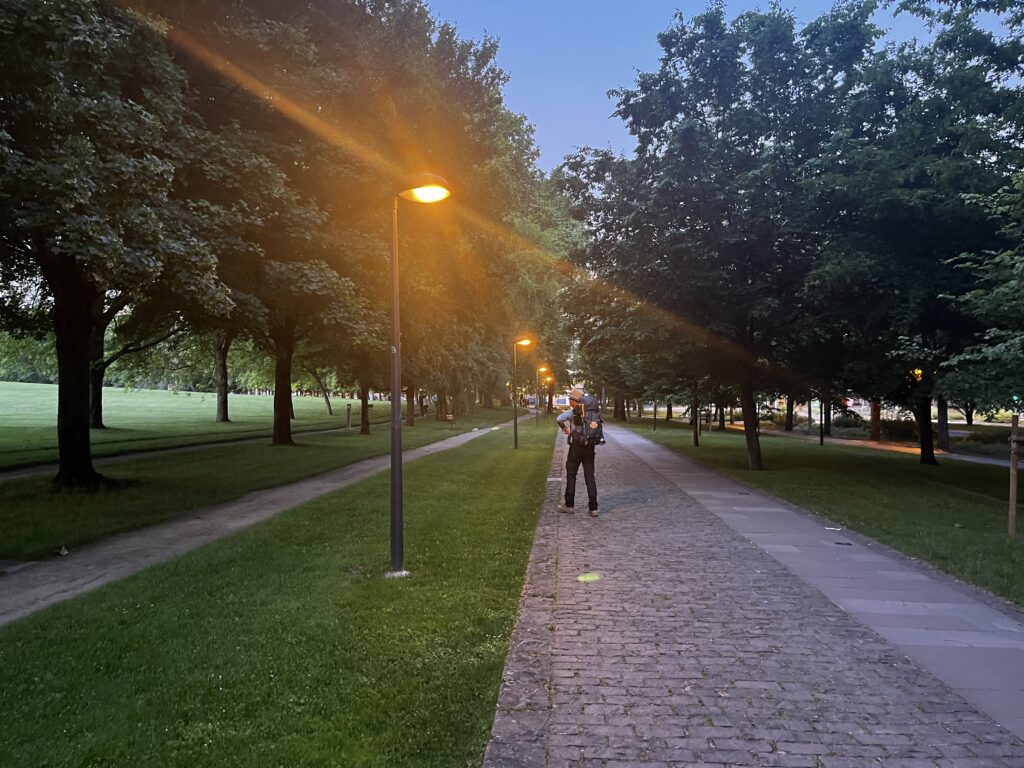
We walked down a long, beautiful urban park that was created when part of the old walls were torn down.
There were a surprising number of people in the streets, and not just pilgrims. We passed joggers, people taking early morning walks, and partiers who still hadn’t gone home from last night, some in formal wear with their ties still neatly knotted.
At 6:35, Herve spotted an open café across the street, and in we went. Powered by coffee and pastries, we resumed at just about 7:00.
We passed through some of the higher density parts of the city before walking through the lush and green campus of the University of Navarra.
At 7:20, we passed the sign telling us we had left the city, walking on an asphalt bike path.
Within ten minutes, the bike path, still paralleling a main road, was now going through farm country. I am astonished at how much this part of the Camino has changed in just ten years. It’s basically unrecognizable.
At about 7:40, we entered the town of Cizur Menor, with our feet having never touched grass or dirt.
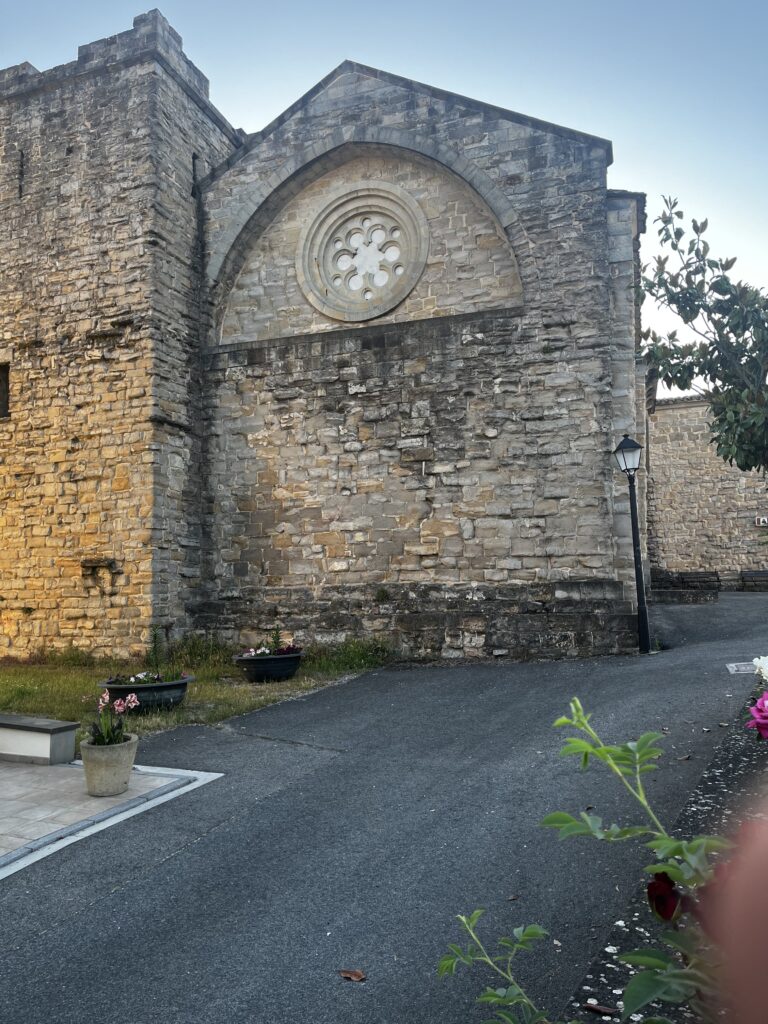
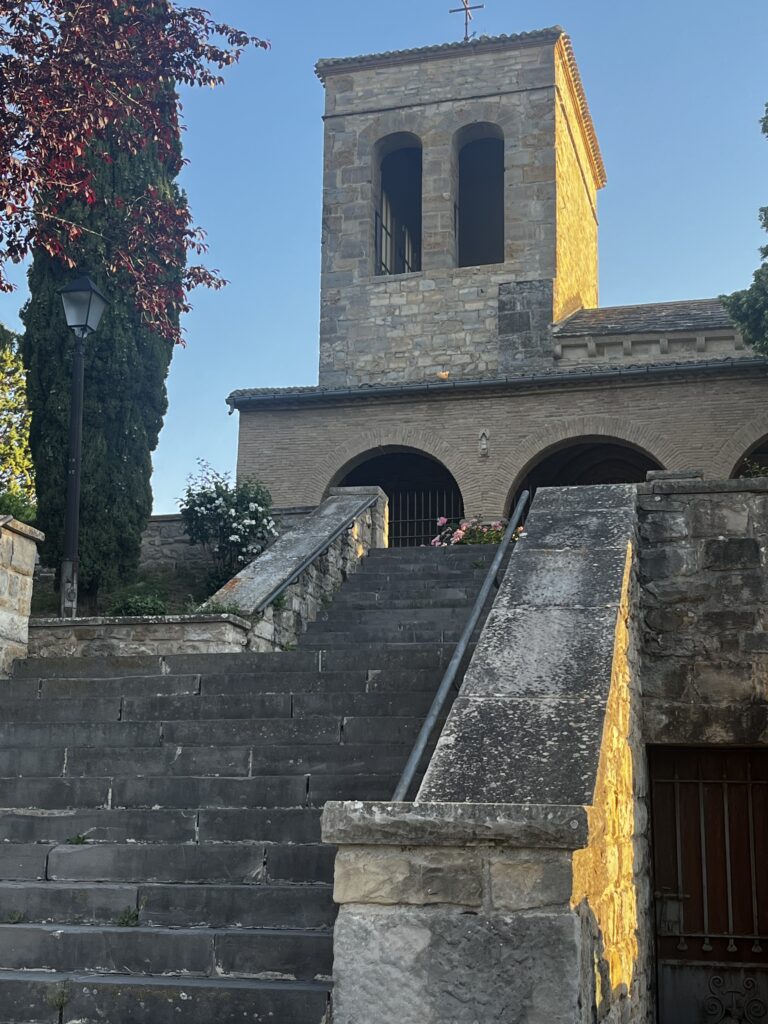
The old Hospitalar church of Sanjuanista was of course locked up. After all, why should a church be open on Pentecost? I tried the second church in town, at the top of a hill and stairs, but again no luck.
I was already sweating.
After the town, the Camino followed abroad path of fine gravel. By the time we reached the neighboring town of Zizur Mayor just a few moments later, it was back to the sidewalk.
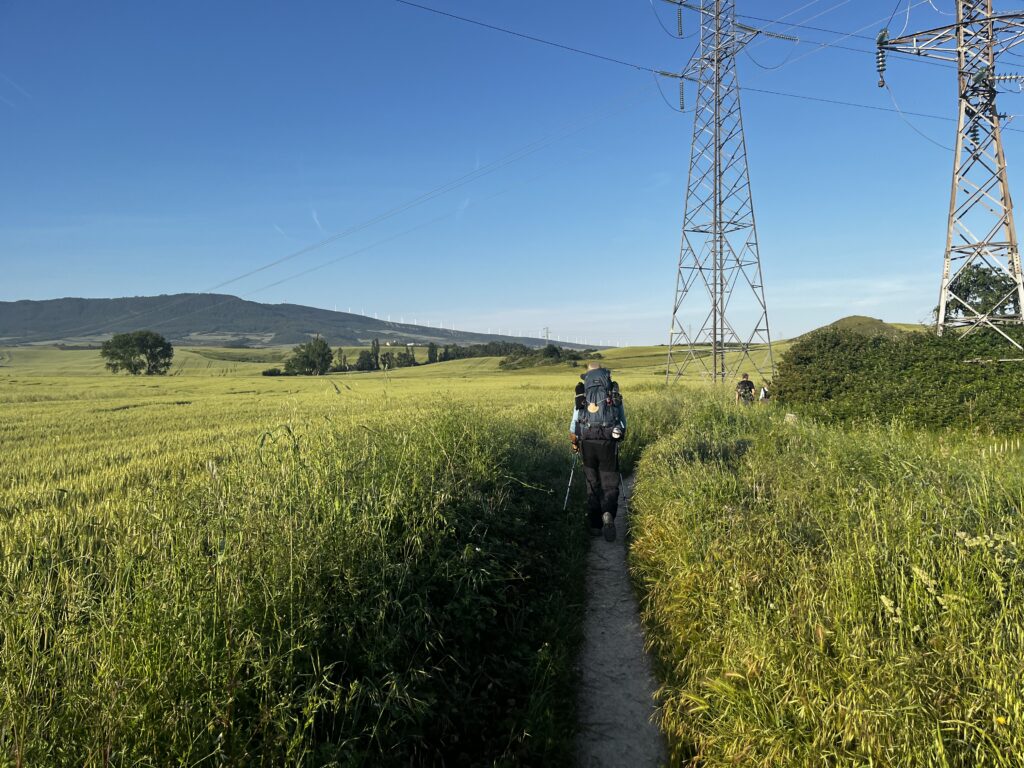
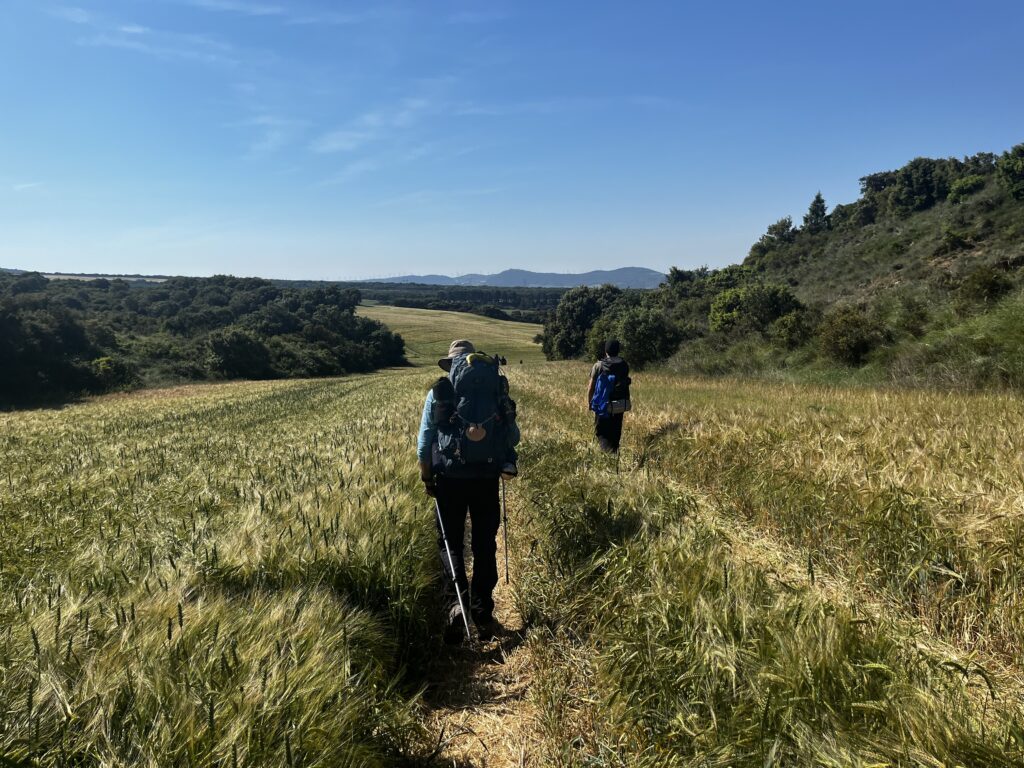
Sometime after 8 AM, we finally hit a trail of stone and gravel, even if there were still apartment blocks in view. The trail broke away from the town and the road and headed through rolling hills planted thick with grain.
About 8:15, we started getting more scrubby bushes, even trees. There was a short section of very narrow path through two hedges of thorn bushes. The path soon joined a road of dirt and stone, rolling over the hills but trending ever upward.
And still, we were surrounded by the endless fields of grain rolling up into the forest hills.
At 8:30, the path definitively turned towards the trees, and we were in the blessed shade. Herve was pretty far ahead of me by now. I was not nearly as energetic this morning as I have been for the past few days.
Part of it was that my pack wasn’t sitting quite right. No matter how I adjusted it, it wasn’t comfortable. I suspect I’ve crossed some sort of threshold with my weight loss again, and I will have to make some other adjustments.
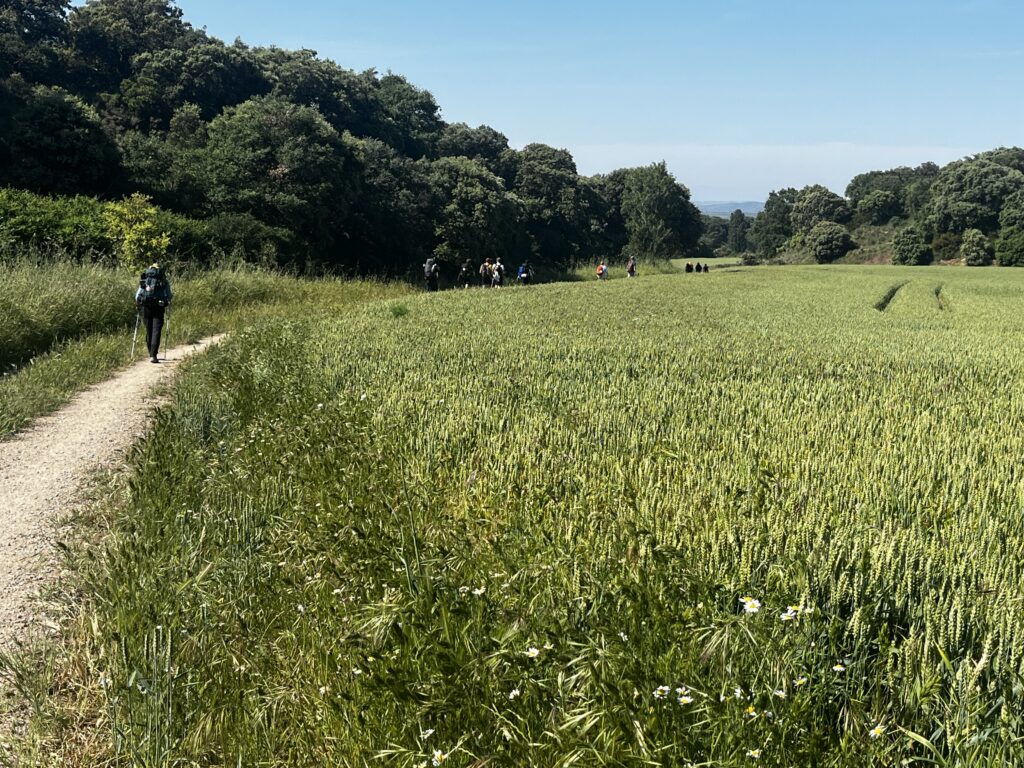
The shade didn’t last, and by 8:35 I was once again out in the open fields. I could see a seemingly endless string of pilgrims ahead of me stretching off toward the ridge.
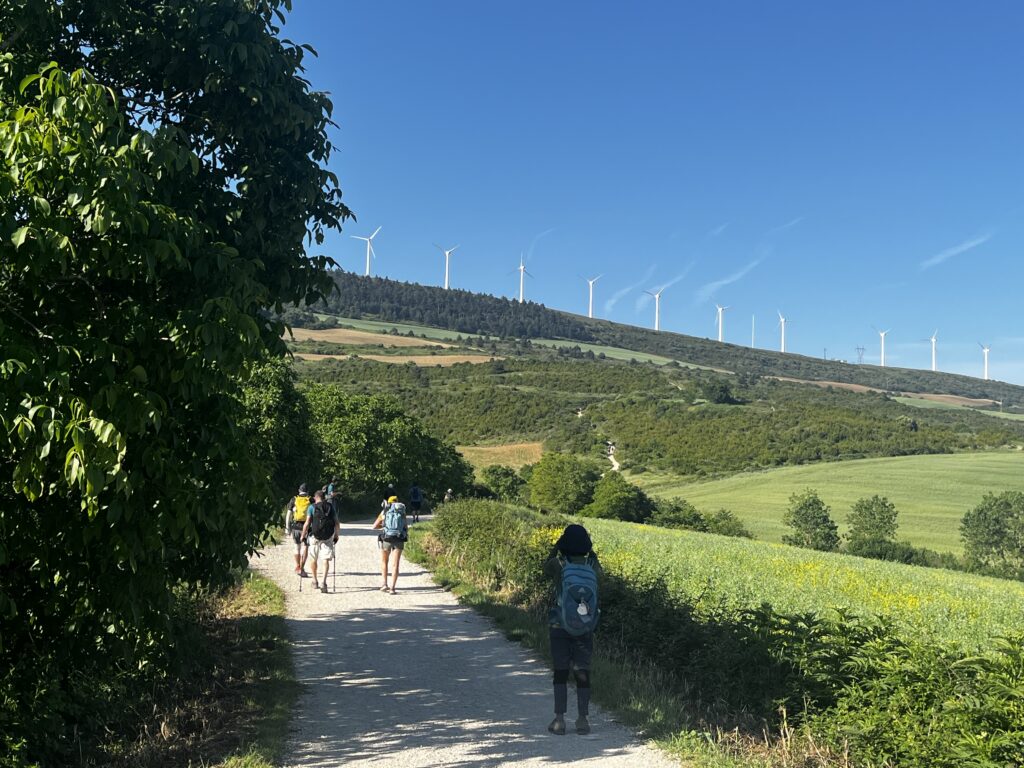
The major physical challenge today is cresting a ridge called Alto del Perdón. The ridge is lined with windmills, making comparisons with Don Quixote almost inevitable. By 8:45, the uphill began in earnest. I put up my umbrella shortly thereafter.
I arrived in the village of Zariquiegui at just about 9 AM. There have definitely been improvements here – for one thing they are now public restrooms and a rejuvenated public fountain at the entrance to the village.
I met up with Herve again here, and refreshed myself with Kas Limón. The village church of San Andrés was open and full of pilgrims. It was not terribly conducive to prayer, but I managed.
The path out of town was a smooth gravel road. as the slope increased, the trail narrowed and grew rougher, with large gravel and small stones.
About halfway up, I had to take down my umbrella because of the encroaching bushes. The path now was dirt with embedded stones narrow, twisting, up and up.
I can’t remember if the switchbacks were here in 2016, but they definitely weren’t in 2013.
When we passed the last of the bushes, I put the umbrella right back up. The closer we got to the top, the looser the stones in the path were.
We arrived at the top right at 10 AM.
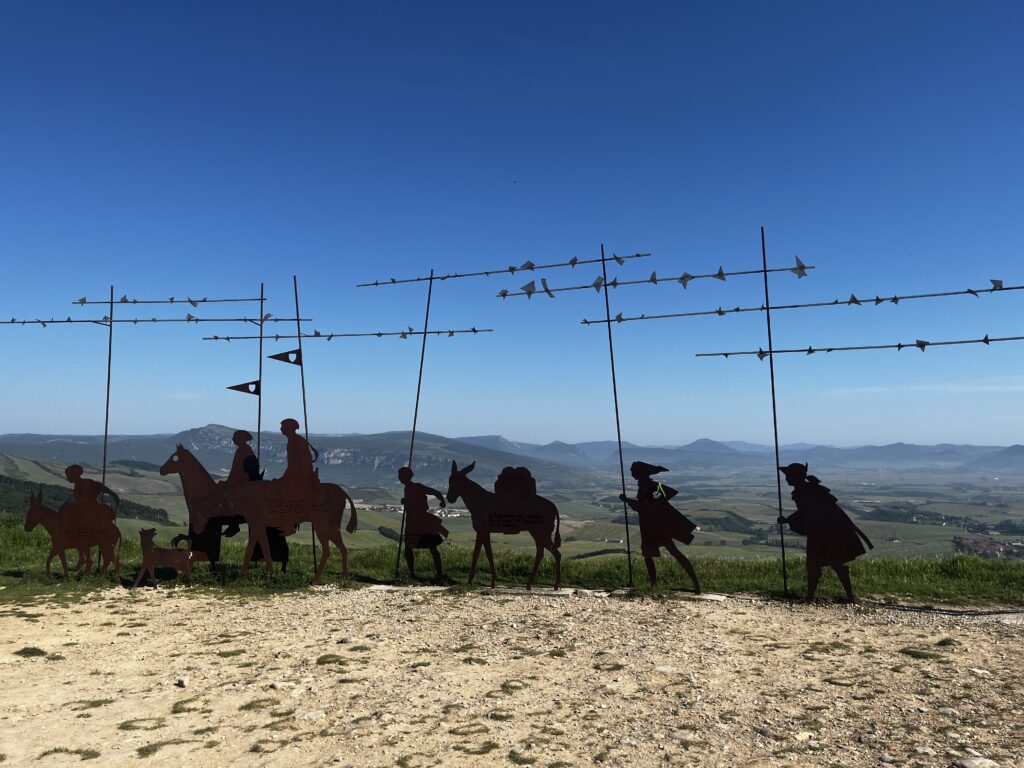
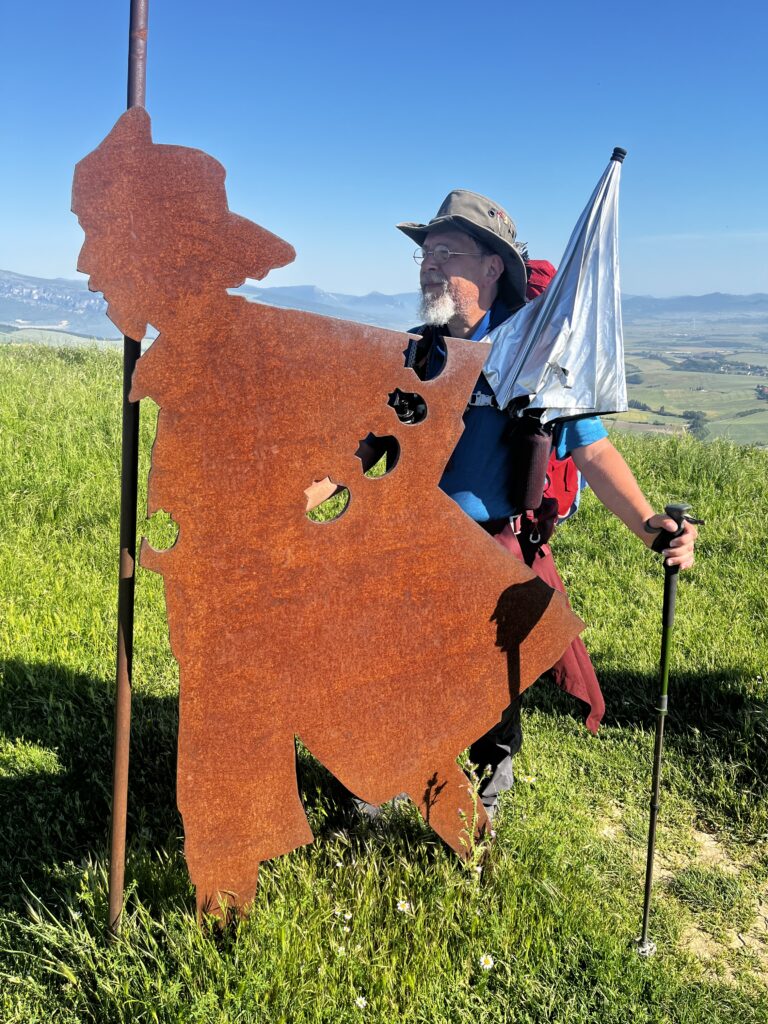
The top of the ridge was crowded with pilgrims resting in the shade and taking photos of the metal statues here. The art represents pilgrims from different periods of history, from the most ancient to the most recent. It’s absolutely iconic, and you can see Pamplona in the valley below if you look.
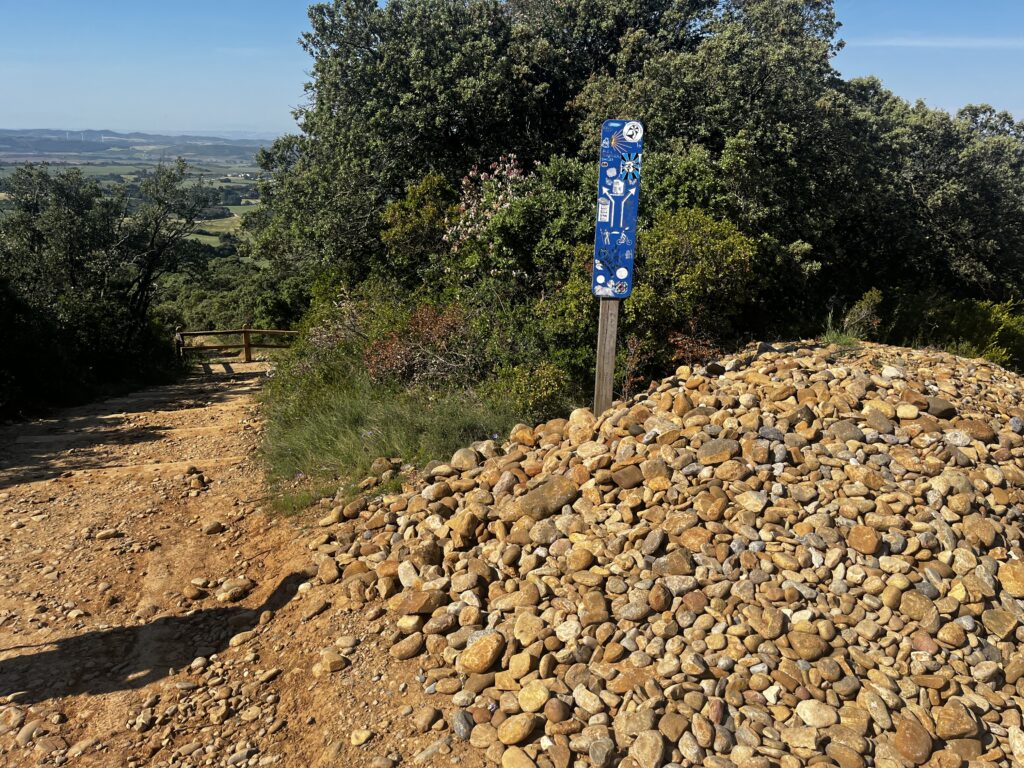
On the other side of the ridge, there’s a quieter monument. This is to the victims of fascism in this region of Spain.
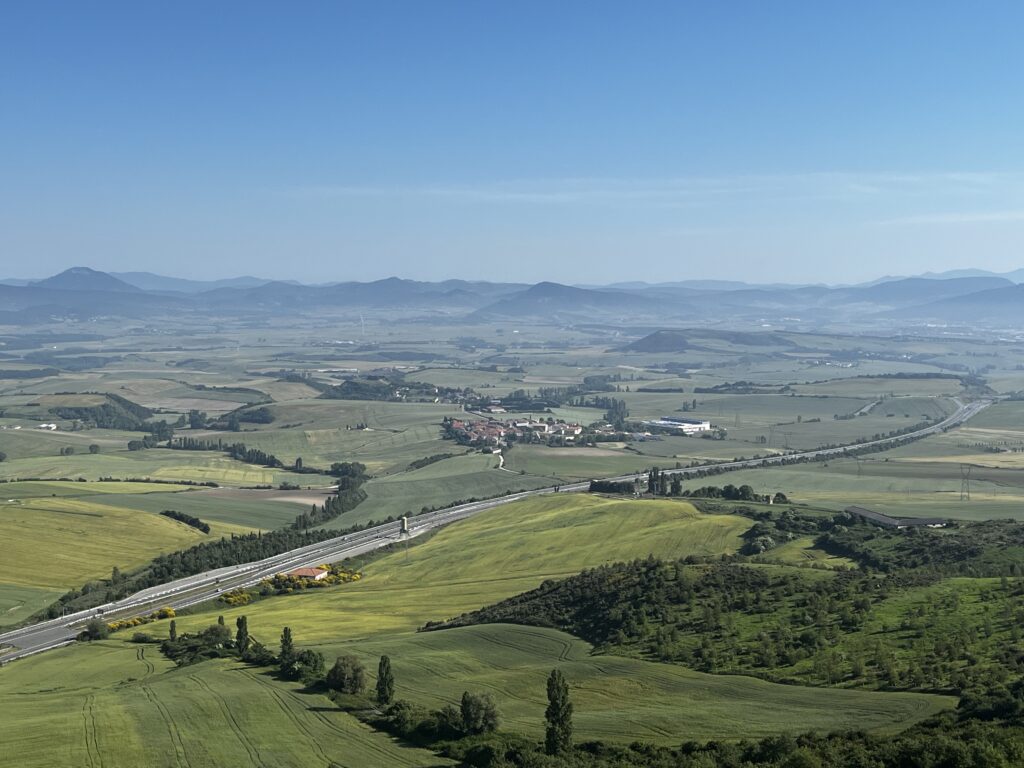
Beyond it, we enter a new valley, with villages laid out like game pieces on a quilted board of farmland and forest. Heading down here is an adventure, with some of the slope being as steep as 34°.
As tricky as this is, there have definitely been trail improvements here. There’s far fewer loose stones than there used to be. In fact, if you look carefully off the side of the road, you can see where they’ve bulldozed them away and just piled them up.
At about 10:35, we were diverted off the old route entirely as they are making some additional “improvements” which appears to be paving the Camino.
Instead, we walked down a trail through a farmer’s field. Just about ten minutes later, we were on a gravel road lined with thistle and poppies and daisies.
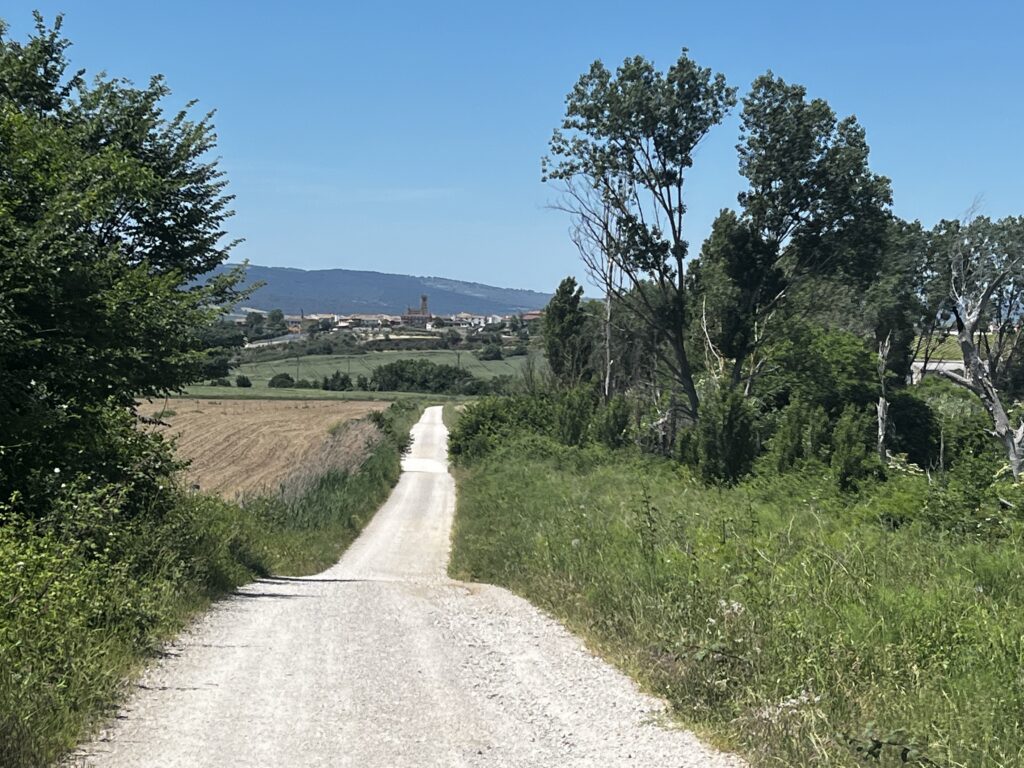
This eventually joined a much larger road of dirt and white gravel. I suspect that before long this section will be completely paved.
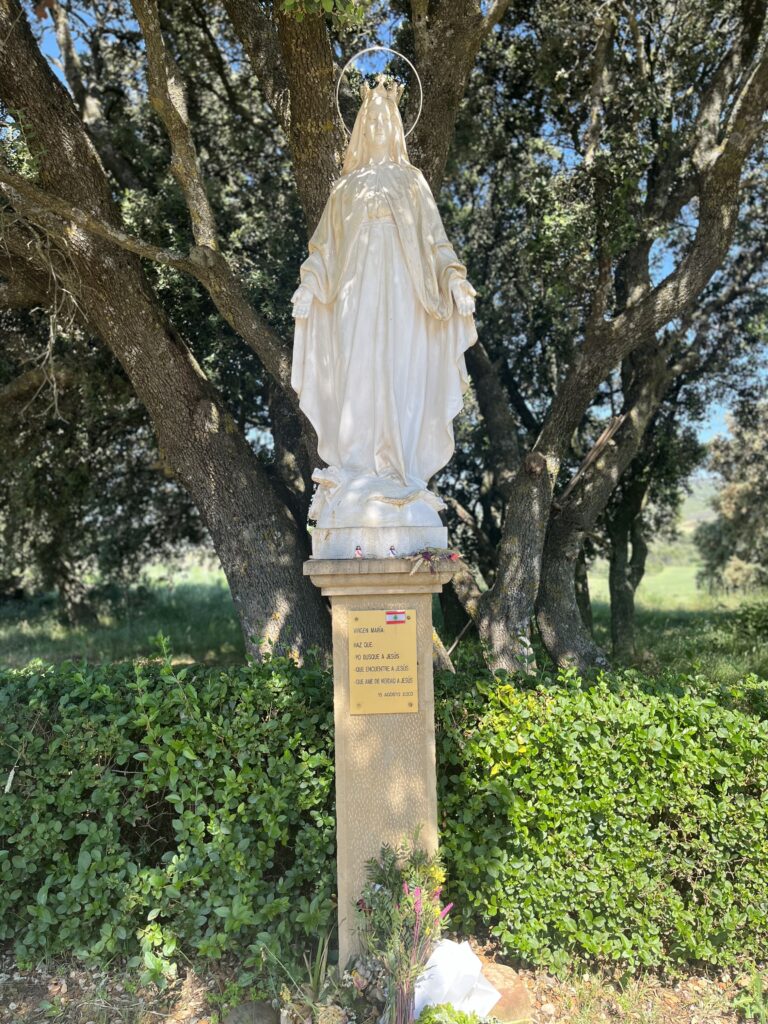
As we approached the village of Uterga, we came to the statue of the Virgin of Irunbidea erected here by a grateful pilgrim around the turn of the century. As I stood there lost and thought, I heard the church bells toll eleven.
Herve was already fifty meters closer to the village, in search of some refreshment. I hastened to follow.
The church was locked, of course.
We ended up stopping at the same Gastropub I’ve stopped at three times previously. They’ve gotten a lot of business out of me over the years, and from the number of people stopping here I imagine business is good all around.
We met up with Tom from Germany (one of the Toms from Germany, at any rate) and he left with Herve and I at about 12:10. We were hoping to go to Eunate, but we wouldn’t know if it was open until we get to the next village.
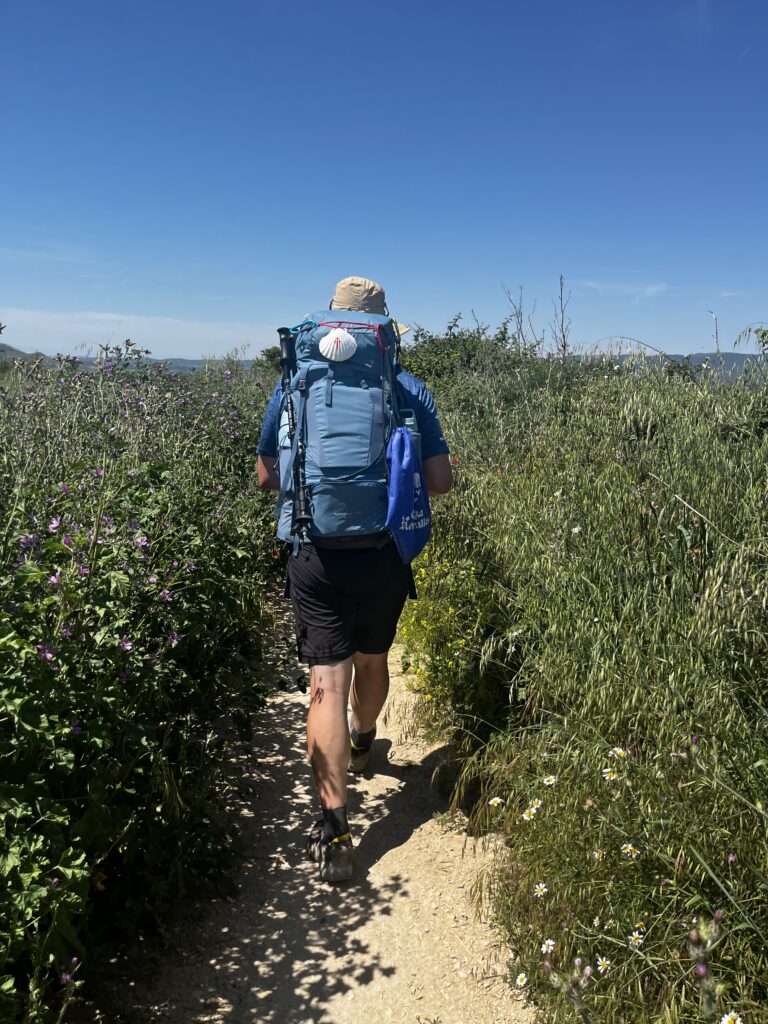
It was a new road out of the village, and then a dirt path through the fields, with bushes and flowers to either side.
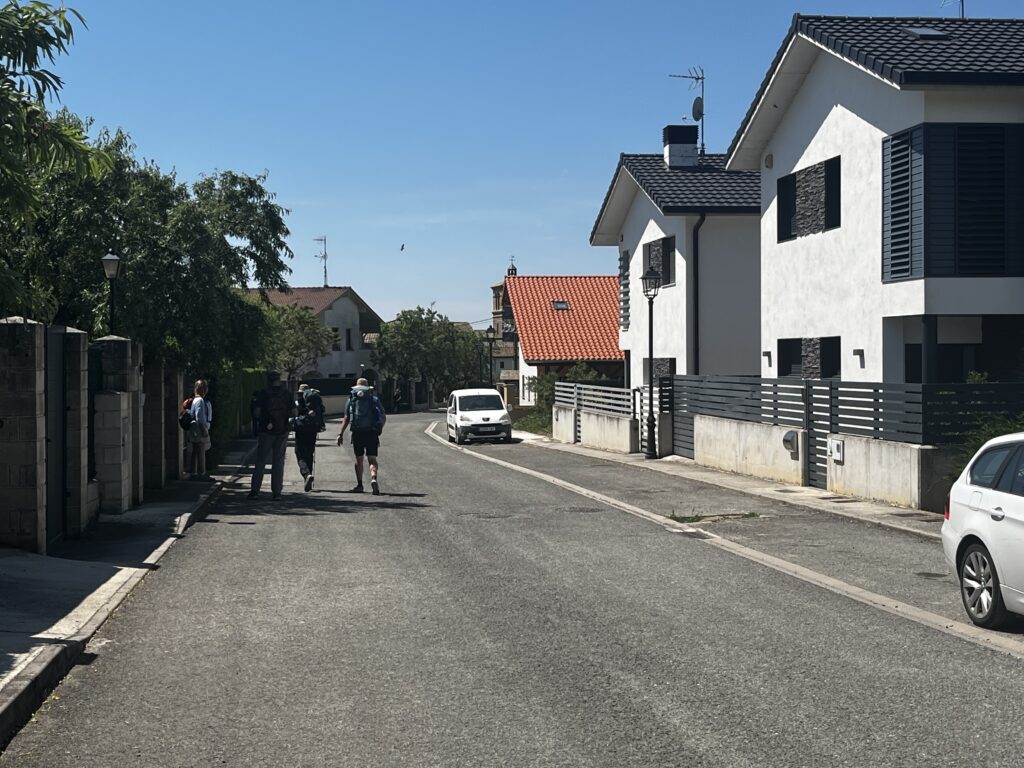
We entered the thoroughly modern village of Muruzábal right at 12:35. The path ends abruptly and a sidewalk and wide asphalt street begin just as abruptly.
We passed through the village quickly, after ascertaining Eunate’s opening hours. Hervey, Tom, and I set off down an asphalt road that within just a few hundred meters became gravel. And for 2 km on the gravel we hoofed it to get there before it closed.
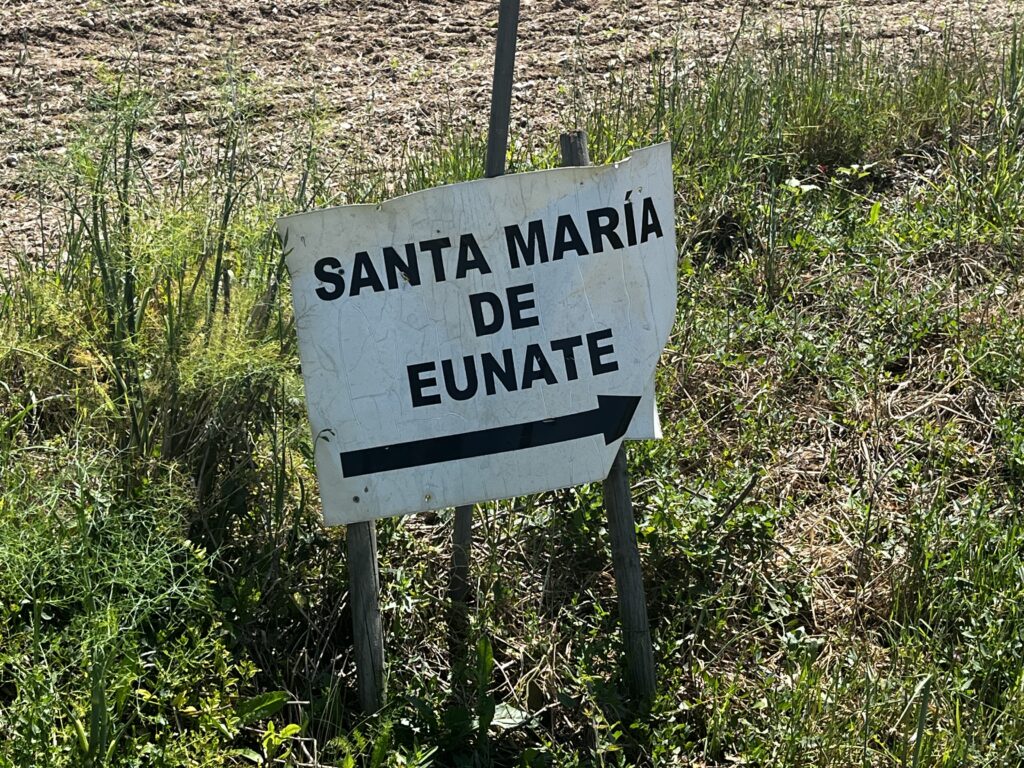
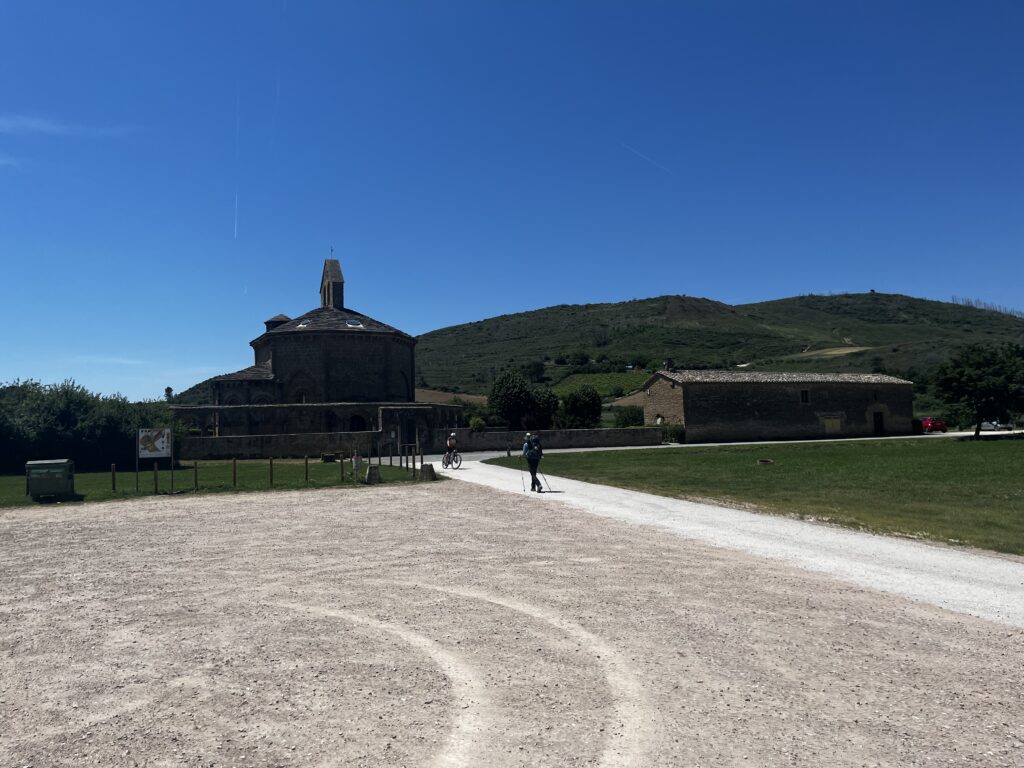
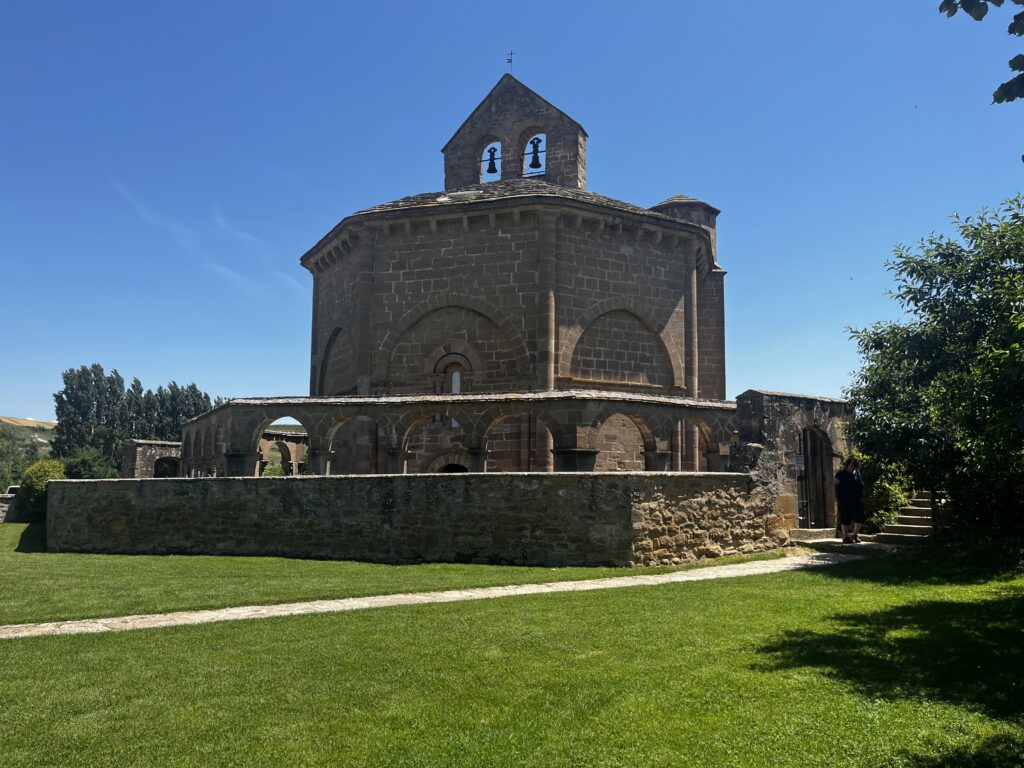
I don’t know what time we got to the church of Santa Maria de Eunate but it must have been just after 1 PM.
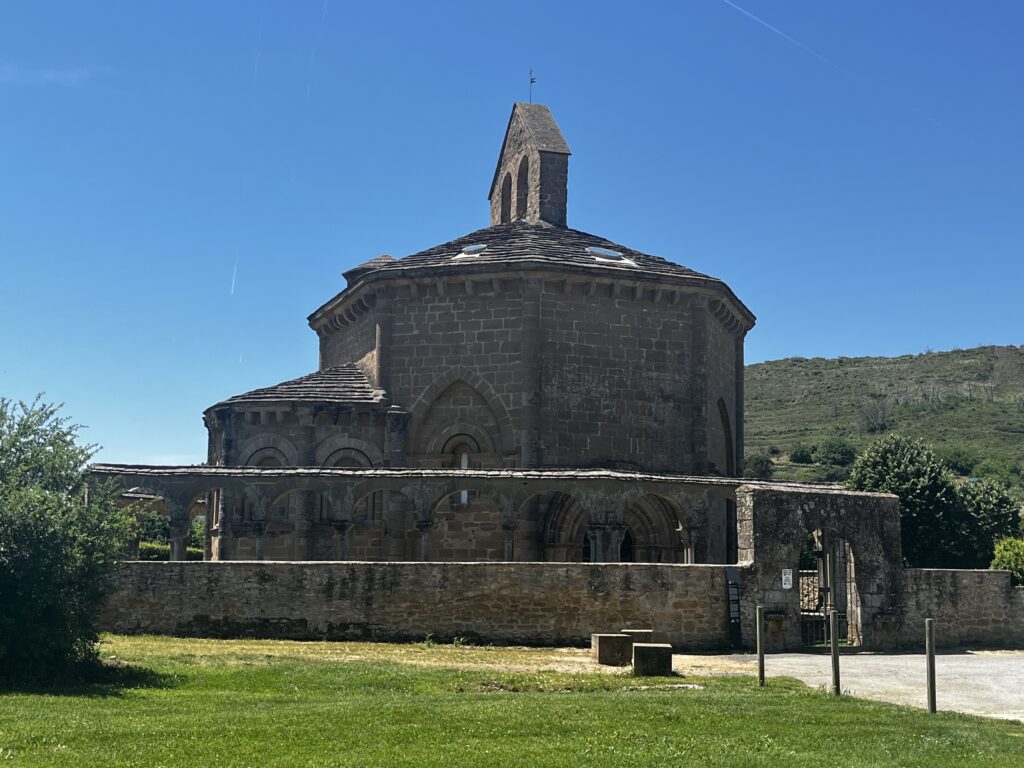
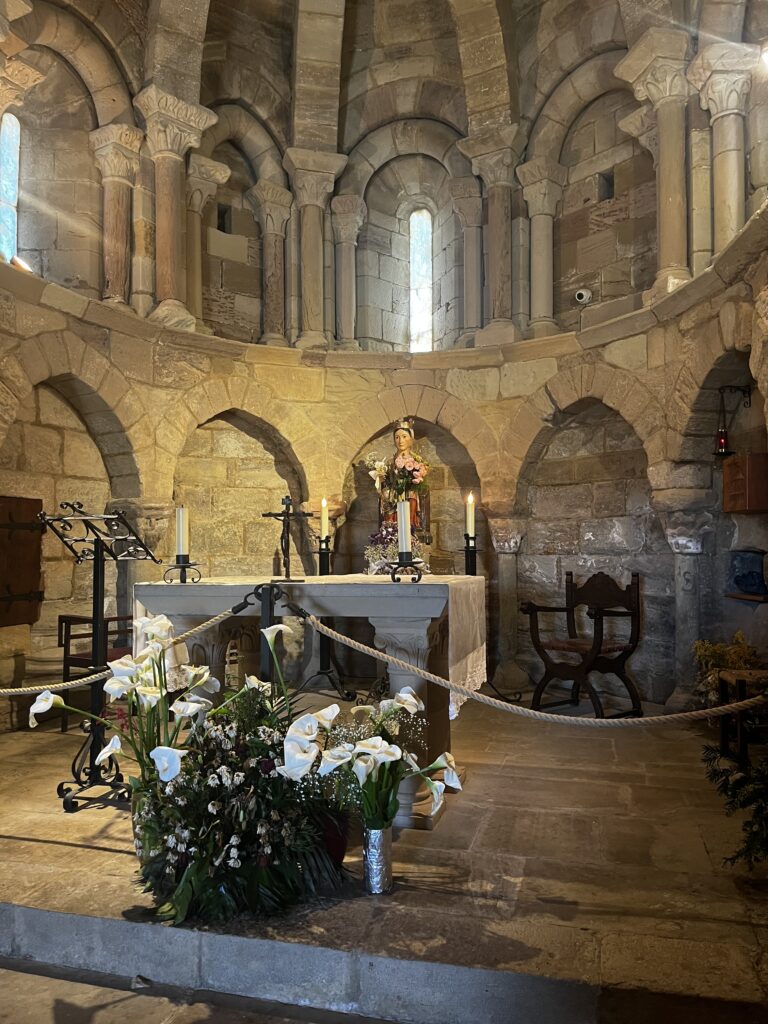
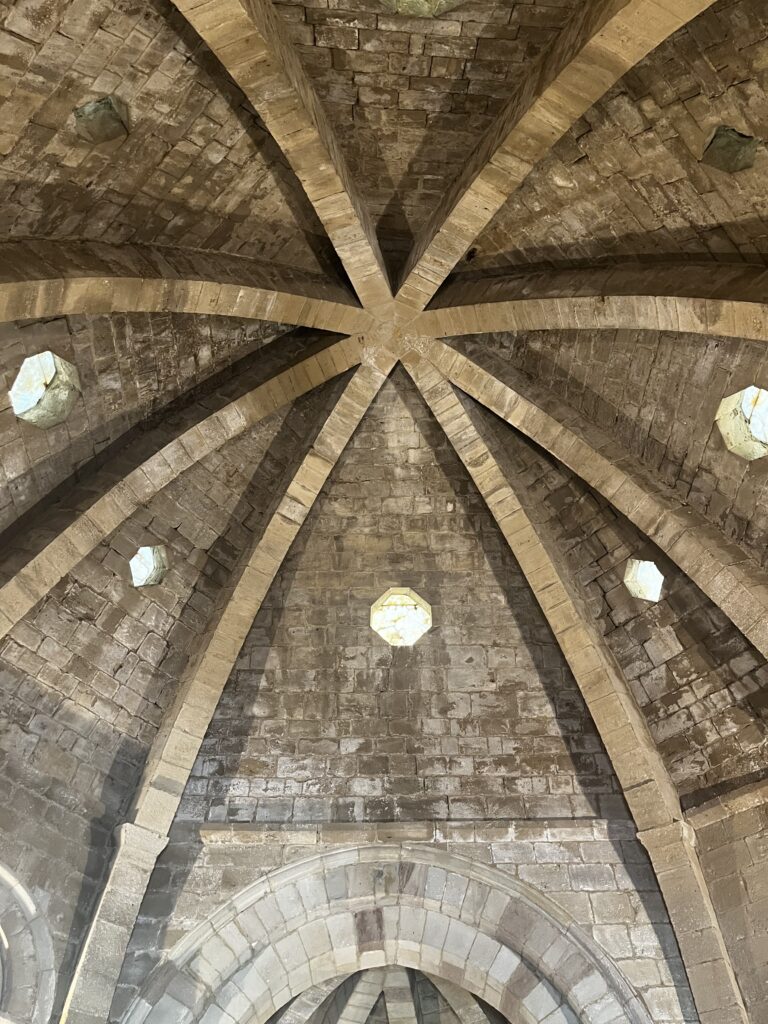
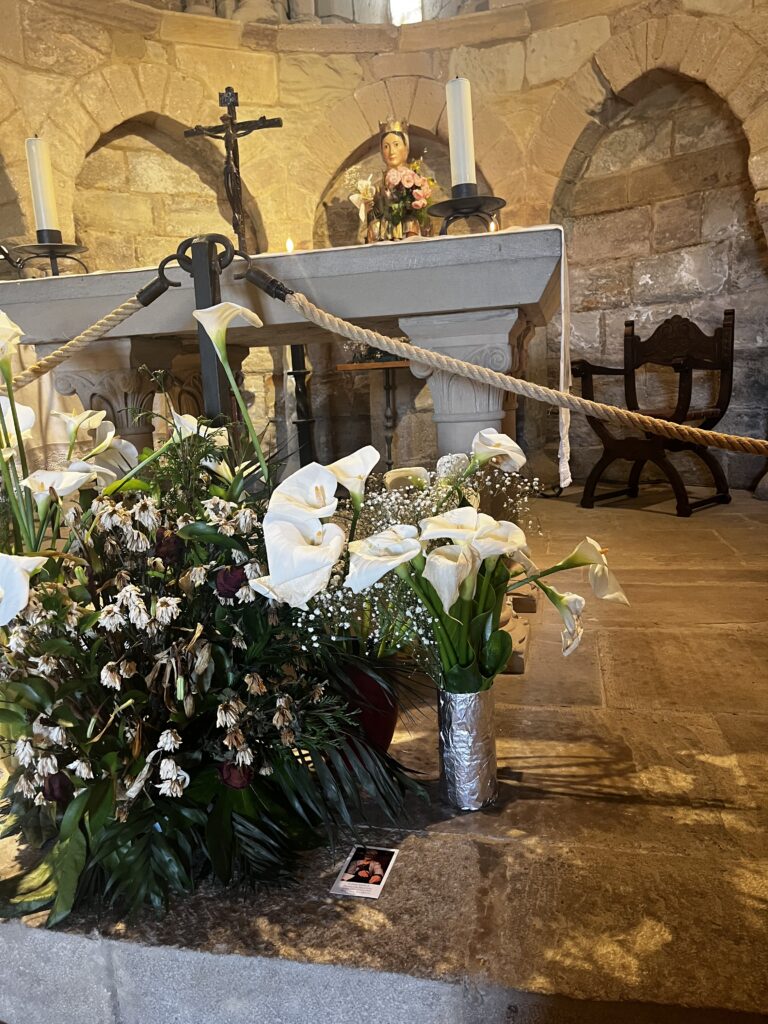
I don’t know how to describe this church. It’s a little pre-Romanesque building in the middle of nowhere. The building has seven sides, plus an apse giving it a vague sort of eight-fold symmetry. But if you look at the vaulting in the ceiling, you realize that nothing here is properly in proportion. And yet somehow, it all holds together.
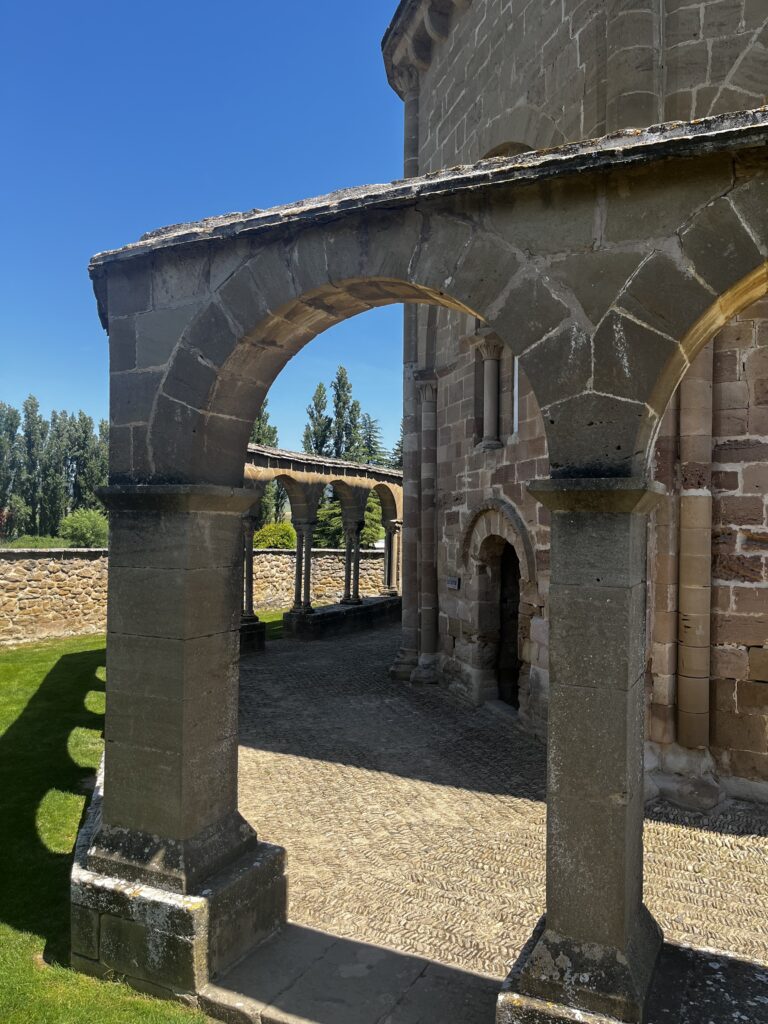
The outside of the building surrounded by colonnade of arches. Their function is absolutely obscure. The story is that the brotherhood that built this church used to pray the rosary here, and they used the arches effectively as beads. The problem with this, is of course, that the building predates the introduction of the rosary by at least a century.
An awful a lot about this church is obscure. In fact, the name “Eunate” is of Basque origin, but no one actually knows what the word originally meant.
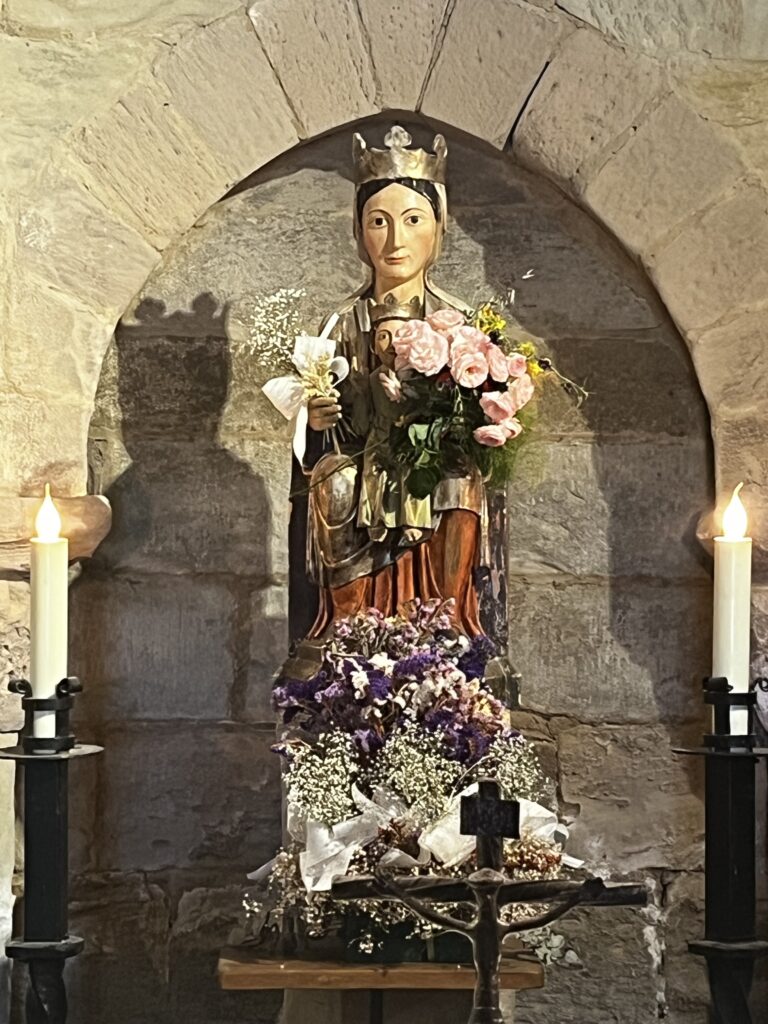
Similarly, the origin of the statue of Virgin and Child here is unknown.
There are plenty of theories about each of these things, but none of them hold together on examination.
None of that matters. Because if you sit in this church, you can feel yourself intimately in the presence of God in a way that is very difficult to explain.
And so I did. And I prayed. And I left Francine’s card at the foot of the altar.
We left it just before the 2 PM closing time. Then it was back to the gravel road heading towards Puente la Reina.
It was unbelievably hot, and I was sucking down water even with the shade of the umbrella.
The road turned into asphalt going steeply uphill into the village of Obanos. We arrived there just before 2:30 PM.
We found a bar with a cool stone interior. We got some cold drinks, but mostly we just stayed in a cold room for a while. We finally left about 3 PM.
Sadly, the church in Onanos of happy memory was locked up tight.
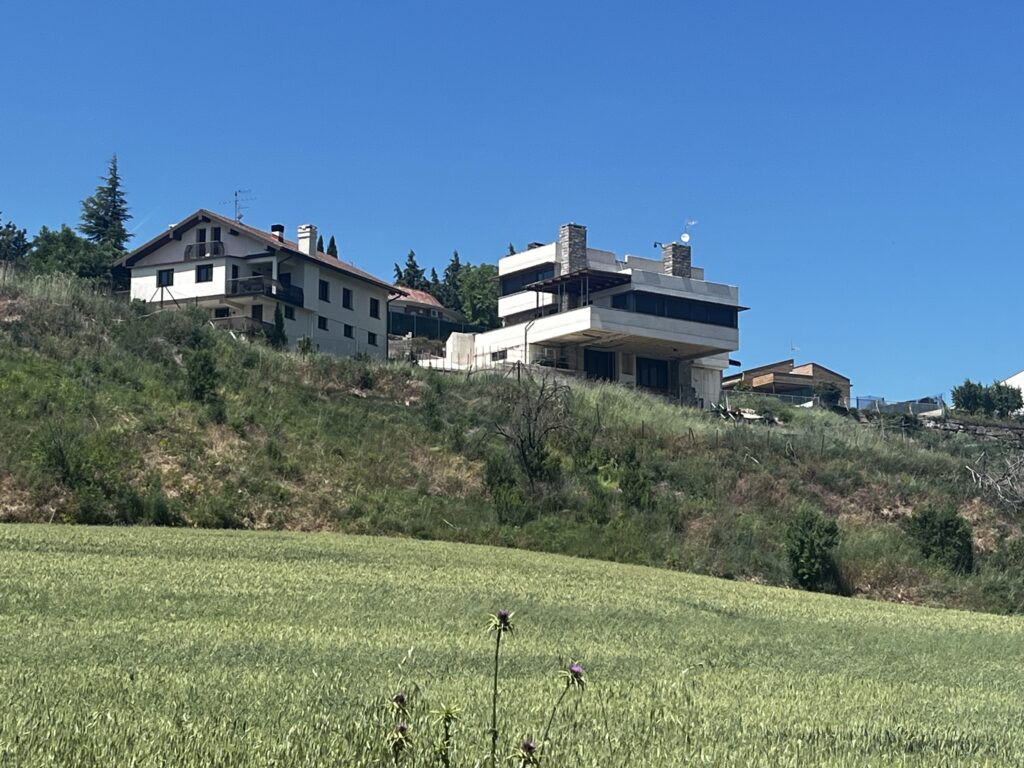
There are quite a few new houses being built in this village. The sidewalk ended at the edge of town, and we were once again on the wide gravel path through scrub land. The valley below was all farmland. We could see the church spires of Puente la Reina almost immediately. But to get there, we would have to climb down into the valley and then partially up the other side.
The path, which soon became dirt, took us down through small farms and past farm houses. One of them is growing corn, which is a pretty rare site here.
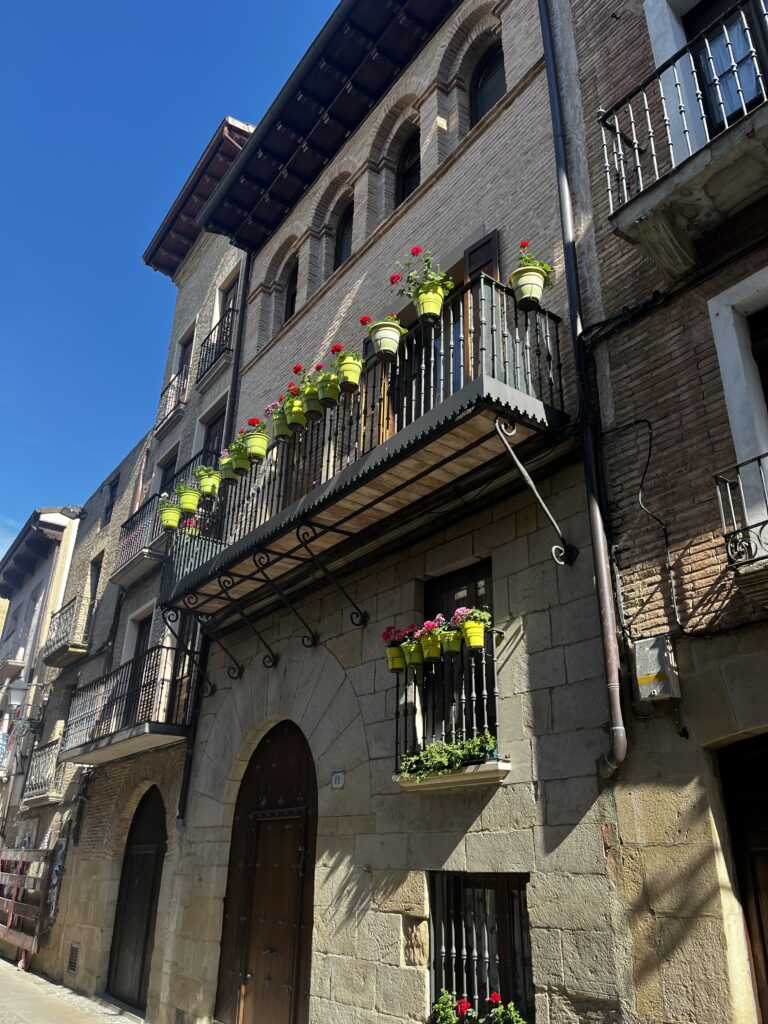
Finally, we entered Puente la Reina at about 3:25. The village is a long string along a highway, so we continued on towards the older section to find a suitable albergue.
Somehow we ended up at a place I’ve been twice before, a no-frills parroquial.
After the usual pilgrim chores, it was exploration time.
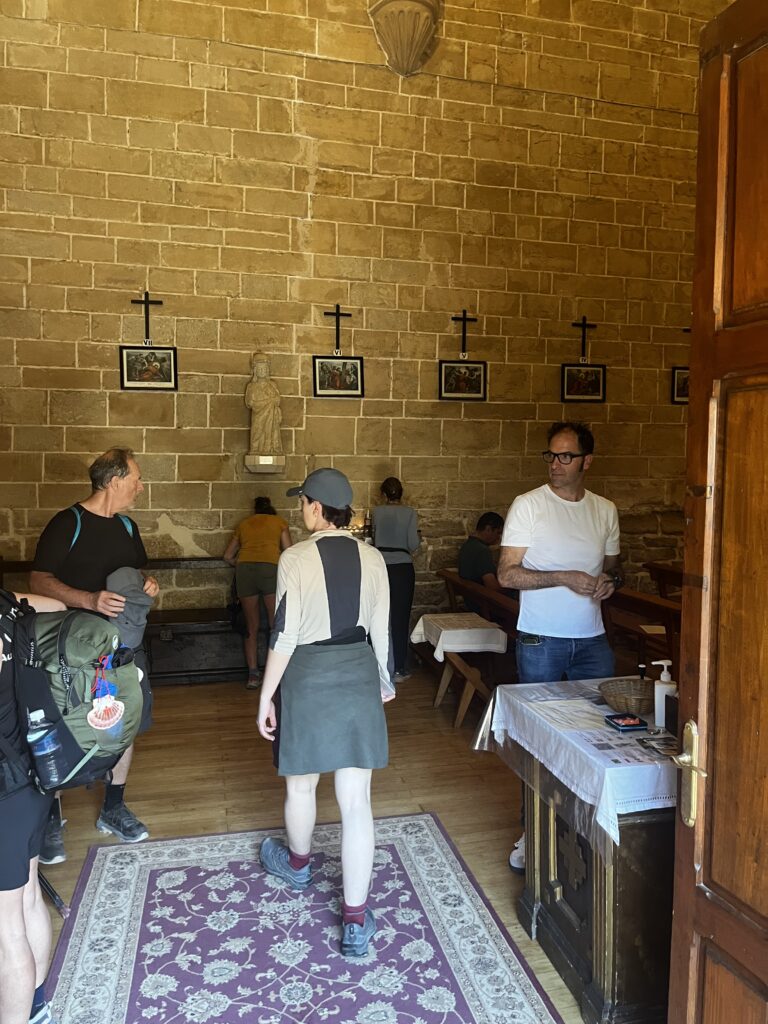
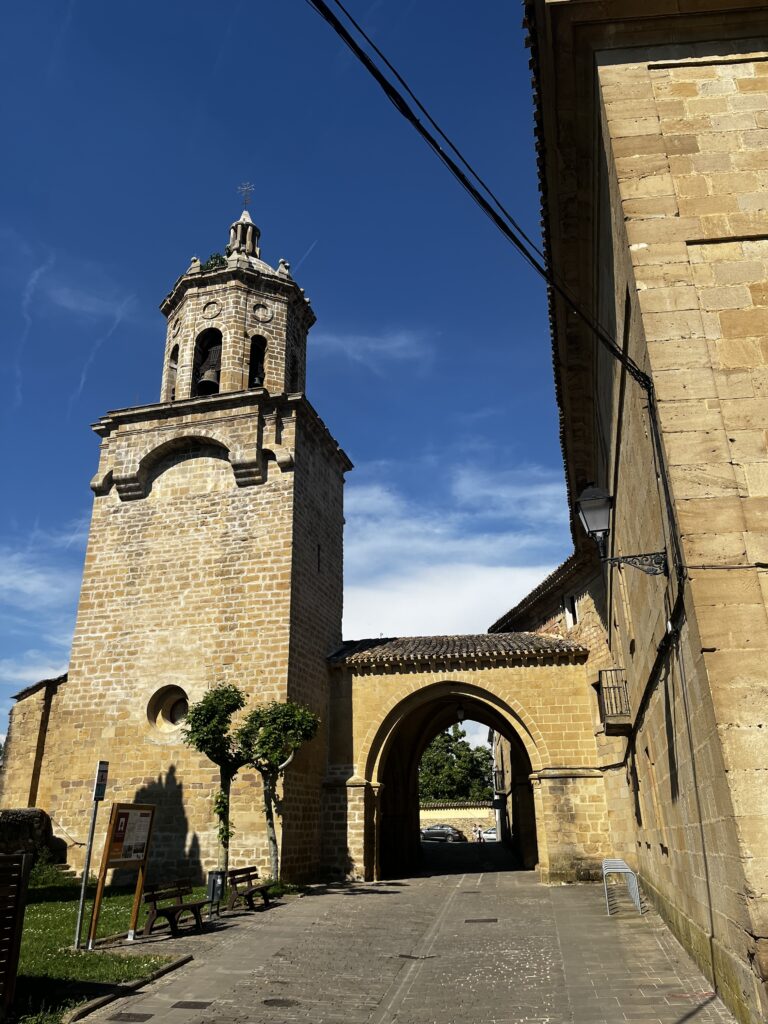
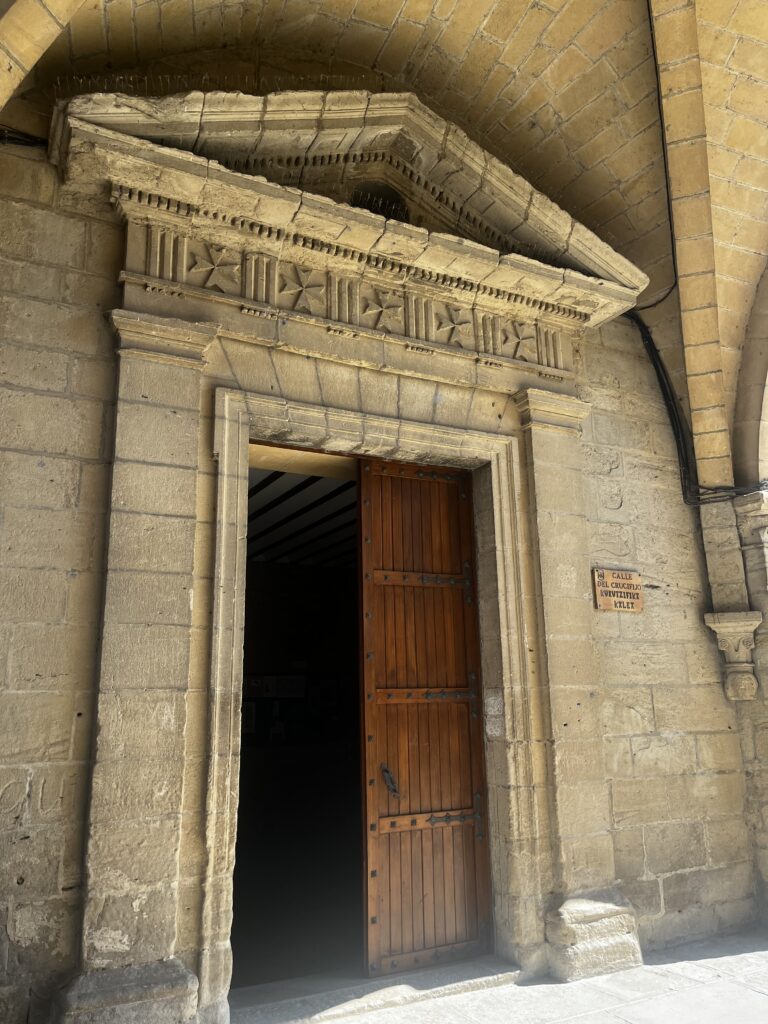
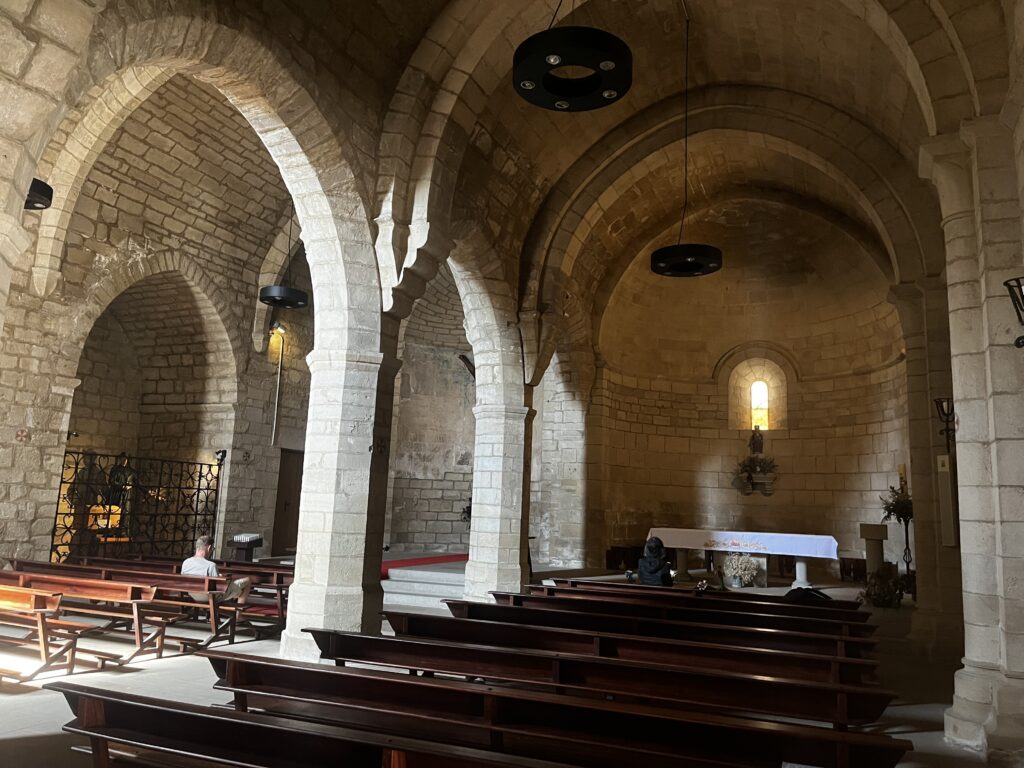
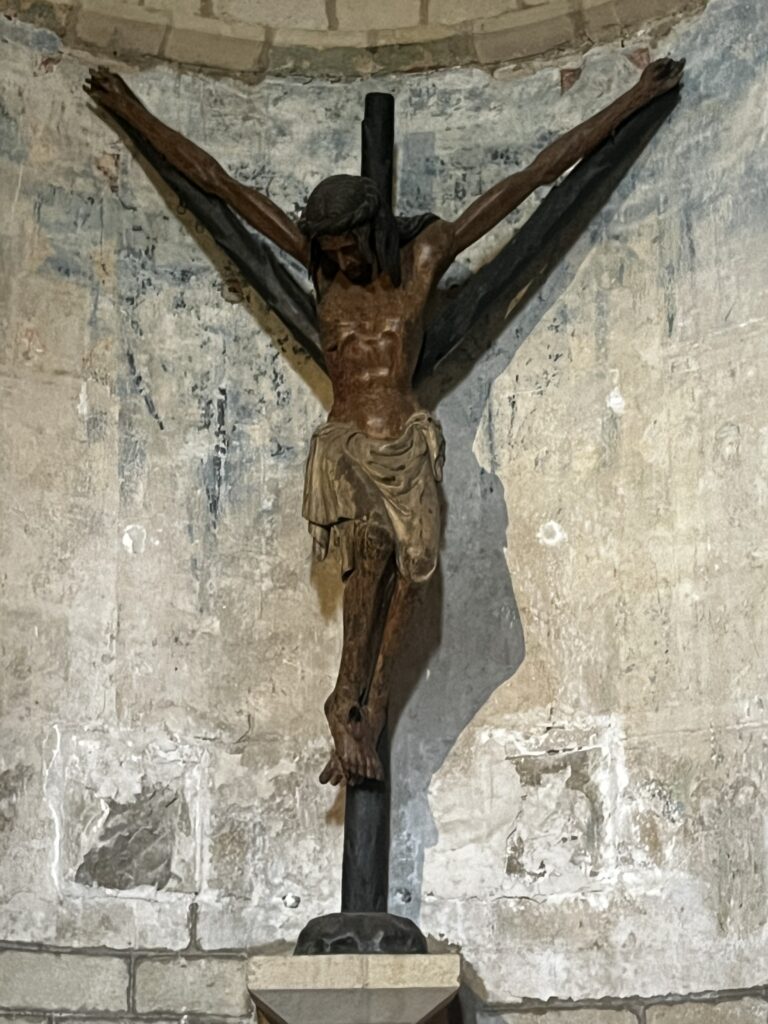
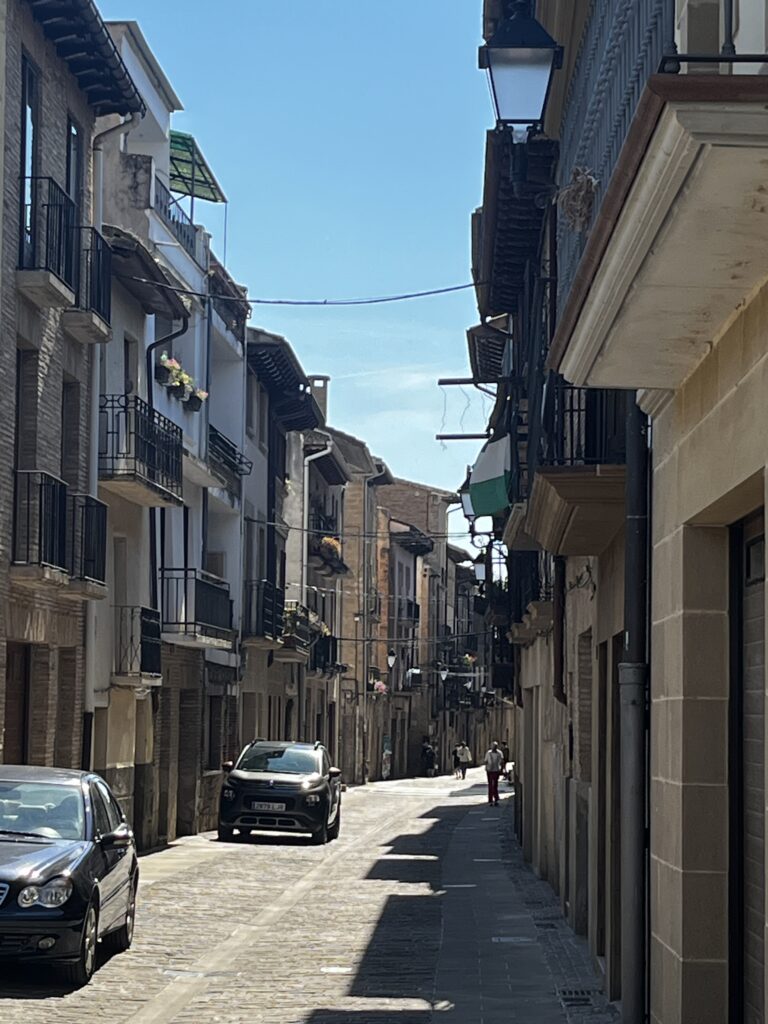
My first stop was the Iglesia del Crucifijo. This tiny church with a double nave contains one of the most arresting images of the Crucifixion you’re very likely to see. I sat here for a while, while a local musician tuned and practiced with a pair of mandolins.
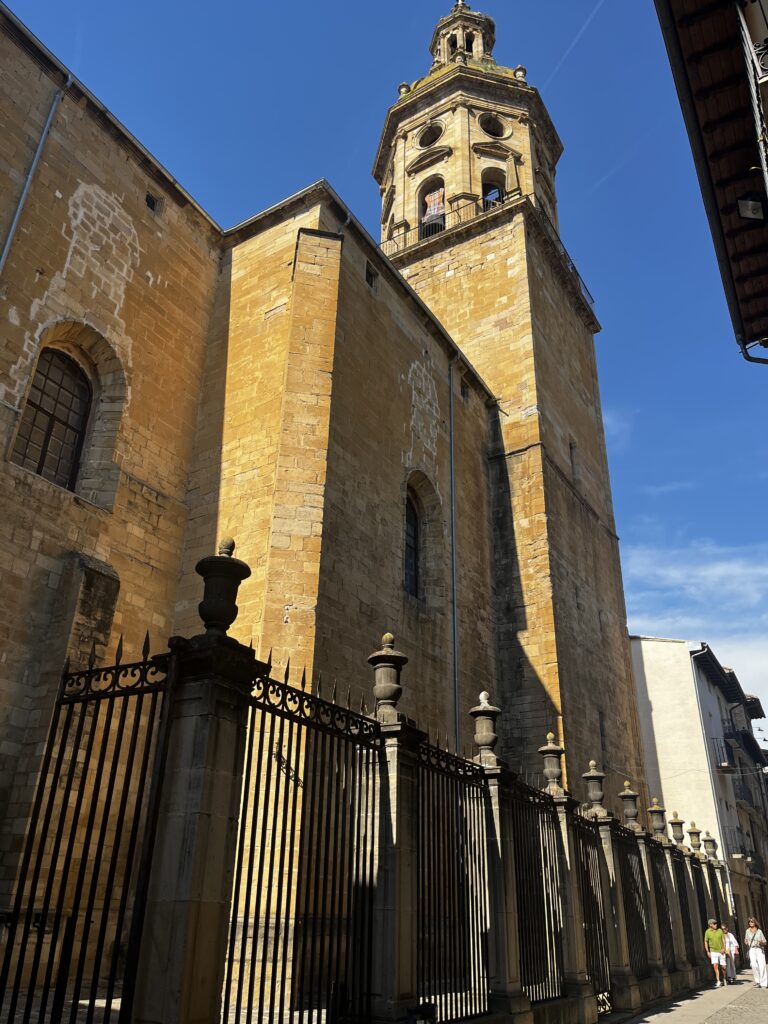
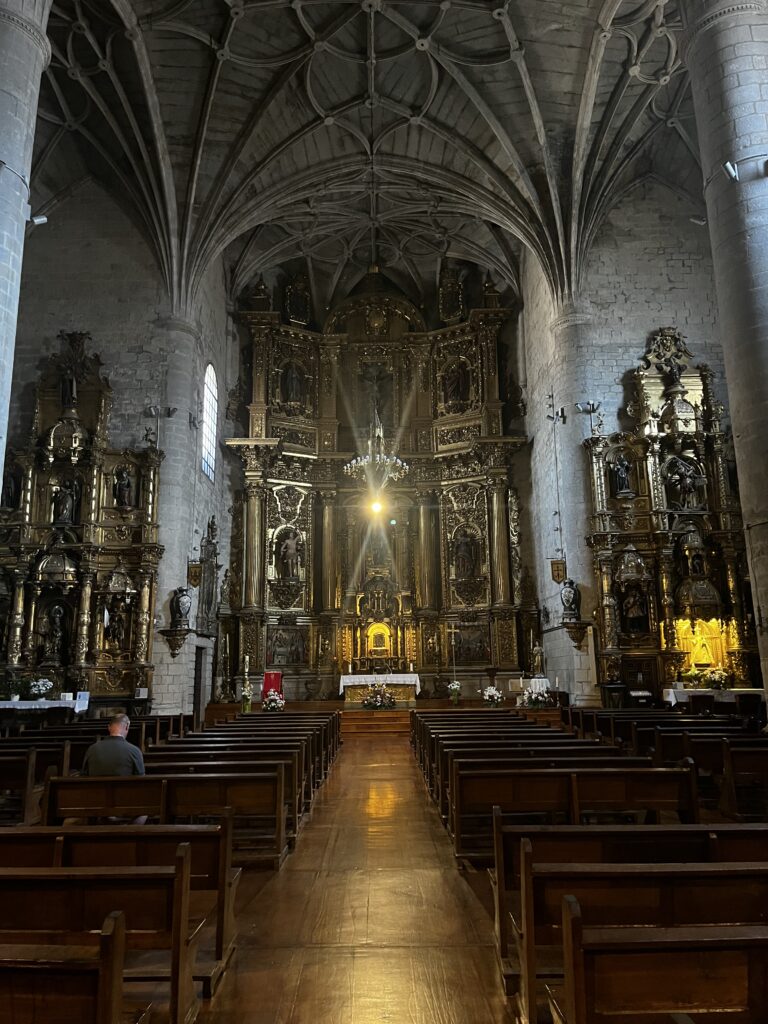
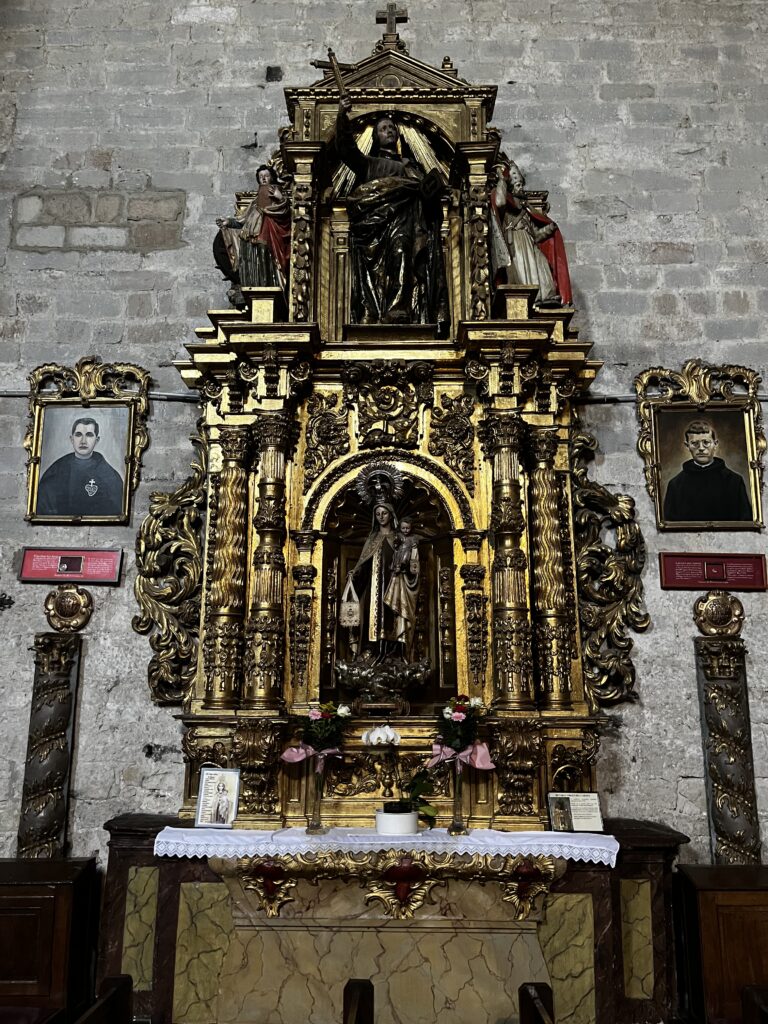
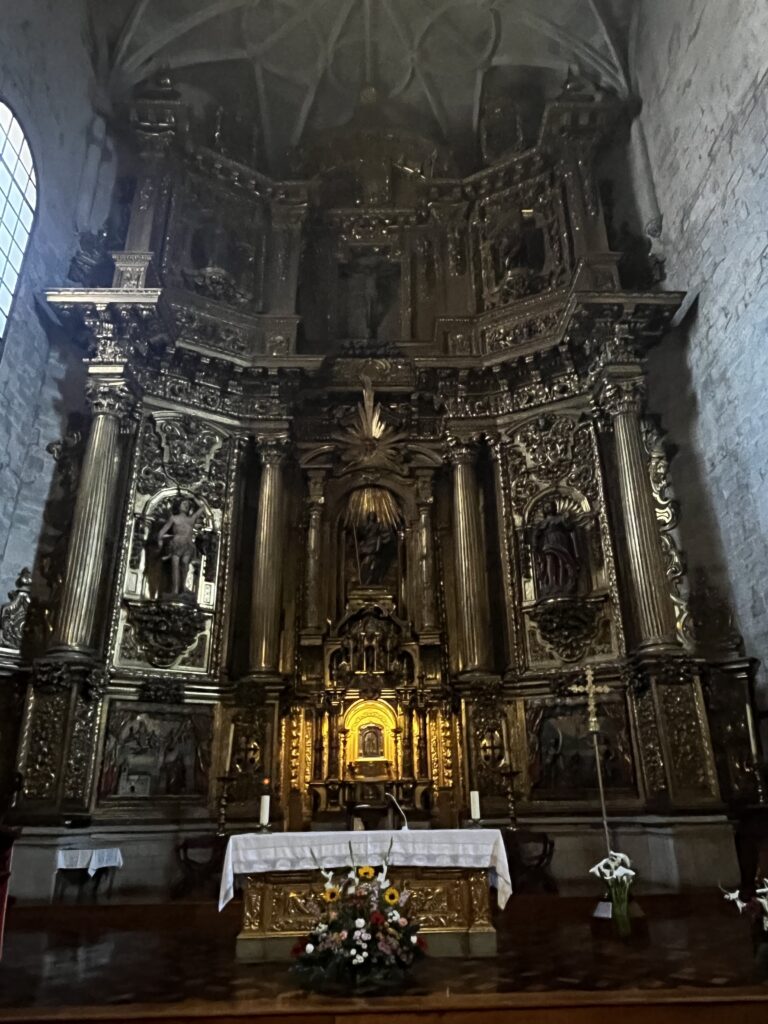
Down the street, you could not ask for a more different experience than the explosion of Rococo that is Iglesia de Santiago. Six side altars soar towards the ceiling in gold pillars and polychrome statues. The retablo of the high altar is probably three stories tall.
Then a long dinner and collapse.
Date: 24 May 2026
Place: Puente la Reina
Today started: Pamplona
Today’s Photos!
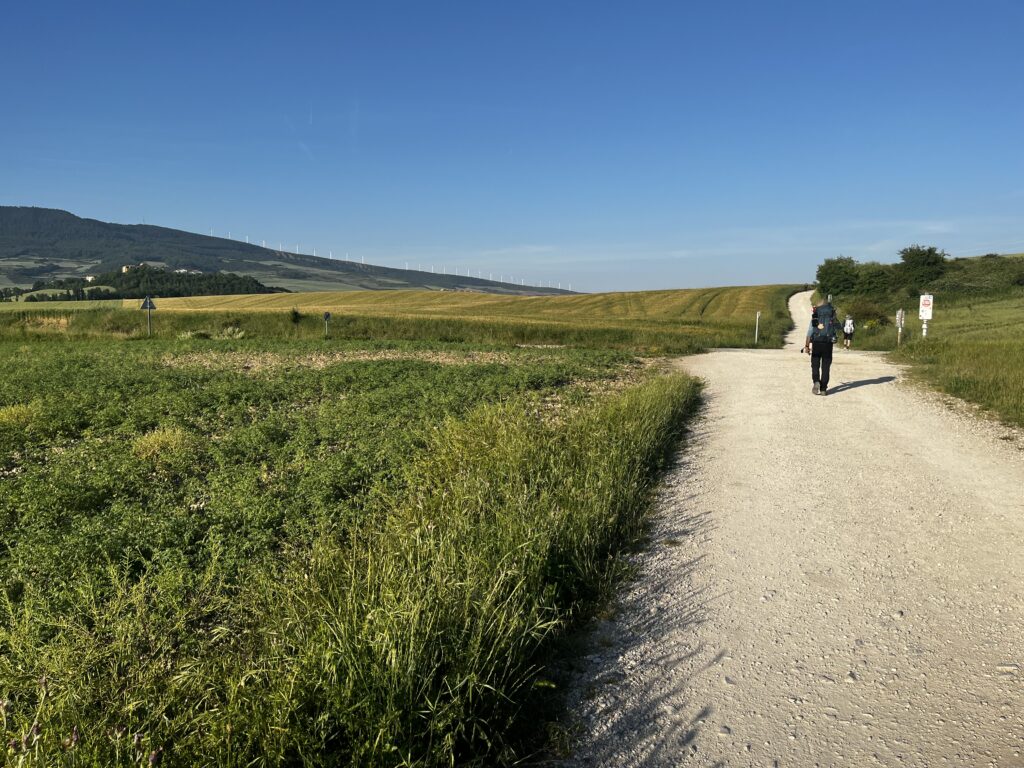
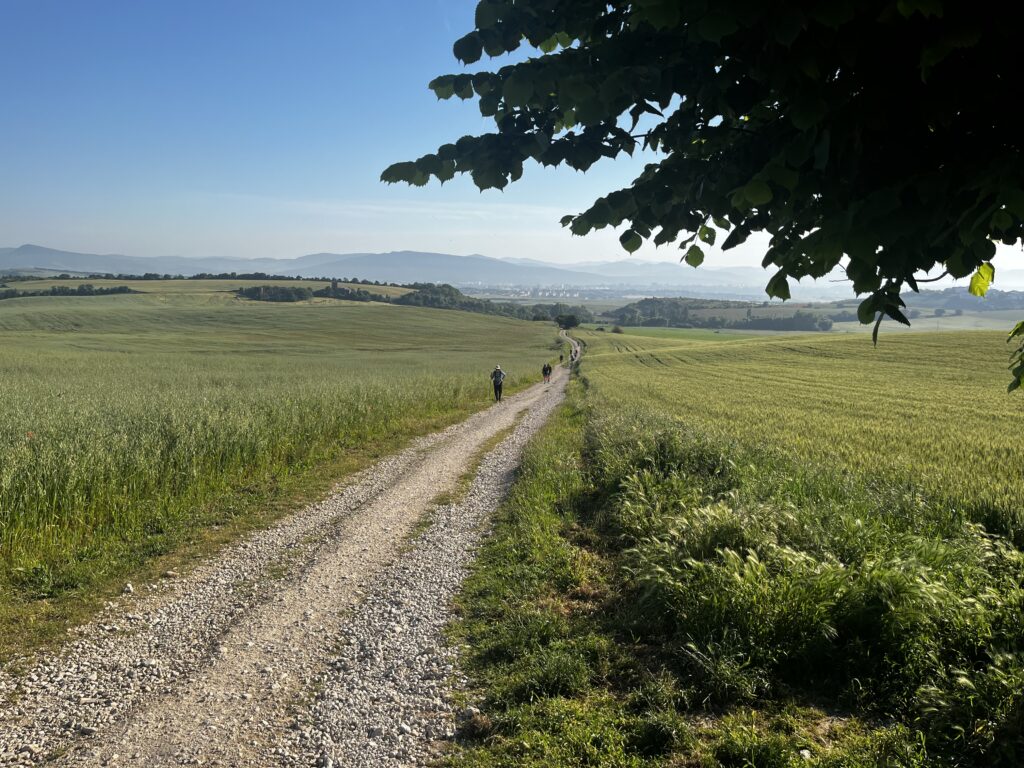
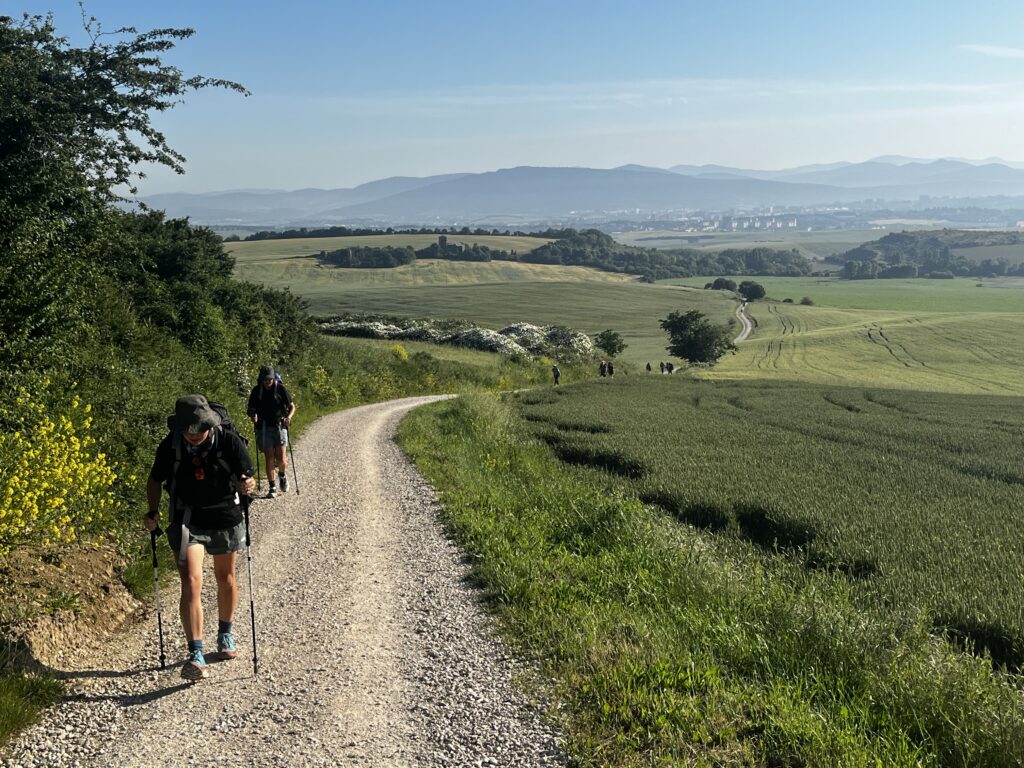
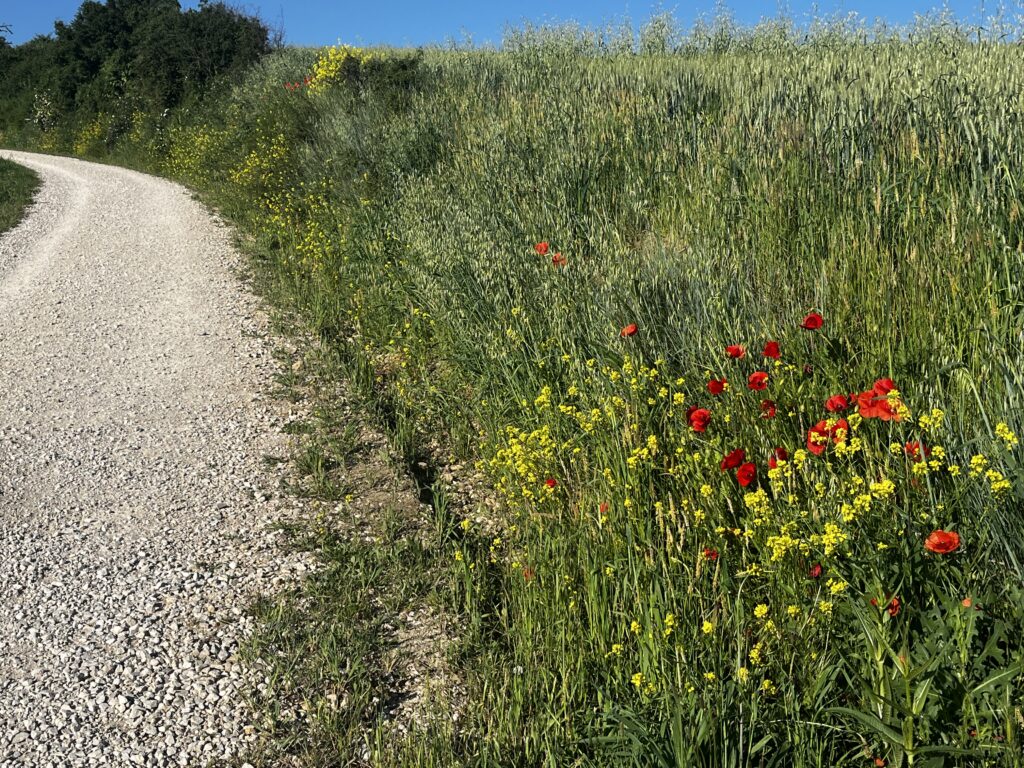
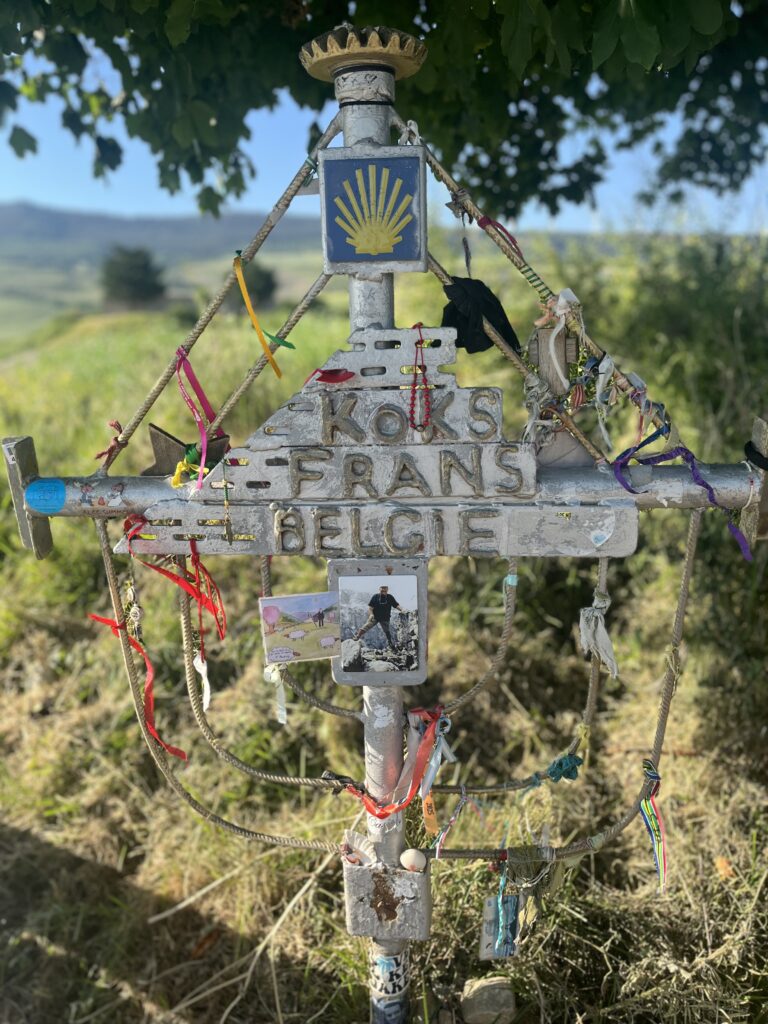
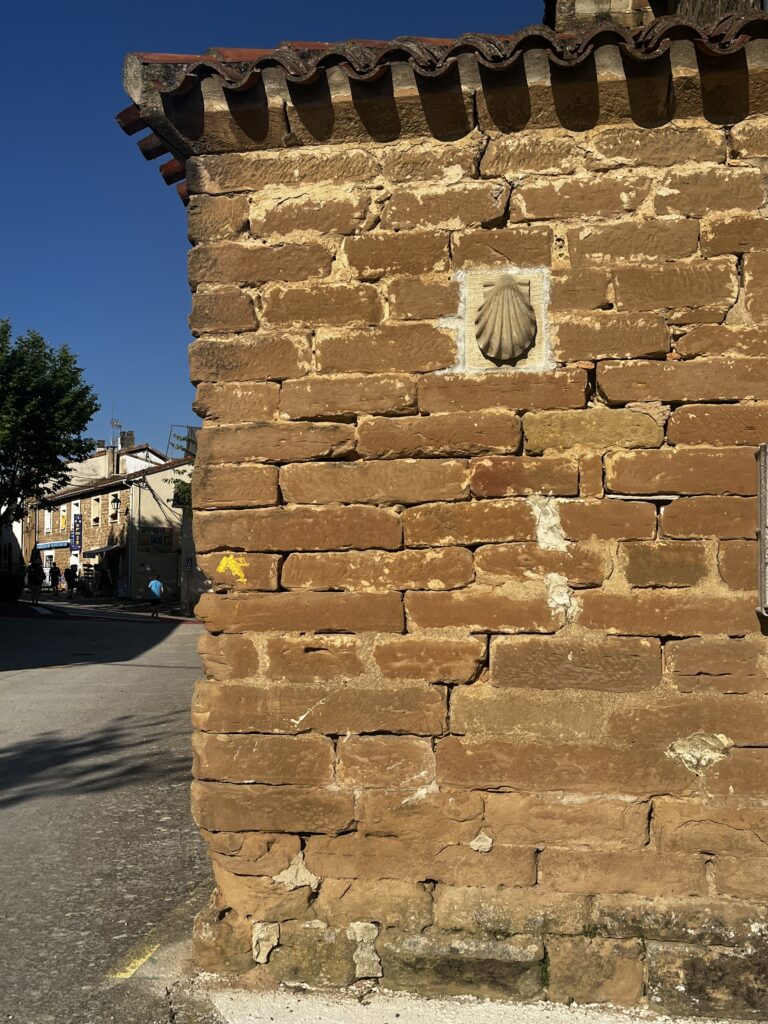
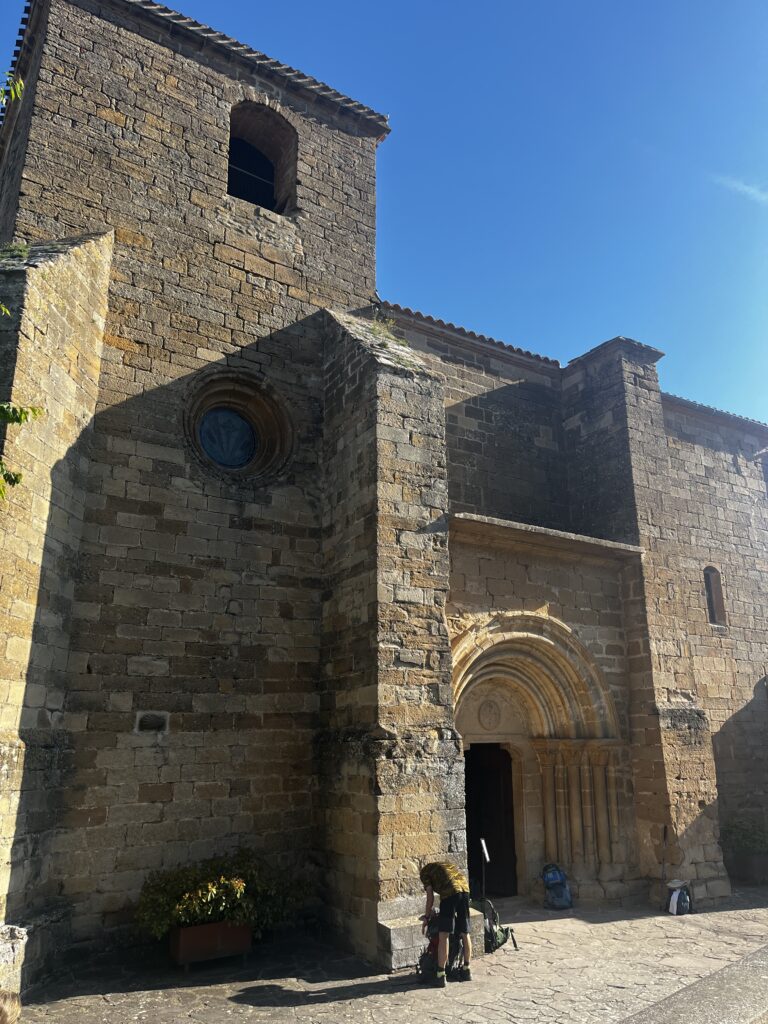
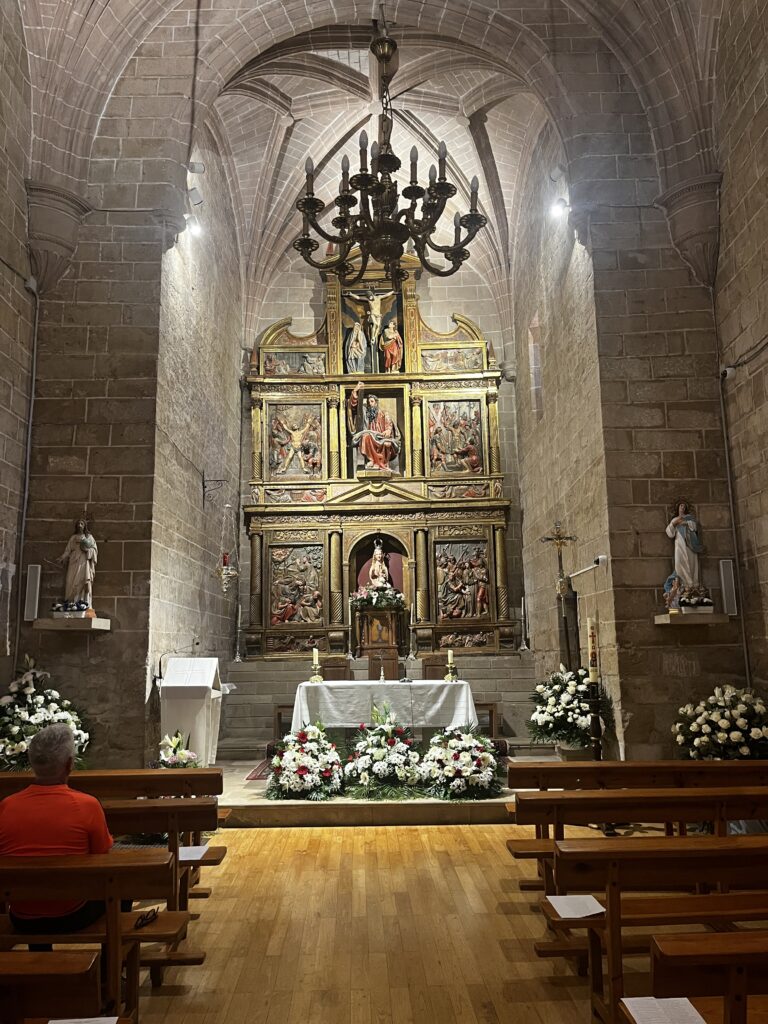
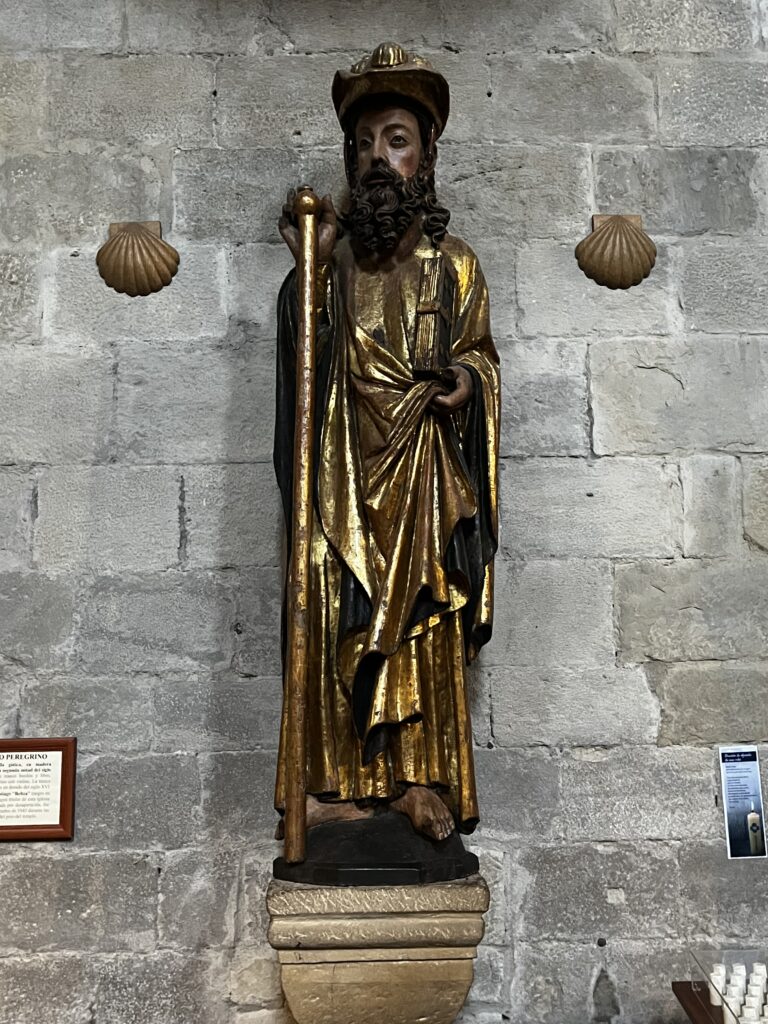
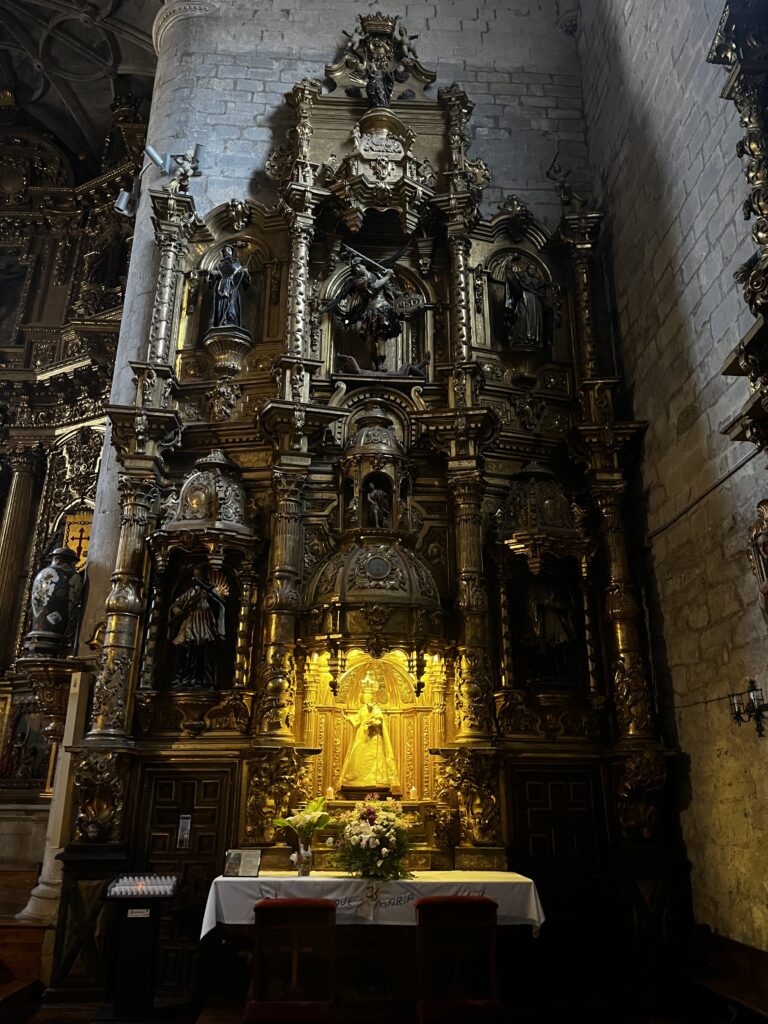
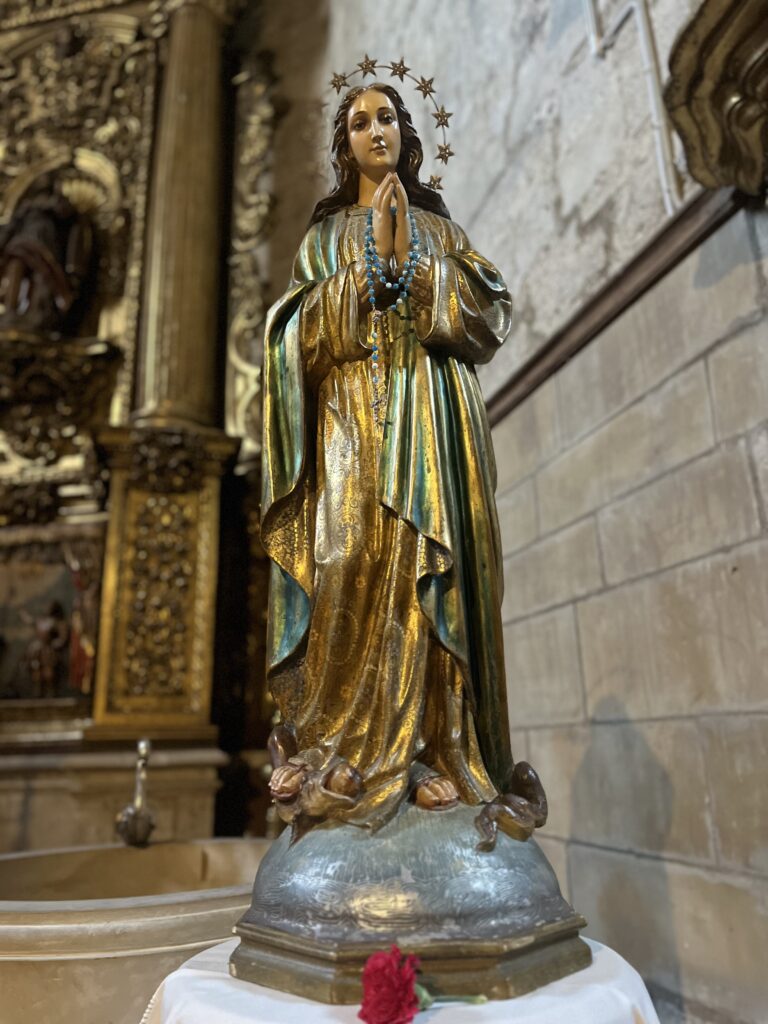
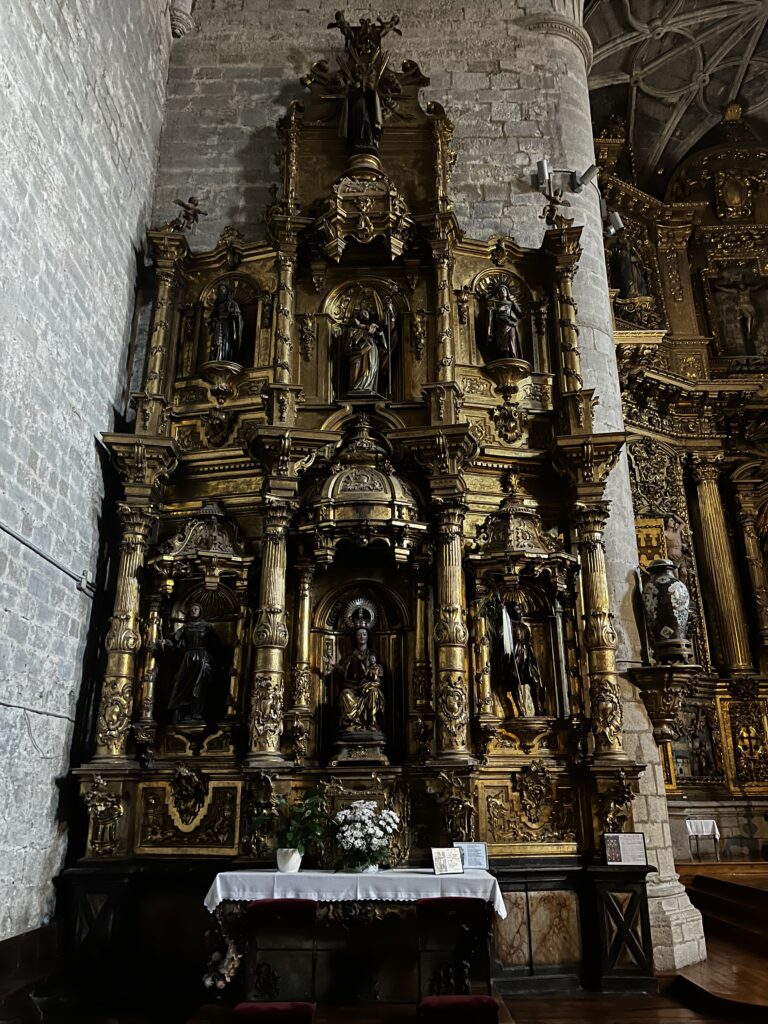
I’m trying to imagine what, if I were the mayor of a town along the Camino, what would be the right way to maintain or renovate the pilgrim path. On one hand, I would definitely be tempted to pave the whole thing – simple, common, and pretty mundane to maintain. On the other hand, modern, ugly, and (as you’ve consistently mentioned!) unpleasant to walk.
I don’t know if it is reasonable or feasible to keep these paths earthen – but maybe bricks? Cobblestone? Especially as one who has never walked the way, I’m at a loss!
Different surface areas are better for different terrains, conditions, and climates.
Unfortunately, generally the people making these decisions have themselves never walked the Camino. They have a very specific idea of what would be helpful, without actually knowing whether it will be or not.
To Fr. Maurer’s point maybe it would be nice if the citizens of Spain and France who care about the Camino and what it brings to their countries in the way of tourists would have volunteer trail maintenance crews like we do in our national forest and parks here in the northwest. Thom we had a great Pentecost Sunday and your crew on the altar did a fantastic job. Hope you get your pack adjusted so your back doesn’t suffer tomorrow.
In Spain, each region, and sometimes each village, is responsible for maintaining their section of the Camino.
There are definitely some very different ideas on how to do this! I think the biggest issue is that most of the people making these decisions are politicians or civil servants with themselves have never walked the Camino.